Netinfo Security ›› 2025, Vol. 25 ›› Issue (12): 1878-1888.doi: 10.3969/j.issn.1671-1122.2025.12.004
Previous Articles Next Articles
Detecting Poisoned Samples for Untargeted Backdoor Attacks
PANG Shuchao1, LI Zhengxiao1, QU Junyi1, MA Ruhao1, CHEN Hechang2, DU Anan3( )
)
- 1. School of Cyber Science and Engineering, Nanjing University of Science and Technology, Nanjing 210094, China
2. School of Artificial Intelligence, Jilin University, Changchun 130012, China
3. School of Computer and Software, Nanjing University of Industry Technology, Nanjing 210023, China
-
Received:2025-10-05Online:2025-12-10Published:2026-01-06 -
Contact:DU Anan E-mail:anan.du@niit.edu.cn

CLC Number:
Cite this article
PANG Shuchao, LI Zhengxiao, QU Junyi, MA Ruhao, CHEN Hechang, DU Anan. Detecting Poisoned Samples for Untargeted Backdoor Attacks[J]. Netinfo Security, 2025, 25(12): 1878-1888.
share this article
Add to citation manager EndNote|Ris|BibTeX
URL: http://netinfo-security.org/EN/10.3969/j.issn.1671-1122.2025.12.004

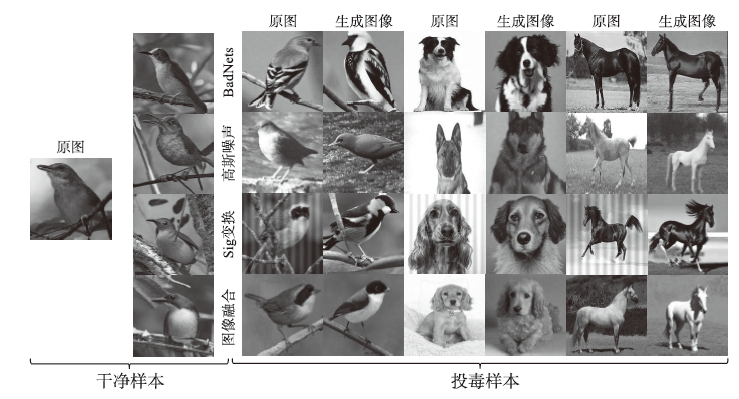
| 后门类型 | ACC | ASR | FPR | TPR |
|---|---|---|---|---|
| BadNets | 91.47% | 0 | 6.88% | 100% |
| 高斯噪声 | 91.95% | 41.33% | 6.51% | 58.67% |
| Sig变换 | 93.08% | 4.84% | 5.76% | 95.16% |
| 图像融合 | 84.96% | 15.79% | 13.20% | 84.21% |
| 生成模型 | ACC | ASR | FPR | TPR |
|---|---|---|---|---|
| DCGAN | 64.29% | 9.68% | 29.74% | 90.32% |
| VAEs | 52.68% | 19.35% | 39.41% | 80.65% |
| SD | 93.08% | 4.84% | 5.76% | 95.16% |
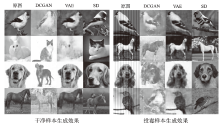
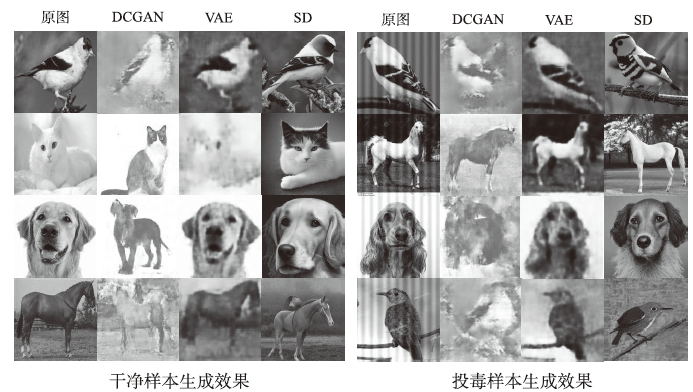
| 防御方法 | ACC | ASR | FPR | TPR |
|---|---|---|---|---|
| NC | 88.31% | 78.45% | 14.82% | 21.55% |
| AC | 89.15% | 82.10% | 12.03% | 17.90% |
| 本文方法 | 93.08% | 4.84% | 5.76% | 95.16% |
| [1] | HE Zeping, XU Jian, DAI Hua, et al. A Review of Federated Learning Application Technologies[J]. Netinfo Security, 2024, 24(12): 1831-1844. |
| 何泽平, 许建, 戴华, 等. 联邦学习应用技术研究综述[J]. 信息网络安全, 2024, 24(12):1831-1844. | |
| [2] | GU Huanhuan, LI Qianmu, LIU Zhen, et al. Research on Hidden Backdoor Prompt Attack Methods Based on False Demonstrations[J]. Netinfo Security, 2025, 25(4): 619-629. |
| 顾欢欢, 李千目, 刘臻, 等. 基于虚假演示的隐藏后门提示攻击方法研究[J]. 信息网络安全, 2025, 25(4):619-629. | |
| [3] | YAN Yukun, TANG Peng, CHEN Rui, et al. A Randomness Enhanced Bi-Level Optimization Defense Method against Data Poisoning Backdoor Attacks[J]. Netinfo Security, 2025, 25(7): 1074-1091. |
| 闫宇坤, 唐朋, 陈睿, 等. 面向数据投毒后门攻击的随机性增强双层优化防御方法[J]. 信息网络安全, 2025, 25(7):1074-1091. | |
| [4] |
VICE J, AKHTAR N, HARTLEY R, et al. Bagm: A Backdoor Attack for Manipulating Text-To-Image Generative Models[J]. IEEE Transactions on Information Forensics and Security, 2024, 19: 4865-4880.
doi: 10.1109/TIFS.2024.3386058 URL |
| [5] |
WU Yi, CHEN Jiayi, LEI Tianbao, et al. Web 3.0 Security: Backdoor Attacks in Federated Learning-Based Automatic Speaker Verification Systems in the 6G Era[J]. Future Generation Computer Systems, 2024, 160: 433-441.
doi: 10.1016/j.future.2024.06.022 URL |
| [6] | LIU Tao, ZHANG Yuhang, FENG Zhu, et al. Beyond Traditional Threats: A Persistent Backdoor Attack on Federated Learning[C]// AAAI. The AAAI Conference on Artificial Intelligence. Menlo Park: AAAI, 2024: 21359-21367. |
| [7] |
LI Yiming, JIANG Yong, LI Zhifeng, et al. Backdoor Learning: A Survey[J]. IEEE Transactions on Neural Networks and Learning Systems, 2022, 35(1): 5-22.
doi: 10.1109/TNNLS.2022.3182979 URL |
| [8] | QI Xiangyu, XIE Tinghao, WANG Jiachen, et al. Towards a Proactive ML Approach for Detecting Backdoor Poison Samples[C]// USENIX. The 32nd USENIX Security Symposium (USENIX Security 23). Berkeley: USENIX, 2023: 1685-1702. |
| [9] | GUO Junfeng, LI Yiming, CHEN Xun, et al. SCALE-UP: An Efficient Black-Box Input-Level Backdoor Detection via Analyzing Scaled Prediction Consistency[EB/OL]. (2023-02-19)[2025-09-10]. https://doi.org/10.48550/arXiv.2302.03251. |
| [10] | ZHANG Zihan, LAI Qingnan, ZHOU Changling. Survey on Fuzzing Test in Deep Learning Frameworks[J]. Netinfo Security, 2024, 24(10): 1528-1536. |
| 张子涵, 赖清楠, 周昌令. 深度学习框架模糊测试研究综述[J]. 信息网络安全, 2024, 24(10):1528-1536. | |
| [11] | GU Tianyu, DOLAN-GAVITT B, GARG S. BadNets: Identifying Vulnerabilities in the Machine Learning Model Supply Chain[EB/OL]. (2019-03-11)[2025-09-10]. https://doi.org/10.48550/arXiv.1708.06733. |
| [12] | CHEN Xinyun, LIU Chang, LI Bo, et al. Targeted Backdoor Attacks on Deep Learning Systems Using Data Poisoning[EB/OL]. (2017-12-15) [2025-09-10]. https://doi.org/10.48550/arXiv.1712.05526. |
| [13] | LI Yiming, BAI Yang, JIANG Yong, et al. Untargeted Backdoor Watermark: Towards Harmless and Stealthy Dataset Copyright Protection[J]. Advances in Neural Information Processing Systems, 2022, 35: 13238-13250. |
| [14] | TURNER A, TSIPRAS D, MADRY A. Label-Consistent Backdoor Attacks[EB/OL]. (2019-12-06)[2025-09-10]. https://doi.org/10.48550/arXiv.1912.02771. |
| [15] | LI Yuezun, LI Yiming, WU Baoyuan, et al. Invisible Backdoor Attack with Sample-Specific Triggers[C]// IEEE. The IEEE/CVF International Conference on Computer Vision (ICCV). New York: IEEE, 2021: 16463-16472. |
| [16] | HE Ke, WANG Jianhua, YU Dan, et al. Adaptive Sampling-Based Machine Unlearning Method[J]. Netinfo Security, 2025, 25(4): 630-639. |
| 何可, 王建华, 于丹, 等. 基于自适应采样的机器遗忘方法[J]. 信息网络安全, 2025, 25(4):630-639. | |
| [17] | GUO Junfeng, LI Ang, LIU Cong. AEVA: Black-Box Backdoor Detection Using Adversarial Extreme Value Analysis[EB/OL]. (2022-04-24) [2025-09-10]. https://doi.org/10.48550/arXiv.2110.14880. |
| [18] | LI Yiming, ZHAI Tongqing, JIANG Yong, et al. Backdoor Attack in the Physical World[EB/OL]. (2021-04-24)[2025-09-10]. https://doi.org/10.48550/arXiv.2104.02361. |
| [19] | MIRZA M, OSINDERO S. Conditional Generative Adversarial Nets[EB/OL]. (2014-11-06)[2025-09-10]. https://doi.org/10.48550/arXiv.1411.1784. |
| [20] | RADFORD A, METZ L, CHINTALA S. Unsupervised Representation Learning with Deep Convolutional Generative Adversarial Networks[EB/OL]. (2016-01-07)[2025-09-10]. https://doi.org/10.48550/arXiv.1511.06434. |
| [21] | SOHN K, YAN Xinchen, LEE H. Learning Structured Output Representation Using Deep Conditional Generative Models[C]// NIPS. Advances in Neural Information Processing Systems (NIPS). Cambridge: MIT, 2015: 3483-3491. |
| [22] | VAN D O A, VINYALS O, KAVUKCUOGLU K. Neural Discrete Representation Learning[C]// NIPS. Advances in Neural Information Processing Systems (NIPS). Cambridge: MIT, 2017: 6309-6318. |
| [23] | HO J, JAIN A, ABBEEL P. Denoising Diffusion Probabilistic Models[C]// NIPS. Advances in Neural Information Processing Systems (NIPS). Cambridge: MIT, 2020: 6840-6851. |
| [24] | NICHOL A, DHARIWAL P, RAMESH A, et al. GLIDE: Towards Photorealistic Image Generation and Editing with Text-Guided Diffusion Models[EB/OL]. (2022-03-08)[2025-09-10]. https://doi.org/10.48550/arXiv.2112.10741. |
| [25] | ROMBACH R, BLATTMANN A, LORENZ D, et al. High-Resolution Image Synthesis with Latent Diffusion Models[C]// IEEE. The IEEE/CVF Conference on Computer Vision and Pattern Recognition. New York: IEEE, 2022: 10684-10695. |
| [26] | WANG Bolun, YAO Yuanshun, SHAN S, et al. Neural Cleanse: Identifying and Mitigating Backdoor Attacks in Neural Networks[C]// IEEE. 2019 IEEE Symposium on Security and Privacy (SP). New York: IEEE, 2019: 707-723. |
| [27] | CHEN B, CARVALHO W, BARACALDO N, et al. Detecting Backdoor Attacks on Deep Neural Networks by Activation Clustering[EB/OL]. (2018-11-09)[2025-09-10]. https://doi.org/10.48550/arXiv.1811.03728. |
| [28] | BANSAL A, BORGNIA E, CHU H M, et al. Cold Diffusion: Inverting Arbitrary Image Transforms without Noise[C]// NeurIPS. Advances in Neural Information Processing Systems (NeurIPS). Cambridge: MIT, 2023: 41259-41282. |
| [1] | XU Ruzhi, WU Xiaoxin, LYU Changran. Research on Transformer-Based Super-Resolution Network Adversarial Sample Defense Method [J]. Netinfo Security, 2025, 25(9): 1367-1376. |
| [2] | CHEN Yonghao, CAI Manchun, ZHANG Yiwen, PENG Shufan, YAO Lifeng, ZHU Yi. A Multi-Scale and Multi-Level Feature Fusion Approach for Deepfake Face Detection [J]. Netinfo Security, 2025, 25(9): 1456-1464. |
| [3] | WANG Xinmeng, CHEN Junbao, YANG Yitao, LI Wenjin, GU Dujuan. Bayesian Optimized DAE-MLP Malicious Traffic Identification Model [J]. Netinfo Security, 2025, 25(9): 1465-1472. |
| [4] | JIN Zhigang, LI Zimeng, CHEN Xuyang, LIU Zepei. Review of Network Intrusion Detection System for Unbalanced Data [J]. Netinfo Security, 2025, 25(8): 1240-1253. |
| [5] | WANG Gang, GAO Yunpeng, YANG Songru, SUN Litao, LIU Naiwei. A Survey on Deep Learning-Based Encrypted Malicious Traffic Detection Methods [J]. Netinfo Security, 2025, 25(8): 1276-1301. |
| [6] | FENG Wei, XIAO Wenming, TIAN Zheng, LIANG Zhongjun, JIANG Bin. Research on Semantic Intelligent Recognition Algorithms for Meteorological Data Based on Large Language Models [J]. Netinfo Security, 2025, 25(7): 1163-1171. |
| [7] | ZHANG Xinglan, TAO Kejin. Universal Perturbations Generation Method Based on High-Level Features and Important Channels [J]. Netinfo Security, 2025, 25(5): 767-777. |
| [8] | JIN Zengwang, JIANG Lingyang, DING Junyi, ZHANG Huixiang, ZHAO Bo, FANG Pengfei. A Review of Research on Industrial Control System Security [J]. Netinfo Security, 2025, 25(3): 341-363. |
| [9] | CHEN Hongsong, LIU Xinrui, TAO Zimei, WANG Zhiheng. A Survey of Anomaly Detection Model for Time Series Data Based on Deep Learning [J]. Netinfo Security, 2025, 25(3): 364-391. |
| [10] | LI Hailong, CUI Zhian, SHEN Xieyang. Overview of Anomaly Analysis and Detection Methods for Network Traffic [J]. Netinfo Security, 2025, 25(2): 194-214. |
| [11] | WU Haoying, CHEN Jie, LIU Jun. Improved Neural Network Differential Distinguisher of Simon32/64 and Simeck32/64 [J]. Netinfo Security, 2025, 25(2): 249-259. |
| [12] | JIN Di, REN Hao, TANG Rui, CHEN Xingshu, WANG Haizhou. Research on Offensive Language Detection in Social Networks Based on Emotion-Assisted Multi-Task Learning [J]. Netinfo Security, 2025, 25(2): 281-294. |
| [13] | LI Guyue, ZHANG Zihao, MAO Chenghai, LYU Rui. A Cumulant-Deep Learning Fusion Model for Underwater Modulation Recognition [J]. Netinfo Security, 2025, 25(10): 1554-1569. |
| [14] | LIANG Fengmei, PAN Zhenghao, LIU Ajian. A Joint Detection Method for Physical and Digital Face Attacks Based on Common Forgery Clue Awareness [J]. Netinfo Security, 2025, 25(10): 1604-1614. |
| [15] | CHEN Xiaojing, TAO Yang, WU Baiqi, DIAO Yunfeng. Optimization Gradient Perception Adversarial Attack for Skeleton-Based Action Recognition [J]. Netinfo Security, 2024, 24(9): 1386-1395. |
| Viewed | ||||||
|
Full text |
|
|||||
|
Abstract |
|
|||||