信息网络安全 ›› 2026, Vol. 26 ›› Issue (10): 1595-1615.doi: 10.3969/j.issn.1671-1122.2026.10.007
分层联邦学习的隐私保护和防御投毒方法
刘沅鑫, 梁义怀( ), 周正春
西南交通大学信息科学与技术学院 成都 611756
-
收稿日期:2026-02-04出版日期:2026-10-10发布日期:2026-11-06 -
通讯作者:梁义怀 E-mail:liangyh@swjtu.edu.cn -
作者简介:刘沅鑫(2000—),男,重庆,博士研究生,主要研究方向为隐私计算、联邦学习|梁义怀(1993—),男,广东,讲师,博士,主要研究方向为数据安全、隐私保护|周正春(1978—),男,江西,教授,博士,主要研究方向为序列编码 -
基金资助:四川省青年科技基金(2025ZNSFSC1475)
Privacy-preserving and anti-poisoning method for hierarchical federated learning
Liu Yuanxin, Liang Yihuai(), Zhou Zhengchun
School of Information Science and Technology ,Southwest Jiaotong University Chengdu 611756, China
-
Received:2026-02-04Online:2026-10-10Published:2026-11-06 -
Contact:Liang Yihuai E-mail:liangyh@swjtu.edu.cn

摘要:
联邦学习(FL)作为一种隐私保护的分布式机器学习范式,已被广泛应用到多个领域。然而,随着用户设备增加,以往的单服务器架构带来服务器通信开销过大的问题,虽然多边缘服务器架构减缓了单点负载压力,但服务器覆盖区域有限,无法满足大规模FL对数据多样性和模型泛化能力的需求。近年来,分层联邦学习(HFL)架构通过在不同区域引入边缘服务器进行中间聚合,云服务器完成全局聚合的方式,有效降低了云服务器的负载,更适合多区域的大规模FL训练。尽管如此,HFL仍面临隐私泄露以及投毒攻击的挑战,且在非独立同分布(non-IID)数据场景下,该问题尤为突出。此外,HFL中间层的边缘服务器不可靠问题也时常被忽视,容易引发合谋和宕机风险,进而威胁隐私安全并影响模型训练。针对这些问题,文章基于HFL架构提出一种安全可靠的聚合方案。首先,通过Shamir秘密共享和掩码机制增强了HFL在训练阶段的隐私保护,也显著提升了系统对边缘服务器合谋和宕机的容忍能力。其次,文章集成高斯混合模型聚类以及缩放点积注意力机制,设计了隐私保护下的防御投毒协议。理论分析证明,该方法在隐私保护以及防范边缘服务器合谋和宕机方面具有良好的可靠性。实验结果表明,该方法在多种数据集以及non-IID场景下能有效抵御投毒攻击,模型准确率较现有方法提升了5%~20%。
中图分类号:
引用本文
刘沅鑫, 梁义怀, 周正春. 分层联邦学习的隐私保护和防御投毒方法[J]. 信息网络安全, 2026, 26(10): 1595-1615.
Liu Yuanxin, Liang Yihuai, Zhou Zhengchun. Privacy-preserving and anti-poisoning method for hierarchical federated learning[J]. Netinfo Security, 2026, 26(10): 1595-1615.
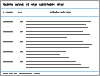
表1
方案比较分析
| 方案 | 分层联邦学习 | 考虑 non-IID | 防范服务器 合谋 | 隐私 保护 | 防范服务器宕机 | 防御 投毒 |
|---|---|---|---|---|---|---|
| GALAXY[ | — | — | √ | √ | √ | √ |
| SHIELD[ | √ | √ | — | — | — | √ |
| RoPPFL[ | √ | √ | — | √ | — | √ |
| PFLS[ | √ | √ | — | √ | — | √ |
| EPIFL[ | √ | √ | — | √ | √ | √ |
| ShieldFL[ | — | √ | — | √ | — | √ |
| ESFL[ | — | √ | — | √ | — | √ |
| MODEL[ | — | √ | — | — | — | √ |
| RoHFL[ | √ | √ | — | — | — | √ |
| BHFL[ | √ | √ | √ | √ | — | √ |
| ApaPRFL[ | √ | — | — | √ | — | √ |
| APFed[ | √ | √ | — | √ | — | √ |
| PDSA[ | √ | √ | √ | √ | — | √ |
| 本文方案 | √ | √ | √ | √ | √ | √ |
表2
主要符号参数
| 符号 | 描述 |
|---|---|
| m | 客户端总数 |
| U | HFL中地理区域的集合 |
| N | 单个区域内边缘服务器的总数 |
| T | SSS的门限值 |
| K | GMM聚类中的簇总数 |
| d | 客户端梯度的维度 |
| deg | 精度值 |
| 客户端i在t轮时的梯度向量 | |
| $\boldsymbol{G}_{i}^{t \prime}$ | 客户端i在t轮时整数化后的梯度向量 |
| 客户端i在t轮时的梯度向量份额 | |
| 区域a在第t轮的区域聚合梯度向量份额 | |
| 簇k的权重值 | |
| 簇k的均值向量 | |
| 簇k的对角协方差向量 | |
| GMM迭代停止的收敛阈值 | |
| Imax | GMM的最大迭代次数 |
| i | 客户端索引 |
| j | 维度索引 |
| k | 簇索引 |
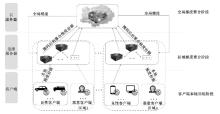
图1
HFL系统架构
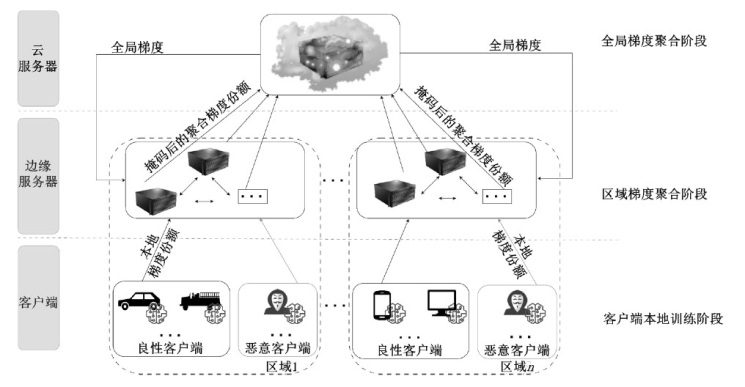
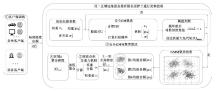
图2
隐私保护下的防御投毒策略
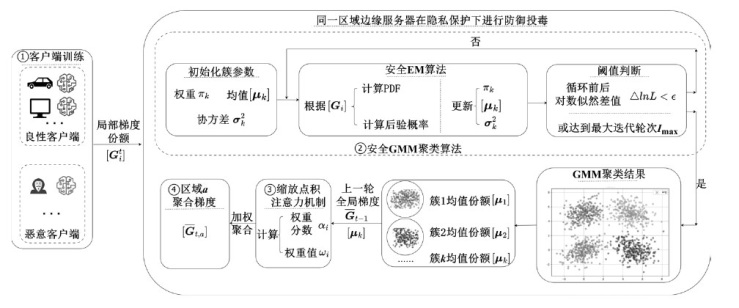
表3
计算复杂度和通信复杂度对比分析
| 阶段 | 算法 | 计算复杂度 | 通信复杂度 |
|---|---|---|---|
| 单客户端 本地训练 | GALAXY | O(N·d) | O(N·d) |
| EPIFL | O(d) | O(d) | |
| 本文方案 | O(N·d) | O(N·d) | |
| 边缘服务器 聚合 | GALAXY | O(N2·m·d) | O(N2·m·d) |
| EPIFL | O(m·d) | O(m·d) | |
| 本文方案 | O(N2·m·d) | O(N2·m·d) | |
| 云服务器 全局聚合 | GALAXY | — | — |
| EPIFL | O(U·d) | O(U·d) | |
| 本文方案 | O(U2·N·d) | O(U·N·d) |
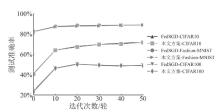
图3
本文方案和FedSGD在non-IID下的准确率
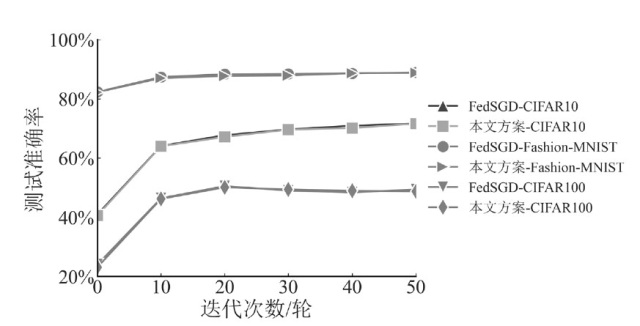
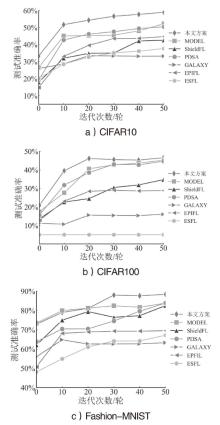
图4
模型在标签翻转攻击下不同迭代次数的准确率对比(投毒客户端比例10%)
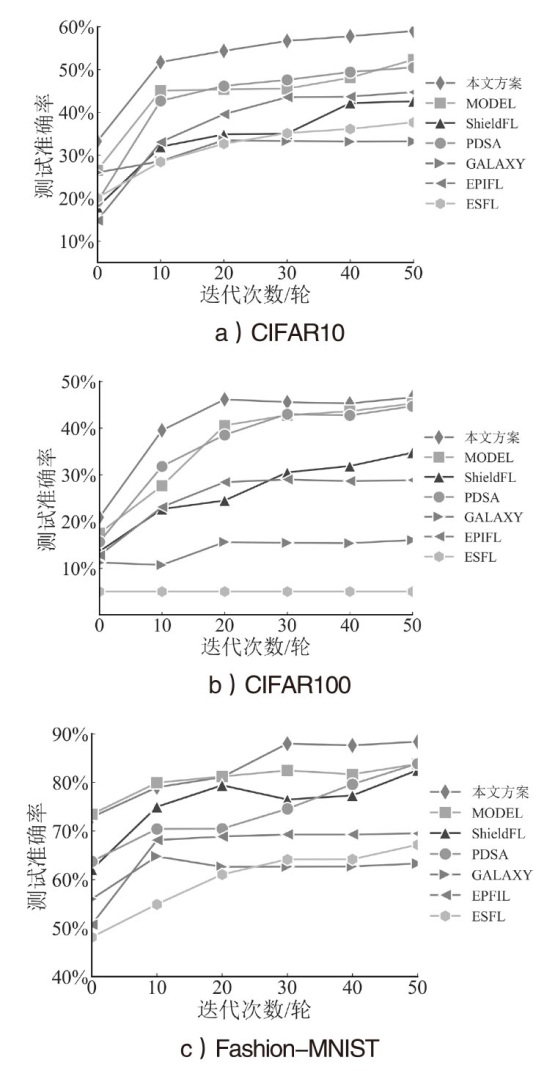
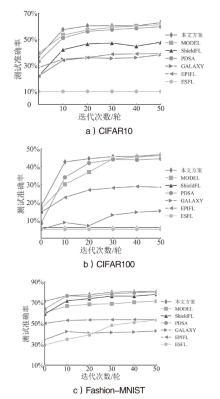
图5
模型在后门攻击下不同迭代次数的准确率对比(投毒客户端比例10%)
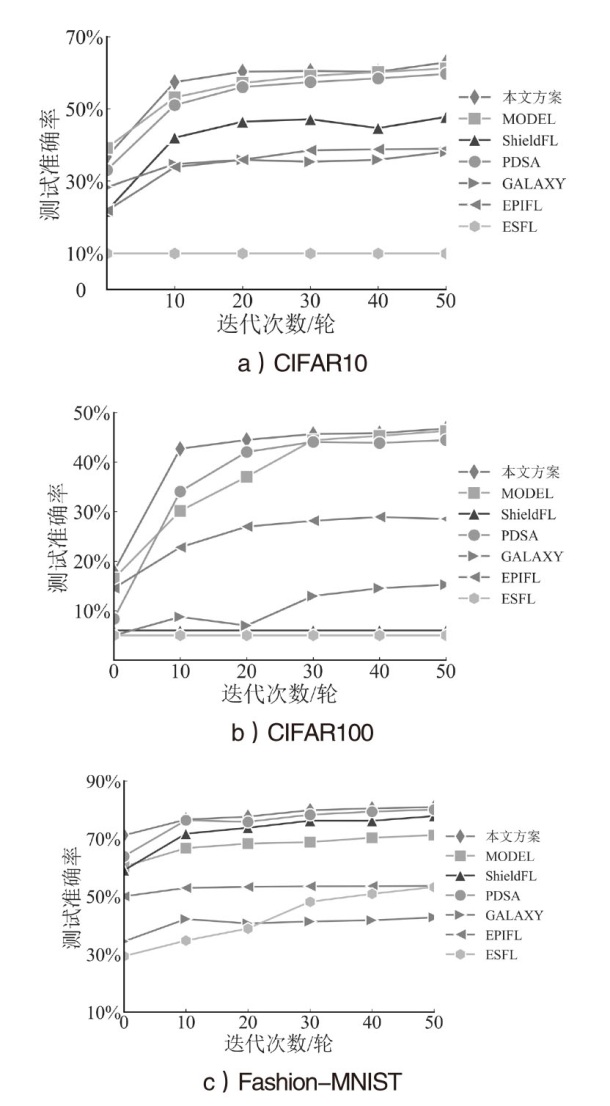
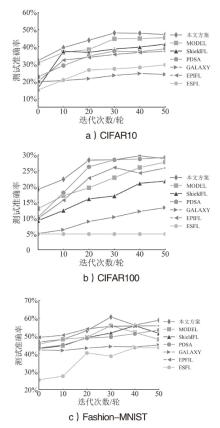
图6
模型在标签翻转攻击下不同迭代次数的准确率对比(投毒客户端比例40%)
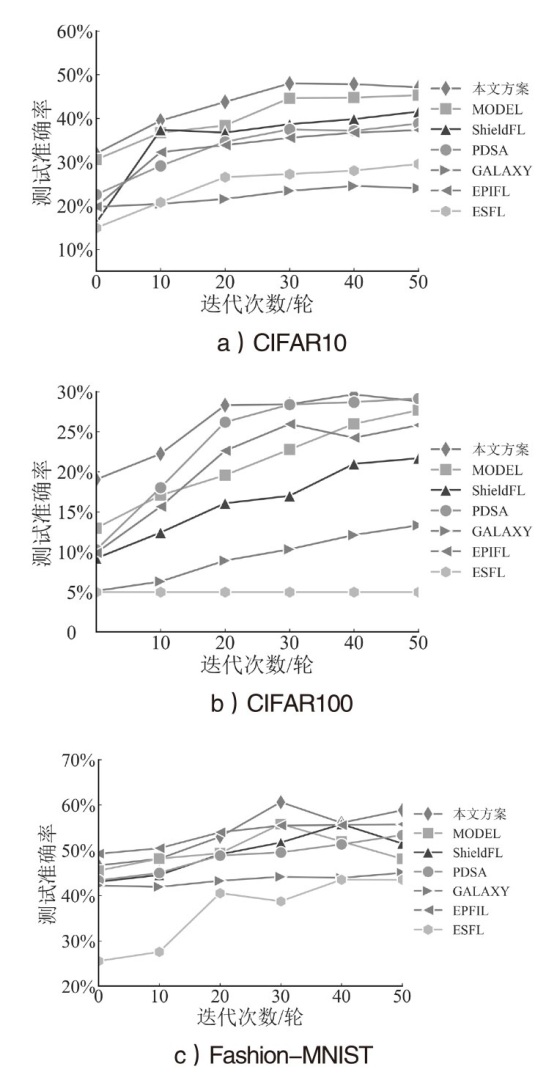
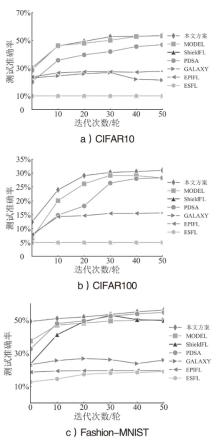
图7
模型在后门攻击下不同迭代次数的准确率对比(投毒客户端比例40%)
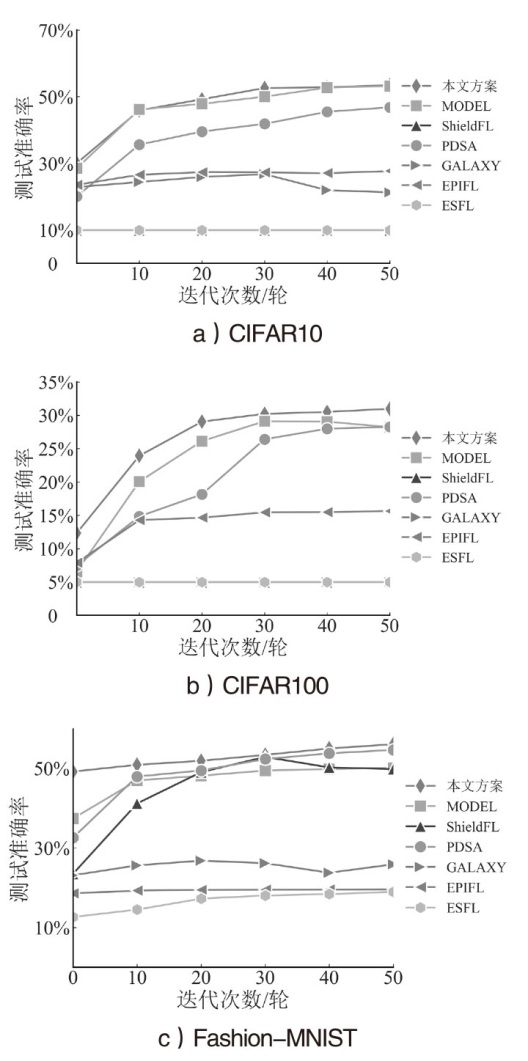
表4
CIFAR10下收敛阶段的测试准确率方差比较
| 方案 | 收敛期准确率方差 (标签翻转攻击下) | 收敛期准确率方差 (后门攻击下) |
|---|---|---|
| 本文方案 | 0.154 | 0.131 |
| MODEL | 0.088 | 1.994 |
| ShieldFL | 1.409 | 0 |
| PDSA | 0.519 | 4.375 |
| GALAXY | 0.203 | 5.907 |
| EPIFL | 0.531 | 0.068 |
| ESFL | 0.912 | 0 |
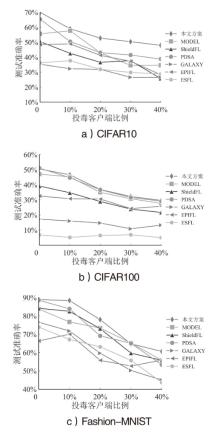
图8
模型在标签翻转攻击下不同投毒客户端比例中的准确率对比
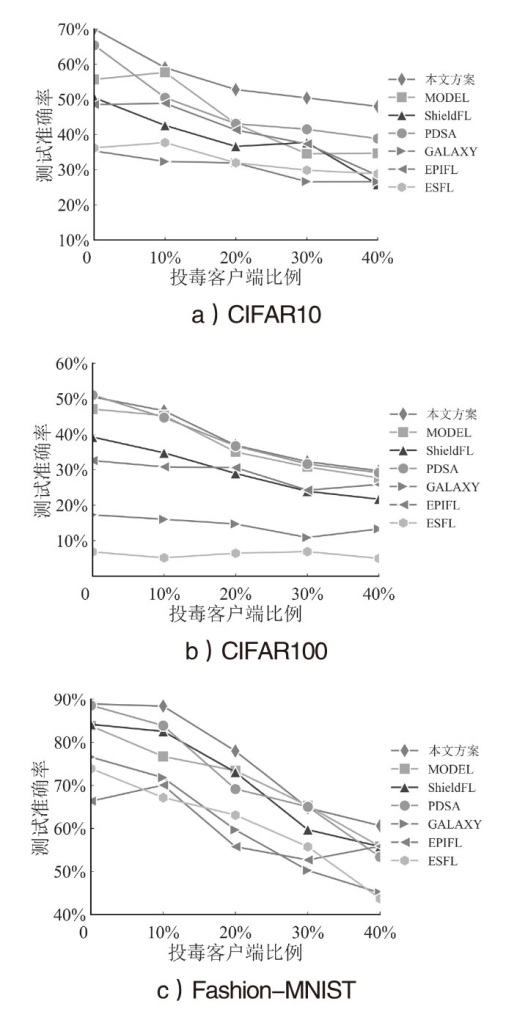
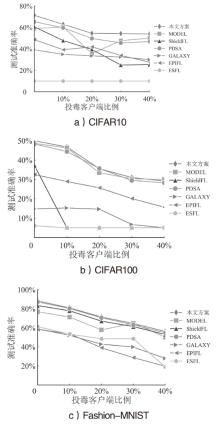
图9
模型在后门攻击下不同投毒客户端比例中的准确率对比
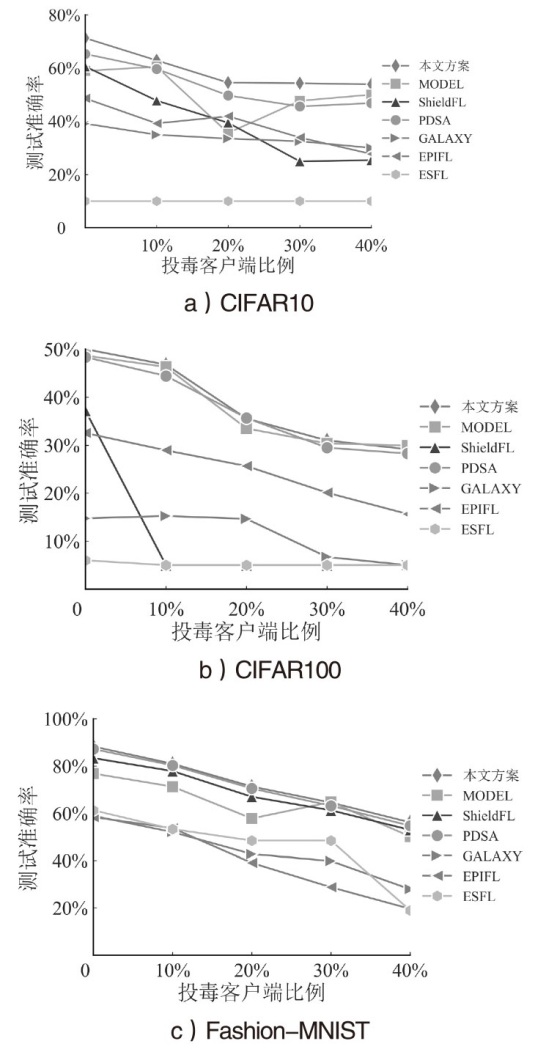
表5
标签翻转攻击下消融实验结果对比
| 投毒 客户端比例 | 仅应用 缩放点积注意力机制 | 仅应用GMM | 本文方案 |
|---|---|---|---|
| 0 | 61.56% | 65.85% | 70.00% |
| 10% | 46.88% | 48.22% | 58.98% |
| 20% | 42.50% | 47.64% | 52.76% |
| 30% | 44.48% | 44.89% | 50.38% |
| 40% | 40.96% | 40.47% | 47.98% |
表6
后门攻击下消融实验结果对比
| 投毒 客户端比例 | 仅应用 缩放点积注意力机制 | 仅应用GMM | 本文方案 |
|---|---|---|---|
| 0 | 65.00% | 57.35% | 71.26% |
| 10% | 54.09% | 55.55% | 62.87% |
| 20% | 45.95% | 45.42% | 54.50% |
| 30% | 36.19% | 50.41% | 54.30% |
| 40% | 35.25% | 46.29% | 53.86% |
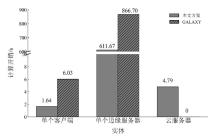
图10
不同方案的计算开销
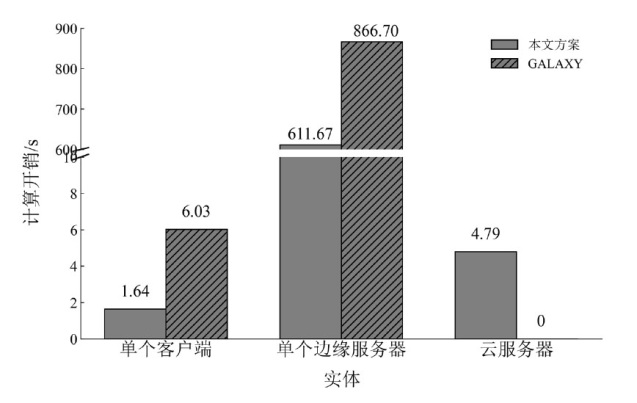
图11
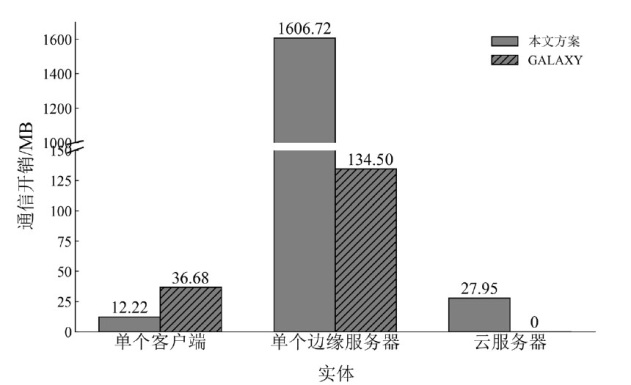
不同方案的通信开销
| [1] |
Le Junqing, Zhang Di, Lei Xinyu, et al. Privacy-preserving federated learning with malicious clients and honest-but-curious servers[J]. IEEE Transactions on Information Forensics and Security, 2023, 18: 4329-4344.
doi: 10.1109/TIFS.2023.3295949 URL |
| [2] |
Zhang Zhuangzhuang, Wu Libing, Ma Chuanguo, et al. LSFL: a lightweight and secure federated learning scheme for edge computing[J]. IEEE Transactions on Information Forensics and Security, 2022, 18: 365-379.
doi: 10.1109/TIFS.2022.3221899 URL |
| [3] |
Li Yiran, Li Hongwei, Xu Guowen, et al. Practical privacy-preserving federated learning in vehicular fog computing[J]. IEEE Transactions on Vehicular Technology, 2022, 71(5): 4692-4705.
doi: 10.1109/TVT.2022.3150806 URL |
| [4] |
Hazra A, Rana P, Adhikari M, et al. Fog computing for next-generation internet of things: fundamental, state-of-the-art and research challenges[J]. Computer Science Review, 2023, 48: 100549.
doi: 10.1016/j.cosrev.2023.100549 URL |
| [5] |
Liu Yi, Nie Jiangtian, Li Xuandi, et al. Federated learning in the sky: aerial-ground air quality sensing framework with uav swarms[J]. IEEE Internet of Things Journal, 2020, 8(12): 9827-9837.
doi: 10.1109/JIOT.2020.3021006 URL |
| [6] | Liu Lumin, Zhang Jun, Song S H, et al. Client-Edge-Cloud hierarchical federated learning[C]// The 2020 IEEE International Conference on Communications (ICC 2020). New York: IEEE, 2020: 1-6. |
| [7] | Lim W Y B, Luong N C, Hoang D T, et al. Federated learning in mobile edge networks: a comprehensive survey[J]. IEEE Communications Surveys & Tutorials, 2020, 22(3): 2031-2063. |
| [8] |
Siriwardhana Y, Pawani P, Liyanage M, et al. SHIELD-Secure aggregation against poisoning in hierarchical federated learning[J]. IEEE Transactions on Dependable and Secure Computing, 2025, 22(2): 1845-1863.
doi: 10.1109/TDSC.2024.3472869 URL |
| [9] |
Li Yanbin, Wang Xuemei, Sun Runkang, et al. Trustiness-Based hierarchical decentralized federated learning[J]. Knowledge-Based Systems, 2023, 276: 110763.
doi: 10.1016/j.knosys.2023.110763 URL |
| [10] |
Zhou Hongliang, Zheng Yifeng, Jia Xiaohua. Towards robust and privacy-preserving federated learning in edge computing[J]. Computer Networks, 2024, 243: 110321.
doi: 10.1016/j.comnet.2024.110321 URL |
| [11] |
Li Xiumin, Wen Mi, He Siying, et al. A privacy-preserving federated learning scheme against poisoning attacks in smart grid[J]. IEEE Internet of Things Journal, 2024, 11(9): 16805-16816.
doi: 10.1109/JIOT.2024.3365142 URL |
| [12] |
Li Xueyang, Liang Yihuai, Zhou Zhengchun, et al. Efficient privacy-preserving federated learning with integrity in fog computing[J]. IEEE Transactions on Network Science and Engineering, 2026, 13: 391-407.
doi: 10.1109/TNSE.2025.3584157 URL |
| [13] |
Xu Guowen, Li Hongwei, Ren Hao, et al. Data security issues in deep learning: attacks, countermeasures, and opportunities[J]. IEEE Communications Magazine, 2019, 57(11): 116-122.
doi: 10.1109/MCOM.001.1900091 |
| [14] | Melis L, Song Congzheng, De C E, et al.Exploiting unintended feature leakage in collaborative learning[C]//2019 IEEE Symposium on Security and Privacy (SP). New York: IEEE, 2019: 691-706. |
| [15] |
Miao Yinbin, Yan Xinru, Li Xinghua, et al. RFed: robustness-enhanced privacy-preserving federated learning against poisoning attack[J]. IEEE Transactions on Information Forensics and Security, 2024, 19: 5814-5827.
doi: 10.1109/TIFS.2024.3402113 URL |
| [16] | Bonawitz K, Ivanov V, Kreuter B, et al. Practical secure aggregation for privacy-preserving machine learning[C]// The 2017 ACM SIGSAC Conference on Computer and Communications Security. New York: ACM, 2017: 1175-1191. |
| [17] | Vaswani A, Shazeer N, Parmar N, et al. Attention is all you need[C]// The 31st International Conference on Neural Information Processing Systems. New York: Curran Associates, 2017: 6000-6010. |
| [18] |
Ma Zhuoran, Ma Jianfeng, Miao Yinbin, et al. ShieldFL: mitigating model poisoning attacks in privacy-preserving federated learning[J]. IEEE Transactions on Information Forensics and Security, 2022, 17: 1639-1654.
doi: 10.1109/TIFS.2022.3169918 URL |
| [19] |
Zeng Honghong, Lou Jiong, Li Kailai, et al. ESFL: accelerating poisonous model detection in privacy-preserving federated learning[J]. IEEE Transactions on Dependable and Secure Computing, 2025, 22(4): 3780-3794.
doi: 10.1109/TDSC.2025.3541633 URL |
| [20] |
Wu Minzhe, Zhao Bowen, Xiao Yang, et al. MODEL: a model poisoning defense framework for federated learning via truth discovery[J]. IEEE Transactions on Information Forensics and Security, 2024, 19: 8747-8759.
doi: 10.1109/TIFS.2024.3461449 URL |
| [21] |
Li Xueyang, Yang Xue, Zhou Zhengchun, et al. Efficiently achieving privacy preservation and poisoning attack resistance in federated learning[J]. IEEE Transactions on Information Forensics and Security, 2024, 19: 4358-4373.
doi: 10.1109/TIFS.2024.3378006 URL |
| [22] |
Zhou Hongliang, Zheng Yifeng, Huang Hejiao, et al. Toward robust hierarchical federated learning in internet of vehicles[J]. IEEE Transactions on Intelligent Transportation Systems, 2023, 24(5): 5600-5614.
doi: 10.1109/TITS.2023.3243003 URL |
| [23] |
Liu Jingwei, Wu Yufeng, Du Wei, et al. Byzantine-Robust hierarchical aggregation for cross-device federated learning in consumer IoT[J]. IEEE Transactions on Consumer Electronics, 2024, 71(2): 6359-6370.
doi: 10.1109/TCE.2024.3450649 URL |
| [24] |
Zuo Shaojun, Xie Yong, Wu Libing, et al. ApaPRFL: robust privacy-preserving federated learning scheme against poisoning adversaries for intelligent devices using edge computing[J]. IEEE Transactions on Consumer Electronics, 2024, 70(1): 725-734.
doi: 10.1109/TCE.2024.3376561 URL |
| [25] |
Chen Xiao, Yu Haining, Jia Xiaohua, et al. APFed: anti-poisoning attacks in privacy-preserving heterogeneous federated learning[J]. IEEE Transactions on Information Forensics and Security, 2023, 18: 5749-5761.
doi: 10.1109/TIFS.2023.3315125 URL |
| [26] |
Huang Zixuan, Bi Yuanguo, Zhang Kuan, et al. PDSA-FL: a poisoning-defense secure aggregation in federated learning[J]. IEEE Transactions on Information Forensics and Security, 2025, 20: 7617-7632.
doi: 10.1109/TIFS.2025.3588324 URL |
| [27] |
Liang Yihuai, Li Yan, Shin B S. Privacy-Preserving and reliable truth discovery for heterogeneous fog-based crowdsensing[J]. IEEE Transactions on Dependable and Secure Computing, 2025, 22(3): 2338-2351.
doi: 10.1109/TDSC.2024.3497965 URL |
| [28] |
Shamir A. How to share a secret[J]. Communications of the ACM, 1979, 22(11): 612-613.
doi: 10.1145/359168.359176 URL |
| [29] |
Fu Yinlin, Liu Xiaonan, Sarkar S, et al. Gaussian mixture model with feature selection: an embedded approach[J]. Computers & Industrial Engineering, 2021, 152: 107000.
doi: 10.1016/j.cie.2020.107000 URL |
| [30] |
Xu Lei, Jordan M I. On convergence properties of the EM algorithm for gaussian mixtures[J]. Neural Computation, 1996, 8(1): 129-151.
doi: 10.1162/neco.1996.8.1.129 URL |
| [31] | Zhu Ligeng, Liu Zhijian, Han Song. Deep leakage from gradients[C]// The 33rd International Conference on Neural Information Processing Systems. New York: NeurIPS, 2019, 1323: 14774-14784. |
| [32] | Pasquini D, Ateniese G, Bernaschi M. Unleashing the tiger: inference attacks on split learning[C]// The 2021 ACM SIGSAC Conference on Computer and Communications Security. New York: ACM, 2021: 2113-2129. |
| [33] |
Li Guohao, Yang Li, Zhou Lu, et al. Practical and collusion-resistant privacy-preserving aggregation for edge intelligence[J]. IEEE Transactions on Dependable and Secure Computing, 2025, 22(6): 7229-7243.
doi: 10.1109/TDSC.2025.3596101 URL |
| [34] |
Liu Yuanxin, Liang Yihuai, Zhang Rui, et al. Secure federated learning with configurable reliability in heterogeneous edge computing[J]. Computer Networks, 2026, 274: 111808.
doi: 10.1016/j.comnet.2025.111808 URL |
| [1] | 聂豪杰, 孙德刚, 潘兴博, 万巍, 龙春. 面向大语言模型的成员推理攻击与防御技术综述[J]. 信息网络安全, 2026, 26(9): 1341-1353. |
| [2] | 李子豪, 张锋巍. 基于可信执行环境的联邦学习平台[J]. 信息网络安全, 2026, 26(5): 788-808. |
| [3] | 崔津华, 董亮, 杨新. 大语言模型推理隐私保护技术综述[J]. 信息网络安全, 2026, 26(4): 503-520. |
| [4] | 易文哲, 徐枭洋, 石磊, 庄泳, 王鹃. 基于知识迁移和冻结的模型反演防御方法[J]. 信息网络安全, 2026, 26(4): 566-578. |
| [5] | 郭毅, 李旭青, 张子蛟, 张宏涛, 张连成, 张香丽. 基于区块链的数据安全共享研究[J]. 信息网络安全, 2026, 26(1): 1-23. |
| [6] | 朱率率, 刘科乾. 基于掩码的选择性联邦蒸馏方案[J]. 信息网络安全, 2025, 25(6): 920-932. |
| [7] | 赵锋, 范淞, 赵艳琦, 陈谦. 基于本地差分隐私的可穿戴医疗设备流数据隐私保护方法[J]. 信息网络安全, 2025, 25(5): 700-712. |
| [8] | 秦金磊, 康毅敏, 李整. 智能电网中轻量级细粒度的多维多子集隐私保护数据聚合[J]. 信息网络安全, 2025, 25(5): 747-757. |
| [9] | 胡宇涵, 杨高, 蔡红叶, 付俊松. 三维分布式无线智能系统数据传输路径隐私保护方案[J]. 信息网络安全, 2025, 25(4): 536-549. |
| [10] | 何可, 王建华, 于丹, 陈永乐. 基于自适应采样的机器遗忘方法[J]. 信息网络安全, 2025, 25(4): 630-639. |
| [11] | 李佳东, 曾海涛, 彭莉, 汪晓丁. 一种保护数据隐私的匿名路由联邦学习框架[J]. 信息网络安全, 2025, 25(3): 494-503. |
| [12] | 张观平, 魏福山, 陈熹, 顾纯祥. 基于区块链的隐私保护跨域认证协议[J]. 信息网络安全, 2025, 25(12): 1948-1960. |
| [13] | 王后珍, 江皓朗, 刘继辰, 涂航. 基于Paillier同态加密的隐私保护排序方案[J]. 信息网络安全, 2025, 25(12): 1975-1989. |
| [14] | 王亚杰, 陆锦标, 李宇航, 范青, 张子剑, 祝烈煌. 基于可信执行环境的联邦学习分层动态防护算法[J]. 信息网络安全, 2025, 25(11): 1762-1773. |
| [15] | 温金明, 刘庆, 陈洁, 吴永东. 基于错误学习的全同态加密技术研究现状与挑战[J]. 信息网络安全, 2024, 24(9): 1328-1351. |
| 阅读次数 | ||||||
|
全文 |
|
|||||
|
摘要 |
|
|||||