信息网络安全 ›› 2026, Vol. 26 ›› Issue (2): 274-290.doi: 10.3969/j.issn.1671-1122.2026.02.008
基于大语言模型的SQL注入漏洞检测载荷生成方法
顾兆军1, 李丽2, 隋翯3( )
)
1.中国民航大学信息安全测评中心 天津 300300 2.中国民航大学安全科学与工程学院 天津 300300 3.中国民航大学航空工程学院 天津 300300
-
收稿日期:2025-09-11出版日期:2026-02-10发布日期:2026-02-23 -
通讯作者:隋翯 hsui@cauc.edu.cn -
作者简介:顾兆军(1966—),男,山东,教授,博士,主要研究方向为网络与信息安全、民航信息系统|李丽(1998—),女,河南,硕士研究生,主要研究方向为网络空间安全|隋翯(1987—),男,吉林,讲师,博士,主要研究方向为工业控制系统网络与信息安全 -
基金资助:国家自然科学基金(U2333201)
A Payload Generation Method for SQL Injection Vulnerability Detection Based on Large Language Models
GU Zhaojun1, LI Li2, SUI He3()
1. Information Security Evaluation Center ,Civil Aviation University of China Tianjin 300300, China 2. College of Safety Science and Engineering ,Civil Aviation University of China Tianjin 300300, China 3. College of Aeronautical Engineering ,Civil Aviation University of China Tianjin 300300, China
-
Received:2025-09-11Online:2026-02-10Published:2026-02-23

摘要:
针对现有SQL注入漏洞检测方法存在鲁棒性不足以及测试用例缺乏针对性等问题,文章提出一种基于大语言模型的SQL注入漏洞检测载荷生成方法。该方法通过生成针对性的检测载荷实现SQL注入漏洞检测,借助提示工程与DeepSeek-V3模型自动提取和统一构建漏洞特征;利用贡献度对漏洞特征进行分析和选择,构建模型的核心输入;通过将关键特征组织成思维链的形式促进多维度漏洞表征融合,并采用低秩适配技术对Qwen模型进行领域自适应监督微调。实验在多个公开漏洞靶场中验证Qwen模型与SqliGPT、GPT-2-web和SQLMap等模型的性能差异和生成质量,并深入分析DeepSeek-V3模型在复杂SQL注入漏洞数据中的特征提取能力。实验结果表明,Qwen模型的平均检测准确率达到75%以上,比SqliGPT、GPT-2-web和SQLMap模型分别提升49.18%、59.64%和15.19%,且载荷生成质量显著优于现有模型,证明了基于大语言模型生成检测载荷,实现SQL注入漏洞检测方法的有效性与优越性。
中图分类号:
引用本文
顾兆军, 李丽, 隋翯. 基于大语言模型的SQL注入漏洞检测载荷生成方法[J]. 信息网络安全, 2026, 26(2): 274-290.
GU Zhaojun, LI Li, SUI He. A Payload Generation Method for SQL Injection Vulnerability Detection Based on Large Language Models[J]. Netinfo Security, 2026, 26(2): 274-290.
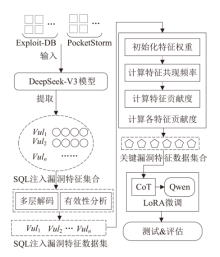
图1
基于LLM的SQL注入漏洞检测载荷生成方法框架
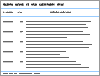
表1
系统提示词各部分及其作用
| 提示词内容 | 作用 |
|---|---|
| 全局规则 | 定义数据处理基本准则,确保数据一致性和标准化 |
| 字段要求 | 规定从漏洞文本中提取的关键信息及其格式 |
| 处理流程 | 指导模型从识别漏洞到生成最终输出的具体步骤 |
| 示例输出 | 展示根据上述规则组织和呈现提取出的信息 |
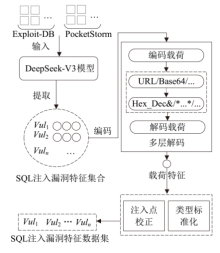
图2
多层解码机制
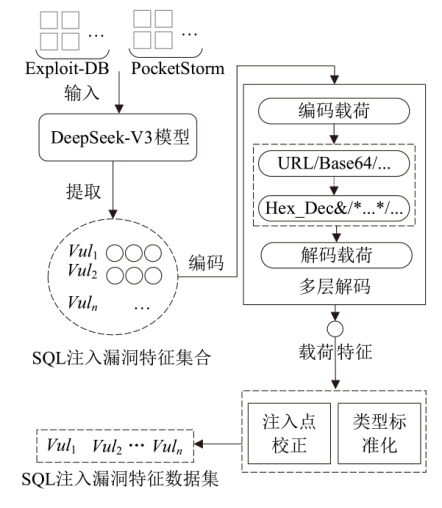
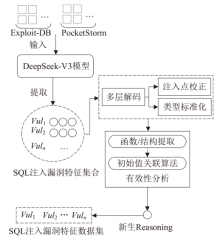
图3
SQL注入漏洞Reasoning特征生成流程
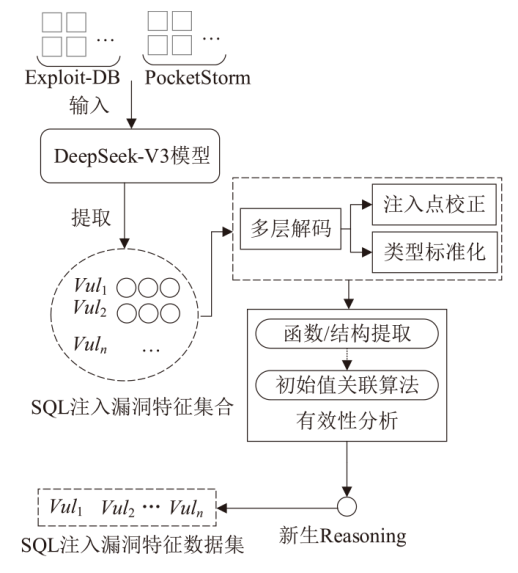
表2
关键特征选择的变量定义
| 定义变量 | 含义 |
|---|---|
| D={d1, d2,…, dN} | SQL注入漏洞样本集合,其中,di表示第i个样本,N表示漏洞样本总数 |
| Ki={ki,1, ki,2,…, ki, M} | 样本di的关键词集合,该样本的关键词总数为M=|Ki| |
| F={f1, f2,…, fS} Fi={fi,1, fi,2,…, fi, S} | F为总体漏洞特征集合,Fi为样本di特征集合,其中,每个特征表示为键值对形式(fi, j,vi, j),fi, j∈Fi,特征 总数为S |
| 样本di中特征fi, j的共现次数 | |
| 样本di中特征fi, j的共现频率 | |
| 特征fj在所有漏洞样本中的总共现频率 | |
| 特征fj的初始权重 |
表3
CoT漏洞特征提示的变量定义
| 定义变量 | 含义 |
|---|---|
| Riinitial | 第个i样本的初始Reasoning特征,包含关键函数和结构 |
| fi,injection | 第i个样本中的注入点特征,包括参数、初始值和闭合方法 |
| fi,type | 第i个样本的漏洞类型特征 |
| Sprompt | 系统提示模板,用于指导模型 |
| Pi | 第i个样本的检测载荷,即Pi∈di |
| T(·) | 模型的处理函数,将输入转为CoT提示 |
| Ci={ci,1, ci,2,…, ci, k} | 第i个样本中的CoT提示,其中,ci, j表示一个推理步骤 |
表4
实验数据来源及描述
| 数据集 | 来源 | 描述 |
|---|---|---|
| 训练数据 | Exploit-Database | 收录大量真实攻击载荷与利用代码,提升模型对实际攻击行为的理解 |
| PacketStorm | 提供丰富的安全技术文档与利用示例,增强数据集的多样性与覆盖范围 | |
| CVE[ | 提供标准化漏洞标识与描述,确保数据的代表性和时效性 | |
| 测试数据 | SQL-Libs[ | 专注于SQL注入漏洞的资源库,提供多种攻击示例及修复方法 |
| DVWA[ | 提供常见Web攻击技术的合法环境,包括基础、中级和高级的SQL注入漏洞场景 | |
| Pikachu[ | 专注于练习Web漏洞的安全测试平台,漏洞类型广泛,包括但不限于SQL注入和XSS等 | |
| bWAPP[ | 支持超过100种不同漏洞场景的练习平台,适用于多种服务器端编程语言,包括SQL注入漏洞 | |
| Newsqliset | 收集CVE、CNVD和Freebuf等报告及个人复现的ORM、NoSQL和GraphQL等注入漏洞案例 |
表5
训练数据的SQL注入漏洞样本分类统计
| 来源 类型 | Exploit-Database/个 | PacketStorm /个 | CVE/个 | 总数/个 |
|---|---|---|---|---|
| Union-based | 1032 | 33 | 54 | 1119 |
| Time Blind | 126 | 147 | 88 | 361 |
| Error-based | 48 | 41 | 42 | 131 |
| Boolean Blind | 240 | 94 | 28 | 362 |
| Stacked Query | 49 | 6 | 7 | 62 |
| Wide Byte | 0 | 0 | 1 | 1 |
| Column Probing | 10 | 2 | 1 | 13 |
| File Write | 11 | 3 | 3 | 17 |
| Bypass | 173 | 51 | 13 | 237 |
| Multi Parameter | 5 | 0 | 0 | 5 |
| ORM | 0 | 2 | 1 | 3 |
表6
初始SQL注入漏洞特征权重
| 漏洞特征 | 初始权重 | 含义 |
|---|---|---|
| 漏洞URL | 0.5 | 一般重要,辅助判断注入点上下文环境(例如,URL中含“/admin/”路径,需考虑权限提升方法) |
| 漏洞系统 | 0.4 | 一般重要,特定系统可能存在过滤规则(CMS框架输入过滤机制) |
| 注入点 | 0.6 | 重要,直接决定Payload构造的注入位置和 闭合方式 |
| 漏洞类型 | 0.8 | 关键,确定载荷类型(盲注需时间延迟函数,报错注入需触发机制) |
| 漏洞数据库 | 0.6 | 重要,决定特定数据库函数/语法的使用 |
| Reasoning | 0.5 | 重要,包含攻击逻辑的关键技术要素,如函数使用、条件判断结构 |
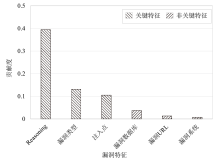
图4
基于贡献度的关键漏洞特征选择结果
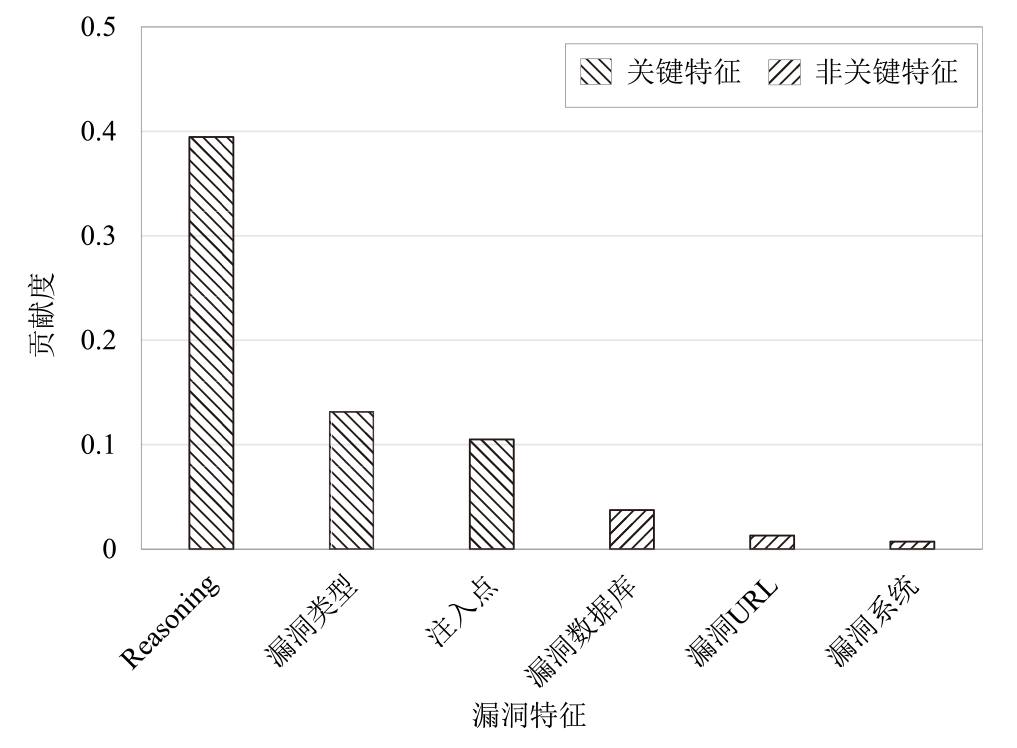
表7
测试数据的SQL注入漏洞样本分类统计
| 来源 类型 | bWAPP /个 | DVWA /个 | Pikachu /个 | SQL-Libs /个 | Newsqliset /个 | 总数 /个 |
|---|---|---|---|---|---|---|
| Union-based | 14 | 7 | 11 | 10 | 0 | 42 |
| Time Blind | 1 | 6 | 0 | 7 | 0 | 14 |
| Error-based | 5 | 7 | 6 | 8 | 0 | 26 |
| Boolean Blind | 1 | 9 | 1 | 4 | 0 | 15 |
| Stacked Query | 0 | 0 | 0 | 5 | 0 | 5 |
| Wide Byte | 0 | 0 | 4 | 3 | 0 | 7 |
| Column Probing | 1 | 2 | 0 | 1 | 0 | 4 |
| File Write | 0 | 0 | 0 | 0 | 0 | 0 |
| Bypass | 2 | 0 | 0 | 2 | 0 | 4 |
| Multi Parameter | 0 | 0 | 0 | 3 | 0 | 3 |
| ORM | 0 | 0 | 0 | 0 | 7 | 7 |
| NoSQL | 0 | 0 | 0 | 0 | 14 | 14 |
| GraphQL | 0 | 0 | 0 | 0 | 9 | 9 |
表8
总体检测性能对比
| 测试数据集 | 模型 | Nsuccess | AC | FPR | FNR |
|---|---|---|---|---|---|
| SQL-Libs、DVWA、Pikachu、bWAPP | Qwen | 91 | 0.7583 | 0.0990 | 0.1727 |
| SqliGPT | 61 | 0.5083 | 0.1644 | 0.4352 | |
| GPT-2-web | 57 | 0.4750 | 0.1972 | 0.4623 | |
| SQLMap | 79 | 0.6583 | 0.0920 | 0.2946 | |
| SQL-Libs、DVWA、Pikachu、bWAPP、Newsqliset | Qwen | 104 | 0.6933 | 0.1034 | 0.2464 |
| SqliGPT | 72 | 0.4800 | 0.1627 | 0.4706 | |
| GPT-2-web | 67 | 0.4467 | 0.2024 | 0.4962 |
表9
各模型在不同测试数据集上的检测性能对比
| 测试数据集 | 模型 | Nsuccess | AC | FPR | FNR |
|---|---|---|---|---|---|
| bWAPP | Qwen | 18 | 0.7500 | 0.1000 | 0.1818 |
| SqliGPT | 13 | 0.5417 | 0.1333 | 0.4091 | |
| GPT-2-web | 12 | 0.5000 | 0.2000 | 0.4286 | |
| SQLMap | 14 | 0.5833 | 0.1250 | 0.3636 | |
| DVWA | Qwen | 23 | 0.7419 | 0.1481 | 0.1481 |
| SqliGPT | 18 | 0.5806 | 0.1818 | 0.3333 | |
| GPT-2-web | 16 | 0.5161 | 0.1579 | 0.4286 | |
| SQLMap | 24 | 0.7742 | 0.1111 | 0.1429 | |
| Newsqliset | Qwen | 13 | 0.4333 | 0.1333 | 0.5357 |
| SqliGPT | 11 | 0.3667 | 0.1538 | 0.6071 | |
| GPT-2-web | 10 | 0.3333 | 0.2308 | 0.6296 | |
| SQLMap | 0 | 0 | 0 | 0 | |
| Pikachu | Qwen | 19 | 0.8636 | 0 | 0.1364 |
| SqliGPT | 5 | 0.2273 | 0 | 0.7727 | |
| GPT-2-web | 8 | 0.3636 | 0.1111 | 0.6190 | |
| SQLMap | 14 | 0.6364 | 0 | 0.3636 | |
| SQL-Libs | Qwen | 31 | 0.7209 | 0.1143 | 0.2051 |
| SqliGPT | 25 | 0.5814 | 0.1935 | 0.3243 | |
| GPT-2-web | 21 | 0.4884 | 0.2500 | 0.4167 | |
| SQLMap | 27 | 0.6279 | 0.1000 | 0.3250 |
表10
各模型在Newsqliset数据集上的检测性能对比
| 漏洞类型 | 模型 | Nsuccess | AC | FPR | FNR |
|---|---|---|---|---|---|
| ORM | Qwen | 3 | 0.4286 | 0.2500 | 0.5000 |
| SqliGPT | 2 | 0.2857 | 0.5000 | 0.6000 | |
| GPT-2-web | 4 | 0.5714 | 0.2000 | 0.3333 | |
| NoSQL | Qwen | 5 | 0.3571 | 0.1667 | 0.6154 |
| SqliGPT | 3 | 0.2143 | 0 | 0.7857 | |
| GPT-2-web | 2 | 0.1429 | 0.3333 | 0.8462 | |
| GraphQL | Qwen | 5 | 0.5556 | 0 | 0.4444 |
| SqliGPT | 6 | 0.6667 | 0 | 0.3333 | |
| GPT-2-web | 4 | 0.4444 | 0.2000 | 0.5000 |
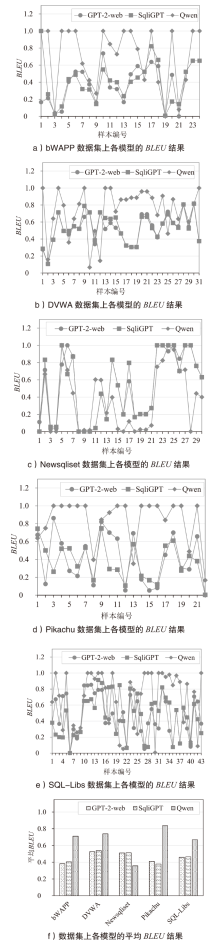
图5
测试数据集上各模型的BLEU结果
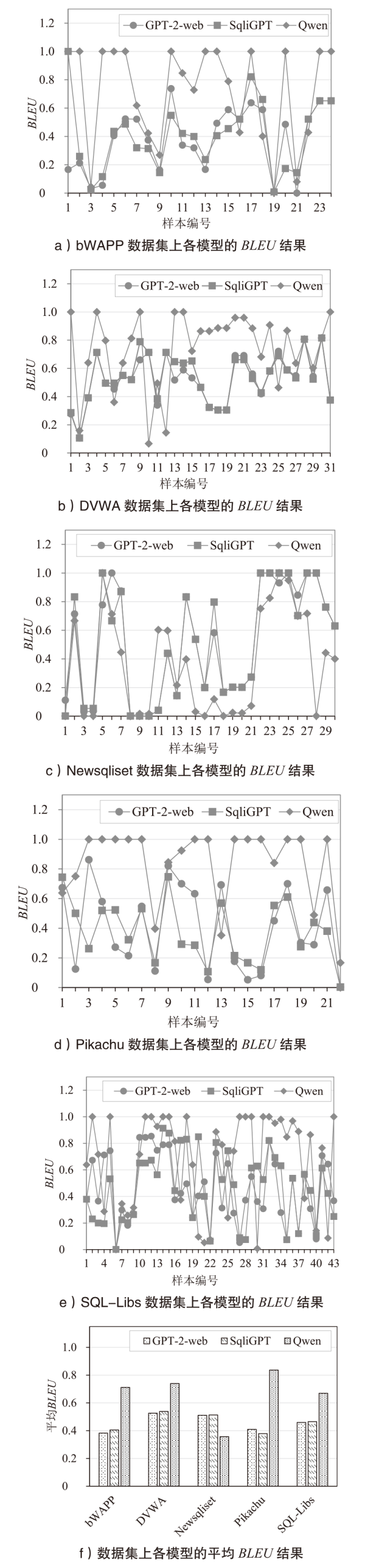
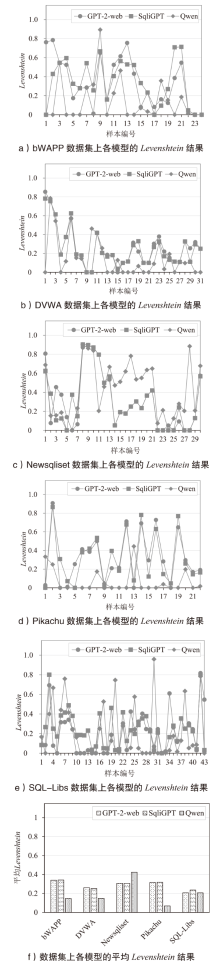
图6
在测试数据上各模型的Levenshtein结果
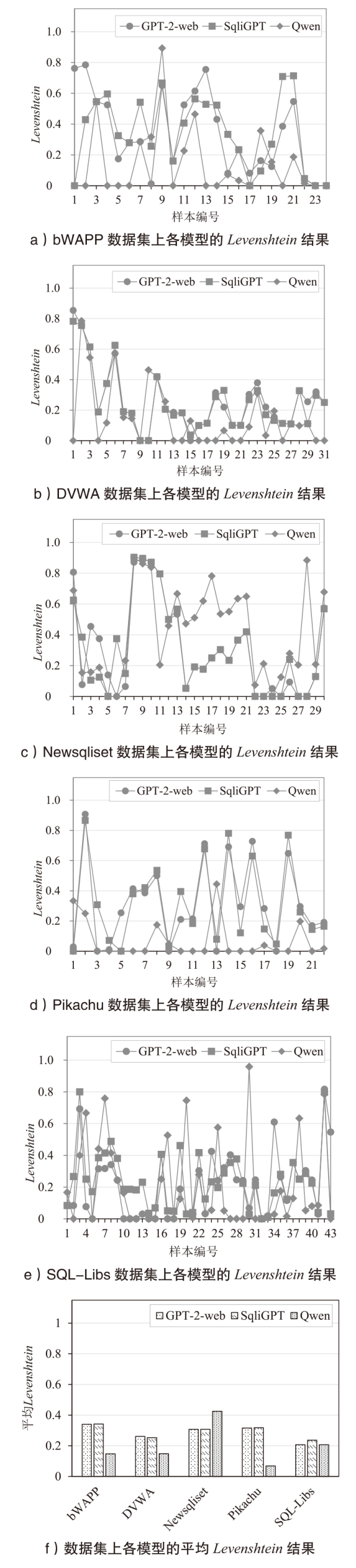
表11
DeepSeek-V3漏洞特征提取结果
| 漏洞库 | ES | SA | DI |
|---|---|---|---|
| Exploit-Database | 91.68% | 79.85% | 95.21% |
| PacketStorm | 80.21% | 88.82% | 94.37% |
| CVE | 80.25% | 89.01% | 93.88% |
| 总体 | 88.62% | 82.03% | 94.99% |
| [1] | JAIN S. 160 Cybersecurity Statistics[EB/OL]. (2025-01-09)[2025-05-24]. https://www.getastra.com/blog/security-audit/cyber-security-statistics/. |
| [2] | FreeBuf. 2023 Global Top 10 Security Vulnerabilities | FreeBuf Annual Review[EB/OL]. (2024-01-04)[2025-05-24]. https://www.freebuf.com/news/388742.html. |
| FreeBuf. 2023 全球年度安全漏洞TOP 10 | FreeBuf 年度盘点[EB/OL]. (2024-01-04)[2025-05-24]. https://www.freebuf.com/news/388742.html. | |
| [3] | HUANG Kaijie, WANG Jian, CHEN Jiongyi. A Large Language Model Based SQL Injection Attack Detection Method[J]. Netinfo Security, 2023, 23(11): 84-93. |
| 黄恺杰, 王剑, 陈炯峄. 一种基于大语言模型的SQL注入攻击检测方法[J]. 信息网络安全, 2023, 23(11):84-93. | |
| [4] | LU Dongzhe, FEI Jinlong, LIU Long. A Semantic Learning-Based SQL Injection Attack Detection Technology[EB/OL]. (2023-02-09)[2025-05-10]. https://doi.org/10.3390/electronics1206134. |
| [5] |
BOLOTNIKOV I V, BORODIN A E. Interprocedural Static Analysis for Finding Bugs in Go Programs[J]. Programming and Computer Software, 2021, 47(5): 344-352.
doi: 10.1134/S0361768821050030 |
| [6] | LIVSHITS V B, LAM M S. Finding Security Vulnerabilities in Java Applications with Static Analysis[C]// USENIX. The 14th Conference on USENIX Security Symposium. New York: USENIX, 2005: 18-29. |
| [7] |
LI Qi, LI Weishi, WANG Junfeng, et al. A SQL Injection Detection Method Based on Adaptive Deep Forest[J]. IEEE Access, 2019, 7: 145385-145394.
doi: 10.1109/ACCESS.2019.2944951 |
| [8] | RADFORD A, NARASIMHAN K, SALIMANS T, et al. Improving Language Understanding by Generative Pre-Training[EB/OL]. [2025-05-17]. https://api.semanticscholar.org/CorpusID:49313245. |
| [9] | TOUVRON H, LAVRIL T, IZACARD G, et al. LLaMA: Open and Efficient Foundation Language Models[EB/OL]. (2023-02-27)[2025-05-17]. https://arxiv.org/abs/2302.13971. |
| [10] | GUI Zhiwen, WANG Enze, DENG Binbin, et al. SqliGPT: Evaluating and Utilizing Large Language Models for Automated SQL Injection Black-Box Detection[EB/OL]. (2024-08-07)[2025-05-17]. https://doi.org/10.3390/app1416692. |
| [11] | ĆIRKOVIĆ S, MLADENOVIĆ V, TOMIĆ S, et al. Utilizing Fine-Tuning of Large Language Models for Generating Synthetic Payloads: Enhancing Web Application Cybersecurity through Innovative Penetration Testing Techniques[J]. Computers, Materials & Continua, 2025, 82(3): 4409-4430. |
| [12] | WU Peize, LI Guanghui, WU Jinyu. Research on Automated Vulnerability Verification Code Generation Based on Large Language Models[EB/OL]. (2024-06-20)[2025-05-10]. https://kns.cnki.net/kcms2/article/abstract?v=MXvIvFkaDQz0Ed1hcQN9CL-gXr5KEIhM5964CkAGitVLQj534FnW1QowKkJ4WAgttjFFL0fZhSaGn07arFP_v3d_Buwl9snK_NfzS-YnI0oSzgnHjsO-O0TrWBMHKVS99os3LXwpBVAl_JCWrFc-_pT5Ybux81d8cT6Gw2I5naP9T-kI9v978mcS2fJKkXwY&uniplatform=NZKPT&language=CHS. |
| 吴佩泽, 李光辉, 吴津宇. 基于大语言模型的自动化漏洞验证代码生成方法研究[EB/OL]. (2024-06-20)[2025-05-10]. https://kns.cnki.net/kcms2/article/abstract?v=MXvIvFkaDQz0Ed1hcQN9CL-gXr5KEIhM5964CkAGitVLQj534FnW1QowKkJ4WAgttjFFL0fZhSaGn07arFP_v3d_Buwl9snK_NfzS-YnI0oSzgnHjsO-O0TrWBMHKVS99os3LXwpBVAl_JCWrFc-_pT5Ybux81d8cT6Gw2I5naP9T-kI9v978mcS2fJKkXwY&uniplatform=NZKPT&language=CHS. | |
| [13] | YANG Guang, ZHOU Yu, CHEN Xiang, et al. ExploitGen: Template-Augmented Exploit Code Generation Based on CodeBERT[EB/OL]. (2023-03-01)[2025-05-17]. https://doi.org/10.1016/j.jss.2022.11157. |
| [14] |
PENG Qi, CAI Yi, LIU Jiankun, et al. Integration of Multi-Source Medical Data for Medical Diagnosis Question Answering[J]. IEEE Transactions on Medical Imaging, 2025, 44(3): 1373-1385.
doi: 10.1109/TMI.2024.3496862 pmid: 40030182 |
| [15] | LIAO Xingming, CHEN Chong, WANG Zhuowei, et al. Large Language Model Assisted Fine-Grained Knowledge Graph Construction for Robotic Fault Diagnosis[EB/OL]. (2025-05-01)[2025-06-17]. https://doi.org/10.1016/j.aei.2025.10313. |
| [16] | WEI J, WANG Xuezhi, SCHUURMANS D, et al. Chain-of-Thought Prompting Elicits Reasoning in Large Language Models[C]// ACM. The 36th International Conference on Neural Information Processing Systems. New York: ACM, 2022: 24824-24837. |
| [17] | OU Jianjiu, ZHOU Jianlong, DONG Yifei, et al. Chain of Thought Prompting in Vision-Language Model for Vision Reasoning Tasks[C]// Springer. The 37th Australasian Joint Conference on Artificial Intelligence. Heidelberg: Springer, 2024: 298-311. |
| [18] | YAO Chengyuan, FUJITA S. Adaptive Control of Retrieval-Augmented Generation for Large Language Models through Reflective Tags[EB/OL]. (2024-11-25)[2025-07-15]. https://doi.org/10.3390/electronics1323464. |
| [19] | OffSEC. Exploit Database[EB/OL]. (2010-11-01)[2025-09-07]. https://www.exploit-db.com/. |
| [20] | Private Internet Access. PacketStorm Security Archive[EB/OL]. [2025-07-15]. https://packetstormsecurity.com/. |
| [21] | OpenAI. Completion-OpenAI API[EB/OL]. [2025-12-05]. https://beta.openai.com/docs/guides/completion/prompt-design. |
| [22] | DeepSeek. DeepSeek-V3[EB/OL]. [2025-03-07]. https://huggingface.co/deepseek-ai/DeepSeek-V3. |
| [23] | HU E J, SHEN Yelong, WALLIS P, et al. LoRA: Low-Rank Adaptation of Large Language Models[EB/OL]. (2021-06-17)[2025-04-17]. https://doi.org/10.48550/arXiv.2106.0968. |
| [24] | STAMPAR M, DAMELE A G B. SQLMap: Automatic SQL Injection and Database Takeover Tool[EB/OL]. [2025-03-26]. https://github.com/sqlmapproject/sqlmap. |
| [25] | MITRE. Common Vulnerabilities and Exposures(CVE)[EB/OL]. (2000-01-01)[2025-07-15]. https://cve.mitre.org/. |
| [26] | Audi-1. SQLI-Labs[EB/OL]. (2014-04-01)[2025-04-17]. https://github.com/Audi-1/sqli-labs. |
| [27] | DEWHURST R. Damn Vulnerable Web Application(DVWA)[EB/OL]. (2023-05-21)[2025-04-17]. https://github.com/digininja/DVWA. |
| [28] | HUN Lu. Pikachu[EB/OL]. [2025-04-18]. https://github.com/zhuifengshaonianhanlu/pikachu. |
| [29] | MALIK B. BWAPP[EB/OL]. (2013-01-08)[2025-04-18]. https://sourceforge.net/projects/bwapp/. |
| [30] | SHITOU CLOUD. AutoDL: High-Performance Cloud Computing Platform for Deep Learning[EB/OL]. [2025-05-07]. https://www.autodl.com. |
| 视拓云. AutoDL:高性能深度学习算力云平台[EB/OL]. [2025-05-07]. https://www.autodl.com. | |
| [31] | ZHENG Yaowei, ZHANG Richong, ZHANG Junhao, et al. LlamaFactory: Unified Efficient Fine-Tuning of 100+ Language Models[C]// Association for Computational Linguistics. Proceedings of the 62nd Annual Meeting of the Association for Computational Linguistics. Pennsylvania: Association for Computational Linguistics, 2024: 400-410. |
| [32] | PAPINENI K, ROUKOS S, WARD T, et al. Bleu: A Method for Automatic Evaluation of Machine Translation[C]// ACL. The 40th Annual Meeting of the Association for Computational Linguistics. Philadelphia: ACL, 2002: 311-318. |
| [33] |
BERGER B, WATERMAN M S, YU Y W. Levenshtein Distance, Sequence Comparison and Biological Database Search[J]. IEEE Transactions on Information Theory, 2021, 67(6): 3287-3294.
doi: 10.1109/tit.2020.2996543 pmid: 34257466 |
| [1] | 仝鑫, 焦强, 王靖亚, 袁得嵛, 金波. 公共安全领域大语言模型的可信性研究综述:风险、对策与挑战[J]. 信息网络安全, 2026, 26(1): 24-37. |
| [2] | 胡雨翠, 高浩天, 张杰, 于航, 杨斌, 范雪俭. 车联网安全自动化漏洞利用方法研究[J]. 信息网络安全, 2025, 25(9): 1348-1356. |
| [3] | 刘会, 朱正道, 王淞鹤, 武永成, 黄林荃. 基于深度语义挖掘的大语言模型越狱检测方法研究[J]. 信息网络安全, 2025, 25(9): 1377-1384. |
| [4] | 王磊, 陈炯峄, 王剑, 冯袁. 基于污点分析与文本语义的固件程序交互关系智能逆向分析方法[J]. 信息网络安全, 2025, 25(9): 1385-1396. |
| [5] | 张燕怡, 阮树骅, 郑涛. REST API设计安全性检测研究[J]. 信息网络安全, 2025, 25(8): 1313-1325. |
| [6] | 陈平, 骆明宇. 云边端内核竞态漏洞大模型分析方法研究[J]. 信息网络安全, 2025, 25(7): 1007-1020. |
| [7] | 酆薇, 肖文名, 田征, 梁中军, 姜滨. 基于大语言模型的气象数据语义智能识别算法研究[J]. 信息网络安全, 2025, 25(7): 1163-1171. |
| [8] | 张学旺, 卢荟, 谢昊飞. 基于节点中心性和大模型的漏洞检测数据增强方法[J]. 信息网络安全, 2025, 25(4): 550-563. |
| [9] | 顾欢欢, 李千目, 刘臻, 王方圆, 姜宇. 基于虚假演示的隐藏后门提示攻击方法研究[J]. 信息网络安全, 2025, 25(4): 619-629. |
| [10] | 解梦飞, 傅建明, 姚人懿. 基于LLM的多媒体原生库模糊测试研究[J]. 信息网络安全, 2025, 25(3): 403-414. |
| [11] | 秦中元, 王田田, 刘伟强, 张群芳. 大语言模型水印技术研究进展[J]. 信息网络安全, 2025, 25(2): 177-193. |
| [12] | 杨立群, 李镇, 韦超仁, 闫治敏, 仇勇鑫. 大语言模型引导的协议模糊测试技术研究[J]. 信息网络安全, 2025, 25(12): 1847-1862. |
| [13] | 孟辉, 毛琳琳, 彭聚智. 大语言模型驱动的无害化处理识别方法[J]. 信息网络安全, 2025, 25(12): 1990-1998. |
| [14] | 胡斌, 黑一鸣, 吴铁军, 郑开发, 刘文忠. 大模型安全检测评估技术综述[J]. 信息网络安全, 2025, 25(10): 1477-1492. |
| [15] | 胡隆辉, 宋虹, 王伟平, 易佳, 张智雄. 大语言模型在安全托管服务误报处理中的应用研究[J]. 信息网络安全, 2025, 25(10): 1570-1578. |
| 阅读次数 | ||||||
|
全文 |
|
|||||
|
摘要 |
|
|||||