Netinfo Security ›› 2026, Vol. 26 ›› Issue (6): 854-869.doi: 10.3969/j.issn.1671-1122.2026.06.002
Previous Articles Next Articles
A Study on Intrusion Detection Methods Based on Explainable Artificial Intelligence
YANG Wang( ), ZHENG Weite
School of Cyber Science and Engineering ,Southeast University Nanjing 211189, China
-
Received:2025-12-31Online:2026-06-10Published:2026-07-27 -
Contact:YANG Wang E-mail:wang.yang@seu.edu.cn

CLC Number:
Cite this article
YANG Wang, ZHENG Weite. A Study on Intrusion Detection Methods Based on Explainable Artificial Intelligence[J]. Netinfo Security, 2026, 26(6): 854-869.
share this article
Add to citation manager EndNote|Ris|BibTeX
URL: http://netinfo-security.org/EN/10.3969/j.issn.1671-1122.2026.06.002
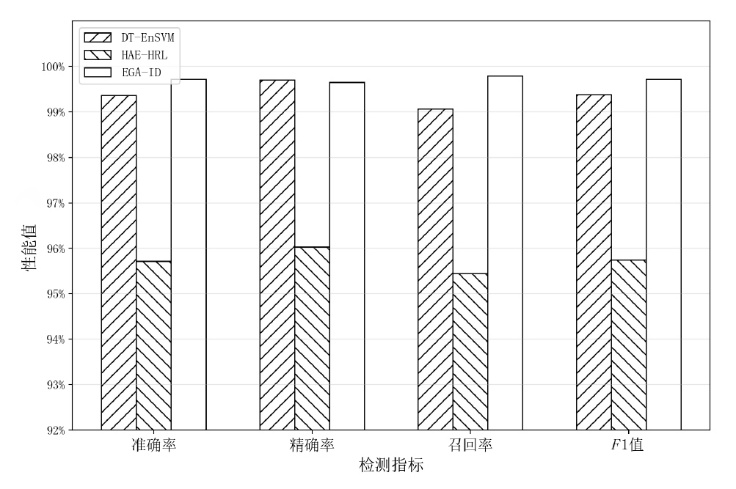
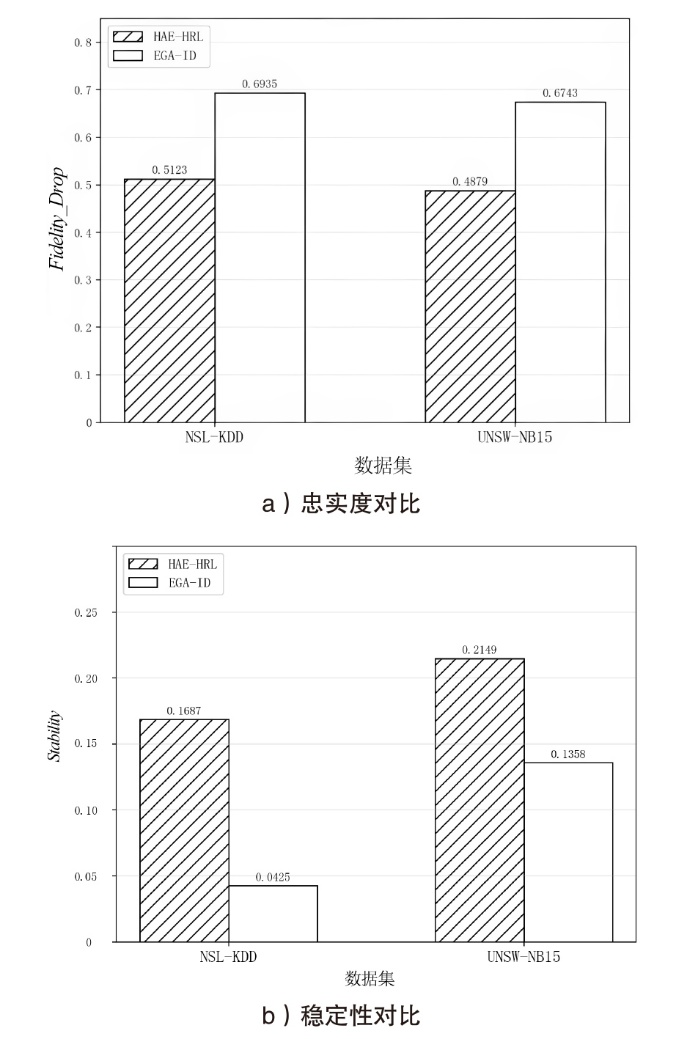
| 数据集 | 模型名称 | Accuracy | Precision | Recall | F1-Score |
|---|---|---|---|---|---|
| NSL-KDD | CNN | 94.85% | 95.12% | 94.60% | 94.86% |
| LSTM | 94.20% | 94.45% | 93.90% | 94.17% | |
| Random Forest | 98.72% | 98.85% | 98.50% | 98.67% | |
| XGBoost | 99.15% | 99.20% | 99.08% | 99.14% | |
| DT-EnSVM | 99.36% | 99.70% | 99.07% | 99.38% | |
| HAE-HRL | 95.72% | 96.03% | 95.45% | 95.74% | |
| EGA-ID | 99.72% | 99.65% | 99.79% | 99.72% | |
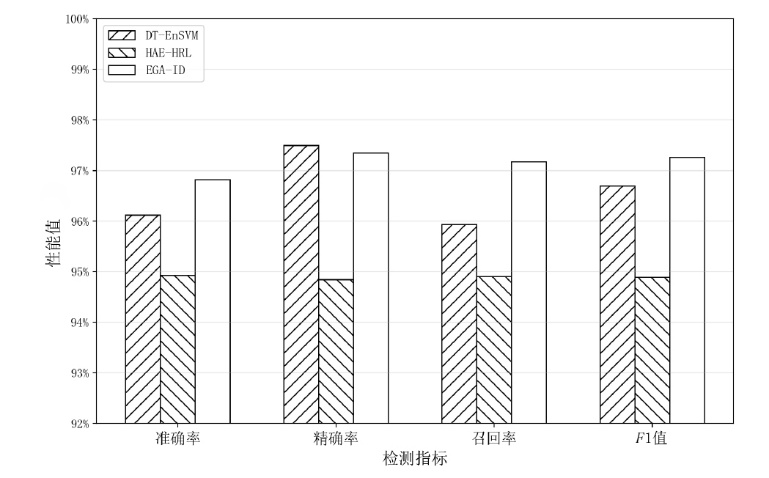
| UNSW-NB15 | CNN | 91.55% | 92.10% | 91.05% | 91.57% |
| LSTM | 90.85% | 91.30% | 90.45% | 90.87% | |
| Random Forest | 94.15% | 94.80% | 93.55% | 94.17% | |
| XGBoost | 95.35% | 96.10% | 94.75% | 95.42% | |
| DT-EnSVM | 96.12% | 97.50% | 95.93% | 96.70% | |
| HAE-HRL | 94.93% | 94.85% | 94.91% | 94.89% | |
| EGA-ID | 96.82% | 97.35% | 97.18% | 97.26% |
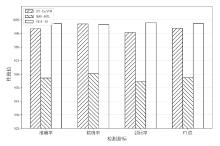
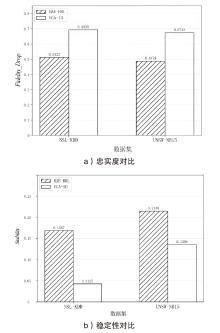
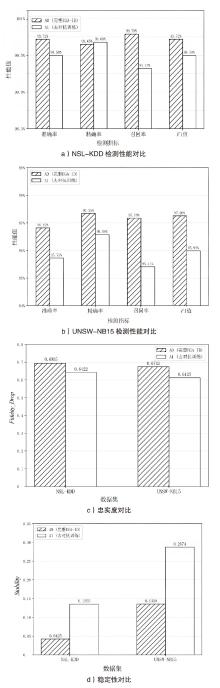
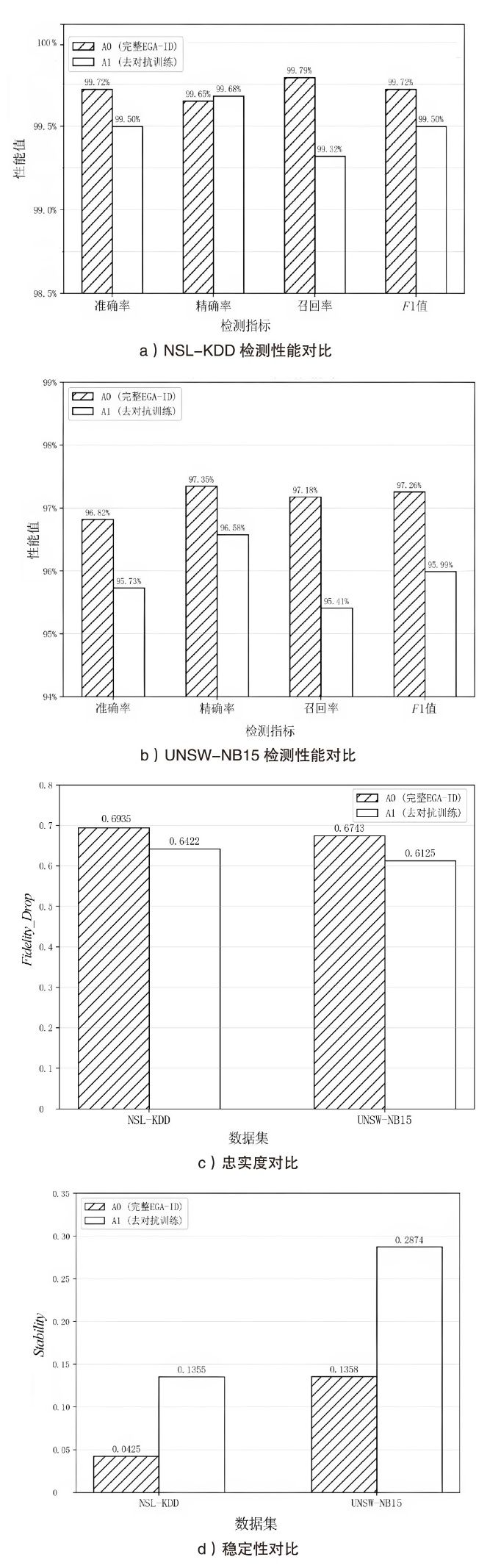
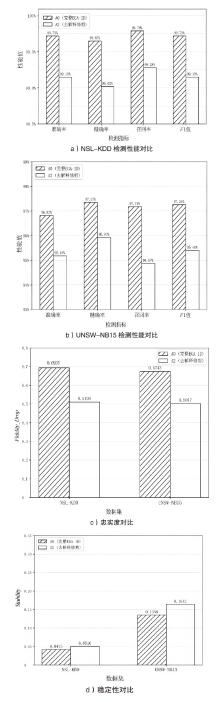
| 数据集 | 编号 | Accuracy | Precision | Recall | F1-Score | Fidelity_Drop | Stability |
|---|---|---|---|---|---|---|---|
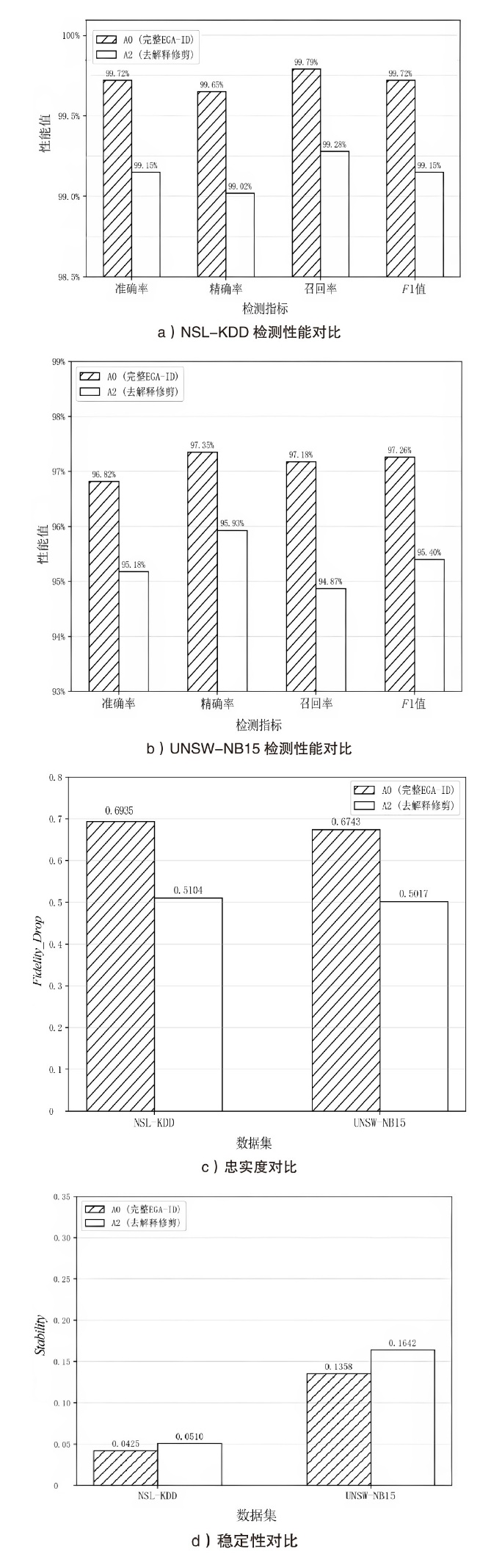
| NSL-KDD | A0 | 99.72% | 99.65% | 99.79% | 99.72% | 0.6935 | 0.0425 |
| A1 | 99.50% | 99.68% | 99.32% | 99.50% | 0.6422 | 0.1355 | |
| A2 | 99.15% | 99.02% | 99.28% | 99.15% | 0.5104 | 0.0510 | |
| UNSW-NB15 | A0 | 96.82% | 97.35% | 97.18% | 97.26% | 0.6743 | 0.1358 |
| A1 | 95.73% | 96.58% | 95.41% | 95.99% | 0.6125 | 0.2874 | |
| A2 | 95.18% | 95.93% | 94.87% | 95.40% | 0.5017 | 0.1642 |
| [1] | ROESCH M. Snort: Lightweight Intrusion Detection for Networks[EB/OL]. (1999-11-09)[2025-12-20]. https://dl.acm.org/doi/10.5555/1039834.1039864. |
| [2] | PATCHA A, PARK J M. An Overview of Anomaly Detection Techniques: Existing Solutions and Latest Technological Trends[J]. Computer Networks, 2007, 51(12): 3448-3470. |
| [3] | BUCZAK A L, GUVEN E. A Survey of Data Mining and Machine Learning Methods for Cyber Security Intrusion Detection[J]. IEEE Communications Surveys & Tutorials, 2016, 18(2): 1153-1176. |
| [4] | LOTFOLLAHI M, JAFARI S M, SHIRALI H Z R, et al. Deep Packet: A Novel Approach for Encrypted Traffic Classification Using Deep Learning[J]. Soft Computing, 2020, 24(3): 1999-2012. |
| [5] | MOHALE V Z, OBAGBUWA I C. A Systematic Review on the Integration of Explainable Artificial Intelligence in Intrusion Detection Systems to Enhancing Transparency and Interpretability in Cybersecurity[EB/OL]. (2025-01-28)[2025-12-20]. https://doi.org/10.3389/frai.2025.1526221. |
| [6] | MALLAMPATI S B, SEETHA H. Enhancing Intrusion Detection with Explainable AI: A Transparent Approach to Network Security[J]. Cybernetics and Information Technologies, 2024, 24(1): 98-117. |
| [7] | IKRAM I, HUMA Z. An Explainable AI Approach to Intrusion Detection Using Interpretable Machine Learning Models[EB/OL]. (2024-05-31)[2025-12-20]. https://evjai.com/index.php/evjai/article/view/20. |
| [8] | SARHAN M. L-XAIDS: A LIME-Based Explainable AI Framework for Intrusion Detection Systems[EB/OL]. (2025-09-03)[2025-12-20]. https://link.springer.com/article/10.1007/s10586-025-05326-9. |
| [9] | GRABOWSKI A, XU Shengjie. Advancing Cybersecurity Practice: Explainable Machine Learning for Network Intrusion Detection[EB/OL]. (2025-12-15)[2025-12-20]. https://digitalcommons.kennesaw.edu/jcerp/vol2025/iss1/25/. |
| [10] | COREA P M, LIU Yongxin, WANG Jian, et al. Explainable AI for Comparative Analysis of Intrusion Detection Models[C]// IEEE. 2024 IEEE International Mediterranean Conference on Communications and Networking (MeditCom). New York: IEEE, 2024: 585-590. |
| [11] | ALMOLHIS N A. Intrusion Detection Using Hybrid Random Forest and Attention Models and Explainable AI Visualization[J]. Journal of Internet Services and Information Security, 2025, 15(1): 371-384. |
| [12] | MARICAR A, ANOOP A, SAMUEL B E, et al. An Improved Explainable Artificial Intelligence for Intrusion Detection System[EB/OL]. [2025-12-20]. https://ijisae.org/index.php/IJISAE/article/view/4642. |
| [13] | AHMED U, ZHENG Jiangbin, ALMOGREN A, et al. Explainable AI-Based Innovative Hybrid Ensemble Model for Intrusion Detection[EB/OL]. (2024-10-21)[2025-12-20]. https://link.springer.com/article/10.1186/s13677-024-00712-x. |
| [14] | NUGRAHA B, JNANASHREE A V, BAUSCHERT T. A Versatile XAI-Based Framework for Efficient and Explainable Intrusion Detection Systems[J]. Annals of Telecommunications, 2025, 80(11/12): 1095-1120. |
| [15] | ARRECHE O, GUNTUR T, ABDALLAH M. XAI-Based Feature Selection for Improved Network Intrusion Detection Systems[EB/OL]. (2024-10-14)[2025-12-20]. https://arxiv.org/abs/2410.10050. |
| [16] | ALABBADI A, BAJABER F. An Intrusion Detection System over the IoT Data Streams Using eXplainable Artificial Intelligence (XAI)[EB/OL]. (2025-01-30)[2025-12-20]. https://www.mdpi.com/1424-8220/25/3/847. |
| [17] | OZAWA N, SUNAHARA S, HAGIHARA S. Evaluation Criteria for Explainable AI in Intrusion Detection to Ensure the Creation of High-Quality Threat Intelligence[C]// ACM. The 2025 14th International Conference on Software and Computer Applications. New York: ACM, 2025: 60-66. |
| [18] | ARRECHE O, ABDALLAH M. A Comparative Analysis of DNN-Based White-Box Explainable AI Methods in Network Security[EB/OL]. (2025-04-24)[2025-12-20]. https://link.springer.com/article/10.1186/s13635-025-00201-x. |
| [19] | AL S, SAGIROGLU S. Explainable Artificial Intelligence Models in Intrusion Detection Systems[EB/OL]. (2025-01-31)[2025-12-20]. https://doi.org/10.1016/j.engappai.2025.110145. |
| [20] | XUE Yankun, KANG Chunying, YU Hongchen. HAE-HRL: A Network Intrusion Detection System Utilizing a Novel Autoencoder and a Hybrid Enhanced LSTM-CNN-Based Residual Network[EB/OL]. (2025-01-16)[2025-12-20]. https://doi.org/10.1016/j.cose.2025.104328. |
| [21] | GU Jie, WANG Lihong, WANG Huiwen, et al. A Novel Approach to Intrusion Detection Using SVM Ensemble with Feature Augmentation[J]. Computers & Security, 2019, 86: 53-62. |
| [1] | SUN Yu, ZHANG Xuanrui, LIU Xinyu. Advances in Advanced Persistent Threat Detection and Provenance Research [J]. Netinfo Security, 2026, 26(6): 833-853. |
| [2] | ZHANG Hao, YE Junwei. Deep Active Learning Based Federated Semi-Supervised Intrusion Detection System [J]. Netinfo Security, 2026, 26(6): 944-957. |
| [3] | CHEN Chao, WANG Nuoxuan, ZHOU Shengli. Anomaly Detection Method for Bitcoin Transactions Based on ADASYN, Lasso Regression, and Ensemble Learning [J]. Netinfo Security, 2026, 26(3): 452-461. |
| [4] | WANG Xinmeng, CHEN Junbao, YANG Yitao, LI Wenjin, GU Dujuan. Bayesian Optimized DAE-MLP Malicious Traffic Identification Model [J]. Netinfo Security, 2025, 25(9): 1465-1472. |
| [5] | CAO Yue, FANG Boying, WEI Gaoda, LI Jinyu, YANG Yang, PENG Tao. Compatibility Evaluation and Optimization of CAN Bus Intrusion Detection Systems in In-Vehicle Ethernet Environment [J]. Netinfo Security, 2025, 25(8): 1175-1195. |
| [6] | JIN Zhigang, LI Zimeng, CHEN Xuyang, LIU Zepei. Review of Network Intrusion Detection System for Unbalanced Data [J]. Netinfo Security, 2025, 25(8): 1240-1253. |
| [7] | SUN Nan, QIN Zhongyuan, HU Aiqun, LI Tao. Immune-Based Intrusion Detection Methods for Programmable Data Plane [J]. Netinfo Security, 2025, 25(8): 1263-1275. |
| [8] | XUN Yijie, CUI Jiarong, MAO Bomin, QIN Junman. Intrusion Detection System for the Controller Area Network Bus of Intelligent Vehicles Based on Federated Learning [J]. Netinfo Security, 2025, 25(6): 872-888. |
| [9] | JIN Zengwang, JIANG Lingyang, DING Junyi, ZHANG Huixiang, ZHAO Bo, FANG Pengfei. A Review of Research on Industrial Control System Security [J]. Netinfo Security, 2025, 25(3): 341-363. |
| [10] | LIU Chenfei, WAN Liang. CAN Bus Intrusion Detection Method Based on Spatio-Temporal Graph Neural Networks [J]. Netinfo Security, 2025, 25(3): 478-493. |
| [11] | LIU Lianhai, LI Huiye, MAO Donghui. CBAM-CNN Network-Based Intrusion Detection Method Using Image Convex Hull Features [J]. Netinfo Security, 2024, 24(9): 1422-1431. |
| [12] | ZHAO Wei, REN Xiaoning, XUE Yinxing. Membership Inference Attacks Method Based on Ensemble Learning [J]. Netinfo Security, 2024, 24(8): 1252-1264. |
| [13] | XIANG Hui, XUE Yunhao, HAO Lingxin. Large Language Model-Generated Text Detection Based on Linguistic Feature Ensemble Learning [J]. Netinfo Security, 2024, 24(7): 1098-1109. |
| [14] | ZHANG Hao, XIE Dazhi, HU Yunsheng, YE Junwei. A Review of Network Anomaly Detection Based on Semi-Supervised Learning [J]. Netinfo Security, 2024, 24(4): 491-508. |
| [15] | TU Xiaohan, ZHANG Chuanhao, LIU Mengran. Design and Implementation of Malicious Traffic Detection Model [J]. Netinfo Security, 2024, 24(4): 520-533. |
| Viewed | ||||||
|
Full text |
|
|||||
|
Abstract |
|
|||||