Netinfo Security ›› 2026, Vol. 26 ›› Issue (6): 833-853.doi: 10.3969/j.issn.1671-1122.2026.06.001
Previous Articles Next Articles
Advances in Advanced Persistent Threat Detection and Provenance Research
SUN Yu1,2( ), ZHANG Xuanrui1,2, LIU Xinyu1,2
- 1
School of Cyber Science and Technology ,Beihang University Beijing 100191, China
2State Key Laboratory of Integrated Services Networks Xi’an 710071, China
-
Received:2026-03-03Online:2026-06-10Published:2026-07-27 -
Contact:SUN Yu E-mail:sunyv@buaa.edu.cn

CLC Number:
Cite this article
SUN Yu, ZHANG Xuanrui, LIU Xinyu. Advances in Advanced Persistent Threat Detection and Provenance Research[J]. Netinfo Security, 2026, 26(6): 833-853.
share this article
Add to citation manager EndNote|Ris|BibTeX
URL: http://netinfo-security.org/EN/10.3969/j.issn.1671-1122.2026.06.001
| 维度 | 传统攻击 | APT攻击 |
|---|---|---|
| 攻击者 | 个体或小组织网络犯罪分子 | 全球性、有组织、有纪律的黑客组织、敌对势力 |
| 攻击目标 | 随机性选择攻击,通常以个体为主,以达到获取金钱、盗窃身份、欺诈等目的 | 特定攻击目标,通常针对国家 安全信息、重要技术设施、重要行业商业机密等 |
| 攻击手段 | 攻击手段单一,常基于已有的恶意软件展开攻击 | 攻击手段复杂隐蔽、形式多样,结合特制工具、社会工程学等 展开攻击 |
| 攻击时间 | 攻击时间较短,以一次性、 大范围攻击为主 | 攻击时间较长、长期潜伏、多次渗透、低频回传 |
| 攻击影响 | 通常造成短期的系统中断或数据泄露,对个人用户和企业的运营产生一定的干扰和损失 | 可对关键设施造成长期的破坏,在国际政治和军事冲突中发挥重要 作用,甚至影响全球的安全形势 |
| 追溯难度 | 攻击特性强,容易在短时间内被检测和捕获 | 攻击特征弱,隐蔽性强,缺少 样本数据,很难被检测和捕获 |


| 数据集 | 年份 | 主机操作系统 | 数据格式 | 大小 |
|---|---|---|---|---|
| LANL[ | 2015 | Windows | .txt | 160 GB |
| Streamspot[ | 2016 | Linux | .tsv | 2.8 GB |
| Unicorn SC[ | 2020 | Linux | .txt | 147 GB |
| DARPA TC E3[ | 2018 | Windows, Linux, FreeBSD, Android | CDM v18 | 116 GB |
| DARPA TC E5[ | 2019 | Windows, Linux, FreeBSD, Android | CDM v20 | 340 GB |
| DARPA OpTC[ | 2020 | Windows 10 | eCar | 1TB |
| ATLAS[ | 2021 | Windows | .txt | 6.5 GB |
| ATLASv2[ | 2023 | Windows | .txt | 154 GB |
| Nodlink SD[ | 2024 | Windows, Linux | .json | 15 GB |
| Kellect4APT[ | 2024 | Windows | .csv | 18.5 GB |
| Linux-APT[ | 2024 | Linux | .csv | 205 MB |
| 数据集 | 真实世界模拟程度 | |||||
|---|---|---|---|---|---|---|
| 良性数据来源 | 攻击面 | 主机数 /个 | 总事件 /件 | 恶意事件 /件 | 时间 跨度 | |
| LANL[ | 真实 | DNS | 17684 | 10亿 | 0.3亿 | 56天 |
| Streamspot[ | 模拟 | Firefox | 1 | 0.6亿 | 0.45亿 | 1天 |
| Unicorn SC[ | 模拟 | CI服务器 | 1 | 2.8亿 | 480万 | 3天 |
| DARPA TC E3[ | 模拟 | Firefox SMB Nginx | 7 | 20亿 | 0.5亿 | 10天 |
| DARPA TC E5[ | 模拟 | Firefox SMB Nginx | 18 | 120亿 | 2.5亿 | 9天 |
| DARPA OpTC[ | 模拟 | Powershell | 500 | 170亿 | 3亿 | 7天 |
| ATLAS[ | 模拟 | Flash Word | 2 | 249万 | 17万 | 1天 |
| ATLASv2[ | 模拟 | Flash Word | 2 | 27637 | 18146 | 5天 |
| Nodlink SD[ | 模拟 | Apache Struts2 MSSQL | 300 | 4116 | 190 | 5天 |
| Kellect4APT[ | 模拟 | Firefox SMB Nginx Flash Word | 1 | 5100万 | 49万 | 1天 |
| Linux-APT[ | 模拟 | Flash Word | 2 | 10万 | 2.5万 | 6周 |
| 数据集 | APT攻击生命周期覆盖度 | 标注粒度与质量 | 文档 完整性 | — | — | — |
| LANL[ | 完整 | 实体 | × | — | — | — |
| Streamspot[ | 部分 | 图 | × | — | — | — |
| Unicorn SC[ | 部分 | 图 | × | — | — | — |
| DARPA TC E3[ | 部分 | 实体 | × | — | — | — |
| DARPA TC E5[ | 部分 | 实体 | × | — | — | — |
| DARPA OpTC[ | 部分 | 实体 | × | — | — | — |
| ATLAS[ | 完整 | 实体 | × | — | — | — |
| ATLASv2[ | 完整 | 实体 | × | — | — | — |
| Nodlink SD[ | 完整 | 实体 | × | — | — | — |
| Kellect4APT[ | 完整 | TTP | × | — | — | — |
| Linux-APT[ | 完整 | 实体 | × | — | — | — |
| 数据集 | 覆盖技术数 | 复杂度 | 标注字段 | 标注方法 |
|---|---|---|---|---|
| LANL[ | 中等 | 高 | 登录事件、进程ID、网络流 | 红队演练日志映射 |
| Streamspot[ | 简单 | 低 | 仅标记恶意/良性图结构 | 脚本执行自动生成 |
| Unicorn SC[ | 中等 | 中 | CamFlow审计日志 | 基于攻击阶段人工批次划分 |
| DARPA TC E3[ | 中等 | 中 | PID、文件路径、Socket、系统调用 | 红队日志和专家 手工映射 |
| DARPA TC E5[ | 中等 | 中 | 完整CDM字段(进程、文件、网络等) | 专家根据攻击方案手工标记 |
| DARPA OpTC[ | 完整 | 高 | eCar格式(进程、文件、注册表、网络等) | 基于红队操作日志的自动映射 |
| ATLAS[ | 完整 | 中 | 核心受损实体(进程命令行、文件路径) | 专家人工选择性 标注 |
| ATLASv2[ | 完整 | 高 | 多源日志(Sysmon 树、Carbon Black 审计) | 真实操作过程嵌入人工标记 |
| Nodlink SD[ | 中等 | 中 | 事件语义(Web Socket连接、文件写入) | 基于脚本触发时间人工校验 |
| Kellect4APT[ | 完整 | 中 | TTP ID、应用调用栈、内核级事件 | 基于原子红队工具半自动标注 |
| Linux-APT[ | 完整 | 低 | 告警信息(源IP、文件、规则描述) | 基于安全预警规则后验标记 |
| 检测方法 | 系统 | 检测新型 攻击 | 假阳率 | 及时性 | 攻击还原 | 可解释性 | 告警粒度 |
|---|---|---|---|---|---|---|---|
| 图匹配 方法 | Provg-Searcher[ | ○ | ◑ | ○ | × | ○ | 图 |
| MEGR-APT[ | ○ | ◑ | ○ | × | ○ | 图 | |
| 基于规则 匹配的 方法 | APTSHIELD[ | ○ | ◑ | ● | √ | ● | 节点 |
| CAPTAIN[ | ○ | ◑ | ◑ | × | ◑ | 节点 | |
| CAPTAIN+[ | ○ | ◑ | ● | × | ◑ | 节点 | |
| 基于重建 的图学习 方法 | ProGrapher[ | ● | ◑ | ● | × | ○ | 节点 |
| ThreaTrace[ | ● | ◑ | ● | × | ○ | 节点 | |
| FLASH[ | ● | ◑ | ● | √ | ◑ | 节点 | |
| MAGIC[ | ● | ○ | ◑ | × | ○ | 节点 | |
| APT-SSC[ | ● | ○ | ● | × | ○ | 节点 | |
| LT-ProveGD[ | ● | ○ | ● | × | ○ | 节点 | |
| KAIROS[ | ● | ◑ | ● | √ | ◑ | 图 | |
| JBEIL[ | ● | ◑ | ● | × | ○ | 节点 | |
| Nodlink[ | ● | ○ | ● | √ | ◑ | 节点 | |
| R-CAID[ | ● | ◑ | ● | × | ○ | 节点 | |
| ShadeWatcher[ | ● | ◑ | ◑ | × | ◑ | 边 | |
| VELOX[ | ● | ○ | ● | × | ◑ | 边 | |
| ORTHRUS[ | ● | ○ | ● | √ | ◑ | 边 | |
| 基于分类 的图学习 方法 | Prov-gem[ | ● | ◑ | ● | × | ○ | 节点 |
| ATLAS[ | ◑ | ○ | ◑ | × | ◑ | 路径 | |
| TREC[ | ● | ○ | ● | √ | ● | 攻击手段 | |
| APT-KGL[ | ◑ | ◑ | ◑ | × | ○ | 节点 | |
| OCR-APT[ | ● | ○ | ● | √ | ◑ | 节点 | |
| STGAN[ | ◑ | ○ | ● | √ | ○ | 节点 | |
| Slot[ | ◑ | ○ | ● | √ | ◑ | 节点 | |
| 基于LLM的方法 | APT-LLM[ | ● | ○ | ◑ | × | ○ | 节点 |
| OMNISEC[ | ◑ | ○ | ◑ | × | ◑ | 节点 | |
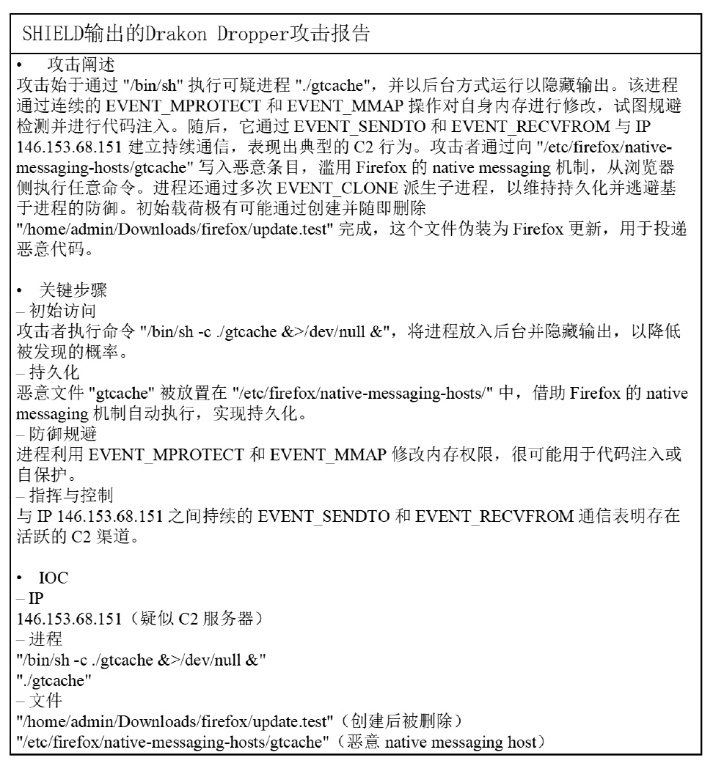
| SHIELD[ | ◑ | ○ | ◑ | √ | ● | 节点 | |
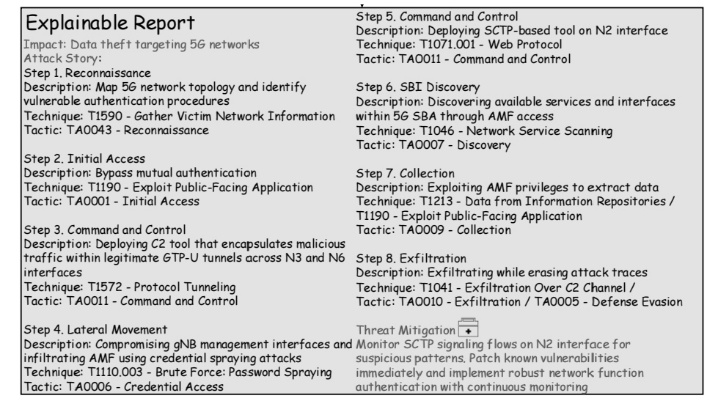
| SAGE[ | ● | ○ | ● | √ | ● | 节点 |
| 溯源方法 | 系统 | 假阳率 | 假阴率 | 及时性 | 可解释性 | 溯源输入 | 溯源输出 |
|---|---|---|---|---|---|---|---|
| 因果分析 | ATLAS[ | ◑ | ◑ | ◑ | ◑ | 路径 | 攻击故事 |
| Steiner树 | Nodlink[ | ● | ◑ | ● | ◑ | 节点 | 告警溯源图 |
| 标签传播 | SLOT[ | ◑ | ◑ | ● | ◑ | 节点 | 攻击链 |
| 因果分析 | FLASH[ | ● | ◑ | ● | ◑ | 节点 | 攻击演化图 |
| 因果分析 | APT-SSC[ | ◑ | ◑ | ● | ◑ | 节点 | 语义增强溯源路径 |
| 因果分析 | LT-ProveGD[ | ○ | ◑ | ● | ◑ | 节点 | 长程关联溯源子图 |
| 社区发现 | KAIROS[ | ◑ | ◑ | ● | ◑ | 图 | 候选概要图 |
| 因果分析 | STGAN[ | ○ | ◑ | ● | ◑ | 节点 | 攻击场景图 |
| 因果分析 | ORTHRUS[ | ◑ | ◑ | ● | ◑ | 节点 | 攻击概要图 |
| 基于LLM | OCR-APT[ | ◑ | ◑ | ◑ | ● | 节点 | 攻击报告 |
| SHIELD[ | ◑ | ◑ | ◑ | ● | 节点 | 攻击报告 | |
| PROVSEEK[ | ◑ | ◑ | ◑ | ● | 日志 | 攻击报告 | |
| SAGE[ | ◑ | ○ | ◑ | ● | 节点/ 日志 | 攻击报告 |


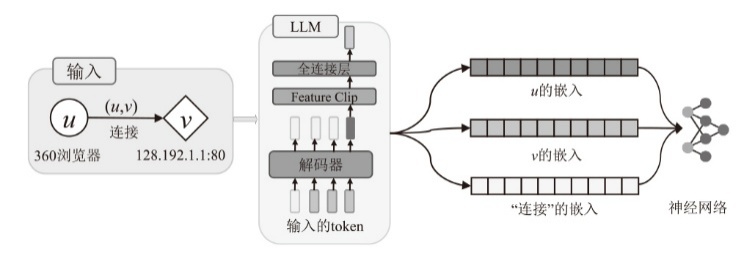
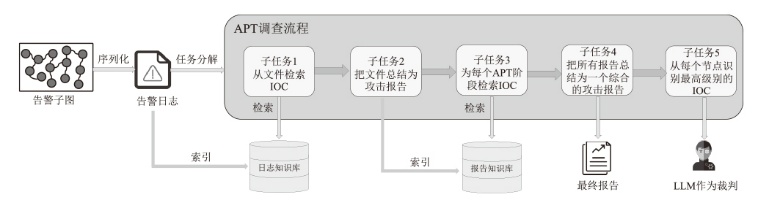
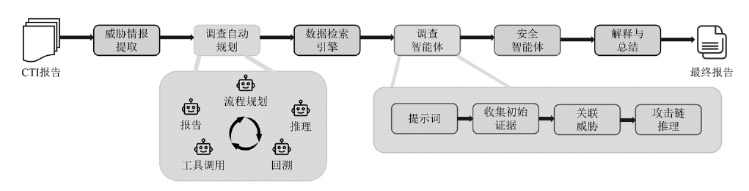
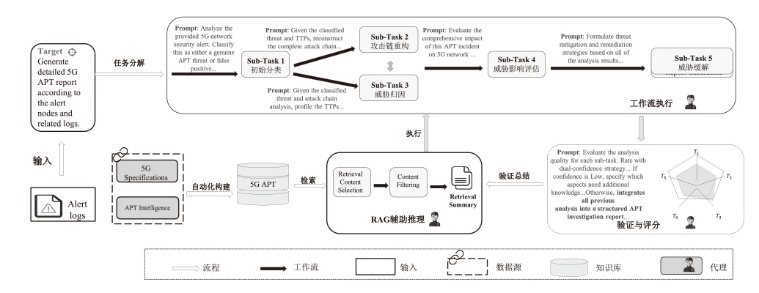
| 对比维度 | 初始嵌入 | RAG +思维链 | 多智能体协同 |
|---|---|---|---|
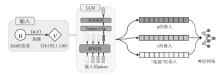
| 核心机制 | 将日志及图特征编码为向量 | 动态检索TTP 并逻辑推理 | 多智能体分工与工具调用 |
| 准确性 | 中 | 高 | 极高 |
| 推理效率 | 高 | 中 | 低 |
| 可解释性 | 低 | 高 | 极高 |
| 部署复杂度 | 异常节点筛选 | 中 | 高 |
| 适用场景 | 高频异常 已知恶意行为 | 低频APT 行为关联 | 5G垂直行业协议渗透 |
| [1] | TANKARD C. Advanced Persistent Threats and how to Monitor and Deter Them[J]. Network Security, 2011, 2011(8): 16-19. |
| [2] | 360 Digital Security Group. Global APT Threat Research Report[EB/OL]. [2026-02-14]. https://pub1-bjyt.s3.360.cn/bcms/2025%E5%B9%B4%E5%BA%A6%E5%85%A8%E7%90%83APT%E5%A8%81%E8%83%81%E7%A0%94%E7%A9%B6%E6%8A%A5%E5%91%8A.pdf. |
| 360 数字安全集团. 2025年度全球APT威胁研究报告[EB/OL]. [2026-02-14]. https://pub1-bjyt.s3.360.cn/bcms/2025%E5%B9%B4%E5%BA%A6%E5%85%A8%E7%90%83APT%E5%A8%81%E8%83%81%E7%A0%94%E7%A9%B6%E6%8A%A5%E5%91%8A.pdf. | |
| [3] | LIU Fucheng, WEN Yu, ZHANG Dongxue, et al. Log2vec: A Heterogeneous Graph Embedding Based Approach for Detecting Cyber Threats within Enterprise[C]//ACM. The 2019 ACM SIGSAC Conference on Computer and Communications Security. New York: ACM, 2019: 1777-1794. |
| [4] | INAM M A, CHEN Yinfang, GOYAL A, et al. SoK: History Is a Vast Early Warning System: Auditing the Provenance of System Intrusions[C]//IEEE. 2023 IEEE Symposium on Security and Privacy (SP). New York: IEEE, 2023: 2620-2638. |
| [5] | KENT A D. Comprehensive, Multi-Source Cyber-Security Events[EB/OL]. [2026-02-14]. https://csr.lanl.gov/data/cyber1/. |
| [6] | MANZOOR E, MILAJERDI S M, AKOGLU L. Fast Memory-Efficient Anomaly Detection in Streaming Heterogeneous Graphs[C]//ACM. The 22nd ACM SIGKDD International Conference on Knowledge Discovery and Data Mining. New York: ACM, 2016: 1035-1044. |
| [7] | HAN Xueyuan, PASQUIER T, BATES A, et al. UNICORN: Runtime Provenance-Based Detector for Advanced Persistent Threats[EB/OL]. (2020-01-14)[2026-02-14]. https://arxiv.org/abs/2001.01525. |
| [8] | GitHub. Transparent Computing Engagement 3 Data Release[EB/OL]. [2026-02-14]. https://github.com/darpa-i2o/Transparent-Computing/blob/master/README-E3.md. |
| [9] | GitHub. Operationally Transparent Cyber (OpTC) Data Release[EB/OL]. [2026-02-14]. https://github.com/FiveDirections/OpTC-data. |
| [10] | ALSAHEEL A, NAN Yuhong, MA Shiqing. ATLAS: A Sequence-Based Learning Approach for Attack Investigation[EB/OL]. (2025-07-07)[2026-02-14]. https://www.usenix.org/conference/atc25. |
| [11] | RIDDLE A, WESTFALL K, BATES A. ATLASv2: ATLAS Attack Engagements, Version 2[EB/OL]. (2023-10-03)[2026-02-14]. https://arxiv.org/abs/2401.01341. |
| [12] | LI Shaofei, DONG Feng, XIAO Xusheng, et al. NODLINK: An Online System for Fine-Grained APT Attack Detection and Investigation[EB/OL]. (2023-11-09)[2026-02-14]. https://arxiv.org/abs/2311.02331. |
| [13] | LYU Mingqi, GAO Hongzhe, QIU Xuebo, et al. TREC: APT Tactic/ Technique Recognition via Few-Shot Provenance Subgraph Learning[C]//ACM. The 2024 on ACM SIGSAC Conference on Computer and Communications Security. New York: ACM, 2024: 139-152. |
| [14] | MILAJERDI S M, GJOMEMO R, ESHETE B, et al. HOLMES: Real-Time APT Detection through Correlation of Suspicious Information Flows[C]//IEEE. 2019 IEEE Symposium on Security and Privacy (SP). New York: IEEE, 2019: 1137-1152. |
| [15] | XIONG Chunlin, ZHU Tiantian, DONG Weihao, et al. Conan: A Practical Real-Time APT Detection System with High Accuracy and Efficiency[J]. IEEE Transactions on Dependable and Secure Computing, 2022, 19(1): 551-565. |
| [16] | JIA Zian, XIONG Yun, NAN Yuhong. MAGIC: Detecting Advanced Persistent Threats via Masked Graph Representation Learning[EB/OL]. [2026-02-14]. https://www.usenix.org/system/files/usenixsecurity24-jia-zian.pdf. |
| [17] | CHENG Zijun, LYU Qiujian, LIANG Jinyuan, et al. Kairos: Practical Intrusion Detection and Investigation Using Whole-System Provenance[C]//IEEE. 2024 IEEE Symposium on Security and Privacy (SP). New York: IEEE, 2024: 3533-3551. |
| [18] | ZENGY J, WANG Xiang, LIU Jiahao, et al. SHADEWATCHER: Recommendation-Guided Cyber Threat Analysis Using System Audit Records[C]//IEEE. 2022 IEEE Symposium on Security and Privacy (SP). New York: IEEE, 2022: 489-506. |
| [19] | XU Zhiqiang, FANG Pengcheng, LIU Changlin, et al. DEPCOMM: Graph Summarization on System Audit Logs for Attack Investigation[C]// IEEE. 2022 IEEE Symposium on Security and Privacy (SP). New York: IEEE, 2022: 540-557. |
| [20] | CHENG Wenrui, ZHU Tiantian, XIONG Chunlin, et al. SoK: Knowledge Is All You Need: Accelerating Last Mile Delivery for Automated Provenance-based Intrusion Detection with LLMs[EB/OL]. (2025-07-22)[2026-02-14]. https://arxiv.org/abs/2503.03108v2. |
| [21] | ALY A, MANSOUR E, YOUSSEF A. OCR-APT: Reconstructing APT Stories from Audit Logs Using Subgraph Anomaly Detection and LLMs[EB/OL]. (2025-10-20)[2026-02-14]. https://arxiv.org/abs/2510.15188. |
| [22] | BENABDERRAHMANE S, VALTCHEV P, CHENEY J, et al. APT-LLM: Embedding-Based Anomaly Detection of Cyber Advanced Persistent Threats Using Large Language Models[EB/OL]. (2025-02-13)[2026-02-14]. https://arxiv.org/abs/2502.09385. |
| [23] | GANDHI P A, WUDALI P N, AMARU Y, et al. Shield: Apt Detection and Intelligent Explanation Using LLM[EB/OL]. (2025-02-04)[2026-02-14]. https://arxiv.org/abs/2502.02342. |
| [24] | MUKHERJEE K, KANTARCIOGLU M. LLM-Driven Provenance Forensics for Threat Investigation and Detection[EB/OL]. (2025-11-09)[2026-02-14]. https://arxiv.org/abs/2508.21323. |
| [25] | Liu Xinyu, Sun Yu, Xiong Gaojian, et al. SAGE: Self-Reflective End-to-End Framework for Automated APT Investigation in 5G Networks[C]// IEEE. IEEE INFOCOM 2026-IEEE Conference on Computer Communications. New York: IEEE, 2026: 1-10. |
| [26] | ZIPPERLE M, GOTTWALT F, CHANG E, et al. Provenance-Based Intrusion Detection Systems: A Survey[J]. ACM Computing Surveys, 2023, 55(7): 1-36. |
| [27] | ZHANG Bo, GAO Yansong, KUANG Boyu, et al. A Survey on Advanced Persistent Threat Detection: A Unified Framework, Challenges, and Countermeasures[J]. ACM Computing Surveys, 2025, 57(3): 1-36. |
| [28] | WANG Zhiwei, HE Xijie, YI Xin, et al. Survey of Attack and Detection Based on the Full Life Cycle of APT[J]. Journal of Communications, 2024, 45(9): 206-228. |
| 王郅伟, 何睎杰, 易鑫, 等. 基于APT活动全生命周期的攻击与检测综述[J]. 通信学报, 2024, 45(9): 206-228. | |
| [29] | YANG Xiuzhang, PENG Guojun, LIU Side, et al. Survey on Attribution and Inference Research for APT Attacks[J]. Journal of Software, 2024, 36(1): 203-252. |
| 杨秀璋, 彭国军, 刘思德. 面向APT攻击的溯源和推理研究综述[J]. 软件学报, 2024, 36(1): 203-252. | |
| [30] | QIU Jing, CHEN Rongrong, ZHU Haojin, et al. A Survey of Network Attack Investigation Based on Provenance Graph[J]. Acta Electronica Sinica, 2024, 52(7): 2529-2556. |
| 仇晶, 陈荣融, 朱浩瑾, 等. 基于溯源图的网络攻击调查研究综述[J]. 电子学报, 2024, 52(7): 2529-2556. | |
| [31] | HUTCHINS E M, CLOPPERT M J, AMIN M R. Intelligence-Driven Computer Network Defense Informed by Analysis of Adversary Campaigns and Intrusion Kill Chains[EB/OL]. [2026-02-14]. https://www.lockheedmartin.com/content/dam/lockheed-martin/rms/documents/cyber/LM-White-Paper-Intel-Driven-Defense.pdf. |
| [32] | STROM B E, APPLEBAUM A, MILLER D P, et al. Mitre ATT&CK: Design and Philosophy[EB/OL]. [2026-02-14]. https://www.mitre.org/sites/default/files/2021-11/prs-19-01075-28-mitre-attack-design-and-philosophy.pdf. |
| [33] | CALTAGIRONE S, PENDERGAST A, BETZ C. The Diamond Model of Intrusion Analysis[EB/OL]. [2026-02-14]. https://www.activeresponse.org/wp-content/uploads/2013/07/diamond.pdf. |
| [34] | SHOSTACK A. Threat Modeling: Designing for Security[EB/OL]. [2026-02-14]. https://www.usenix.org/system/files/login/articles/14_books.pdf. |
| [35] | ALBERTS C, DOROFEE A, STEVENS J, et al. Introduction to the OCTAVE Approach[EB/OL]. [2026-02-14]. https://fitxers.oriolrius.cat/1296/octave.pdf. |
| [36] | ANDREW J, ERIC I, ARNOTH D R, et al. High-Level Overview[EB/OL]. [2026-02-14]. https://fight.mitre.org/FiGHT_High-Level_Overview_PRS-23-2698.pdf. |
| [37] | KING S T, CHEN P M. Backtracking Intrusions[C]// ACM. The Nineteenth ACM Symposium on Operating Systems Principles. New York: ACM, 2003: 223-236. |
| [38] | JIANG Baoxiang, MADHOUN N E, AGHA K A, et al. Orthrus: Achieving High Quality of Attribution in Provenance-based Intrusion Detection Systems[EB/OL]. [2026-02-14]. https://www.usenix.org/conference/usenixsecurity25/presentation/jiang-baoxiang. |
| [39] | WANG Su, WANG Zhiliang, ZHOU Tao, et al. THREATRACE: Detecting and Tracing Host-Based Threats in Node Level through Provenance Graph Learning[J]. IEEE Transactions on Information Forensics and Security, 2022, 17: 3972-3987. |
| [40] | KARIM S S, AFZAL M, IQBAL W, et al. Advanced Persistent Threat (APT) and Intrusion Detection Evaluation Dataset for Linux Systems 2024[EB/OL]. (2024-03-05)[2026-02-14]. https://doi.org/10.1016/j.dib.2024.110290. |
| [41] | LIU Qi, BAO Kaibin, HAGENMEYER V. Aviator: A MITRE Emulation Plan-Derived Living Dataset for Advanced Persistent Threat Detection and Investigation[C]// IEEE. 2024 IEEE International Conference on Big Data (BigData). New York: IEEE, 2024: 5610-5619. |
| [42] | Microsoft. Microsoft System Moniter[EB/OL]. [2026-02-14]. https://learn.microsoft.com/zh-cn/sysinternals/downloads/sysmon. |
| [43] | Broadcom. Carbon Black Cloud[EB/OL]. [2026-02-14]. https://www.vmware.com/products/carbon-. |
| [44] | LENART L. S2-046[EB/OL]. [2026-02-14]. https://cwiki.apache.org/confluence/display/ww/S2-046. |
| [45] | GitHub. Atomic Red Team[EB/OL]. [2026-02-14]. https://github.com/redcanaryco/atomic-red-team. |
| [46] | Wazuh, Inc. The Open Source Security Platform[EB/OL]. [2026-02-14]. https://wazuh.com/. |
| [47] | ALTINISIK E, DENIZ F, SENCAR H T. ProvG-Searcher: A Graph Representation Learning Approach for Efficient Provenance Graph Search[C]// ACM. The 2023 ACM SIGSAC Conference on Computer and Communications Security. New York: ACM, 2023: 2247-2261. |
| [48] | ALY A, IQBAL S, YOUSSEF A, et al. MEGR-APT: A Memory-Efficient APT Hunting System Based on Attack Representation Learning[J]. IEEE Transactions on Information Forensics and Security, 2024, 19: 5257-5271. |
| [49] | ZHU Tiantian, YU Jinkai, XIONG Chunlin, et al. APTSHIELD: A Stable, Efficient and Real-Time APT Detection System for Linux Hosts[J]. IEEE Transactions on Dependable and Secure Computing, 2023, 20(6): 5247-5264. |
| [50] | WANG Lingzhi, SHEN Xiangmin, LI Weijian, et al. Incorporating Gradients to Rules: Towards Lightweight, Adaptive Provenance-Based Intrusion Detection[EB/OL]. (2024-09-20)[2026-02-14]. https://arxiv.org/abs/2404.14720. |
| [51] | LI Zhenyuan, WANG Lingzhi, WANG Zhengkai, et al. Incorporating Gradients to Rules: Toward Online, Adaptive Provenance-Based Intrusion Detection[J]. IEEE Transactions on Dependable and Secure Computing, 2026, 23(1): 782-798. |
| [52] | YANG Fan, XU Jiacen, XIONG Chunlin. PROGRAPHER: An Anomaly Detection System Based on Provenance Graph Embedding[EB/OL]. [2026-02-14]. https://www.usenix.org/conference/usenixsecurity23/presentation/yang-fan. |
| [53] | REHMAN M, AHMADI H, UL H W. Flash: A Comprehensive Approach to Intrusion Detection via Provenance Graph Representation Learning[C]// IEEE. 2024 IEEE Symposium on Security and Privacy (SP). New York: IEEE, 2024: 3552-3570. |
| [54] | XIANG Xutao, YANG Yanqing, QIAN Yurong, et al. Provenance Graph-Based Advanced Persistent Threats Detection via Self-Supervised Contrastive Learning[EB/OL]. [2026-02-14]. https://www.computer.org/csdl/proceedings-article/trustcom/2025/653200a352/2dMlD9RLreU. |
| [55] | XU Fan, ZHAO Qinxin, LIU Xiaoxiao, et al. Advanced Persistent Threat Detection via Mining Long-Term Features in Provenance Graphs[EB/OL]. (2025-01-28)[2026-02-14]. https://link.springer.com/article/10.1007/s11704-024-40610-8. |
| [56] | KHOURY J, KLISURA Đ, ZANDDIZARI H, et al. Jbeil: Temporal Graph-Based Inductive Learning to Infer Lateral Movement in Evolving Enterprise Networks[C]// IEEE. 2024 IEEE Symposium on Security and Privacy (SP). New York: IEEE, 2024: 3644-3660. |
| [57] | GOYAL A, WANG Gang, BATES A. R-CAID: Embedding Root Cause Analysis within Provenance-Based Intrusion Detection[C]// IEEE. 2024 IEEE Symposium on Security and Privacy (SP). New York: IEEE, 2024: 3515-3532. |
| [58] | BILOT T, PARIS-SACLAY U, JIANG B, et al. A Comprehensive Analysis of State-of-the-Art Provenance-Based Intrusion Detection Systems[EB/OL]. [2026-02-14]. https://www.usenix.org/conference/usenixsecurity25/presentation/bilot. |
| [59] | KAPOOR M, MELTON J, RIDENHOUR M, et al. PROV-GEM: Automated Provenance Analysis Framework Using Graph Embeddings[C]// IEEE. 2021 20th IEEE International Conference on Machine Learning and Applications (ICMLA). New York: IEEE, 2021: 1720-1727. |
| [60] | CHEN Tieming, DONG Chengyu, Lyu Mingqi, et al. APT-KGL: An Intelligent APT Detection System Based on Threat Knowledge and Heterogeneous Provenance Graph Learning[EB/OL]. (2022-12-26)[2026-02-14]. https://ieeexplore.ieee.org/document/9999407. |
| [61] | SANG Anyuan, FAN Xuezheng, YANG Li, et al. STGAN: Detecting Host Threats via Fusion of Spatial-Temporal Features in Host Provenance Graphs[C]// ACM. The ACM on Web Conference 2025. New York:ACM. 2025: 1046-1057. |
| [62] | QIAO Wei, FENG Yebo, LI Teng. Slot: Provenance-Driven APT Detection through Graph Reinforcement Learning[EB/OL]. (2025-07-17)[2026-02-14]. https://doi.org/10.48550/arXiv.2410.17910. |
| [63] | STEVE G. The Linux Audit Daemon[EB/OL]. [2026-02-14]. https://linux.die.net/man/8/auditd/. |
| [64] | RAMAKI A A, GHAEMI-BAFGHI A, RASOOLZADEGAN A. CAPTAIN: Community-Based Advanced Persistent Threat Analysis in IT Networks[EB/OL]. (2023-07-29)[2026-02-14]. https://www.sciencedirect.com/science/article/abs/pii/S1874548223000331?via%3Dihub. |
| [65] | NARAYANAN A, CHANDRAMOHAN M, VENKATESAN R, et al. Graph2vec:Learning Distributed Representations of Graphs[EB/OL]. (2017-07-17)[2026-02-14]. https://arxiv.org/abs/1707.05005. |
| [66] | LAI Siwei, XU Liheng, LIU Kang, et al. Recurrent Convolutional Neural Networks for Text Classification[J]. Proceedings of the AAAI Conference on Artificial Intelligence, 2015, 29(1): 2267-2273. |
| [67] | HAMILTON W, YING R, LESKOVEC J. Inductive Representation Learning on Large Graphs[EB/OL]. (2017-12-04)[2026-02-14]. https://dl.acm.org/doi/10.5555/3294771.3294869. |
| [68] | CHURCH K W. Word2Vec[J]. Natural Language Engineering, 2017, 23(1): 155-162. |
| [69] | ZHOU Jie, CUI Ganqu, HU Shengding, et al. Graph Neural Networks: A Review of Methods and Applications[J]. AI Open, 2020, 1: 57-81. |
| [70] | VELIČKOVIĆ P, CUCURULL G, CASANOVA A, et al. Graph Attention Networks[EB/OL]. (2018-02-04)[2026-02-14]. https://arxiv.org/abs/1710.10903. |
| [71] | BENTLEY J L. Multidimensional Binary Search Trees Used for Associative Searching[J]. Communications of the ACM, 1975, 18(9): 509-517. |
| [72] | HWANG F K, RICHARDS D S. Steiner Tree Problems[J]. Networks, 1992, 22(1): 55-89. |
| [73] | SALTON G, BUCKLEY C. Term-Weighting Approaches in Automatic Text Retrieval[J]. Information Processing & Management, 1988, 24(5): 513-523. |
| [74] | CHICCO D. Siamese Neural Networks: An Overview[EB/OL]. (2020-08-18)[2026-02-14]. https://link.springer.com/protocol/10.1007/978-1-1016-0826-5_3. |
| [75] | HU Qingyong, LEE C K, LIU Qi, et al. Hierarchical Graph Transformer with Adaptive Node Sampling[EB/OL]. [2026-02-14]. https://www.proceedings.com/068431-1539.html. |
| [76] | CHENG Zhangyu, ZOU Chengming, DONG Jianwei. Outlier Detection Using Isolation Forest and Local Outlier Factor[C]// ACM. The Conference on Research in Adaptive and Convergent Systems. New York: ACM, 2019: 161-168. |
| [77] | SCHLICHTKRULL M, KIPF T N, BLOEM P, et al. Modeling Relational Data with Graph Convolutional Networks[EB/OL]. (2018-06-03)[2026-02-14]. https://link.springer.com/chapter/10.1007/978-3-319-93417-4_38. |
| [78] | BOUNSIAR A, MADDEN M G. One-Class Support Vector Machines Revisited[C]// IEEE. 2014 International Conference on Information Science & Applications (ICISA). New York: IEEE, 2014: 1-4. |
| [79] | DEVLIN J, CHANG Mingwei, LEE K, et al. BERT: Pre-Training of Deep Bidirectional Transformers for Language Understanding[C]//ACL. The 2019 Conference of the North American Chapter of the Association for Computational Linguistics:Human Language Technologies. Stroudsburg: ACL, 2019: 4171-4186. |
| [80] | LAN Zhenzhong, CHEN Mingda, GOODMAN S, et al. ALBERT: A Lite BERT for Self-Supervised Learning of Language Representations[EB/OL]. (2020-02-09)[2026-02-14]. https://arxiv.org/abs/1909.11942. |
| [81] | LIU Yinhan, OTT M, GOYAL N, et al. RoBERTa: A Robustly Optimized BERT Pretraining Approach[EB/OL]. (2019-07-26)[2026-02-14]. https://arxiv.org/abs/1907.11692. |
| [82] | SANH V, DEBUT L, CHAUMOND J, et al. DistilBERT, a Distilled Version of BERT: Smaller, Faster, Cheaper and Lighter[EB/OL]. (2020-03-01)[2026-02-14]. https://arxiv.org/abs/1910.01108. |
| [83] | WANG Wenhui, WEI F, DONG Li, et al. Minilm: Deep Self-Attention Distillation for Task-Agnostic Compression of Pre-Trained Transformers[EB/OL]. [2026-02-14]. https://proceedings.neurips.cc/paper/2020/file/3f5ee243547dee91fbd053c1c4a845aa-Paper.pdf. |
| [84] | HINTON G E, SALAKHUTDINOV R R. Reducing the Dimensionality of Data with Neural Networks[J]. Science, 2006, 313(5786): 504-507. |
| [85] | KINGMA D P, WELLING M. Auto-Encoding Variational Bayes[EB/OL]. (2022-12-10)[2026-02-14]. https://arxiv.org/abs/1312.6114. |
| [86] | VINCENT P, LAROCHELLE H, BENGIO Y, et al. Extracting and Composing Robust Features with Denoising Autoencoders[C]//ACM. The 25th International Conference on Machine Learning(ICML ’08). New York: ACM, 2008: 1096-1103. |
| [87] | LEWIS P, PEREZ E, PIKTUS A, et al. Retrieval-Augmented Generation for Knowledge-Intensive NLP Tasks[C]// ACM. The 34th International Conference on Neural Information Processing Systems. New York: ACM, 2020: 9459-9474. |
| [88] | HE Kaiming, CHEN Xinlei, XIE Saining, et al. Masked Autoencoders Are Scalable Vision Learners[C]// IEEE. 2022 IEEE/CVF Conference on Computer Vision and Pattern Recognition (CVPR). New York: IEEE, 2022: 15979-15988. |
| [89] | SHARMA S, GOSAIN A, JAIN S. A Review of the Oversampling Techniques in Class Imbalance Problem[EB/OL]. (2021-08-18)[2026-02-14]. https://link.springer.com/chapter/10.1007/978-981-16-2594-7_38. |
| [90] | BAHADIR C D, WANG A Q, DALCA A V, et al. Deep-Learning-Based Optimization of the Under-Sampling Pattern in MRI[J]. IEEE Transactions on Computational Imaging, 2020, 6: 1139-1152. |
| [91] | YU Yong, SI Xiaosheng, HU Changhua, et al. A Review of Recurrent Neural Networks: LSTM Cells and Network Architectures[J]. Neural Computation, 2019, 31(7): 1235-1270. |
| [92] | FORTUNATO S. Community Detection in Graphs[J]. Physics Reports, 2010, 486(3/4/5): 75-174. |
| [1] | MIAO Bo, YUAN Deyu, ZHANG Teng, YANG Yi, HUANG Zan. Chain-of-Thought Poisoning Based Retrieval-Augmented Generation Backdoor Attack [J]. Netinfo Security, 2026, 26(6): 977-998. |
| [2] | CUI Jinhua, DONG Liang, YANG Xin. A Survey of Privacy-Preserving Techniques for Large Language Model Inference [J]. Netinfo Security, 2026, 26(4): 503-520. |
| [3] | LI Yan, YANG Wenzhang, XUE Yinxing. Cross-Language Compiler Fuzzing Based on LLM Translation and Differential Testing [J]. Netinfo Security, 2026, 26(4): 591-604. |
| [4] | HU Mianning, LI Xin, LI Mingfeng, YUAN Deyu. Research on Multi-Strategy Enhanced Chinese Network Threat Intelligence Entity Extraction Based on Large Language Model [J]. Netinfo Security, 2026, 26(4): 615-625. |
| [5] | YUAN Ming, ZOU Qilin, YUAN Wenqi, WANG Qun. A Survey on Prompt Injection Attacks and Defenses in Large Language Models [J]. Netinfo Security, 2026, 26(3): 341-354. |
| [6] | GU Zhaojun, LI Li, SUI He. A Payload Generation Method for SQL Injection Vulnerability Detection Based on Large Language Models [J]. Netinfo Security, 2026, 26(2): 274-290. |
| [7] | TONG Xin, JIAO Qiang, WANG Jingya, YUAN Deyu, JIN Bo. A Survey on the Trustworthiness of Large Language Models in the Public Security Domain: Risks, Countermeasures, and Challenges [J]. Netinfo Security, 2026, 26(1): 24-37. |
| [8] | HU Yucui, GAO Haotian, ZHANG Jie, YU Hang, YANG Bin, FAN Xuejian. Automated Exploitation of Vulnerabilities in Vehicle Network Security [J]. Netinfo Security, 2025, 25(9): 1348-1356. |
| [9] | LIU Hui, ZHU Zhengdao, WANG Songhe, WU Yongcheng, HUANG Linquan. Jailbreak Detection for Large Language Model Based on Deep Semantic Mining [J]. Netinfo Security, 2025, 25(9): 1377-1384. |
| [10] | WANG Lei, CHEN Jiongyi, WANG Jian, FENG Yuan. Intelligent Reverse Analysis Method of Firmware Program Interaction Relationships Based on Taint Analysis and Textual Semantics [J]. Netinfo Security, 2025, 25(9): 1385-1396. |
| [11] | CAO Yue, FANG Boying, WEI Gaoda, LI Jinyu, YANG Yang, PENG Tao. Compatibility Evaluation and Optimization of CAN Bus Intrusion Detection Systems in In-Vehicle Ethernet Environment [J]. Netinfo Security, 2025, 25(8): 1175-1195. |
| [12] | ZHANG Yanyi, RUAN Shuhua, ZHENG Tao. Research on REST API Design Security Testing [J]. Netinfo Security, 2025, 25(8): 1313-1325. |
| [13] | CHEN Ping, LUO Mingyu. Research on Large Model Analysis Methods for Kernel Race Vulnerabilities in Cloud-Edge-Device Scenarios [J]. Netinfo Security, 2025, 25(7): 1007-1020. |
| [14] | FENG Wei, XIAO Wenming, TIAN Zheng, LIANG Zhongjun, JIANG Bin. Research on Semantic Intelligent Recognition Algorithms for Meteorological Data Based on Large Language Models [J]. Netinfo Security, 2025, 25(7): 1163-1171. |
| [15] | XUN Yijie, CUI Jiarong, MAO Bomin, QIN Junman. Intrusion Detection System for the Controller Area Network Bus of Intelligent Vehicles Based on Federated Learning [J]. Netinfo Security, 2025, 25(6): 872-888. |
| Viewed | ||||||
|
Full text |
|
|||||
|
Abstract |
|
|||||