Netinfo Security ›› 2026, Vol. 26 ›› Issue (4): 591-604.doi: 10.3969/j.issn.1671-1122.2026.04.007
Previous Articles Next Articles
Cross-Language Compiler Fuzzing Based on LLM Translation and Differential Testing
LI Yan1, YANG Wenzhang2, XUE Yinxing2( )
)
- 1
School of Software Engineering ,University of Science and Technology of China Hefei 230026, China
2Institute of AI for Industries ,Chinese Academy of Sciences Nanjing 211135, China
-
Received:2025-12-16Online:2026-04-10Published:2026-04-29

CLC Number:
Cite this article
LI Yan, YANG Wenzhang, XUE Yinxing. Cross-Language Compiler Fuzzing Based on LLM Translation and Differential Testing[J]. Netinfo Security, 2026, 26(4): 591-604.
share this article
Add to citation manager EndNote|Ris|BibTeX
URL: http://netinfo-security.org/EN/10.3969/j.issn.1671-1122.2026.04.007
| 差分测试维度 | 差分内容 |
|---|---|
| 跨编译器差分 测试 | 源代码 |
| 翻译代码 | |
| 跨优化等级差分测试 | O0(关闭优化,以最直观方式生成代码) |
| O1(只启用基础优化) | |
| O2(开启更激进的优化,包括循环展开与死代码消除) | |
| O3(面向性能的最高级别优化) | |
| Ofast(包含可能违反语言标准的激进优化) | |
| Os(以减小二进制体积为目标的优化) | |
| Oz(进一步压缩二进制大小) |
| 编程语言 | 编译器 | 基线工具 | 测试版本 | 范式 |
|---|---|---|---|---|
| C | Clang | CSmith[ | 20.1.0 | 命令式 |
| C++ | Clang++ | YarpGen[ | 20.1.0 | 面向对象式、命令式、 泛型编程 |
| Rust | Rustc | RustSmith[ | 1.89.0 | 函数式、命令式、并发式 |
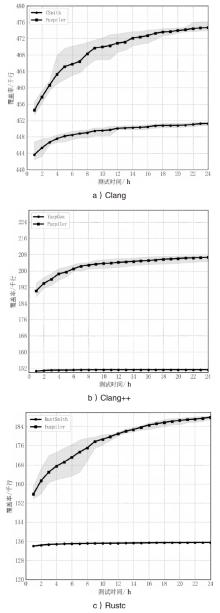
| 编译器 (总代码分支) | 测试工具 | 测试种子数/个 | 分支覆盖/千行 | 分支覆盖 对比 | 成本 /美元 |
|---|---|---|---|---|---|
| Clang (2001432) | CSmith | 1145.0 | 451293.0 | — | — |
| Fuzpiler | 1039.0 | 474699.0 | 23406.0 (+ 5.19%) | 2.08 | |
| Clang++ (1777523) | YarpGen | 2143.2 | 151343.0 | — | — |
| Fuzpiler | 928.8 | 206681.6 | 55338.6(+36.57%) | 2.76 | |
| Rustc (619666) | RustSmith | 6889.4 | 135555.0 | — | — |
| Fuzpiler | 1045.4 | 167966.4 | 32411.4(+23.91%) | 2.32 |
| 源语言 | 目标 语言 | 测试种子数 /个 | 有效种子数 /个 | 有效种子 占比 | 等价种子数 /个 | 等价种子 占比 |
|---|---|---|---|---|---|---|
| C | C++ | 464.0 | 358.8 | 77.33% | 354.2 | 98.72% |
| Rust | 524.2 | 325.4 | 62.08% | 288.2 | 88.57% | |
| C++ | C | 520.6 | 396.2 | 76.10% | 332.0 | 83.80% |
| Rust | 521.2 | 236.0 | 45.28% | 225.6 | 95.59% | |
| Rust | C | 518.4 | 425.4 | 82.06% | 188.6 | 44.33% |
| C++ | 464.8 | 300.4 | 64.63% | 191.0 | 63.58% | |
| 总计 | — | 3013.2 | 2042.2 | 67.78% | 1579.6 | 77.35% |
| 编译器 | 测试 工具 | 测试 种子数 | 有效种子数/个 | 有效种子占比 | 等价种子数/个 | 等价种子 占比 |
|---|---|---|---|---|---|---|
| Clang | Fuzpiler | 1039 | 821.6 | 79.08% | 510.6 | 62.15% |
| w/o OOM | 1104.4 | 814.4 | 73.74% | 467.4 | 57.39% | |
| w/o SEC | 1461.8 | 1073.4 | 73.43% | 544.8 | 50.75% | |
| Clang++ | Fuzpiler | 928.8 | 659.2 | 70.97% | 545.2 | 82.71% |
| w/o OOM | 970.2 | 609.4 | 62.81% | 491.2 | 80.60% | |
| w/o SEC | 1183.4 | 736.2 | 62.21% | 548.2 | 74.46% | |
| Rustc | Fuzpiler | 1045.4 | 561.4 | 53.70% | 543.8 | 96.86% |
| w/o OOM | 1136.0 | 576.8 | 50.77% | 523.8 | 90.81% | |
| w/o SEC | 1452.6 | 723.8 | 49.83% | 539.4 | 74.52% | |
| 编译器 | 测试 工具 | 测试 种子数 | 分支覆盖数/千行 | 分支覆盖对比 | — | — |
| Clang | Fuzpiler | 1039.0 | 474699.0 | — | — | — |
| w/o OOM | 1104.4 | 471431.4 | -3267.6 (-0.69%) | — | — | |
| w/o SEC | 1461.8 | 473025.2 | -1673.8 (-0.35%) | — | — | |
| Clang++ | Fuzpiler | 928.8 | 206681.6 | — | — | — |
| w/o OOM | 970.2 | 199463.0 | -7218.6 (-3.65%) | — | — | |
| w/o SEC | 1183.4 | 203331.0 | -3350.6 (-1.62%) | — | — | |
| Rustc | Fuzpiler | 1045.4 | 167966.4 | — | — | — |
| w/o OOM | 1136.0 | 154930.4 | -13036 (-7.76%) | — | — | |
| w/o SEC | 1452.6 | 159716.0 | -8250.4 (-4.91%) | — | — |
| [1] | RAHMAN A, BOSE D B, BARSHA F L, et al. Defect Categorization in Compilers: A Multi-Vocal Literature Review[J]. ACM Computing Surveys, 2024, 56(4): 1-42. |
| [2] | MANÈS V J M, HAN H, HAN C, et al. The Art, Science, and Engineering of Fuzzing: A Survey[J]. IEEE Transactions on Software Engineering, 2021, 47(11): 2312-2331. |
| [3] | YANG Xuejun, CHEN Yang, EIDE E, et al. Finding and Understanding Bugs in C Compilers[C]// ACM. The 32nd ACM SIGPLAN Conference on Programming Language Design and Implementation. New York: ACM, 2011: 283-294. |
| [4] | LIVINSKII V, BABOKIN D, REGEHR J. Random Testing for C and C++ Compilers with YARPGen[J]. Proceedings of the ACM on Programming Languages, 2020, 4: 1-25. |
| [5] | SHARMA M, YU Pingshi, DONALDSON A F. RustSmith: Random Differential Compiler Testing for Rust[C]// ACM. The 32nd ACM SIGSOFT International Symposium on Software Testing and Analysis. New York: ACM, 2023: 1483-1486. |
| [6] | HOLLER C, HERZIG K, ZELLER A. Fuzzing with Code Fragments[C]// USENIX. 21st USENIX Security Symposium. Berkeley: USENIX, 2012: 445-458. |
| [7] | CHALIASOS S, SOTIROPOULOS T, SPINELLIS D, et al. Finding Typing Compiler Bugs[C]// ACM. The 43rd ACM SIGPLAN International Conference on Programming Language Design and Implementation. New York: ACM, 2022: 183-198. |
| [8] | LE V, AFSHARI M, SU Zhendong. Compiler Validation via Equivalence Modulo Inputs[J]. ACM SIGPLAN Notices, 2014, 49(6): 216-226. |
| [9] | LE V, SUN Chengnian, SU Zhendong. Finding Deep Compiler Bugs via Guided Stochastic Program Mutation[J]. ACM SIGPLAN Notices, 2015, 50(10): 386-399. |
| [10] | LIDBURY C, LASCU A, CHONG N, et al. Many-Core Compiler Fuzzing[J]. ACM SIGPLAN Notices, 2015, 50(6): 65-76. |
| [11] | JIANG Bo, WANG Xiaoyan, CHAN W K, et al. CUDAsmith: A Fuzzer for CUDA Compilers[C]// IEEE. 2020 IEEE 44th Annual Computers, Software, and Applications Conference (COMPSAC). New York: IEEE, 2020: 861-871. |
| [12] | XIAO Dongwei, LIU Zhibo, YUAN Yuanyuan, et al. Metamorphic Testing of Deep Learning Compilers[J]. Proceedings of the ACM on Measurement and Analysis of Computing Systems, 2022, 6(1): 1-28. |
| [13] | CUMMINS C, PETOUMENOS P, MURRAY A, et al. Compiler Fuzzing through Deep Learning[C]// ACM. The 27th ACM SIGSOFT International Symposium on Software Testing and Analysis. New York: ACM, 2018: 95-105. |
| [14] | LEE S, HAN H S, CHA S K, et al. Montage: A Neural Network Language Model-Guided JavaScript Engine Fuzzer[C]// USENIX. 29th USENIX Security Symposium. Berkeley: USENIX, 2020: 2613-2630. |
| [15] | LIU Xiao, LI Xiaoting, PRAJAPATI R, et al. DeepFuzz: Automatic Generation of Syntax Valid C Programs for Fuzz Testing[J]. Proceedings of the AAAI Conference on Artificial Intelligence, 2019, 33(1): 1044-1051. |
| [16] | XU Haoran, WANG Yongjun, FAN Shuhui, et al. DSmith: Compiler Fuzzing through Generative Deep Learning Model with Attention[C]// IEEE. 2020 International Joint Conference on Neural Networks (IJCNN). New York: IEEE, 2020: 1-9. |
| [17] | XIA C S, PALTENGHI M, JIA Letian, et al. Fuzz4All: Universal Fuzzing with Large Language Models[C]// ACM. The IEEE/ACM 46th International Conference on Software Engineering. New York: ACM, 2024: 1-13. |
| [18] | LIU Fang, LIU Yang, SHI Lin, et al. Beyond Functional Correctness: Exploring Hallucinations in LLM-Generated Code[EB/OL].(2024-05-11)[2025-10-25]. https://arxiv.org/abs/2404.00971. |
| [19] | ZHU Xiaogang, ZHOU Wei, HAN Qinglong, et al. When Software Security Meets Large Language Models: A Survey[J]. IEEE/CAA Journal of Automatica Sinica, 2025, 12(2): 317-334. |
| [20] | MIAO Siwei, WANG Juan, ZHANG Chong, et al. Deep Learning in Fuzzing: A Literature Survey[C]// IEEE. 2022 IEEE the 2nd International Conference on Electronic Technology, Communication and Information (ICETCI). New York: IEEE, 2022: 220-223. |
| [21] | ALAGARSAMY S, TANTITHAMTHAVORN C, ALETI A. A3Test:Assertion-Augmented Automated Test Case Generation[EB/OL].(2024-08-30)[2025-10-25]. https://doi.org/10.1016/j.infsof.2024.107565. |
| [22] | DENG Yinlin, XIA C S, YANG Chenyuan, et al. Large Language Models Are Edge-Case Fuzzers: Testing Deep Learning Libraries via FuzzGPT[EB/OL].(2023-04-04)[2025-10-25]. https://arxiv.org/abs/2304.02014. |
| [23] | ZHANG Hongxiang, RONG Yuyang, HE Yifeng, et al. LLAMAFUZZ: Large Language Model Enhanced Greybox Fuzzing[EB/OL].(2025-10-03)[2025-10-25]. https://arxiv.org/abs/2406.07714. |
| [24] | DENG Yinlin, XIA C S, PENG Haoran, et al. Large Language Models Are Zero-Shot Fuzzers: Fuzzing Deep-Learning Libraries via Large Language Models[C]// ACM. The 32nd ACM SIGSOFT International Symposium on Software Testing and Analysis. New York: ACM, 2023: 423-435. |
| [25] | NASHID N, SINTAHA M, MESBAH A. Retrieval-Based Prompt Selection for Code-Related Few-Shot Learning[C]// IEEE. 2023 IEEE/ACM the 45th International Conference on Software Engineering (ICSE). New York: IEEE, 2023: 2450-2462. |
| [26] | VIKRAM V, LEMIEUX C, SUNSHINE J, et al. Can Large Language Models Write Good Property-Based Tests[EB/OL].(2024-07-22)[2025-10-25]. https://arxiv.org/abs/2307.04346. |
| [27] | CHEN Yinghao, HU Zehao, ZHI Chen, et al. ChatUniTest: A Framework for LLM-Based Test Generation[C]// ACM. The 32nd ACM International Conference on the Foundations of Software Engineering. New York: ACM, 2024: 572-576. |
| [28] | MAHBUB P, RAHMAN M M, SHUVO O, et al. Bugsplainer: Leveraging Code Structures to Explain Software Bugs with Neural Machine Translation[C]// IEEE. 2023 IEEE International Conference on Software Maintenance and Evolution (ICSME). New York: IEEE, 2023: 530-535. |
| [29] | YUAN Zhiqiang, LIU Mingwei, DING Shiji, et al. Evaluating and Improving ChatGPT for Unit Test Generation[J]. Proceedings of the ACM on Software Engineering, 2024, 1: 1703-1726. |
| [30] | SHOU Chaofan, LIU Jing, LU Doudou, et al. LLM4Fuzz:Guided Fuzzing of Smart Contracts with Large Language Models[EB/OL].(2024-01-20)[2025-10-25]. https://arxiv.org/abs/2401.11108. |
| [31] | LI Yuekang, XUE Yinxing, CHEN Hongxu, et al. Cerebro: Context-Aware Adaptive Fuzzing for Effective Vulnerability Detection[C]// ACM. The 2019 27th ACM Joint Meeting on European Software Engineering Conference and Symposium on the Foundations of Software Engineering. New York: ACM, 2019: 533-544. |
| [32] | GALLEY M, GAO Jianfeng, HE Pengcheng, et al. Guiding Large Language Models via Directional Stimulus Prompting[J]. Advances in Neural Information Processing Systems, 2023, 36: 62630-62656. |
| Viewed | ||||||
|
Full text |
|
|||||
|
Abstract |
|
|||||