Netinfo Security ›› 2026, Vol. 26 ›› Issue (2): 274-290.doi: 10.3969/j.issn.1671-1122.2026.02.008
Previous Articles Next Articles
A Payload Generation Method for SQL Injection Vulnerability Detection Based on Large Language Models
GU Zhaojun1, LI Li2, SUI He3( )
)
1. Information Security Evaluation Center ,Civil Aviation University of China Tianjin 300300, China 2. College of Safety Science and Engineering ,Civil Aviation University of China Tianjin 300300, China 3. College of Aeronautical Engineering ,Civil Aviation University of China Tianjin 300300, China
-
Received:2025-09-11Online:2026-02-10Published:2026-02-23

CLC Number:
Cite this article
GU Zhaojun, LI Li, SUI He. A Payload Generation Method for SQL Injection Vulnerability Detection Based on Large Language Models[J]. Netinfo Security, 2026, 26(2): 274-290.
share this article
Add to citation manager EndNote|Ris|BibTeX
URL: http://netinfo-security.org/EN/10.3969/j.issn.1671-1122.2026.02.008
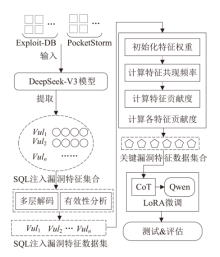
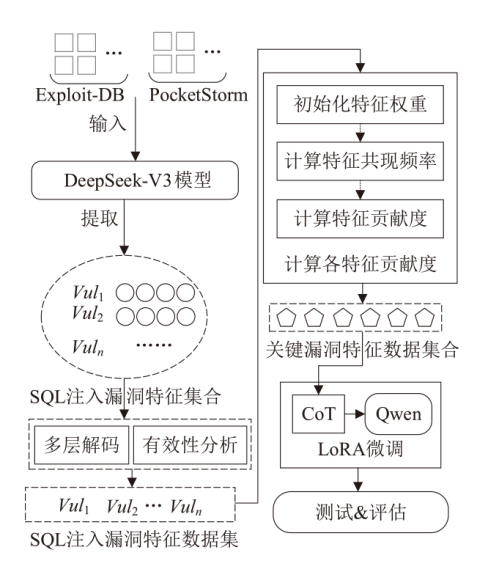
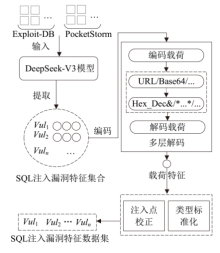
| 提示词内容 | 作用 |
|---|---|
| 全局规则 | 定义数据处理基本准则,确保数据一致性和标准化 |
| 字段要求 | 规定从漏洞文本中提取的关键信息及其格式 |
| 处理流程 | 指导模型从识别漏洞到生成最终输出的具体步骤 |
| 示例输出 | 展示根据上述规则组织和呈现提取出的信息 |
| 定义变量 | 含义 |
|---|---|
| D={d1, d2,…, dN} | SQL注入漏洞样本集合,其中,di表示第i个样本,N表示漏洞样本总数 |
| Ki={ki,1, ki,2,…, ki, M} | 样本di的关键词集合,该样本的关键词总数为M=|Ki| |
| F={f1, f2,…, fS} Fi={fi,1, fi,2,…, fi, S} | F为总体漏洞特征集合,Fi为样本di特征集合,其中,每个特征表示为键值对形式(fi, j,vi, j),fi, j∈Fi,特征 总数为S |
| 样本di中特征fi, j的共现次数 | |
| 样本di中特征fi, j的共现频率 | |
| 特征fj在所有漏洞样本中的总共现频率 | |
| 特征fj的初始权重 |
| 定义变量 | 含义 |
|---|---|
| Riinitial | 第个i样本的初始Reasoning特征,包含关键函数和结构 |
| fi,injection | 第i个样本中的注入点特征,包括参数、初始值和闭合方法 |
| fi,type | 第i个样本的漏洞类型特征 |
| Sprompt | 系统提示模板,用于指导模型 |
| Pi | 第i个样本的检测载荷,即Pi∈di |
| T(·) | 模型的处理函数,将输入转为CoT提示 |
| Ci={ci,1, ci,2,…, ci, k} | 第i个样本中的CoT提示,其中,ci, j表示一个推理步骤 |
| 数据集 | 来源 | 描述 |
|---|---|---|
| 训练数据 | Exploit-Database | 收录大量真实攻击载荷与利用代码,提升模型对实际攻击行为的理解 |
| PacketStorm | 提供丰富的安全技术文档与利用示例,增强数据集的多样性与覆盖范围 | |
| CVE[ | 提供标准化漏洞标识与描述,确保数据的代表性和时效性 | |
| 测试数据 | SQL-Libs[ | 专注于SQL注入漏洞的资源库,提供多种攻击示例及修复方法 |
| DVWA[ | 提供常见Web攻击技术的合法环境,包括基础、中级和高级的SQL注入漏洞场景 | |
| Pikachu[ | 专注于练习Web漏洞的安全测试平台,漏洞类型广泛,包括但不限于SQL注入和XSS等 | |
| bWAPP[ | 支持超过100种不同漏洞场景的练习平台,适用于多种服务器端编程语言,包括SQL注入漏洞 | |
| Newsqliset | 收集CVE、CNVD和Freebuf等报告及个人复现的ORM、NoSQL和GraphQL等注入漏洞案例 |
| 来源 类型 | Exploit-Database/个 | PacketStorm /个 | CVE/个 | 总数/个 |
|---|---|---|---|---|
| Union-based | 1032 | 33 | 54 | 1119 |
| Time Blind | 126 | 147 | 88 | 361 |
| Error-based | 48 | 41 | 42 | 131 |
| Boolean Blind | 240 | 94 | 28 | 362 |
| Stacked Query | 49 | 6 | 7 | 62 |
| Wide Byte | 0 | 0 | 1 | 1 |
| Column Probing | 10 | 2 | 1 | 13 |
| File Write | 11 | 3 | 3 | 17 |
| Bypass | 173 | 51 | 13 | 237 |
| Multi Parameter | 5 | 0 | 0 | 5 |
| ORM | 0 | 2 | 1 | 3 |
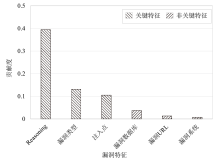
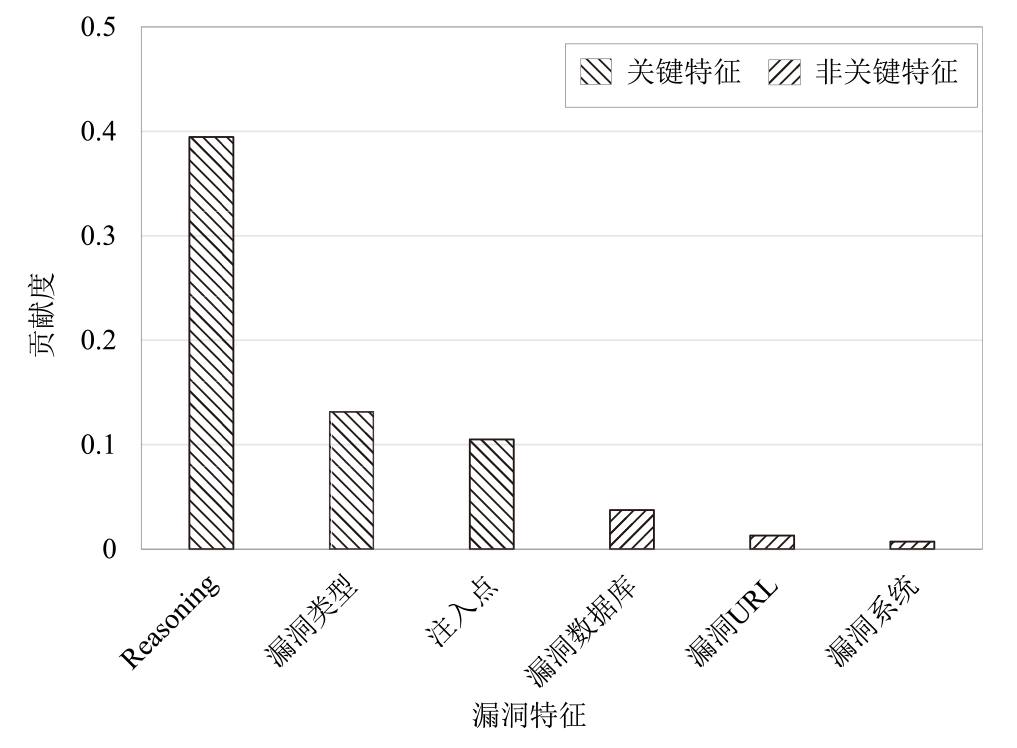
| 漏洞特征 | 初始权重 | 含义 |
|---|---|---|
| 漏洞URL | 0.5 | 一般重要,辅助判断注入点上下文环境(例如,URL中含“/admin/”路径,需考虑权限提升方法) |
| 漏洞系统 | 0.4 | 一般重要,特定系统可能存在过滤规则(CMS框架输入过滤机制) |
| 注入点 | 0.6 | 重要,直接决定Payload构造的注入位置和 闭合方式 |
| 漏洞类型 | 0.8 | 关键,确定载荷类型(盲注需时间延迟函数,报错注入需触发机制) |
| 漏洞数据库 | 0.6 | 重要,决定特定数据库函数/语法的使用 |
| Reasoning | 0.5 | 重要,包含攻击逻辑的关键技术要素,如函数使用、条件判断结构 |
| 来源 类型 | bWAPP /个 | DVWA /个 | Pikachu /个 | SQL-Libs /个 | Newsqliset /个 | 总数 /个 |
|---|---|---|---|---|---|---|
| Union-based | 14 | 7 | 11 | 10 | 0 | 42 |
| Time Blind | 1 | 6 | 0 | 7 | 0 | 14 |
| Error-based | 5 | 7 | 6 | 8 | 0 | 26 |
| Boolean Blind | 1 | 9 | 1 | 4 | 0 | 15 |
| Stacked Query | 0 | 0 | 0 | 5 | 0 | 5 |
| Wide Byte | 0 | 0 | 4 | 3 | 0 | 7 |
| Column Probing | 1 | 2 | 0 | 1 | 0 | 4 |
| File Write | 0 | 0 | 0 | 0 | 0 | 0 |
| Bypass | 2 | 0 | 0 | 2 | 0 | 4 |
| Multi Parameter | 0 | 0 | 0 | 3 | 0 | 3 |
| ORM | 0 | 0 | 0 | 0 | 7 | 7 |
| NoSQL | 0 | 0 | 0 | 0 | 14 | 14 |
| GraphQL | 0 | 0 | 0 | 0 | 9 | 9 |
| 测试数据集 | 模型 | Nsuccess | AC | FPR | FNR |
|---|---|---|---|---|---|
| SQL-Libs、DVWA、Pikachu、bWAPP | Qwen | 91 | 0.7583 | 0.0990 | 0.1727 |
| SqliGPT | 61 | 0.5083 | 0.1644 | 0.4352 | |
| GPT-2-web | 57 | 0.4750 | 0.1972 | 0.4623 | |
| SQLMap | 79 | 0.6583 | 0.0920 | 0.2946 | |
| SQL-Libs、DVWA、Pikachu、bWAPP、Newsqliset | Qwen | 104 | 0.6933 | 0.1034 | 0.2464 |
| SqliGPT | 72 | 0.4800 | 0.1627 | 0.4706 | |
| GPT-2-web | 67 | 0.4467 | 0.2024 | 0.4962 |
| 测试数据集 | 模型 | Nsuccess | AC | FPR | FNR |
|---|---|---|---|---|---|
| bWAPP | Qwen | 18 | 0.7500 | 0.1000 | 0.1818 |
| SqliGPT | 13 | 0.5417 | 0.1333 | 0.4091 | |
| GPT-2-web | 12 | 0.5000 | 0.2000 | 0.4286 | |
| SQLMap | 14 | 0.5833 | 0.1250 | 0.3636 | |
| DVWA | Qwen | 23 | 0.7419 | 0.1481 | 0.1481 |
| SqliGPT | 18 | 0.5806 | 0.1818 | 0.3333 | |
| GPT-2-web | 16 | 0.5161 | 0.1579 | 0.4286 | |
| SQLMap | 24 | 0.7742 | 0.1111 | 0.1429 | |
| Newsqliset | Qwen | 13 | 0.4333 | 0.1333 | 0.5357 |
| SqliGPT | 11 | 0.3667 | 0.1538 | 0.6071 | |
| GPT-2-web | 10 | 0.3333 | 0.2308 | 0.6296 | |
| SQLMap | 0 | 0 | 0 | 0 | |
| Pikachu | Qwen | 19 | 0.8636 | 0 | 0.1364 |
| SqliGPT | 5 | 0.2273 | 0 | 0.7727 | |
| GPT-2-web | 8 | 0.3636 | 0.1111 | 0.6190 | |
| SQLMap | 14 | 0.6364 | 0 | 0.3636 | |
| SQL-Libs | Qwen | 31 | 0.7209 | 0.1143 | 0.2051 |
| SqliGPT | 25 | 0.5814 | 0.1935 | 0.3243 | |
| GPT-2-web | 21 | 0.4884 | 0.2500 | 0.4167 | |
| SQLMap | 27 | 0.6279 | 0.1000 | 0.3250 |
| 漏洞类型 | 模型 | Nsuccess | AC | FPR | FNR |
|---|---|---|---|---|---|
| ORM | Qwen | 3 | 0.4286 | 0.2500 | 0.5000 |
| SqliGPT | 2 | 0.2857 | 0.5000 | 0.6000 | |
| GPT-2-web | 4 | 0.5714 | 0.2000 | 0.3333 | |
| NoSQL | Qwen | 5 | 0.3571 | 0.1667 | 0.6154 |
| SqliGPT | 3 | 0.2143 | 0 | 0.7857 | |
| GPT-2-web | 2 | 0.1429 | 0.3333 | 0.8462 | |
| GraphQL | Qwen | 5 | 0.5556 | 0 | 0.4444 |
| SqliGPT | 6 | 0.6667 | 0 | 0.3333 | |
| GPT-2-web | 4 | 0.4444 | 0.2000 | 0.5000 |
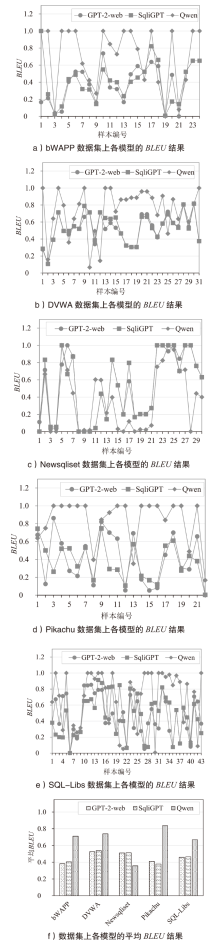
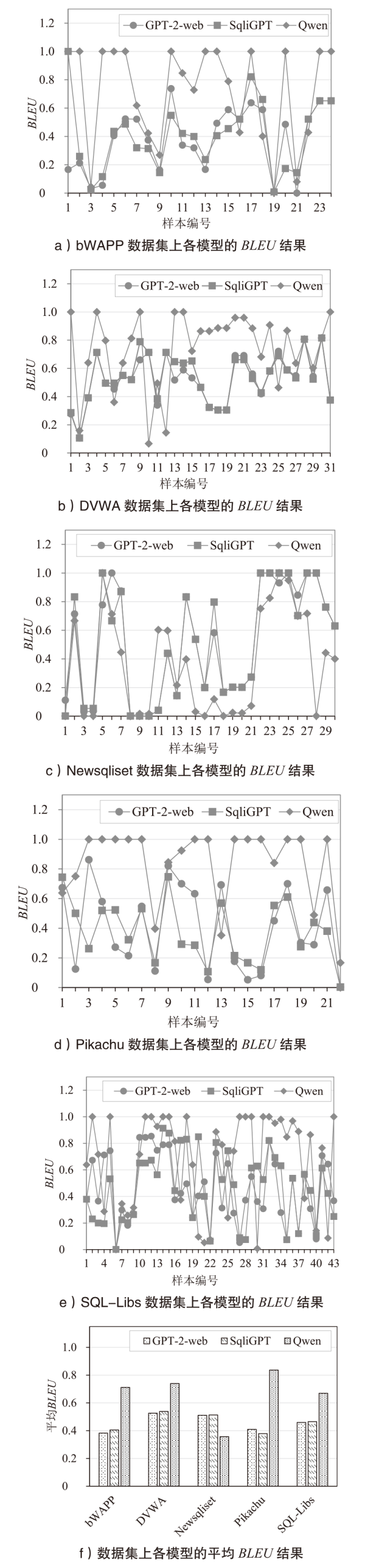
| 漏洞库 | ES | SA | DI |
|---|---|---|---|
| Exploit-Database | 91.68% | 79.85% | 95.21% |
| PacketStorm | 80.21% | 88.82% | 94.37% |
| CVE | 80.25% | 89.01% | 93.88% |
| 总体 | 88.62% | 82.03% | 94.99% |
| [1] | JAIN S. 160 Cybersecurity Statistics[EB/OL]. (2025-01-09)[2025-05-24]. https://www.getastra.com/blog/security-audit/cyber-security-statistics/. |
| [2] | FreeBuf. 2023 Global Top 10 Security Vulnerabilities | FreeBuf Annual Review[EB/OL]. (2024-01-04)[2025-05-24]. https://www.freebuf.com/news/388742.html. |
| FreeBuf. 2023 全球年度安全漏洞TOP 10 | FreeBuf 年度盘点[EB/OL]. (2024-01-04)[2025-05-24]. https://www.freebuf.com/news/388742.html. | |
| [3] | HUANG Kaijie, WANG Jian, CHEN Jiongyi. A Large Language Model Based SQL Injection Attack Detection Method[J]. Netinfo Security, 2023, 23(11): 84-93. |
| 黄恺杰, 王剑, 陈炯峄. 一种基于大语言模型的SQL注入攻击检测方法[J]. 信息网络安全, 2023, 23(11):84-93. | |
| [4] | LU Dongzhe, FEI Jinlong, LIU Long. A Semantic Learning-Based SQL Injection Attack Detection Technology[EB/OL]. (2023-02-09)[2025-05-10]. https://doi.org/10.3390/electronics1206134. |
| [5] |
BOLOTNIKOV I V, BORODIN A E. Interprocedural Static Analysis for Finding Bugs in Go Programs[J]. Programming and Computer Software, 2021, 47(5): 344-352.
doi: 10.1134/S0361768821050030 |
| [6] | LIVSHITS V B, LAM M S. Finding Security Vulnerabilities in Java Applications with Static Analysis[C]// USENIX. The 14th Conference on USENIX Security Symposium. New York: USENIX, 2005: 18-29. |
| [7] |
LI Qi, LI Weishi, WANG Junfeng, et al. A SQL Injection Detection Method Based on Adaptive Deep Forest[J]. IEEE Access, 2019, 7: 145385-145394.
doi: 10.1109/ACCESS.2019.2944951 |
| [8] | RADFORD A, NARASIMHAN K, SALIMANS T, et al. Improving Language Understanding by Generative Pre-Training[EB/OL]. [2025-05-17]. https://api.semanticscholar.org/CorpusID:49313245. |
| [9] | TOUVRON H, LAVRIL T, IZACARD G, et al. LLaMA: Open and Efficient Foundation Language Models[EB/OL]. (2023-02-27)[2025-05-17]. https://arxiv.org/abs/2302.13971. |
| [10] | GUI Zhiwen, WANG Enze, DENG Binbin, et al. SqliGPT: Evaluating and Utilizing Large Language Models for Automated SQL Injection Black-Box Detection[EB/OL]. (2024-08-07)[2025-05-17]. https://doi.org/10.3390/app1416692. |
| [11] | ĆIRKOVIĆ S, MLADENOVIĆ V, TOMIĆ S, et al. Utilizing Fine-Tuning of Large Language Models for Generating Synthetic Payloads: Enhancing Web Application Cybersecurity through Innovative Penetration Testing Techniques[J]. Computers, Materials & Continua, 2025, 82(3): 4409-4430. |
| [12] | WU Peize, LI Guanghui, WU Jinyu. Research on Automated Vulnerability Verification Code Generation Based on Large Language Models[EB/OL]. (2024-06-20)[2025-05-10]. https://kns.cnki.net/kcms2/article/abstract?v=MXvIvFkaDQz0Ed1hcQN9CL-gXr5KEIhM5964CkAGitVLQj534FnW1QowKkJ4WAgttjFFL0fZhSaGn07arFP_v3d_Buwl9snK_NfzS-YnI0oSzgnHjsO-O0TrWBMHKVS99os3LXwpBVAl_JCWrFc-_pT5Ybux81d8cT6Gw2I5naP9T-kI9v978mcS2fJKkXwY&uniplatform=NZKPT&language=CHS. |
| 吴佩泽, 李光辉, 吴津宇. 基于大语言模型的自动化漏洞验证代码生成方法研究[EB/OL]. (2024-06-20)[2025-05-10]. https://kns.cnki.net/kcms2/article/abstract?v=MXvIvFkaDQz0Ed1hcQN9CL-gXr5KEIhM5964CkAGitVLQj534FnW1QowKkJ4WAgttjFFL0fZhSaGn07arFP_v3d_Buwl9snK_NfzS-YnI0oSzgnHjsO-O0TrWBMHKVS99os3LXwpBVAl_JCWrFc-_pT5Ybux81d8cT6Gw2I5naP9T-kI9v978mcS2fJKkXwY&uniplatform=NZKPT&language=CHS. | |
| [13] | YANG Guang, ZHOU Yu, CHEN Xiang, et al. ExploitGen: Template-Augmented Exploit Code Generation Based on CodeBERT[EB/OL]. (2023-03-01)[2025-05-17]. https://doi.org/10.1016/j.jss.2022.11157. |
| [14] |
PENG Qi, CAI Yi, LIU Jiankun, et al. Integration of Multi-Source Medical Data for Medical Diagnosis Question Answering[J]. IEEE Transactions on Medical Imaging, 2025, 44(3): 1373-1385.
doi: 10.1109/TMI.2024.3496862 pmid: 40030182 |
| [15] | LIAO Xingming, CHEN Chong, WANG Zhuowei, et al. Large Language Model Assisted Fine-Grained Knowledge Graph Construction for Robotic Fault Diagnosis[EB/OL]. (2025-05-01)[2025-06-17]. https://doi.org/10.1016/j.aei.2025.10313. |
| [16] | WEI J, WANG Xuezhi, SCHUURMANS D, et al. Chain-of-Thought Prompting Elicits Reasoning in Large Language Models[C]// ACM. The 36th International Conference on Neural Information Processing Systems. New York: ACM, 2022: 24824-24837. |
| [17] | OU Jianjiu, ZHOU Jianlong, DONG Yifei, et al. Chain of Thought Prompting in Vision-Language Model for Vision Reasoning Tasks[C]// Springer. The 37th Australasian Joint Conference on Artificial Intelligence. Heidelberg: Springer, 2024: 298-311. |
| [18] | YAO Chengyuan, FUJITA S. Adaptive Control of Retrieval-Augmented Generation for Large Language Models through Reflective Tags[EB/OL]. (2024-11-25)[2025-07-15]. https://doi.org/10.3390/electronics1323464. |
| [19] | OffSEC. Exploit Database[EB/OL]. (2010-11-01)[2025-09-07]. https://www.exploit-db.com/. |
| [20] | Private Internet Access. PacketStorm Security Archive[EB/OL]. [2025-07-15]. https://packetstormsecurity.com/. |
| [21] | OpenAI. Completion-OpenAI API[EB/OL]. [2025-12-05]. https://beta.openai.com/docs/guides/completion/prompt-design. |
| [22] | DeepSeek. DeepSeek-V3[EB/OL]. [2025-03-07]. https://huggingface.co/deepseek-ai/DeepSeek-V3. |
| [23] | HU E J, SHEN Yelong, WALLIS P, et al. LoRA: Low-Rank Adaptation of Large Language Models[EB/OL]. (2021-06-17)[2025-04-17]. https://doi.org/10.48550/arXiv.2106.0968. |
| [24] | STAMPAR M, DAMELE A G B. SQLMap: Automatic SQL Injection and Database Takeover Tool[EB/OL]. [2025-03-26]. https://github.com/sqlmapproject/sqlmap. |
| [25] | MITRE. Common Vulnerabilities and Exposures(CVE)[EB/OL]. (2000-01-01)[2025-07-15]. https://cve.mitre.org/. |
| [26] | Audi-1. SQLI-Labs[EB/OL]. (2014-04-01)[2025-04-17]. https://github.com/Audi-1/sqli-labs. |
| [27] | DEWHURST R. Damn Vulnerable Web Application(DVWA)[EB/OL]. (2023-05-21)[2025-04-17]. https://github.com/digininja/DVWA. |
| [28] | HUN Lu. Pikachu[EB/OL]. [2025-04-18]. https://github.com/zhuifengshaonianhanlu/pikachu. |
| [29] | MALIK B. BWAPP[EB/OL]. (2013-01-08)[2025-04-18]. https://sourceforge.net/projects/bwapp/. |
| [30] | SHITOU CLOUD. AutoDL: High-Performance Cloud Computing Platform for Deep Learning[EB/OL]. [2025-05-07]. https://www.autodl.com. |
| 视拓云. AutoDL:高性能深度学习算力云平台[EB/OL]. [2025-05-07]. https://www.autodl.com. | |
| [31] | ZHENG Yaowei, ZHANG Richong, ZHANG Junhao, et al. LlamaFactory: Unified Efficient Fine-Tuning of 100+ Language Models[C]// Association for Computational Linguistics. Proceedings of the 62nd Annual Meeting of the Association for Computational Linguistics. Pennsylvania: Association for Computational Linguistics, 2024: 400-410. |
| [32] | PAPINENI K, ROUKOS S, WARD T, et al. Bleu: A Method for Automatic Evaluation of Machine Translation[C]// ACL. The 40th Annual Meeting of the Association for Computational Linguistics. Philadelphia: ACL, 2002: 311-318. |
| [33] |
BERGER B, WATERMAN M S, YU Y W. Levenshtein Distance, Sequence Comparison and Biological Database Search[J]. IEEE Transactions on Information Theory, 2021, 67(6): 3287-3294.
doi: 10.1109/tit.2020.2996543 pmid: 34257466 |
| [1] | TONG Xin, JIAO Qiang, WANG Jingya, YUAN Deyu, JIN Bo. A Survey on the Trustworthiness of Large Language Models in the Public Security Domain: Risks, Countermeasures, and Challenges [J]. Netinfo Security, 2026, 26(1): 24-37. |
| [2] | HU Yucui, GAO Haotian, ZHANG Jie, YU Hang, YANG Bin, FAN Xuejian. Automated Exploitation of Vulnerabilities in Vehicle Network Security [J]. Netinfo Security, 2025, 25(9): 1348-1356. |
| [3] | LIU Hui, ZHU Zhengdao, WANG Songhe, WU Yongcheng, HUANG Linquan. Jailbreak Detection for Large Language Model Based on Deep Semantic Mining [J]. Netinfo Security, 2025, 25(9): 1377-1384. |
| [4] | WANG Lei, CHEN Jiongyi, WANG Jian, FENG Yuan. Intelligent Reverse Analysis Method of Firmware Program Interaction Relationships Based on Taint Analysis and Textual Semantics [J]. Netinfo Security, 2025, 25(9): 1385-1396. |
| [5] | ZHANG Yanyi, RUAN Shuhua, ZHENG Tao. Research on REST API Design Security Testing [J]. Netinfo Security, 2025, 25(8): 1313-1325. |
| [6] | CHEN Ping, LUO Mingyu. Research on Large Model Analysis Methods for Kernel Race Vulnerabilities in Cloud-Edge-Device Scenarios [J]. Netinfo Security, 2025, 25(7): 1007-1020. |
| [7] | FENG Wei, XIAO Wenming, TIAN Zheng, LIANG Zhongjun, JIANG Bin. Research on Semantic Intelligent Recognition Algorithms for Meteorological Data Based on Large Language Models [J]. Netinfo Security, 2025, 25(7): 1163-1171. |
| [8] | ZHANG Xuewang, LU Hui, XIE Haofei. A Data Augmentation Method Based on Graph Node Centrality and Large Model for Vulnerability Detection [J]. Netinfo Security, 2025, 25(4): 550-563. |
| [9] | XIE Mengfei, FU Jianming, YAO Renyi. Research on LLM-Based Fuzzing of Native Multimedia Libraries [J]. Netinfo Security, 2025, 25(3): 403-414. |
| [10] | QIN Zhongyuan, WANG Tiantian, LIU Weiqiang, ZHANG Qunfang. Advances in Watermarking Techniques for Large Language Models [J]. Netinfo Security, 2025, 25(2): 177-193. |
| [11] | YANG Liqun, LI Zhen, WEI Chaoren, YAN Zhimin, QIU Yongxin. Research on Protocol Fuzzing Technology Guided by Large Language Models [J]. Netinfo Security, 2025, 25(12): 1847-1862. |
| [12] | MENG Hui, MAO Linlin, PENG Juzhi. Sanitize Processing and Recognition Method Driven by Large Language Model [J]. Netinfo Security, 2025, 25(12): 1990-1998. |
| [13] | HU Longhui, SONG Hong, WANG Weiping, YI Jia, ZHANG Zhixiong. Research on the Application of Large Language Model in False Positive Handling for Managed Security Services [J]. Netinfo Security, 2025, 25(10): 1570-1578. |
| [14] | CHEN Haoran, LIU Yu, CHEN Ping. Endogenous Security Heterogeneous Entity Generation Method Based on Large Language Model [J]. Netinfo Security, 2024, 24(8): 1231-1240. |
| [15] | XIANG Hui, XUE Yunhao, HAO Lingxin. Large Language Model-Generated Text Detection Based on Linguistic Feature Ensemble Learning [J]. Netinfo Security, 2024, 24(7): 1098-1109. |
| Viewed | ||||||
|
Full text |
|
|||||
|
Abstract |
|
|||||