Netinfo Security ›› 2026, Vol. 26 ›› Issue (6): 944-957.doi: 10.3969/j.issn.1671-1122.2026.06.008
Previous Articles Next Articles
Deep Active Learning Based Federated Semi-Supervised Intrusion Detection System
ZHANG Hao1,2,3, YE Junwei1,2,3( )
)
- 1
College of Computer and Data Science ,Fuzhou University Fuzhou 350116, China
2Fujian Key Laboratory of Network Computing and Intelligent Information Processing Fuzhou 350116, China
3Engineering Research Center of Big Data Intelligence ,Chinese Ministry of Education Fuzhou 350116, China
-
Received:2025-04-15Online:2026-06-10Published:2026-07-27 -
Contact:YE Junwei E-mail:xeno73@foxmail.com

CLC Number:
Cite this article
ZHANG Hao, YE Junwei. Deep Active Learning Based Federated Semi-Supervised Intrusion Detection System[J]. Netinfo Security, 2026, 26(6): 944-957.
share this article
Add to citation manager EndNote|Ris|BibTeX
URL: http://netinfo-security.org/EN/10.3969/j.issn.1671-1122.2026.06.008
| 类型 | 参数设置 |
|---|---|
| 1D-CNN | 卷积核大小为3,卷积核数量为64 |
| LSTM | 隐藏层单元数为64,层数为1 |
| Dropout | 比率为0.1 |
| 参数名称 | 描述 | 默认值 | |
|---|---|---|---|
| NSL-KDD | UNSW-NB15 | ||
| CommunicationRound | 联邦学习通信轮次 | 20 | 20 |
| Epoch | 本地迭代次数 | 5 | 10 |
| BatchSize/bit | 批量大小 | 2048 | 512 |
| Lr | 学习率 | 0.0001 | 0.0001 |
| 有标签数据量 | 1% | 5% | 10% | 20% |
|---|---|---|---|---|
| 伪标签 | 70.81% | 71.42% | 72.87% | 74.30% |
| 有监督 | 69.90% | 70.76% | 71.77% | 72.77% |
| 有标签数据量 | 1% | 5% | 10% | 20% |
|---|---|---|---|---|
| 伪标签 | 68.48% | 70.79% | 72.55% | 73.16% |
| 有监督 | 67.93% | 70.34% | 71.66% | 72.78% |
| 有标签数据量 | 1% | 5% | 10% | 20% |
|---|---|---|---|---|
| 伪标签 | 58.08% | 58.82% | 61.84% | 63.04% |
| 有监督 | 57.63% | 58.10% | 61.42% | 62.81% |
| 有标签数据量 | 1% | 5% | 10% | 20% |
|---|---|---|---|---|
| 伪标签 | 61.82% | 62.58% | 64.39% | 66.86% |
| 有监督 | 61.31% | 61.94% | 63.82% | 66.29% |
| 方案 | 加权召回率 | 加权精确率 | 加权F1分数 |
|---|---|---|---|
| 本文方案 | 81.01% | 77.68% | 73.79% |
| 多样性采样消融 | 76.35% | 74.60% | 71.82% |
| 深度模型迁移消融 | 79.56% | 73.77% | 71.03% |
| 方案 | 加权召回率 | 加权精确率 | 加权F1分数 |
|---|---|---|---|
| 本文方案 | 72.98% | 73.04% | 71.68% |
| 多样性采样消融 | 69.34% | 72.67% | 68.65% |
| 深度模型迁移消融 | 69.68% | 73.69% | 69.39% |
| 通信轮次 | 策略1 | 策略2 | 策略3 |
|---|---|---|---|
| 1 | 66.76% | 65.51% | 66.14% |
| 2 | 66.70% | 67.42% | 69.85% |
| 3 | 69.58% | 71.63% | 71.56% |
| 4 | 69.70% | 70.69% | 71.25% |
| 5 | 69.80% | 71.00% | 70.76% |
| 6 | 70.91% | 71.60% | 71.27% |
| 7 | 72.17% | 72.86% | 71.19% |
| 8 | 73.01% | 72.71% | 72.55% |
| 9 | 73.69% | 72.74% | 72.60% |
| 10 | 73.95% | 72.75% | 72.57% |
| 11 | 74.01% | 72.72% | 72.53% |
| 12 | 74.22% | 73.00% | 72.63% |
| 13 | 74.18% | 73.16% | 72.71% |
| 14 | 74.30% | 73.26% | 73.15% |
| 15 | 74.39% | 73.34% | 73.70% |
| 16 | 74.61% | 73.30% | 74.03% |
| 17 | 75.11% | 73.48% | 74.04% |
| 18 | 75.36% | 73.68% | 73.96% |
| 19 | 75.69% | 73.70% | 74.15% |
| 20 | 75.63% | 74.06% | 74.30% |
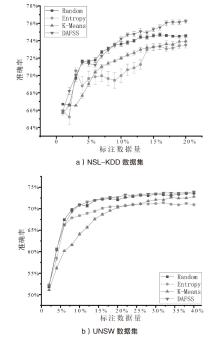
| 方案 | 加权召回率 | 加权精确率 | 加权F1分数 | |||
|---|---|---|---|---|---|---|
| NSL-KDD | UNSW-NB15 | NSL-KDD | UNSW-NB15 | NSL-KDD | UNSW-NB15 | |
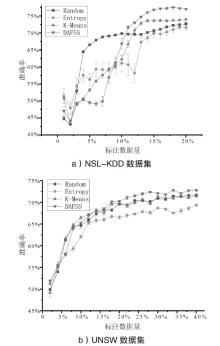
| DAFSS | 81.01% | 72.98% | 77.68% | 73.04% | 73.79% | 71.68% |
| Random | 79.05% | 71.24% | 73.77% | 73.32% | 69.57% | 69.88% |
| Entropy | 67.79% | 69.36% | 72.03% | 71.20% | 67.26% | 69.04% |
| K-Means | 68.25% | 69.68% | 69.72% | 73.69% | 67.13% | 69.39% |
| 方案 | 加权召回率 | 加权精确率 | 加权F1分数 | |||
|---|---|---|---|---|---|---|
| NSL-KDD | UNSW-NB15 | NSL-KDD | UNSW-NB15 | NSL-KDD | UNSW-NB15 | |
| DAFSS | 81.01% | 72.98% | 77.68% | 73.04% | 73.79% | 71.68% |
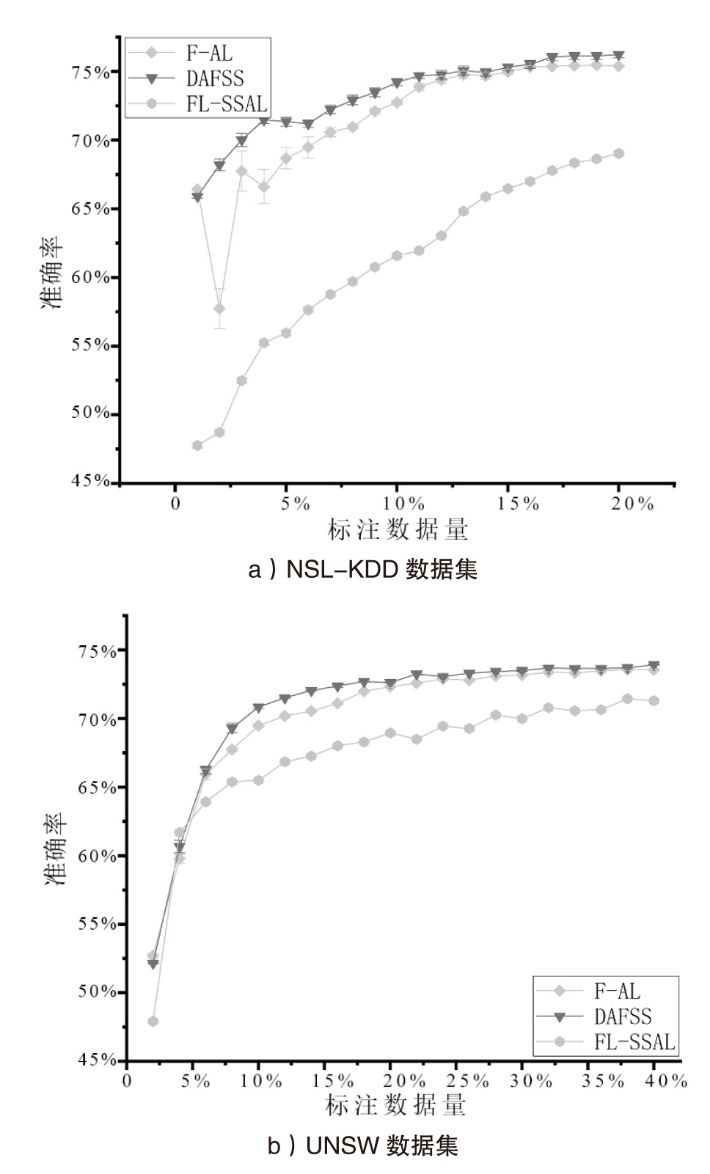
| F-AL | 80.68% | 71.20% | 77.14% | 73.07% | 73.35% | 71.21% |
| FL-SSAL | 60.34% | 65.55% | 58.09% | 70.30% | 55.72% | 66.66% |
| 方案 | 加权召回率 | 加权精确率 | 加权F1分数 | |||
|---|---|---|---|---|---|---|
| NSL-KDD | UNSW-NB15 | NSL-KDD | UNSW-NB15 | NSL-KDD | UNSW-NB15 | |
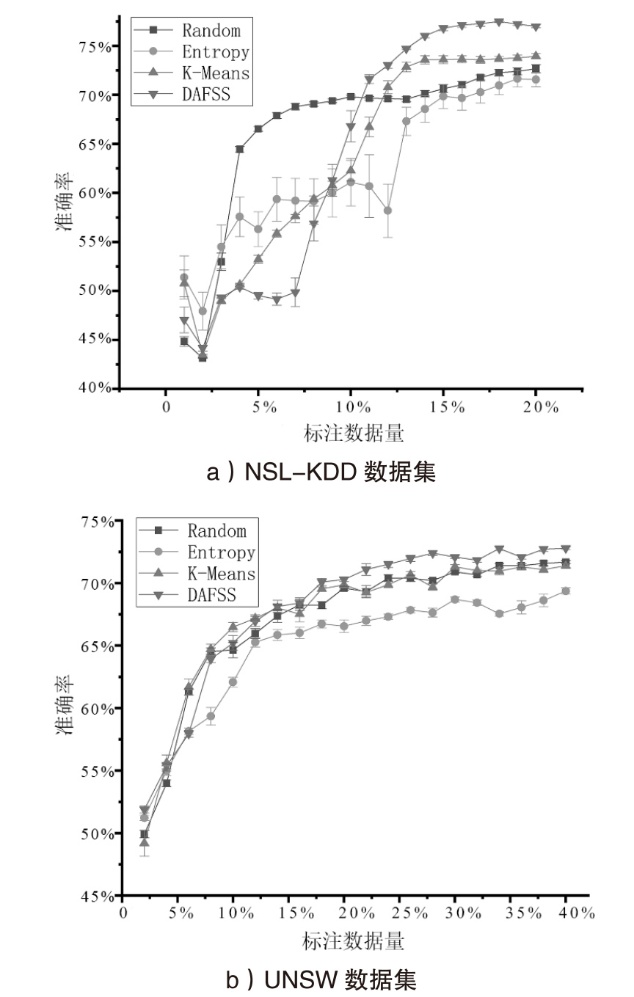
| DAFSS | 80.88% | 70.76% | 76.90% | 73.81% | 73.28% | 70.11% |
| Random | 76.64% | 70.17% | 72.27% | 73.70% | 68.81% | 69.57% |
| Entropy | 75.73% | 67.79% | 72.61% | 72.03% | 69.10% | 67.26% |
| K-Means | 73.77% | 68.25% | 76.21% | 69.72% | 72.76% | 67.13% |
| 方案 | 加权召回率 | 加权精确率 | 加权F1分数 | |||
|---|---|---|---|---|---|---|
| NSL-KDD | UNSW-NB15 | NSL-KDD | UNSW-NB15 | NSL-KDD | UNSW-NB15 | |
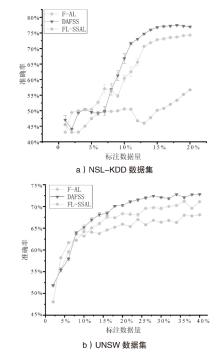
| DAFSS | 80.88% | 70.76% | 76.90% | 73.81% | 73.28% | 70.11% |
| F-AL | 79.81% | 68.47% | 77.31% | 71.38% | 73.18% | 69.07% |
| FL-SSAL | 45.32% | 65.28% | 51.06% | 67.46% | 42.27% | 64.64% |
| [1] | BAI Hongpeng, DENG Dongxu, XU Guangquan, et al. Research onIntrusion Detection Mechanism Based on Federated Learning[J]. NetinfoSecurity, 2022, 22(1): 46-54. |
| 白宏鹏, 邓东旭, 许光全, 等. 基于联邦学习的入侵检测机制研究[J]. 信息网络安全, 2022, 22(1): 46-54. | |
| [2] | MCMAHAN B, MOORE E, RAMAGE D, et al. Communication-Efficient Learning of Deep Networks from Decentralized Data[C]// PMLR. Artificial Intelligence and Statistics. Cambridge: PMLR, 2017: 1273-1282. |
| [3] | XU Jian, XIAO Yongcai, LIN Zejian, et al. Privacy Protection Anomaly Detection in Smart Grids Based on Homomorphic Encryption[J]. Computer Technology and Development, 2025, 35(8): 93-100. |
| 徐健, 肖勇才, 林泽键, 等. 基于同态加密的智能电网隐私保护异常检测技术[J]. 计算机技术与发展, 2025, 35(8): 93-100. | |
| [4] | WEN Z, PIZARRO O, WILLIAMS S. Training from a Better Start Point: Active Self-Semi-Supervised Learning for Few Labeled Samples[EB/OL]. (2022-03-09)[2025-03-27]. https://arxiv.org/abs/2203.04560 |
| [5] | SHEN Yeming, LI Beibei, LIU xiaojie, et al. Research on Intrusion Detection of Industrial Internet Based on Active Learning[J]. Netinfo Security, 2021, 21(1): 80-87. |
| 沈也明, 李贝贝, 刘晓洁, 等. 基于主动学习的工业互联网入侵检测研究[J]. 信息网络安全, 2021, 21(1): 80-87. | |
| [6] | NAEEM F, ALI M, KADDOUM G. Federated-Learning-Empowered Semi-Supervised Active Learning Framework for Intrusion Detection in ZSM[J]. IEEE Communications Magazine, 2023, 61(2): 88-94. |
| [7] | ZHANG Yong, NIU Jie, HE Guojian, et al. Network Intrusion Detection Based on Active Semi-Supervised Learning[C]// IEEE. The 51st Annual IEEE/IFIP International Conference on Dependable Systems and Networks Workshops. New York: IEEE, 2021: 129-135. |
| [8] | LI Beibei, WU Yuhao, SONG Jiarui, et al. DeepFed: Federated Deep Learning for Intrusion Detection in Industrial Cyber-Physical Systems[J]. IEEE Transactions on Industrial Informatics, 2021, 17(8): 5615-5624. |
| [9] | MOTHUKURI V, KHARE P, PARIZI R M, et al. Federated-Learning-Based Anomaly Detection for IoT Security Attacks[J]. IEEE Internet of Things Journal, 2022, 9(4): 2545-2554. |
| [10] | HUONG T T, BAC T P, LONG D M, et al. Detecting Cyberattacks Using Anomaly Detection in Industrial Control Systems: A Federated Learning Approach[J]. Computers in Industry, 2021, 132: 509-518. |
| [11] | ABDEL-BASSET M, MOUSTAFA N, HAWASH H, et al. Federated Intrusion Detection in Blockchain-Based Smart Transportation Systems[J]. IEEE Transactions on Intelligent Transportation Systems, 2022, 23(3): 2523-2537. |
| [12] | MILLER D J, UYAR H. A Mixture of Experts Classifier with Learning Based on Both Labelled and Unlabelled Data[EB/OL]. (1996-09-05)[2025-03-27]. https://proceedings.neurips.cc/paper/1996/hash/a58149d355f02887dfbe55ebb2b64ba3-Abstract.html. |
| [13] | LEE D-H. Pseudo-Label: The Simple and Efficient Semi-Supervised Learning Method for Deep Neural Networks[C]// ICML. The Workshop on Challenges in Representation Learning. Cambridge: PMLR, 2013: 896-906. |
| [14] | RIZVE M N, DUARTE K, RAWAT Y S, et al. In Defense of Pseudo-Labeling: An Uncertainty-Aware Pseudo-Label Selection Framework for Semi-Supervised Learning[EB/OL]. (2021-01-15)[2025-03-27]. https://arxiv.org/abs/2101.06329 |
| [15] | SETTLES B. Active Learning Literature Survey[EB/OL]. (2009-03-16)[2025-03-27]. http://apophenia.wdfiles.com/local-files/start/settles_active_learning.pdf |
| [16] | NIU Zequn, GUO Wenjie, XUE Jingfeng, et al. A Novel Anomaly Detection Approach Based on Ensemble Semi-Supervised Active Learning (ADESSA)[J]. Computers & Security, 2023, 129: 90-99. |
| [17] | CONTARDO G, DENOYER L, ARTIERES T. A Meta-Learning Approach to One-Step Active-Learning[EB/OL]. (2017-07-17)[2025-03-27]. https://arxiv.org/abs/1706.08334 |
| [18] | ZHU Jiajie, BENTO J. Generative Adversarial Active Learning[EB/OL]. (2017-02-25)[2025-03-27]. https://arxiv.org/abs/1702.07956 |
| [19] | LIU Peng, WANG Lizhe, RANJAN R, et al. A Survey on Active Deep Learning: from Model Driven to Data Driven[J]. ACM Computing Surveys (CSUR), 2022, 54(10): 1-34. |
| [20] | ZHAN Xueying, LIU Huan, LI Qing, et al. A Comparative Survey: Benchmarking for Pool-Based Active Learning[C]// IJCAI. The International Joint Conferences on Artificial Intelligence Organization. Amsterdam: IJCAI, 2021: 4679-4686. |
| [21] | DUCOFFE M, PRECIOSO F. Adversarial Active Learning for Deep Networks: A Margin Based Approach[EB/OL]. (2018-02-27)[2025-03-27]. https://arxiv.org/abs/1802.09841 |
| [22] | MUNJAL P, HAYAT N, HAYAT M, et al. Towards Robust and Reproducible Active Learning Using Neural Networks[C]// IEEE. The IEEE/CVF Conference on Computer Vision and Pattern Recognition. New York: IEEE, 2022: 223-232. |
| [23] | ZHANG Yu, YANG Qiang. A Survey on Multi-Task Learning[J]. IEEE Transactions on Knowledge and Data Engineering, 2021, 34(12): 5586-5609. |
| [24] | LECUN Y, BENGIO Y, HINTON G. Deep Learning[J]. Nature, 2015, 521(3): 436-444. |
| [25] | LIU Ming, BUNTINE W, HAFFARI G. Learning How to Actively Learn: A Deep Imitation Learning Approach[C]//ACL. The 56th Annual Meeting of the Association for Computational Linguistics. Cambridge: MIT Press, 2018: 1874-1883. |
| [26] | REVATHI S, MALATHI A. A Detailed Analysis on NSL-KDD Dataset Using Various Machine Learning Techniques for Intrusion Detection[J]. International Journal of Engineering Research & Technology (IJERT), 2013, 2(12): 1848-1853. |
| [27] | MOUSTAFA N, SLAY J. UNSW-NB15: A Comprehensive Data Set for Network Intrusion Detection Systems (UNSW-NB15 Network Data Set)[C]//IEEE. The Military Communications and Information Systems Conference. New York: IEEE, 2015: 1-6. |
| [28] | AHN J H, KIM K, KOH J, et al. Federated Active Learning (F-AL): An Efficient Annotation Strategy for Federated Learning[J]. IEEE Access, 2024(12): 39261-39269. |
| [29] | HSU T-M H, QI H, BROWN M. Measuring the Effects of Non-Identical Data Distribution for Federated Visual Classification[EB/OL]. (2019-09-13)[2025-03-27]. https://arxiv.org/abs/1909.06335 |
| [1] | LI Zihao, ZHANG Fengwei. TEE-Based Federated Learning Platform [J]. Netinfo Security, 2026, 26(5): 788-808. |
| [2] | ZHENG Kaifa, LUO Zhenpeng, LIU Jiayi, LIU Zhiquan, WANG Ze, WU Yunkun. A Lightweight Dynamic Node Participation Scheme for Federated Learning Nodes Supporting Attribute Update [J]. Netinfo Security, 2026, 26(1): 102-114. |
| [3] | SHI Yinsheng, BAO Yang, PANG Jingjing. Research on a Federated Privacy Enhancement Method against GAN Attacks [J]. Netinfo Security, 2026, 26(1): 49-58. |
| [4] | CHEN Xianyi, WANG Xuebo, CUI Qi, FU Zhangjie, WANG Qianqian, ZENG Yifu. Overview of Backdoor Attacks and Defenses in Personalized Federated Learning [J]. Netinfo Security, 2025, 25(9): 1418-1438. |
| [5] | JIN Zhigang, LI Zimeng, CHEN Xuyang, LIU Zepei. Review of Network Intrusion Detection System for Unbalanced Data [J]. Netinfo Security, 2025, 25(8): 1240-1253. |
| [6] | XUN Yijie, CUI Jiarong, MAO Bomin, QIN Junman. Intrusion Detection System for the Controller Area Network Bus of Intelligent Vehicles Based on Federated Learning [J]. Netinfo Security, 2025, 25(6): 872-888. |
| [7] | DENG Dongshang, WANG Weiye, ZHANG Weidong, WU Xuangou. Layered Personalized Federated Learning Guided by Model Feature Orientation [J]. Netinfo Security, 2025, 25(6): 889-897. |
| [8] | ZHU Shuaishuai, LIU Keqian. A Masking-Based Selective Federated Distillation Scheme [J]. Netinfo Security, 2025, 25(6): 920-932. |
| [9] | LI Jiadong, ZENG Haitao, PENG Li, WANG Xiaoding. An Anonymous Routing Federated Learning Framework for Data Privacy Protection [J]. Netinfo Security, 2025, 25(3): 494-503. |
| [10] | WANG Yajie, LU Jinbiao, LI Yuhang, FAN Qing, ZHANG Zijian, ZHU Liehuang. Hierarchical Dynamic Protection Algorithm for Federated Learning Based on Trusted Execution Environment [J]. Netinfo Security, 2025, 25(11): 1762-1773. |
| [11] | XU Ruzhi, TONG Yumeng, DAI Lipeng. Research on Federated Learning Adaptive Differential Privacy Method Based on Heterogeneous Data [J]. Netinfo Security, 2025, 25(1): 63-77. |
| [12] | GUO Qian, ZHAO Jin, GUO Yi. Hierarchical Clustering Federated Learning Framework for Personalized Privacy-Preserving [J]. Netinfo Security, 2024, 24(8): 1196-1209. |
| [13] | XUE Mingzhu, HU Liang, WANG Ming, WANG Feng. TAP Rule Processing System Based on Federated Learning and Blockchain Technology [J]. Netinfo Security, 2024, 24(3): 473-485. |
| [14] | LIN Yihang, ZHOU Pengyuan, WU Zhiqian, LIAO Yong. Federated Learning Backdoor Defense Method Based on Trigger Inversion [J]. Netinfo Security, 2024, 24(2): 262-271. |
| [15] | JIN Zhigang, DING Yu, WU Xiaodong. Federated Intrusion Detection Algorithm with Bilateral Correction Merging Gradient Difference [J]. Netinfo Security, 2024, 24(2): 293-302. |
| Viewed | ||||||
|
Full text |
|
|||||
|
Abstract |
|
|||||