Netinfo Security ›› 2026, Vol. 26 ›› Issue (6): 967-976.doi: 10.3969/j.issn.1671-1122.2026.06.010
Previous Articles Next Articles
A Stochastic Game Model for Host Scanning and Anti-Scanning
XIE Xiaomin1,2,3, LI Pengdeng1,2,3, LIU Yuan1,2,3( ), TIAN Zhihong1,2,3
- 1
Cyberspace Institute of Advanced Technology ,Guangzhou University Guangzhou 510006, China
2Guangdong Provincial Key Laboratory of Industrial Control System Security Guangzhou 510006, China
3Huangpu Research School of Guangzhou University Guangzhou 510000, China
-
Received:2025-06-12Online:2026-06-10Published:2026-07-27 -
Contact:LIU Yuan E-mail:yuanliu@gzhu.edu.cn

CLC Number:
Cite this article
XIE Xiaomin, LI Pengdeng, LIU Yuan, TIAN Zhihong. A Stochastic Game Model for Host Scanning and Anti-Scanning[J]. Netinfo Security, 2026, 26(6): 967-976.
share this article
Add to citation manager EndNote|Ris|BibTeX
URL: http://netinfo-security.org/EN/10.3969/j.issn.1671-1122.2026.06.010
| 符号 | 定义 |
|---|---|
| N | 目标主机范围内主机总数 |
| n | 攻击者当前已扫描主机数量 |
| m | 防御者将合法源地址误报为恶意扫描地址的数量 |
| τ | 扫描一组主机所需的时间 |
| t | 第t个时间步(表示博弈时间进程) |
| G | 分组总数 |
| T | 扫描全部主机所需的总时间步 |
| | 各阶段博弈对抗的状态 |
| | 参与者i的行动 |
| | 参与者i遵循均衡策略 |
| | 博弈状态中,扫描行为被检测成功的标识 |
| | 参与者i的收益函数 |
| | 参与者i的折扣因子(表示耐心程度) |
| | 参与者i的收益函数 |
| | 参与者i的策略 |
| | 参与者i的策略空间 |
| | 第i个主机分组的编号 |
| | 第i个主机分组中包含的主机数量 |
| | 参与者i的最优均衡策略 |
| 参数 | N | | MAX_A | MAX_D | | | |
|---|---|---|---|---|---|---|---|
| 数值设置 | 100 | 1 | 100 | 100 | 0.15 | 0.82 | 0.20 |
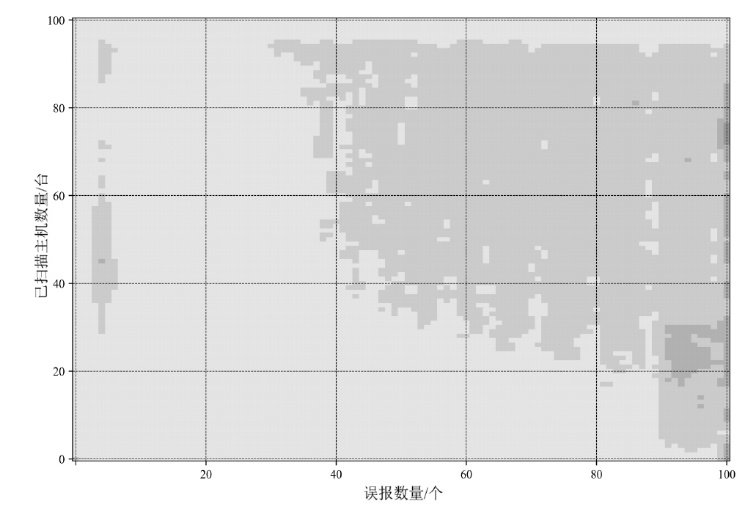
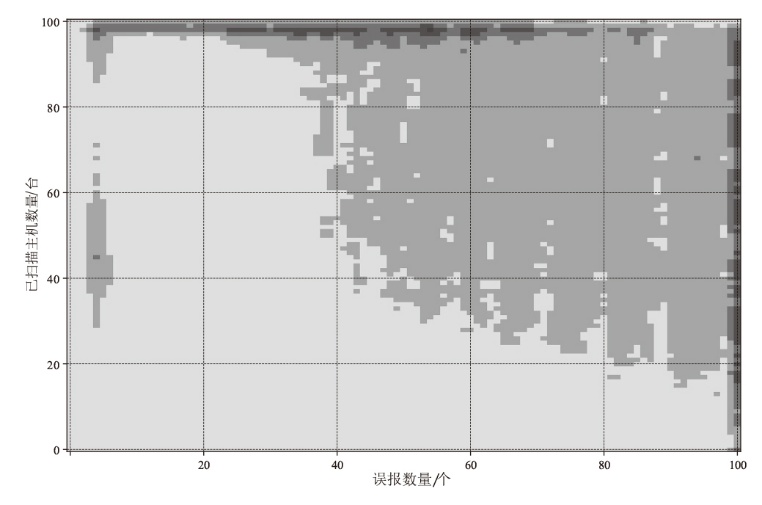
| [1] | ZOU Zhenwan, HOU Yingsa, GUO Qingrui. Research on Cyberspace Surveying and Mapping Technology Based on Asset Detection[C]// IEEE. 2024 IEEE 6th Advanced Information Management, Communicates, Electronic and Automation Control Conference (IMCEC). New York: IEEE, 2024: 946-949. |
| [2] | XUE Xiangyang, ZOU Hong, ZHAO Jin, et al. Advances in Anti-Surveying-and-Mapping Theory and Technologies for Data Infrastructure[J]. Strategic Study of CAE, 2025, 27(1): 72-87. |
| 薛向阳, 邹宏, 赵进, 等. 数据基础设施抗测绘理论与技术发展研究[J]. 中国工程科学, 2025, 27(1): 72-87. | |
| [3] | DURUMERIC Z, BAILEY M, HALDERMAN J A. An {Internet-Wide} View of {Internet-Wide} Scanning[C]// USENIX. The 23rd USENIX Conference on Security Symposium. Berkeley: USENIX, 2014: 65-78. |
| [4] | SHENG Chuan, YAO Yu, ZHAO Lianxiang, et al. Scanner-Hunter: An Effective ICS Scanning Group Identification System[J]. IEEE Transactions on Information Forensics and Security, 2024, 19: 3077-3092. |
| [5] | CASWELL B, FOSTER J C, RUSSELL R, et al. Snort 2.0 Intrusion Detection[M]. Rockland: Syngress Publishing, 2003. |
| [6] | SHAPLEY L S. Stochastic Games[J]. Proceedings of the National Academy of Sciences of the United States of America (PNAS), 1953, 39(10): 1095-1100. |
| [7] | BITIRGEN K, FILIK U B. Markov Game Based on Reinforcement Learning Solution against Cyber-Physical Attacks in Smart Grid[EB/OL]. (2024-12-01)[2025-05-13]. https://www.sciencedirect.com/science/article/abs/pii/S095741742401474X |
| [8] | HU Junling, WELLMAN M P. Nash Q-Learning for General-Sum Stochastic Games[J]. Journal of Machine Learning Research, 2003(4): 1039-1069. |
| [9] | LEONARD D, LOGUINOV D. Demystifying Service Discovery: Implementing an Internet-Wide Scanner[C]// ACM. The 10th ACM SIGCOMM Conference on Internet Measurement. New York: ACM, 2010: 109-122. |
| [10] | LEONARD D, YAO Zhongmei, WANG Xiaoming, et al. Stochastic Analysis of Horizontal IP Scanning[C]// IEEE. 2012 Proceedings IEEE INFOCOM. New York: IEEE, 2012: 2077-2085. |
| [11] | ALI M Q, AL-SHAER E, SAMAK T. Firewall Policy Reconnaissance: Techniques and Analysis[J]. IEEE Transactions on Information Forensics and Security, 2014, 9(2): 296-308. |
| [12] | LEE C B, ROEDEL C, SILENOK E. Detection and Characterization of Port Scan Attacks[EB/OL]. (2003-06-18)[2025-05-13]. https://www.semanticscholar.org/paper/Detection-and-Characterization-of-Port-Scan-Attacks-Lee-Roedel/8830f1780bd7da10fd6090346b83d17fc9b09c97 |
| [13] | RICHTER P, SMARAGDAKIS G, PLONKA D, et al. Beyond Counting: New Perspectives on the Active IPv4 Address Space[C]// ACM. The 2016 Internet Measurement Conference. New York: ACM, 2016: 135-149. |
| [14] | STANIFORD S, PAXSON V, WEAVER N. How to Own the Internet in Your Spare Time[EB/OL]. (2002-08-05)[2025-05-13]. https://www.researchgate.net/publication/238280597_Nicholas_Weaver_How_to_0wn_the_Internet_in_Your_Spare_Time |
| [15] | WANG Pinghui, ZHENG Qinghua, NIU Guolin, et al. Port Scan Detection Algorithms Based on Statistical Traffic Features[J]. Journal on Communications, 2007(12): 14-18. |
| 王平辉, 郑庆华, 牛国林, 等. 基于流量统计特征的端口扫描检测算法[J]. 通信学报, 2007(12): 14-18. | |
| [16] | SAGATOV E S, MAYHOUB S, SUKHOV A M, et al. Proactive Detection for Countermeasures on Port Scanning Based Attacks[C]// IEEE. 2021 17th International Conference on Network and Service Management (CNSM). New York: IEEE, 2021: 402-406. |
| [17] | AFFINITO A, BOTTA A, GALLO L, et al. Spark-Based Port and Net Scan Detection[C]// ACM. The 35th Annual ACM Symposium on Applied Computing. New York: ACM, 2020: 1172-1179. |
| [18] | PATEL S K, SONKER A. Rule-Based Network Intrusion Detection System for Port Scanning with Efficient Port Scan Detection Rules Using Snort[J]. International Journal of Future Generation Communication and Networking, 2016, 9(6): 339-350. |
| [19] | VUGRIN E D, CRUZ J, REEDY C, et al. Cyber Threat Modeling and Validation: Port Scanning and Detection[C]//ACM. The 7th Symposium on Hot Topics in the Science of Security. New York: ACM, 2020: 1-10. |
| [20] | KIKUCHI H, FUKUNO N, KOBORI T, et al. Automated Port-Scan Classification with Decision Tree and Distributed Sensors[J]. Journal of Information Processing, 2008, 16: 165-175. |
| [21] | BOUKEBOUS A A E, FETTACHE M I, BENDIAB G, et al. A Comparative Analysis of Snort3 and Suricata[C]// IEEE. 2023 IEEE IAS Global Conference on Emerging Technologies (GlobConET). New York: IEEE, 2023: 1-6. |
| [22] | NING Zepeng, XIE Lihua. A Survey on Multi-Agent Reinforcement Learning and Its Application[J]. Journal of Automation and Intelligence, 2024, 3(2): 73-91. |
| [23] | MOGHADDAM A R, KEBRIAEI H. Multiagent Reinforcement Learning for Nash Equilibrium Seeking in General-Sum Markov Games[J]. IEEE Transactions on Systems, Man, and Cybernetics: Systems, 2025, 55(1): 221-227. |
| [24] | HU Jueming, PALIWAL Y, KIM H, et al. Reinforcement Learning with Predefined and Inferred Reward Machines in Stochastic Games[EB/OL]. (2024-09-28)[2025-05-13]. https://www.sciencedirect.com/science/article/abs/pii/S092523122400941X |
| [1] | WANG Gang, GAO Yunpeng, YANG Songru, SUN Litao, LIU Naiwei. A Survey on Deep Learning-Based Encrypted Malicious Traffic Detection Methods [J]. Netinfo Security, 2025, 25(8): 1276-1301. |
| [2] | SUN Jianwen, ZHANG Bin, SI Nianwen, FAN Ying. Lightweight Malicious Traffic Detection Method Based on Knowledge Distillation [J]. Netinfo Security, 2025, 25(6): 859-871. |
| [3] | GENG Zhiyuan, XU Zexuan, ZHANG Hengwei. A Decision-Making Method for Cloud-Native Moving Target Defense Based on Stochastic Games and DQN Algorithm [J]. Netinfo Security, 2025, 25(6): 967-976. |
| [4] | GUO Yuzheng, GUO Chun, CUI Yunhe, LI Xianchao. Inducement Game Model of Data-Stealing Trojan Based on Stochastic Game Nets [J]. Netinfo Security, 2024, 24(8): 1241-1251. |
| [5] | LI Zhihua, CHEN Liang, LU Xulin, FANG Zhaohui, QIAN Junhao. Lightweight Detection Method for IoT Mirai Botnet [J]. Netinfo Security, 2024, 24(5): 667-681. |
| [6] | GU Guomin, CHEN Wenhao, HUANG Weida. A Covert Tunnel and Encrypted Malicious Traffic Detection Method Based on Multi-Model Fusion [J]. Netinfo Security, 2024, 24(5): 694-708. |
| [7] | TU Xiaohan, ZHANG Chuanhao, LIU Mengran. Design and Implementation of Malicious Traffic Detection Model [J]. Netinfo Security, 2024, 24(4): 520-533. |
| [8] | ZHANG Qiang, HE Junjiang, LI Wenshan, LI Tao. Anomaly Traffic Detection Based on Deep Metric Learning [J]. Netinfo Security, 2024, 24(3): 462-472. |
| [9] | ZHANG Zhiqiang, BAO Yadong. Anomaly Traffic Detection Algorithm Integrating RF and CNN [J]. Netinfo Security, 2024, 24(11): 1655-1664. |
| [10] | LIU Yuxiao, CHEN Wei, ZHANG Tianyue, WU Lifa. Explainable Anomaly Traffic Detection Based on Sparse Autoencoders [J]. Netinfo Security, 2023, 23(7): 74-85. |
| [11] | ZHANG Hao, CHEN Long, WEI Zhiqiang. Abnormal Traffic Detection Technology Based on Data Augmentation and Model Update [J]. Netinfo Security, 2020, 20(2): 66-74. |
| [12] | Guanheng CHEN, Jinshu SU. Abnormal Traffic Detection Algorithm Based on Deep Neural Network [J]. Netinfo Security, 2019, 19(6): 68-75. |
| [13] | Yi ZHU, Xingshu CHEN, Jinghan CHEN, Guolin SHAO. DNS Health Assessment Based on Fuzzy Comprehensive Evaluation [J]. Netinfo Security, 2018, 18(4): 65-71. |
| [14] | Xiaoping WU, Zhou ZHOU, Hongcheng LI. Research and Implementation on Network Traffic Anomaly Detection without Guidance Learning with Spark [J]. Netinfo Security, 2016, 16(6): 1-7. |
| [15] | Yangrui HU, Xingshu CHEN, Junfeng WANG, Xiaoming YE. Anomalous Traffic Detection Based on Traffic Behavior Characteristics [J]. Netinfo Security, 2016, 16(11): 45-51. |
| Viewed | ||||||
|
Full text |
|
|||||
|
Abstract |
|
|||||