Netinfo Security ›› 2026, Vol. 26 ›› Issue (2): 171-188.doi: 10.3969/j.issn.1671-1122.2026.02.001
Previous Articles Next Articles
A Survey of Neural Network-Based Evaluation of Random Number Generators
HAN Yiliang( ), FENG Haokang, WU Xuguang, SUN Yuteng, WANG Yuanyuan
College of Cryptography Engineering ,Engineering University of PAP Xi’an 710086, China
-
Received:2025-04-07Online:2026-02-10Published:2026-02-23

CLC Number:
Cite this article
HAN Yiliang, FENG Haokang, WU Xuguang, SUN Yuteng, WANG Yuanyuan. A Survey of Neural Network-Based Evaluation of Random Number Generators[J]. Netinfo Security, 2026, 26(2): 171-188.
share this article
Add to citation manager EndNote|Ris|BibTeX
URL: http://netinfo-security.org/EN/10.3969/j.issn.1671-1122.2026.02.001
| 测试 | 块长度/bit |
|---|---|
| Block Frequency Test | 20000 |
| NonOverlapping Template Test | 9 |
| Overlapping Template Test | 9 |
| Approximate Entropy Test | 500 |
| Serial Test | 10 |
| Linear Complexity Test | 10 |
| 由平稳源生成的模拟数据集 | 由非平稳源生成的模拟数据集 |
|---|---|
| 离散均匀分布 | 时变正态分布取整 |
| 离散近似均匀分布 | |
| 整数舍入的正态分布 | |
| 马尔可夫模型 | |
| 三角分布取整 |
| 数据集 | ||
|---|---|---|
| 离散均匀分布序列 | 8 | |
| 离散近似均匀分布序列 | 0.00586 | 7.41439 |
| 正态分布序列 | 0.01614 | 5.95339 |
| 三角分布取整序列 | 7 | |
| M序列 | 1 | 0 |
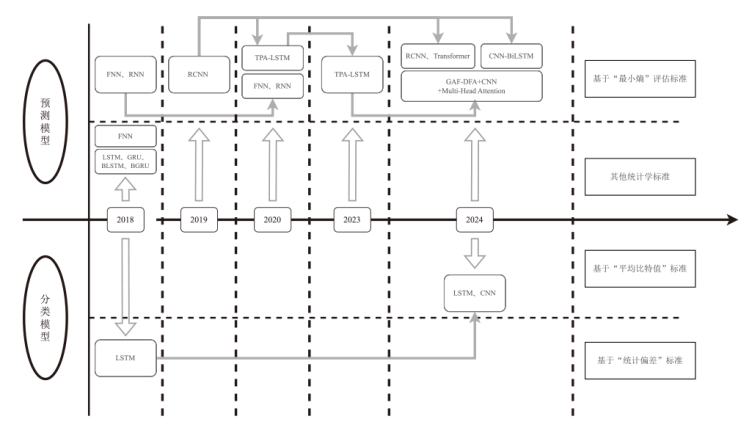
| 方案 | 模型 | 随机数 生成器 | 评估 标准 | 对比对象 |
|---|---|---|---|---|
| FAN[ | FNN | PRNG | 成功预测概率 | 无 |
| FISCHER[ | LSTM、GRU、BLSTM、BGRU | PRNG、CSPRNG | 统计学标准 | Diehard测试 |
| YANG[ 等人方案 | FNN和RNN | PRNG | 最小熵 | NIST 800-90B |
| TRUONG[ | RCNN(LSTM+CNN) | TRNG、CSRNG | 最小熵 | NIST STS |
| LI[ 方案 | TPA-LSTM | TRNG、PRNG | 最小熵 | NIST SP 800-22 |
| LYU[ | FNN和RNN | PRNG | 最小熵 | NIST 800-90B |
| LI[ 方案 | TPA-LSTM | PRNG | 最小熵 | NIST 800-90B、FNN、RNN |
| BLANCO-ROMERO[ | RCNN、Transformer | PRNG | 平均最小熵 | NIST 800-90B |
| CAO[ | CNN-BiLSTM | TRNG | 最小熵 | NIST SP 800-22、RCNN |
| HUANG[ | GAF-DFA+二维CNN+ 多头自注意力机制 | PRNG | 最小熵 | NIST 800-90B、FNN、RNN、RCNN、TPA-LSTM |
| 分类方案 | 模型 | RNG | 评估标准 | 对比对象 |
|---|---|---|---|---|
| KIMURA[ 等人方案 | LSTM | PRNG | 平均比特值 | NIST SP 800-22 |
| CRESPO[ 等人方案 | LSTM、CNN | PRNG、TRNG | 平均比特值 | NIST SP 800-22 |
| [1] |
CHEN Dongyu, CHEN Hua, FAN Limin, et al. Research on Test Strategy for Randomness Based on Deep Learning[J]. Journal on Communications, 2023, 44(6): 23-33.
doi: 10.11959/j.issn.1000-436x.2023111 |
|
陈东昱, 陈华, 范丽敏, 等. 基于深度学习的随机性检验策略研究[J]. 通信学报, 2023, 44(6): 23-33.
doi: 10.11959/j.issn.1000-436x.2023111 |
|
| [2] |
YOSHIYA K, TERASHIMA Y, KANNO K, et al. Entropy Evaluation of White Chaos Generated by Optical Heterodyne for Certifying Physical Random Number Generators[J]. Optics Express, 2020, 28(3): 3686-3698.
doi: 10.1364/OE.382234 pmid: 32122032 |
| [3] |
WANG Anbang, WANG Yuncai, WANG Bingjie, et al. Physical White Chaos Generation[J]. IEEE Journal of Selected Topics in Quantum Electronics, 2015, 21(6): 531-540.
doi: 10.1109/JSTQE.2015.2427253 URL |
| [4] | MARSAGLIA G. Random Number CDROM Including the Diehard Battery of Tests of Randomness[EB/OL]. (1995-12-09).[2025-02-03]. https://cir.nii.ac.jp/crid/1571698600607540352. |
| [5] | L’ECUYER P, SIMARD R. TestU01: A C Library for Empirical Testing of Random Number Generators[J]. ACM Transactions on Mathematical Software, 2007, 33(4): 1-40. |
| [6] | TURAN M S, BARKER E, KELSEY J, et al. Recommendation for the Entropy Sources Used for Random Bit Generation: NIST SP 800-90b[EB/OL]. (2025-01-27)[2025-03-27]. https://nvlpubs.nist.gov/nistpubs/SpecialPublications/NIST.SP.800-90B.pdf. |
| [7] |
GISIN N, RIBORDY G, TITTEL W, et al. Quantum Cryptography[J]. Reviews of Modern Physics, 2002, 74(1): 145-195.
doi: 10.1103/RevModPhys.74.145 URL |
| [8] | FENG Yulong, HAO Lingyi. Testing Randomness Using Artificial Neural Network[J]. IEEE Access, 2020, 8: 163685-163693. |
| [9] | VOLOVICH I V. Randomness in Classical Mechanics and Quantum Mechanics[J]. Foundations of Physics, 2011, 41(3): 516-528. |
| [10] |
OZKAYNAK F. Cryptographically Secure Random Number Generator with Chaotic Additional Input[J]. Nonlinear Dynamics, 2014, 78(3): 2015-2020.
doi: 10.1007/s11071-014-1591-y URL |
| [11] | PRENEEL B, DODUNEKOV S, RIJMEN V. Enhancing Cryptographic Primitives with Techniques from Error Correcting Codes[M]. Amsterdam: IOS Press, 2000. |
| [12] | HAAHR M. Introduction to Randomness and Random Numbers[J]. Statistics, 1999(8): 1-4. |
| [13] | LEE J S, CLEAVER G B. The Cosmic Microwave Background Radiation Power Spectrum as a Random Bit Generator for Symmetric and Asymmetric-Key Cryptography[J]. Heliyon, 2017, 3(10): 1-11. |
| [14] | ZHUN Huang, CHENHongyi. A Truly Random Number Generator Based on Thermal Noise[C]// IEEE. The 4th International Conference on ASIC. New York: IEEE, 2001: 62-86. |
| [15] | HAMBURG M, KOCHER P, MARSON M E. Analysis of Intel’s Ivy Bridge Digital Random Number Generator[R]. San Francisco, CA: Cryptography Research, Inc., Intel_TRNG_Report_20120312, 2012. |
| [16] |
STOJANOVSKI T, PIHL J, KOCAREV L. Chaos-Based Random Number Generators[J]. IEEE Transactions on Circuits and Systems I: Fundamental Theory and Applications, 2001, 48(3): 382-385.
doi: 10.1109/81.915396 URL |
| [17] | ANANTHASWAMY A. How to Ttrn a Quantum Computer into the Ultimate Randomness Generator[EB/OL]. (2019-06-19)[2025-03-27]. https://www.quantamagazine.org/how-to-turn-a-quantum-computer-into-the-ultimate-randomness-generator-20190619/. |
| [18] |
ELMAN J L. Finding Structure in Time[J]. Cognitive Science, 1990, 14(2): 179-211.
doi: 10.1207/s15516709cog1402_1 URL |
| [19] |
LECUN Y, BOTTOU L, BENGIO Y, et al. Gradient-Based Learning Applied to Document Recognition[J]. Proceedings of the IEEE, 1998, 86(11): 2278-2324.
doi: 10.1109/5.726791 URL |
| [20] | VASWANI A, SHAZEER N, PARMAR N, et al. Attention Is All You Need[EB/OL]. (2017-11-07)[2025-03-27]. https://arxiv.org/abs/1706.03762.. |
| [21] |
HOCHREITER S, SCHMIDHUBER J. Long Short-Term Memory[J]. Neural Computation, 1997, 9(8): 1735-1780.
doi: 10.1162/neco.1997.9.8.1735 pmid: 9377276 |
| [22] | CHO K, MERRIENBOER B, GULCEHRE C, et al. Learning Phrase Representations Using RNN Encoder-Decoder for Statistical Machine Translation[EB/OL]. (2014-09-03)[2025-03-29]. http://arxiv.org/abs/1406.1078. |
| [23] | RUKHIN A, SOTO J, NECHVATAL J, et al. A Statistical Test Suite for Random and Pseudo Random Number Generators for Cryptographic Applications[M]. Gaithersburg: NIST, 2001. |
| [24] | GM/T 0005-2021 Randomness Testing Specification[S]. Beijing: State Cryptography Administration, 2021. |
| GM/T 0005-2021 随机性检测规范[S]. 北京: 国家密码管理局, 2021. | |
| [25] |
HURLEY-SMITH D, HERNANDEZ-CASTRO J. Certifiably Biased: An In-Depth Analysis of a Common Criteria EAL4+ Certified TRNG[J]. IEEE Transactions on Information Forensics and Security, 2018, 13(4): 1031-1041.
doi: 10.1109/TIFS.2017.2777342 URL |
| [26] | MANTIN I, SHAMIR A. A Practical Attack on Broadcast RC4[C]// Springer. Fast Software Encryption Conference. Heidelberg: Springer, 2002: 152-164. |
| [27] | CRYPTREC. Investigation Reports on Cryptographic Techniques[EB/OL]. (2023-02-12)[2025-03-29]. https://www.cryptrec.go.jp/en/tech_reports.html. |
| [28] |
SHANNON C E. Prediction and Entropy of Printed English[J]. Bell System Technical Journal, 1951, 30(1): 50-64.
doi: 10.1002/bltj.1951.30.issue-1 URL |
| [29] | HAGERTY P, DRAPER T. Entropy Bounds and Statistical Tests[C]// NIST. The NIST Random Bit Generation Workshop. Gaithersburg: NIST, 2012: 5-6. |
| [30] | GOLIC J D. New Methods for Digital Generation and Postprocessing of Random Data[J]. IEEE Transactions on Computers, 2006, 55(10): 1217-1229. |
| [31] | WIECZOREK P Z, GOŁOFIT K. Dual-Metastability Time-Competitive True Random Number Generator[J]. IEEE Transactions on Circuits and Systems I: Regular Papers, 2014, 61(1): 134-145. |
| [32] | TURAN M S, BARKER E, KELSEY J, et al. Recommendation for the Entropy Sources Used for Random Bit Generation[R]. Gaithersburg: National Institute of Standards and Technology, NIST SP 800-90b, 2018. |
| [33] | KELSEY J, MCKAY K, TURAN M. Predictive Models for Min-Entropy Estimation[C]// Springer. Cryptographic Hardware and Embedded Systems Conference. Heidelberg: Springer, 2015: 373-392. |
| [34] | ZHU Shuangyi, MA Yuan, CHEN Tianyu, et al. Analysis and Improvement of Entropy Estimators in NIST SP 800-90B for Non-IID Entropy Sources[J]. IACR Transactions on Symmetric Cryptology, 2017(6): 151-168. |
| [35] | MENEZES A J, OORSCHOT P C, VANSTONE S A. Handbook of Applied Cryptography[M]. Boca Raton: CRC Press, 2018. |
| [36] | SAVIR J, MCANNEY W H. A Multiple Seed Linear Feedback Shift Register[C]// IEEE. International Test Conference. New York: IEEE, 1990: 657-659. |
| [37] | LI Youru, ZHU Zhenfeng, KONG Deqiang, et al. EA-LSTM: Evolutionary Attention-Based LSTM for Time Series Prediction[J]. Knowledge-Based Systems, 2019, 181: 85-96. |
| [38] | NIU Zhenwen, YU Zeyuan, TANG Wenhu, et al. Wind Power Forecasting Using Attention-Based Gated Recurrent Unit Network[J]. Energy, 2020, 196: 70-81. |
| [39] |
YUAN Ye, JIA Kebin, MA Fenglong, et al. A Hybrid Self-Attention Deep Learning Framework for Multivariate Sleep Stage Classification[J]. BMC Bioinformatics, 2019, 20(16): 586-595.
doi: 10.1186/s12859-019-3075-z |
| [40] | FAN Fenglei, WANG Ge. Learning from Pseudo-Randomness with an Artificial Neural Network-Does God Play Pseudo-Dice?[J]. IEEE Access, 2018, 6: 22987-22992. |
| [41] | FISCHER T. Testing Cryptographically Secure Pseudo Random Number Generators with Artificial Neural Networks[C]// IEEE. The 17th IEEE International Conference on Trust, Security and Privacy in Computing and Communications. New York: IEEE, 2018: 1214-1223. |
| [42] | YANG Jing, ZHU Shuangyi, CHEN Tianyu, et al. Neural Network Based Min-Entropy Estimation for Random Number Generators[C]// Springer. Security and Privacy in Communication Networks. Heidelberg: Springer, 2018: 231-250. |
| [43] | TRUONG N D, HAW J Y, ASSAD S M, et al. Machine Learning Cryptanalysis of a Quantum Random Number Generator[J]. IEEE Transactions on Information Forensics and Security, 2019, 14(2): 403-414. |
| [44] | LI Cai, ZHANG Jianguo, SANG Luxiao, et al. Deep Learning-Based Security Verification for a Random Number Generator Using White Chaos[J]. Entropy, 2020, 22(10): 11-34. |
| [45] | LYU Na, CHEN Tianyu, ZHU Shuangyi, et al. High-Efficiency Min-Entropy Estimation Based on Neural Network for Random Number Generators[J]. Security and Communication Networks, 2020, 20: 1-18. |
| [46] | LI Haohao, ZHANG Jianguo, LI Zhihua, et al. Improvement of Min-Entropy Evaluation Based on Pruning and Quantized Deep Neural Network[J]. IEEE Transactions on Information Forensics and Security, 2023, 18: 1410-1420. |
| [47] | BLANCO-ROMERO J, LORENZO V, ALMENARES M F, et al. Machine Learning Predictors for Min-Entropy Estimation[J]. Entropy, 2025, 27(2): 156-165. |
| [48] | CAO Jian, ZHANG Minghui, LIU Weiqi, et al. Deep Learning-Based Security Analysis of Quantum Random Numbers Generated by Imperfect Devices[J]. IEEE Transactions on Information Forensics and Security, 2024, 19: 7841-7852. |
| [49] | HUANG Yilong, FAN Fan, HUANG Chaofeng, et al. MA-DG: Learning Features of Sequences in Different Dimensions for Min-Entropy Evaluation via 2D-CNN and Multi-Head Self-Attention[J]. IEEE Transactions on Information Forensics and Security, 2024, 19: 7879-7894. |
| [50] | ZHU Shuangyi, MA Yuan, LI Xusheng, et al. On the Analysis and Improvement of Min-Entropy Estimation on Time-Varying Data[J]. IEEE Transactions on Information Forensics and Security, 2020, 15: 1696-1708. |
| [51] | KIMURA H, ISOBE T, OHIGASHI T. Neural-Network-Based Pseudo-Random Number Generator Evaluation Tool for Stream Ciphers[C]// IEEE. 2019 Seventh International Symposium on Computing and Networking Workshops. New York: IEEE, 2019: 333-338. |
| [52] | CRESPO J, GONZALEZ-VILLA J, GUTIERREZ J, et al. Assessing the Quality of Random Number Generators through Neural Networks[J]. Machine Learning: Science and Technology, 2024, 5(2): 72-83. |
| [53] | SINHA S, ISLAM S H, OBAIDAT M S. A Comparative Study and Analysis of Some Pseudorandom Number Generator Algorithms[J]. Security and Privacy, 2018, 1(6): 46-52. |
| [54] | PIRANDOLA S, ANDERSEN U L, BANCHI L, et al. Advances in Quantum Cryptography[J]. Advances in Optics and Photonics, 2020, 12(4): 1012-1236. |
| [55] | KIM K, CHOI S, KWON H, et al. FACE-LIGHT: Fast AES-CTR Mode Encryption for Low-End Microcontrollers[C]// Springer. Information Security and Cryptology- ICISC 2019. Heidelberg: Springer, 2020: 102-114. |
| [56] | ZHOU Haoyi, ZHANG Shanghang, PENG Jiepeng, et al. Informer: Beyond Efficient Transformer for Long Sequence Time-Series Forecasting[C]// AAAI. The AAAI Conference on Artificial Intelligence. Cambridge: AAAI, 2021: 11106-11115. |
| [57] | YU Han, GUO Peikun, SANO A. AdaWaveNet: Adaptive Wavelet Network for Time Series Analysis[EB/OL]. (2024-05-17)[2025-03-11]. http://arxiv.org/abs/2405.11124. |
| [58] | LI Yanan, WANG Zhimin, XING Ruipeng, et al. Quantum Gated Recurrent Neural Networks[J]. IEEE Transactions on Pattern Analysis and Machine Intelligence, 2025, 47(4): 2493-2504. |
| [59] | LIU Junhua, LIM K H, WOOD K L, et al. Hybrid Quantum-Classical Convolutional Neural Networks[J]. Science China Physics, Mechanics & Astronomy, 2021, 64(9): 290-311. |
| [60] | SCARANI V, BECHMANN-PASQUINUCCI H, CERF N J, et al. The Security of Practical Quantum Key Distribution[J]. Reviews of Modern Physics, 2009, 81(3): 1301-1350. |
| [1] | LENG Yongqing, AO Tianyong, QIU Xin, CUI Xingli, LI Shaoshi. Design and Implementation of Automatic Assessment System for Cryptographic Criteria of S-Box [J]. Netinfo Security, 2025, 25(7): 1103-1110. |
| [2] | YANG Yijia, LI Kangquan, SUN Bing. Research on Orthomorphic Permutations Based on Cryptographic Structure [J]. Netinfo Security, 2025, 25(5): 722-731. |
| [3] | ZHANG Xinglan, TAO Kejin. Universal Perturbations Generation Method Based on High-Level Features and Important Channels [J]. Netinfo Security, 2025, 25(5): 767-777. |
| [4] | LI Xiao, SONG Xiao, LI Yong. Research on Differential Privacy Methods for Medical Diagnosis Based on Knowledge Distillation [J]. Netinfo Security, 2025, 25(4): 524-535. |
| [5] | HAN Yiliang, PENG Yixuan, WU Xuguang, LI Yu. Multimodal Feature Fusion Encrypted Traffic Classification Model Based on Graph Variational Auto-Encoder [J]. Netinfo Security, 2025, 25(12): 1914-1926. |
| [6] | ZHANG Lu, JIA Peng, LIU Jiayong. Binary Code Similarity Detection Method Based on Multivariate Semantic Graph [J]. Netinfo Security, 2025, 25(10): 1589-1603. |
| [7] | GUO Xiangxin, LIN Jingqiang, JIA Shijie, LI Guangzheng. Security Analysis of Cryptographic Application Code Generated by Large Language Model [J]. Netinfo Security, 2024, 24(6): 917-925. |
| [8] | YAN Hailong, WANG Shulan. Design and Implementation of Integrated Service Platform for Real Estate Registration Based on Domestic Cryptographic Technology [J]. Netinfo Security, 2024, 24(2): 303-308. |
| [9] | ZHANG Xuan, WAN Liang, LUO Heng, YANG Yang. Automated Botnet Detection Method Based on Two-Stage Graph Learning [J]. Netinfo Security, 2024, 24(12): 1933-1947. |
| [10] | SA Qirui, YOU Weijing, ZHANG Yifei, QIU Weiyang, MA Cunqing. A Survey of Ownership Protection Schemes for Federated Learning Models [J]. Netinfo Security, 2024, 24(10): 1553-1561. |
| [11] | JIANG Zenghui, ZENG Weijun, CHEN Pu, WU Shitao. Review of Adversarial Samples for Modulation Recognition [J]. Netinfo Security, 2023, 23(6): 74-90. |
| [12] | ZHAO Xiaolin, WANG Qiyao, ZHAO Bin, XUE Jingfeng. Research on Anonymous Traffic Classification Method Based on Machine Learning [J]. Netinfo Security, 2023, 23(5): 1-10. |
| [13] | ZHAO Caidan, CHEN Jingqian, WU Zhiqiang. Automatic Modulation Recognition Algorithm Based on Multi-Channel Joint Learning [J]. Netinfo Security, 2023, 23(4): 20-29. |
| [14] | WANG Jingyu, MA Zhaofeng, XU Danheng, DUAN Pengfei. Blockchain Transaction Data Privacy-Preserving Scheme Supporting National Cryptographic Algorithm [J]. Netinfo Security, 2023, 23(3): 84-95. |
| [15] | XU Shengwei, DENG Ye, LIU Changhe, TAN Li. A Selective Encryption Scheme for Audio and Video Based on the National Cryptographic Algorithm [J]. Netinfo Security, 2023, 23(11): 48-57. |
| Viewed | ||||||
|
Full text |
|
|||||
|
Abstract |
|
|||||