Netinfo Security ›› 2026, Vol. 26 ›› Issue (10): 1616-1635.doi: 10.3969/j.issn.1671-1122.2026.10.008
Previous Articles Next Articles
Communication-efficient privacy-preserving federated learning method
Han Siyuan1, Miao Yinbin1, Zhang Weibin1, Liu Shuying2( ), Liu Shuqin3
- 1
School of Cyber Engineering ,Xidian University Xi’an 710126, China
2School of Electronic Information ,Northwest University Xi’an 710127, China
3School of Computer Science and Technology ,Xi’an University of Posts and Telecommunications Xi’an 710121, China
-
Received:2026-07-20Online:2026-10-10Published:2026-11-06 -
Contact:Liu Shuying E-mail:lsynate@163.com

CLC Number:
Cite this article
Han Siyuan, Miao Yinbin, Zhang Weibin, Liu Shuying, Liu Shuqin. Communication-efficient privacy-preserving federated learning method[J]. Netinfo Security, 2026, 26(10): 1616-1635.
share this article
Add to citation manager EndNote|Ris|BibTeX
URL: http://netinfo-security.org/EN/10.3969/j.issn.1671-1122.2026.10.008
| 方案 | 异构秩 | 隐私保护 | 层级相关性 | 选择加密 |
|---|---|---|---|---|
| MaskCrypt[ | × | Paillier同态加密 | • | × |
| SHE-LoRA[ | × | CKKS同态加密 | • | × |
| FFA-LoRA[ | • | 差分隐私 | • | • |
| SLoRA[ | • | • | • | • |
| HeterLoRA[ | × | • | • | • |
| NbAFL[ | • | 差分隐私 | • | • |
| MPCFL[ | × | 多方安全计算 | • | • |
| 本文方法 | × | CKKS同态加密 | × | × |
| 符号 | 含义 |
|---|---|
| 客户端总数、第 | |
| 客户端 | |
| 用于提取层级激活并计算CKA/Wanda指标的本地校准集 | |
| 当前通信轮及总通信轮数 | |
| LoRA层数及层索引 | |
| 客户端 | |
| 第 | |
| 客户端 | |
| 输入第 | |
| 客户端 | |
| 参与客户端层级得分的平均值及服务器据此确定的第 统一层级配额 | |
| 均匀方案的每层加密列数上限及名义总加密列数上限 | |
| 基于权重幅值与输入激活范数计算的Wanda敏感度 | |
| 第 | |
| 三元协商得到的第 | |
| 客户端 | |
| 有效单位密文代价、单位明文标量代价及第 | |
| CKKS多项式模次数、SIMD槽数、单个序列化密文字节数及明文标量字节数 | |
| 客户端 | |
| 客户端第 | |
| 三元协商中公共频次、全局敏感度和客户端长尾的列数配额 | |
| RSVD过采样维数及幂迭代次数 | |
| 名义加密比例上限及第 |
| 秩配置 | 方法 | PPL | MMLU | ROUGE-L F1 |
|---|---|---|---|---|
| 无异构(6,6,6,6) | MaskCrypt | 7.136±0.895 | 28.233%±?.???% | 69.919%±?.???% |
| SHE-LoRA | 7.021±0.405 | 28.763%±?.???% | 70.574%±?.???% | |
| CKA-LoRA | 7.018±0.203 | 29.010%±?.???% | 70.931%±?.???% | |
| 轻度异构 (2,4,6,8) | MaskCrypt | 7.284±0.912 | 28.041%±?.???% | 69.672%±?.???% |
| SHE-LoRA | 7.146±0.431 | 28.5125±?.???% | 70.342%±?.???% | |
| CKA-LoRA | 7.108±0.224 | 28.842%±?.???% | 70.716%±?.???% | |
| 中度异构(2,8,16,32) | MaskCrypt | 7.561±0.974 | 27.684%±?.???% | 69.214%±?.???% |
| SHE-LoRA | 7.362±0.462 | 28.207%±?.???% | 69.981%±?.???% | |
| CKA-LoRA | 7.251±0.247 | 28.621%±?.???% | 70.421%±?.???% | |
| 高度异构(2,8,32,64) | MaskCrypt | 7.892±1.086 | 27.201%±?.???% | 68.731%±?.???% |
| SHE-LoRA | 7.648±0.508 | 27.842%±?.???% | 69.562%±?.???% | |
| CKA-LoRA | 7.431±0.286 | 28.394%±?.???% | 70.083%±?.???% |
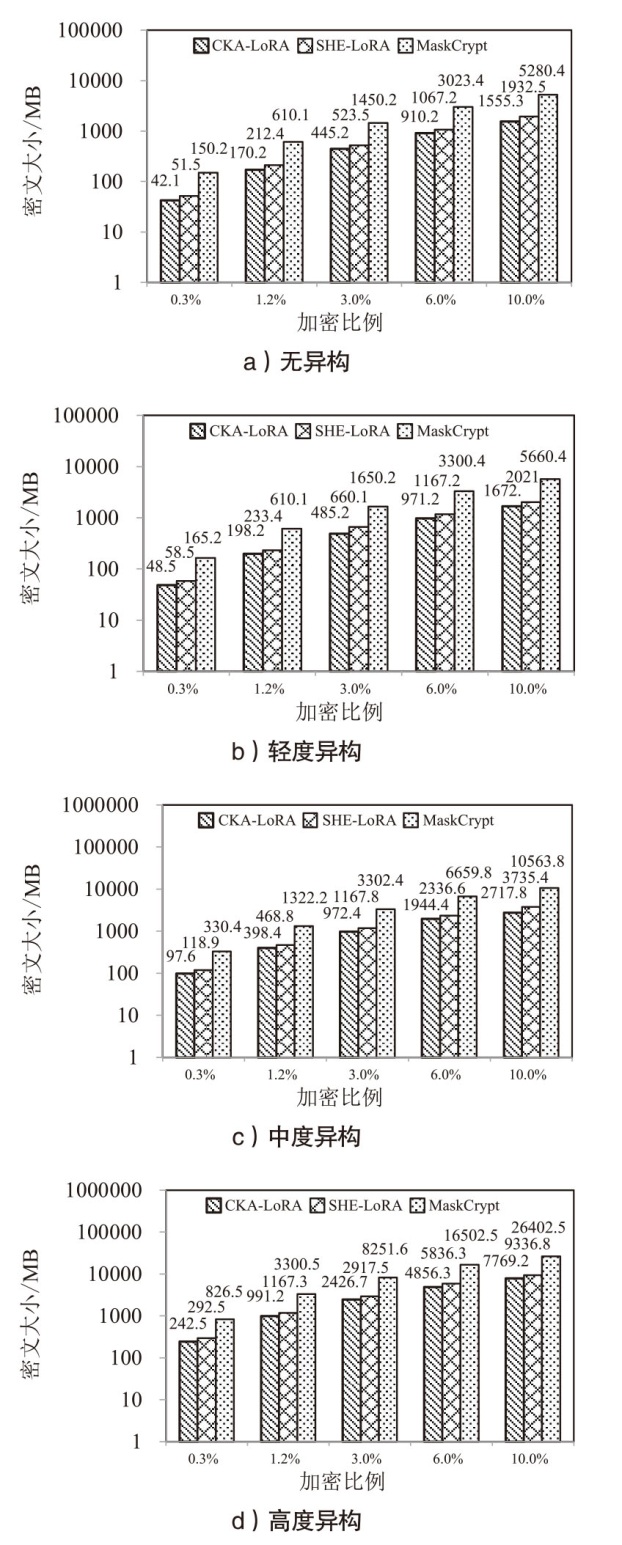
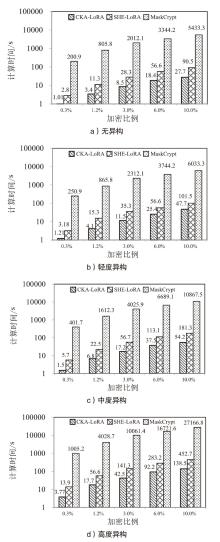
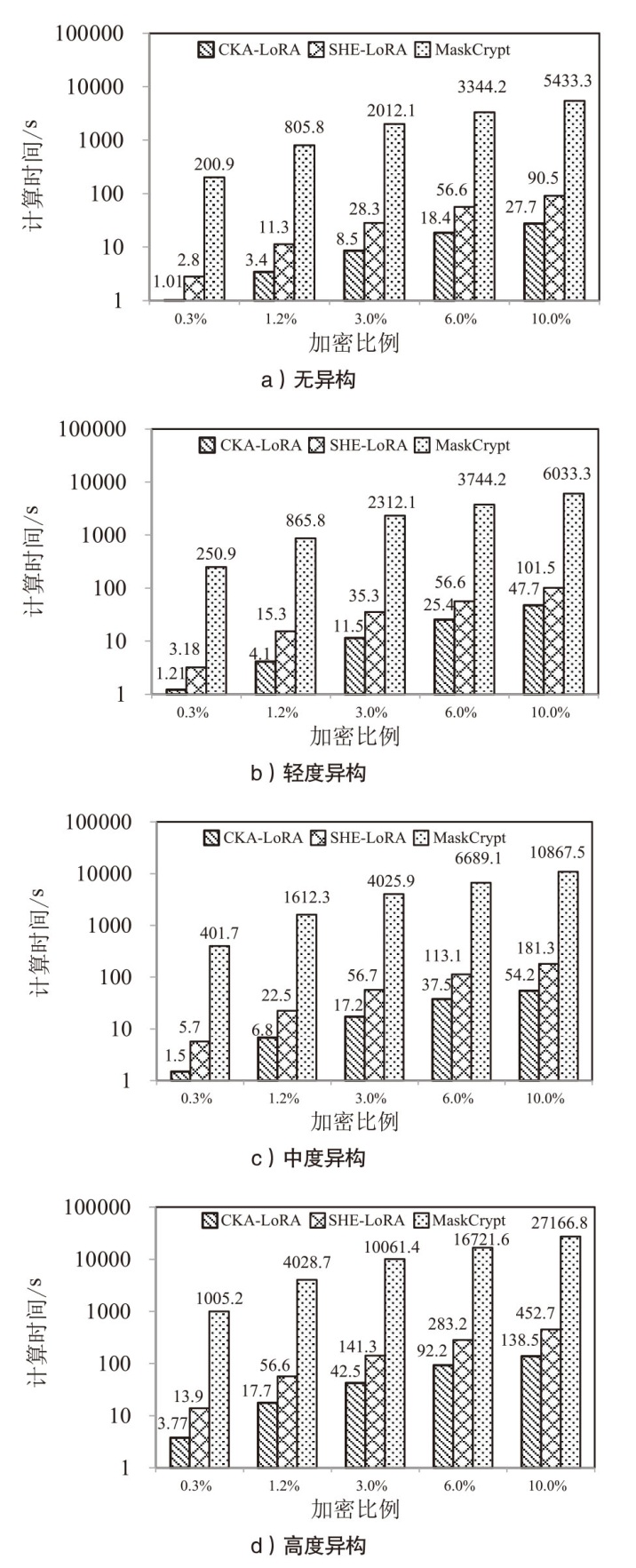
| 消融实验 | PPL | MMLU | 实际加密比例 | 每轮密文量/MB | 每轮聚合 时间/s |
|---|---|---|---|---|---|
| A0 | 8.326± 1.026 | 26.23%± 1.22% | 0.2392% | 562.06 | 7.73±4.84 |
| A1 | 8.331± 1.047 | 25.61%± 0.55% | 0.2969% | 697.63 | 11.74±0.85 |
| A2 | 8.307± 1.051 | 25.00%± 0.46% | 1.2889%± 0.0039% | 3028.68± 9.08 | 12.54±0.49 |
| A3 | 8.338± 1.056 | 26.40%± 0.92% | 0.2392% | 562.06 | 1993.10±50.99 |
| 加密列数 | 加密比例 | ROUGE-L F1 | Token恢复率 | 攻击成功率 |
|---|---|---|---|---|
| 0 | 0 | 71.830%±?.???% | 56.600%±?.???% | 78.380%±?.???% |
| 1 | 0.015% | 6.780%±?.???% | 4.650%±?.???% | 3.700%±?.???% |
| 3 | 0.045% | 1.010%±?.???% | 0.547%±?.???% | 0.842%±?.???% |
| 10 | 0.150% | 0 | 0 | 0 |
| 20 | 0.300% | 0 | 0 | 0 |
| 32 | 0.500% | 0 | 0 | 0 |
| 64 | 1.000% | 0 | 0 | 0 |
| [1] | Li Heju, Wang Rui, Wu Jun, et al. Reconfigurable intelligent surface empowered federated edge learning with statistical CSI[J]. IEEE Transactions on Wireless Communications, 2024, 23(6): 6595-6608. |
| [2] | Xu Liang, Zhu Lei, Wu Yaotong, et al. SuperCLUE-Fin: graded fine-grained analysis of Chinese LLMs on diverse financial tasks and applications[PP/OL]. V1. arXiv (2024-04-29)[2026-07-10]. https://doi.org/10.48550/arXiv.2404.19063. |
| [3] | Li Heju, Wang Rui, Jiang Mingyang, et al. STAR-RIS-empowered heterogeneous federated edge learning with flexible aggregation[J]. IEEE Internet of Things Journal, 2025, 12(14): 28374-28389. |
| [4] | Zhao Yue, Li Meng, Lai Liangzhen, et al. Federated learning with non-IID data[PP/OL]. V2. arXiv (2022-07-21)[2026-07-10]. https://doi.org/10.48550/arXiv.1806.00582. |
| [5] | Li Heju, Wang Rui, Wu Jun, et al. Federated edge learning via reconfigurable intelligent surface with one-bit quantization[C]// 2022 IEEE Global Communications Conference. New York: IEEE, 2022: 1055-1060. |
| [6] | Hu E J, Shen Yelong, Wallis P, et al. LoRA: low-rank adaptation of large language models[PP/OL]. V2. arXiv (2021-10-16)[2026-07-10]. https://doi.org/10.48550/arXiv.2106.09685. |
| [7] | Stich S U, Cordonnier J B, Jaggi M. Sparsified SGD with memory[PP/OL]. V2. arXiv (2018-11-28)[2026-07-10]. https://doi.org/10.48550/arXiv.1809.07599. |
| [8] | Lin Yujun, Han Song, Mao Huizi, et al. Deep gradient compression: reducing the communication bandwidth for distributed training[PP/OL]. V3. arXiv (2020-06-23)[2026-07-10]. https://doi.org/10.48550/arXiv.1712.01887. |
| [9] | Zhu Ligeng, Liu Zhijian, Han Song. Deep leakage from gradients[C]// Advances in Neural Information Processing Systems. Red Hook: Curran Associates, 2019: 14774-14784. |
| [10] | Geiping J, Bauermeister H, Dröge H, et al. Inverting gradients—how easy is it to break privacy in federated learning?[C]// Advances in Neural Information Processing Systems. Red Hook: Curran Associates, 2020: 16937-16947. |
| [11] | Wang Shiqiang, Tuor T, Salonidis T, et al. Adaptive federated learning in resource constrained edge computing systems[J]. IEEE Journal on Selected Areas in Communications, 2019, 37(6): 1205-1221. |
| [12] | Hu Chenghao, Li Baochun. MaskCrypt: federated learning with selective homomorphic encryption[J]. IEEE Transactions on Dependable and Secure Computing, 2025, 22(1): 221-233. |
| [13] | Liu Jianmin, Yan Li, Li Borui, et al. SHE-LoRA: selective homomorphic encryption for federated tuning with heterogeneous LoRA[PP/OL]. V2. arXiv (2026-02-21)[2026-07-10]. https://doi.org/10.48550/arXiv.2505.21051. |
| [14] | Sun Youbang, Li Zitao, Li Yaliang, et al. Improving LoRA in privacy-preserving federated learning[PP/OL]. V1. arXiv (2024-03-18)[2026-07-10]. https://doi.org/10.48550/arXiv.2403.12313. |
| [15] | Babakniya S, Elkordy A R, Ezzeldin Y H, et al. SLoRA: federated parameter efficient fine-tuning of language models[PP/OL]. V1. arXiv (2023-08-12)[2026-07-10]. https://doi.org/10.48550/arXiv.2308.06522. |
| [16] | Li Tian, Sahu A K, Zaheer M, et al. Federated optimization in heterogeneous networks[J]. Proceedings of Machine Learning and Systems, 2020(2): 429-450. |
| [17] | Karimireddy S P, Kale S, Mohri M, et al. SCAFFOLD: stochastic controlled averaging for federated learning[C]// The 37th International Conference on Machine Learning. Cambridge: PMLR, 2020: 5132-5143. |
| [18] | Wang Jianyu, Liu Qinghua, Liang Hao, et al. Tackling the objective inconsistency problem in heterogeneous federated optimization[C]// Advances in Neural Information Processing Systems. Red Hook: Curran Associates, 2020: 7611-7623. |
| [19] | Cho Y J, Liu Luyang, Xu Zheng, et al. Heterogeneous LoRA for federated fine-tuning of on-device foundation models[C]// The 2024 Conference on Empirical Methods in Natural Language Processing. Stroudsburg: ACL, 2024: 12903-12913. |
| [20] | Bai Jiamu, Chen Daoyuan, Qian Bingchen, et al. Federated fine-tuning of large language models under heterogeneous tasks and client resources[PP/OL]. V2. arXiv (2024-05-30)[2026-07-10]. https://doi.org/10.48550/arXiv.2402.11505. |
| [21] | Yan Yunlu, Feng Chunmei, Zuo Wangmeng, et al. Federated residual low-rank adaptation of large language models[C]// The 13th International Conference on Learning Representations. San Diego: ICLR, 2025: 30657-30681. |
| [22] | Wei Kang, Li Jun, Ding Ming, et al. Federated learning with differential privacy: algorithms and performance analysis[J]. IEEE Transactions on Information Forensics and Security, 2020, 15: 3454-3469. |
| [23] | Kaminaga H, Awaysheh F, Alawadi S, et al. MPCFL: towards multi-party computation for secure federated learning aggregation[C]// The 16th IEEE/ACM International Conference on Utility and Cloud Computing. New York: ACM, 2023: 1-10. |
| [24] | Bonawitz K A, Ivanov V, Kreuter B, et al. Practical secure aggregation for privacy-preserving machine learning[C]// The 2017 ACM SIGSAC Conference on Computer and Communications Security. New York: ACM, 2017: 1175-1191. |
| [25] | Zhang Chengliang, Li Suyi, Xia Junming, et al. BatchCrypt: efficient homomorphic encryption for cross-silo federated learning[C]// 2020 USENIX Annual Technical Conference. Berkeley: USENIX, 2020: 493-506. |
| [26] | Jin Weizhao, Yao Yuhang, Han Shanshan, et al. FedML-HE: an efficient homomorphic-encryption-based privacy-preserving federated learning system[PP/OL]. V3. arXiv (2024-06-17)[2026-07-10]. https://doi.org/10.48550/arXiv.2303.10837. |
| [27] | Kornblith S, Norouzi M, Lee H, et al. Similarity of neural network representations revisited[C]// The 36th International Conference on Machine Learning. Cambridge: PMLR, 2019: 3519-3529. |
| [28] | McMahan H B, Moore E, Ramage D, et al. Communication-efficient learning of deep networks from decentralized data[C]// The 20th International Conference on Artificial Intelligence and Statistics. Cambridge: PMLR, 2017: 1273-1282. |
| [29] | Zheng Xiawu, Fei Xiang, Zhang Lei, et al. Neural architecture search with representation mutual information[C]// Proceedings of the IEEE/CVF Conference on Computer Vision and Pattern Recognition. New York: IEEE/CVF, 2022: 11912-11921. |
| [30] | Tishby N, Pereira F C, Bialek W. The information bottleneck method[C]// The 37th Annual Allerton Conference on Communication, Control, and Computing. Monticello: University of Illinois, 1999: 368-377. |
| [31] | Halko N, Martinsson P G, Tropp J A. Finding structure with randomness: probabilistic algorithms for constructing approximate matrix decompositions[J]. SIAM Review, 2011, 53(2): 217-288. |
| [32] | Cheon J H, Kim A, Kim M, et al. Homomorphic encryption for arithmetic of approximate numbers[C]// Advances in Cryptology—ASIACRYPT 2017. Heidelberg: Springer, 2017: 409-437. |
| [33] | Petrov I, Dimitrov D I, Baader M, et al. DAGER: exact gradient inversion for large language models[PP/OL]. V2. arXiv (2024-11-13)[2026-07-10]. https://doi.org/10.48550/arXiv.2405.15586. |
| [34] | Boldyreva A, Chenette N, Lee Y, et al. Order-preserving symmetric encryption[C]// Advances in Cryptology—EUROCRYPT 2009. Heidelberg: Springer, 2009: 224-241. |
| [35] | Sun Mingjie, Liu Zhuang, Bair A, et al. A simple and effective pruning approach for large language models[PP/OL]. V3. arXiv (2024-05-06)[2026-07-10]. https://doi.org/10.48550/arXiv.2306.11695. |
| [36] | Geng Xinyang, Liu Hao. OpenLLaMA: an open reproduction of LLaMA[EB/OL]. [2026-07-10]. https://github.com/openlm-research/open_llama. |
| [37] | Mishra S, Khashabi D, Baral C, et al. Cross-task generalization via natural language crowdsourcing instructions[C]// The 60th Annual Meeting of the Association for Computational Linguistics. Stroudsburg: ACL, 2022: 3470-3487. |
| [38] | Maas A L, Daly R E, Pham P T, et al. Learning word vectors for sentiment analysis[C]// The 49th Annual Meeting of the Association for Computational Linguistics: Human Language Technologies. Stroudsburg: ACL, 2011: 142-150. |
| [39] | Benaissa A, Retiat B, Cebere B, et al. TenSEAL: a library for encrypted tensor operations using homomorphic encryption[PP/OL]. V2. arXiv (2021-04-28)[2026-07-10]. https://doi.org/10.48550/arXiv.2104.03152. |
| [40] | Beutel D J, Topal T, Mathur A, et al. Flower: a friendly federated learning research framework[PP/OL]. V5. arXiv (2022-03-05)[2026-07-10]. https://doi.org/10.48550/arXiv.2007.14390. |
| [41] | Hendrycks D, Burns C, Basart S, et al.Measuring massive multitask language understanding[PP/OL]. V1. arXiv (2020-09-07)[2026-07-10]. https://doi.org/10.48550/arXiv.2009.03300. |
| [42] | Wang A, Singh A, Michael J, et al. GLUE: a multi-task benchmark and analysis platform for natural language understanding[C]// The 2018 EMNLP Workshop BlackboxNLP:Analyzing and Interpreting Neural Networks for NLP. Stroudsburg: ACL, 2018: 353-355. |
| [1] | Nie Haojie, Sun Degang, Pan Xingbo, Wan Wei, Long Chun. A survey of membership inference attacks and defenses for large language models [J]. Netinfo Security, 2026, 26(9): 1341-1353. |
| [2] | Ma Wenfei, Long Chun, Li Jing, Yang Fan, Fu Yuhao. Backdoor poisoning in the fine-tuning stage of large language models: attacks, defenses, and evaluation [J]. Netinfo Security, 2026, 26(9): 1354-1368. |
| [3] | Song Zheng, Yang Ruiqi, Li Huacheng. Survey of repository-level static vulnerability detection: from rule-driven to LLM and agent [J]. Netinfo Security, 2026, 26(9): 1369-1382. |
| [4] | Zhu Xiaoqiang, Lin Yanzi, Zhang Haowen, Yao Yingying. A robust aggregation method for blockchain federated learning based on multi-dimensional features and dynamic defense [J]. Netinfo Security, 2026, 26(9): 1391-1407. |
| [5] | Yao Wuhuang, Wang Jiapeng, Chen Kangbing, Zheng Zhihan, Tan Yu’an. An LLM-assisted firmware memory leak analysis based on instruction translation instrumentation [J]. Netinfo Security, 2026, 26(7): 1087-1100. |
| [6] | Yang Qiaoyang, Fan Ximing, Jia Peng. LLM-based semantic-aware fuzz driver generation [J]. Netinfo Security, 2026, 26(7): 1128-1148. |
| [7] | Song Mengyuan, Xia Hui. Federated unlearning via knowledge distillation and adversarial examples [J]. Netinfo Security, 2026, 26(7): 1149-1163. |
| [8] | SUN Yu, ZHANG Xuanrui, LIU Xinyu. Advances in Advanced Persistent Threat Detection and Provenance Research [J]. Netinfo Security, 2026, 26(6): 833-853. |
| [9] | ZHANG Hao, YE Junwei. Deep Active Learning Based Federated Semi-Supervised Intrusion Detection System [J]. Netinfo Security, 2026, 26(6): 944-957. |
| [10] | MIAO Bo, YUAN Deyu, ZHANG Teng, YANG Yi, HUANG Zan. Chain-of-Thought Poisoning Based Retrieval-Augmented Generation Backdoor Attack [J]. Netinfo Security, 2026, 26(6): 977-998. |
| [11] | LI Zihao, ZHANG Fengwei. TEE-Based Federated Learning Platform [J]. Netinfo Security, 2026, 26(5): 788-808. |
| [12] | CUI Jinhua, DONG Liang, YANG Xin. A Survey of Privacy-Preserving Techniques for Large Language Model Inference [J]. Netinfo Security, 2026, 26(4): 503-520. |
| [13] | LI Yan, YANG Wenzhang, XUE Yinxing. Cross-Language Compiler Fuzzing Based on LLM Translation and Differential Testing [J]. Netinfo Security, 2026, 26(4): 591-604. |
| [14] | HU Mianning, LI Xin, LI Mingfeng, YUAN Deyu. Research on Multi-Strategy Enhanced Chinese Network Threat Intelligence Entity Extraction Based on Large Language Model [J]. Netinfo Security, 2026, 26(4): 615-625. |
| [15] | YUAN Ming, ZOU Qilin, YUAN Wenqi, WANG Qun. A Survey on Prompt Injection Attacks and Defenses in Large Language Models [J]. Netinfo Security, 2026, 26(3): 341-354. |
| Viewed | ||||||
|
Full text |
|
|||||
|
Abstract |
|
|||||