Netinfo Security ›› 2026, Vol. 26 ›› Issue (9): 1391-1407.doi: 10.3969/j.issn.1671-1122.2026.09.006
Previous Articles Next Articles
A robust aggregation method for blockchain federated learning based on multi-dimensional features and dynamic defense
Zhu Xiaoqiang1( ), Lin Yanzi2, Zhang Haowen2, Yao Yingying1
- 1
School of Cyberspace Science and Technology ,Beijing Jiaotong University Beijing 100044, China
2School of Software ,Beijing Jiaotong University Beijing 100044, China
-
Received:2026-06-15Online:2026-09-10Published:2026-09-30 -
Contact:Zhu Xiaoqiang E-mail:xqzhu@bjtu.edu.cn

CLC Number:
Cite this article
Zhu Xiaoqiang, Lin Yanzi, Zhang Haowen, Yao Yingying. A robust aggregation method for blockchain federated learning based on multi-dimensional features and dynamic defense[J]. Netinfo Security, 2026, 26(9): 1391-1407.
share this article
Add to citation manager EndNote|Ris|BibTeX
URL: http://netinfo-security.org/EN/10.3969/j.issn.1671-1122.2026.09.006
| 方法 | 主要检测依据 | 使用 可信 数据 | 客户端 群体关系 建模 | 独立方向异常门控 | 聚合方式 |
|---|---|---|---|---|---|
| FoolsGold | 客户端更新 相似性 | 否 | 是 | 否 | 基于相似性降低权重 |
| FLTrust | 客户端与服务器参考更新的方向关系 | 是 | 否 | 否 | 信任评分与范数归一化 |
| FLDetector | 跨轮次更新 预测偏差 | 否 | 否 | 否 | 异常客户端检测 |
| FLAME | 模型更新聚类、裁剪及噪声 | 否 | 是 | 否 | 聚类筛选与裁剪 |
| Multi-Krum | 客户端更新间的欧氏距离 | 否 | 是 | 否 | 选择距离较小的多个更新聚合 |
| MFDD (本文方法) | 群体一致性、多维行为、 鲁棒中心方向 风险 | 是 | 是 | 是 | 连续信任与条件筛选 |
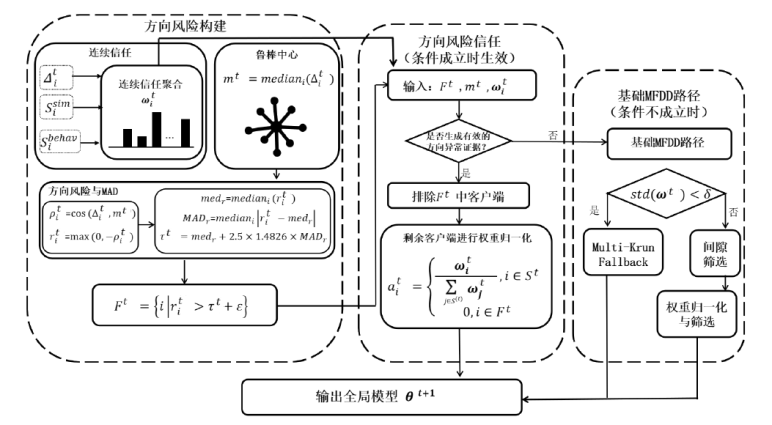
| 符号 | 定义 |
|---|---|
| 第t轮迭代的全局模型参数 | |
| 在第t轮训练结束后客户端 | |
| 用于客户端行为审计的固定探测数据集 | |
| 客户端i,j更新的余弦相似度 | |
| 刻画客户端i更新群体一致性的相似性分量;参与融合前进行归一化,归一化后仍沿用该符号 | |
| 客户端i多维行为异常评分,取值越大表示异常程度越高 | |
| 经Min-Max归一化后的行为异常评分 | |
| 由归一化行为异常评分反向转换并归一化得到的行为信任分量,取值越大表示行为可信度越高 | |
| 归一化行为异常评分 | |
| 相似性分量与行为信任分量融合的自适应调节因子 | |
| 客户端i的连续信任权重 | |
| 避免除零及数值不稳定的小正数 | |
| 第t轮客户端更新的坐标中位数鲁棒中心 | |
| 客户端i更新与鲁棒中心之间的余弦方向相似度 | |
| 客户端i的方向风险评分 | |
| 当前轮次所有客户端方向风险评分的中位数 | |
| 当前轮次方向风险评分的中位数绝对偏差 | |
| 第t轮基于MAD确定的方向风险判别阈值 | |
| 第t轮被方向风险机制标记的客户端集合 | |
| 当前聚合路径下最终保留的客户端集合;方向风险条件成立时为排除 | |
| 客户端i条件筛选后的最终归一化聚合权重 | |
| 连续信任权重退化判别阈值,本文设置为 0.01 | |
| Multi-Krum及安全保留约束使用的拜占庭客户端数量上界 | |
| 升序排列后的相邻连续信任权重之间的第k个间隙 | |
| 最大权重间隙对应的候选分界位置 | |
| 基础MFDD间隙筛选路径最终确定的客户端筛除数量 |
| 项目 | 设置 |
|---|---|
| 客户端数量/个 | 20 |
| 通信轮数/轮 | 50 |
| 本地训练轮数/轮 | 2 |
| 学习率 | 0.01 |
| Batch size | 32 |
| 随机种子 | 42、123、2026 |
| 数据划分 | IID、Shard Non-IID |
| 探测数据集 | 训练集预留100个样本,每类10个,与客户端训练集及最终测试集不重叠 |
| MNIST模型 | Conv(1→16, 3?3) + ReLU + FC(16?26?26→128) + ReLU + FC(128→10) |
| CIFAR-10模型 | 3层卷积网络:32、64、128通道,每层ReLU与2?2最大池化;FC(2048→512) + ReLU + Dropout(0.5) + FC(512→10) |
| 恶意客户端选择 | 每次实验开始时随机无放回抽样,不同seed重新抽样,同一run内固定 |
| 图案后门 | 左上角2?2触发器,像素值置为1.0,目标类别7;恶意客户端每batch中80%的样本注入触发器 |
| 标签翻转 | all-to-one标签投毒,恶意客户端本地样本标签全部修改为目标类别7 |
| CIFAR-10后门通道 | 仅修改第1个图像通道 |
| 协同反向更新 | 对客户端本地更新 |
| ASR测试 | 使用与训练阶段相同规格的触发器,对测试样本全部注入触发器 |
| 主要攻击场景 | 协同反向更新、标签翻转、图案后门 |
| 实验场景 | 评价指标 | MFDD-base | MFDD |
|---|---|---|---|
| Clean | ACC | 0.9790±0.0017 | 0.9790±0.0017 |
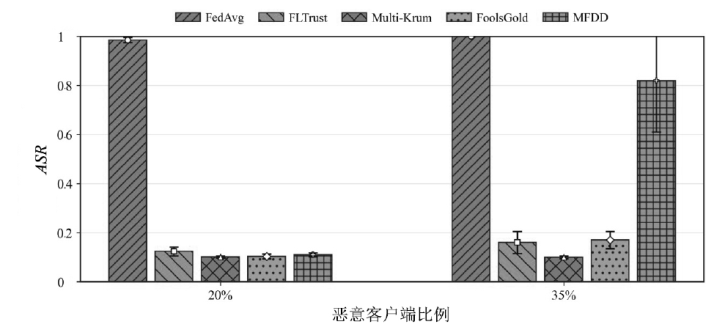
| 图案后门攻击,35% | ASR | 0.8189±0.2061 | 0.8189±0.2061 |
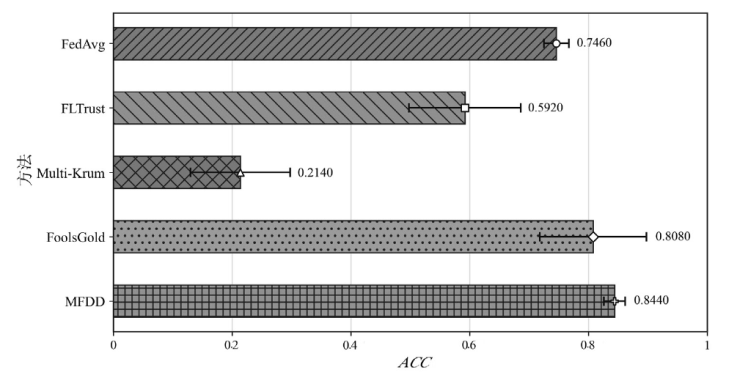
| 协同反向更新,35% | ACC | 0.1763 | 0.9704±0.0025 |
| 协同反向更新,35% | TPR | 0 | 0.4286±0 |
| 验证项目 | 验证对象 | 结果 |
|---|---|---|
| 代表轮次审计 | 第1、25、50轮 | 均完成链上查询 |
| 客户端记录查询 | 每轮20个客户端 | 20/20可查询 |
| 链上链下一致性 | 客户端级与轮次级字段 | MATCH=318,mismatch=0 |
| 重复提交验证 | 相同正式记录重复提交 | 拒绝 |
| 同键覆盖验证 | 相同键提交不同内容 | 拒绝,无静默覆盖 |
| 核心字段篡改验证 | Schema v1核心审计字段 | 8/8通过 |
| 性能指标 | 测试条件 | 平均值/ms | P95/吞吐量 |
|---|---|---|---|
| Payload/outbox生成 | 本地Schema v1审计记录 | 1.791 | — |
| Fabric提交 | Payload生成并提交 | 2095.909 | — |
| 轮次记录查询 | Round record | 11.070 | 30.707 ms |
| 客户端记录查询 | Client record | 11.653 | 27.810 ms |
| 并发提交 | 并发度1 | — | 0.4787 TPS |
| 并发提交 | 并发度2 | — | 0.9452 TPS |
| 并发提交 | 并发度4 | — | 1.8924 TPS |
| 并发提交 | 并发度8 | — | 2.8012 TPS |
| [1] | McMahan B, Moore E, Ramage D, et al. Communication-efficient learning of deep networks from decentralized data[C]// The 20th International Conference on Artificial Intelligence and Statistics. New York: PMLR, 2017: 1273-1282. |
| [2] | 顾育豪, 白跃彬. 联邦学习模型安全与隐私研究进展[J]. 软件学报, 2023, 34(6): 2833-2864. |
| [3] | 穆旭彤, 程珂, 宋安霄, 等. 抗拜占庭攻击的隐私保护联邦学习[J]. 计算机学报, 2024, 47(4): 842-861. |
| [4] | 郑诚波, 闫皓楠, 傅彩利, 等. 面向智能物联网的双层级联邦安全学习架构[J]. 信息网络安全, 2024, 10(6):71-80. |
| [5] |
Wen Jie, Zhang Zhixia, Lan Yang, et al. A survey on federated learning: challenges and applications[J]. International Journal of Machine Learning and Cybernetics, 2023, 14(2): 513-535.
doi: 10.1007/s13042-022-01647-y |
| [6] | Qu Youyang, Uddin M P, Gan Chenquan, et al. Blockchain-enabled federated learning: a survey[J]. ACM Computing Surveys, 2022, 55(4): 1-35. |
| [7] | Issa W, Moustafa N, Turnbull B, et al. Blockchain-based federated learning for securing internet of things: a comprehensive survey[J]. ACM Computing Surveys, 2023, 55(9): 1-43. |
| [8] |
Zheng Zibin, Xie Shaoan, Dai H-N, et al. Blockchain challenges and opportunities: a survey[J]. International Journal of Web and Grid Services, 2018, 14(4): 352-375.
doi: 10.1504/IJWGS.2018.095647 URL |
| [9] |
Zhang Haoran, Jiang Shan, Xuan Shichang. Decentralized federated learning based on blockchain: concepts, framework, and challenges[J]. Computer Communications, 2024, 216: 140-150.
doi: 10.1016/j.comcom.2023.12.042 URL |
| [10] | Shejwalkar V, Houmansadr A, Kairouz P, et al. Back to the drawing board: a critical evaluation of poisoning attacks on production federated learning[C]// 2022 IEEE Symposium on Security and Privacy. New York: IEEE, 2022: 1354-1371. |
| [11] | Zhang Zaixi, Cao Xiaoyu, Jia Jinyuan, et al. FLDetector: defending federated learning against model poisoning attacks via detecting malicious clients[C]// The 28th ACM SIGKDD Conference. New York: ACM, 2022: 2545-2555. |
| [12] | Yin Dong, Chen Yudong, Kannan R, et al. Byzantine-robust distributed learning: towards optimal statistical rates[C]// International Conference on Machine Learning. New York: PMLR, 2018: 5650-5659. |
| [13] | Blanchard P, El Mhamdi E M, Guerraoui R, et al. Machine learning with adversaries: byzantine tolerant gradient descent[C]// Advances in Neural Information Processing Systems 30. Long Beach: Curran Associates Inc, 2017: 118-128. |
| [14] |
Xiao Xiong, Tang Zhuo, Li Chuanying, et al. SCA: sybil-based collusion attacks of IIoT data poisoning in federated learning[J]. IEEE Transactions on Industrial Informatics, 2022, 19(3): 2608-2618.
doi: 10.1109/TII.2022.3172310 URL |
| [15] | Fung C, Yoon C J M, Beschastnikh I. The limitations of federated learning in sybil settings[C]// The 23rd International Symposium on Research in Attacks, Intrusions and Defenses. Berkeley: USENIX, 2020: 301-316. |
| [16] |
Zhu Tengteng, Guo Zehua, Yao Chao, et al. Byzantine-robust federated learning via cosine similarity aggregation[J]. Computer Networks, 2024, 254: 110730.
doi: 10.1016/j.comnet.2024.110730 URL |
| [17] | Hu Hongsheng, Salcic Z, Sun Lichao, et al. Membership inference attacks on machine learning: a survey[J]. ACM Computing Surveys, 2022, 54(11): 1-37. |
| [18] | Fredrikson M, Jha S, Ristenpart T. Model inversion attacks that exploit confidence information and basic countermeasures[C]// The ACM SIGSAC Conference on Computer and Communications Security. New York: ACM, 2015: 1322-1333. |
| [19] | Li Xiang, Huang Kaixuan, Yang Wenhao, et al. On the convergence of FedAvg on non-IID data[C]// The 8th International Conference on Learning Representations (ICLR 2020).OpenReview.net, 2020. |
| [20] | Nguyen T D, Nguyen T, Tran T A, et al. Towards irreversible backdoor attacks in federated learning[C]// Advances in Neural Information Processing Systems 36. New York: Curran Associates, 2023: 66364-66376. |
| [21] | 刘嘉朗, 郭延明, 劳明睿, 等. 联邦学习后门攻击与防御算法综述[J]. 计算机研究与发展, 2024, 61(10): 2607-2626. |
| [22] | Cao Xiaoyu, Fang Minghong, Liu Jia, et al. FLTrust: byzantine-robust federated learning via trust bootstrapping[C]// Network and Distributed System Security Symposium. Reston: Internet Society, 2021: 1-18. |
| [23] | Nguyen T D, Rieger P, Chen H, et al. FLAME: Taming Backdoors in Federated Learning[C]// The 31st USENIX Security Symposium. Berkeley: USENIX, 2022: 1415-1432. |
| [24] | Rieger P, Nguyen T D, Miettinen M, et al. DeepSight: mitigating backdoor attacks in federated learning through deep model inspection[C]// Network and Distributed System Security Symposium. Reston: Internet Society, 2022: 1-18. |
| [25] | Baruch M, Baruch G, Goldberg Y. A little is enough: circumventing defenses for distributed learning[C]// Advances in Neural Information Processing Systems 32. New York: Curran Associates, 2019: 8635-8645. |
| [26] | Fang Minghong, Cao Xiaoyu, Jia Jinyuan, et al. Local model poisoning attacks to byzantine-robust federated learning[C]// The 29th USENIX Security Symposium. Berkeley: USENIX, 2020: 1605-1622. |
| [27] |
Kim H, Park J, Bennis M, et al. Blockchained on-device federated learning[J]. IEEE Communications Letters, 2020, 24(6): 1279-1283.
doi: 10.1109/COML.4234 URL |
| [28] |
Li Yuzheng, Chen Chuan, Liu Nan, et al. A blockchain-based decentralized federated learning framework with committee consensus[J]. IEEE Network, 2021, 35(1): 234-241.
doi: 10.1109/MNET.011.2000263 |
| [1] | Huang Jiaxin, Liu Ruiyuan, Duan Rongcheng, Tian Ye, Sun Jianguo. Ethereum fraud detection method based on transaction sequences and graph structures [J]. Netinfo Security, 2026, 26(9): 1481-1492. |
| [2] | Fu Zhangjie, Liu Tianyi, Song Fuyuan, Jiang Qin. A blockchain-sharding enabled verifiable cross-chain query scheme [J]. Netinfo Security, 2026, 26(8): 1209-1223. |
| [3] | Han Yanyan, Du Yupeng, Yu Zhuozhou, Liu Ang, Liu Wen. Secure blockchain based on semi-quantum network [J]. Netinfo Security, 2026, 26(8): 1237-1249. |
| [4] | Liu Zhefan, Guo Yajun, Guo Yimin, Zhao Sufen. ASCON-based lightweight industrial IoT authentication scheme resistant to implicit attacks [J]. Netinfo Security, 2026, 26(8): 1308-1326. |
| [5] | Song Mengyuan, Xia Hui. Federated unlearning via knowledge distillation and adversarial examples [J]. Netinfo Security, 2026, 26(7): 1149-1163. |
| [6] | ZHANG Hao, YE Junwei. Deep Active Learning Based Federated Semi-Supervised Intrusion Detection System [J]. Netinfo Security, 2026, 26(6): 944-957. |
| [7] | LI Zihao, ZHANG Fengwei. TEE-Based Federated Learning Platform [J]. Netinfo Security, 2026, 26(5): 788-808. |
| [8] | LI Jinkai, WANG Jingwen, DONG Libo, YAO Wenhan, LIU Chengjie, WEN Weiping. A Blockchain Anomaly Transaction Detection Method Based on Temporal Graph Attention Network [J]. Netinfo Security, 2026, 26(4): 579-590. |
| [9] | LUO Wenhua, XU Shilong, LYU Tao, ZHANG Ning. Blockchain Data Provenance Mechanism Integrating Cuckoo Filters and Temporal B+ Tree [J]. Netinfo Security, 2026, 26(3): 442-451. |
| [10] | LIANG Guangjun, QIU Yuchen, SI Hongtao, WANG Qun, MA Zhuo, CHEN Yuqi. Blockchain Virtual Currency Traceability and Analysis [J]. Netinfo Security, 2026, 26(3): 482-490. |
| [11] | GUO Yi, LI Xuqing, ZHANG Zijiao, ZHANG Hongtao, ZHANG Liancheng, ZHANG Xiangli. A Review of Data Security Sharing Based on Blockchain [J]. Netinfo Security, 2026, 26(1): 1-23. |
| [12] | ZHENG Kaifa, LUO Zhenpeng, LIU Jiayi, LIU Zhiquan, WANG Ze, WU Yunkun. A Lightweight Dynamic Node Participation Scheme for Federated Learning Nodes Supporting Attribute Update [J]. Netinfo Security, 2026, 26(1): 102-114. |
| [13] | DONG Jiayu, GAO Hongmin, MA Zhaofeng, LAI Guanhui. Research and Implementation of Multi-Signature Mechanism in Blockchain [J]. Netinfo Security, 2026, 26(1): 125-138. |
| [14] | SHI Yinsheng, BAO Yang, PANG Jingjing. Research on a Federated Privacy Enhancement Method against GAN Attacks [J]. Netinfo Security, 2026, 26(1): 49-58. |
| [15] | CHEN Xianyi, WANG Xuebo, CUI Qi, FU Zhangjie, WANG Qianqian, ZENG Yifu. Overview of Backdoor Attacks and Defenses in Personalized Federated Learning [J]. Netinfo Security, 2025, 25(9): 1418-1438. |
| Viewed | ||||||
|
Full text |
|
|||||
|
Abstract |
|
|||||