Netinfo Security ›› 2026, Vol. 26 ›› Issue (9): 1481-1492.doi: 10.3969/j.issn.1671-1122.2026.09.013
Previous Articles Next Articles
Ethereum fraud detection method based on transaction sequences and graph structures
Huang Jiaxin1, Liu Ruiyuan2, Duan Rongcheng2, Tian Ye1( ), Sun Jianguo1
- 1
Hangzhou Institute of Technology ,Xidian University Hangzhou 311231, China
2Defence Industry Secrecy Examination and Certification Center Beijing 100089, China
-
Received:2026-06-08Online:2026-09-10Published:2026-09-30 -
Contact:Tian Ye E-mail:tianye@xidian.edu.cn

CLC Number:
Cite this article
Huang Jiaxin, Liu Ruiyuan, Duan Rongcheng, Tian Ye, Sun Jianguo. Ethereum fraud detection method based on transaction sequences and graph structures[J]. Netinfo Security, 2026, 26(9): 1481-1492.
share this article
Add to citation manager EndNote|Ris|BibTeX
URL: http://netinfo-security.org/EN/10.3969/j.issn.1671-1122.2026.09.013
| 实际账户类型 | 预测为正常账户 | 预测为钓鱼账户 |
|---|---|---|
| 正常账户 | TN | FP |
| 钓鱼账户 | FN | TP |
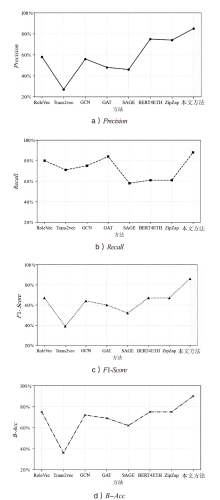
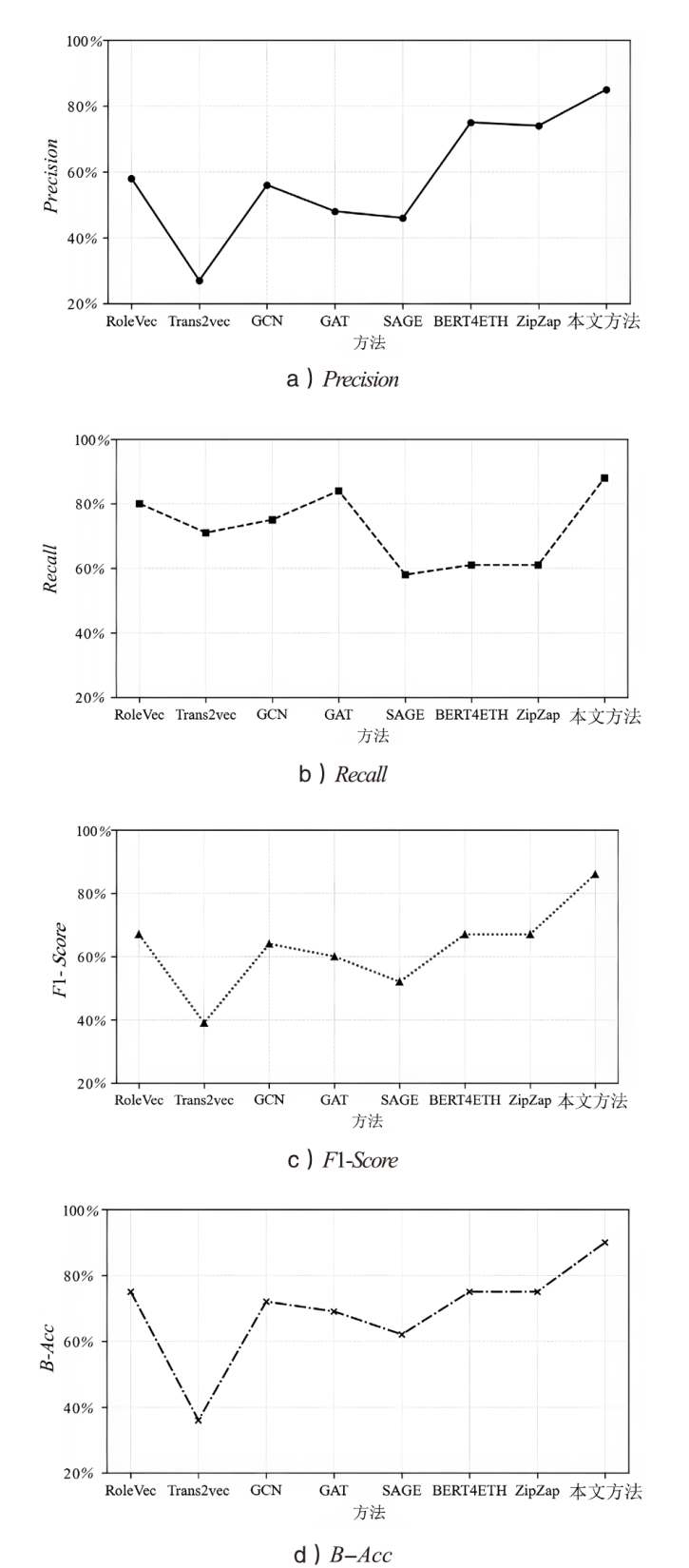
| 方法 | Precision | Recall | F1-Score | B-Acc |
|---|---|---|---|---|
| RoleVec | 57.48% | 79.58% | 66.73% | 75.07% |
| Trans2Vec | 26.34% | 70.43% | 38.42% | 35.98% |
| GCN | 55.15% | 75.08% | 63.59% | 72.28% |
| GAT | 47.29% | 83.48% | 60.38% | 68.48% |
| SAGE | 45.89% | 58.26% | 51.34% | 61.96% |
| BERT4ETH | 74.21% | 61.25% | 67.11% | 75.30% |
| ZipZap | 73.56% | 61.12% | 66.76% | 75.06% |
| 本文方法 | 84.42% | 87.62% | 85.99% | 89.62% |
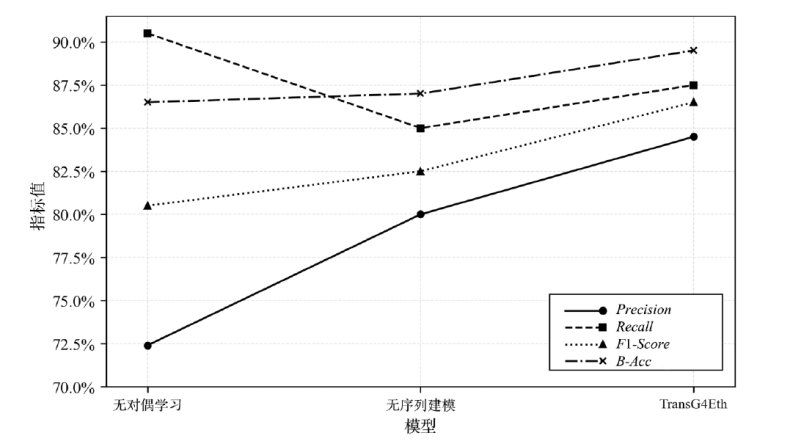
| 模型 | Precision | Recall | F1-Score | B-Acc |
|---|---|---|---|---|
| w/o 对偶学习 | 72.29% | 90.62% | 80.43% | 86.30% |
| w/o 序列建模 | 79.81% | 85.23% | 82.43% | 87.02% |
| TransG4Eth | 84.42% | 87.62% | 85.99% | 89.62% |
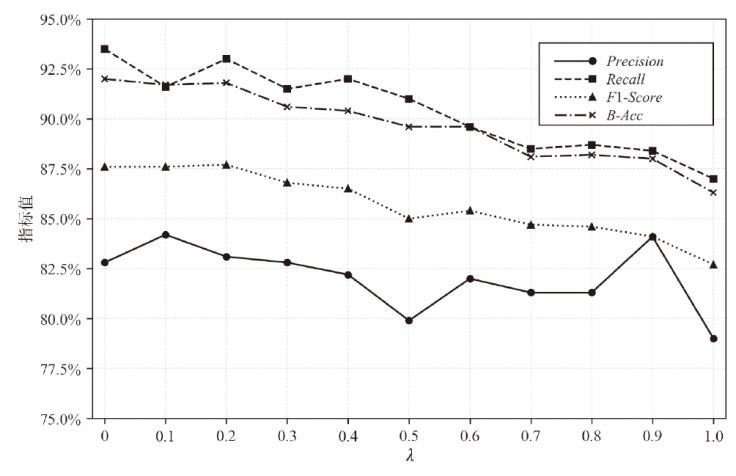
| λ | Precision | Recall | F1-Score | B-Acc |
|---|---|---|---|---|
| 0 | 82.65% | 93.21% | 87.62% | 91.53% |
| 0.1 | 84.07% | 91.62% | 87.68% | 91.31% |
| 0.2 | 83.07% | 93.01% | 87.76% | 91.59% |
| 0.3 | 82.82% | 91.42% | 86.91% | 90.79% |
| 0.4 | 82.17% | 92.02% | 86.82% | 90.83% |
| 0.5 | 79.86% | 91.02% | 85.07% | 89.56% |
| 0.6 | 82.29% | 89.02% | 85.52% | 89.54% |
| 0.7 | 81.37% | 88.02% | 84.56% | 88.78% |
| 0.8 | 81.40% | 88.22% | 84.67% | 88.88% |
| 0.9 | 84.11% | 88.22% | 84.11% | 88.52% |
| 1.0 | 78.91% | 86.63% | 82.59% | 87.31% |
| [1] | 李鹏超, 张全涛, 胡源. 基于双注意力机制图神经网络的智能合约漏洞检测方法[J]. 信息网络安全, 2024, 24(11):1624-1631. |
| [2] |
Wu Jiajing, Yuan Qi, Lin Dan, et al. Who are the phishers? Phishing scam detection on Ethereum via network embedding[J]. IEEE Transactions on Systems, Man, and Cybernetics: Systems, 2022, 52(2): 1156-1166.
doi: 10.1109/TSMC.2020.3016821 URL |
| [3] | Hu Sihao, Zhang Zhen, Lu Shengliang, et al. Sequence-based target coin prediction for cryptocurrency pump-and-dump[J]. Proceedings of the ACM on Management of Data, 2023, 1(1): 1-19. |
| [4] | Chen Weili, Zheng Zibin, Cui Jiahui, et al. Detecting ponzi schemes on Ethereum: towards healthier blockchain technology[C]// The 2018 World Wide Web Conference. New York: ACM, 2018: 1409-1418. |
| [5] | Bian Shuqing, Deng Zhenpeng, Li Fei, et al. Icorating: a deep-learning system for scam ICO identification[EB/OL]. (2018-03-09)[2026-06-01]. https://arxiv.org/abs/1803.03670. |
| [6] | Victor F, Weintraud A M. Detecting and quantifying wash trading on decentralized cryptocurrency exchanges[C]// The Web Conference 2021. New York: ACM, 2021: 23-32. |
| [7] | Daian P, Goldfeder S, Kell T, et al. Flash boys 2.0: frontrunning, transaction reordering, and consensus instability in decentralized exchanges[EB/OL]. (2019-04-10)[2026-06-07]. https://arxiv.org/abs/1904.05234. |
| [8] | Sun Jianguo, Jia Yifan, Wang Yanbin, et al. Ethereum fraud detection via joint transaction language model and graph representation learning[J]. Information Fusion, 2025, 120: 1-12. |
| [9] |
Zhang Sheng, Song Liangliang, Wang Yanbin. Dynamic feature fusion: combining global graph structures and local semantics for blockchain phishing detection[J]. IEEE Transactions on Network and Service Management, 2025, 22(5): 4706-4718.
doi: 10.1109/TNSM.2025.3576130 URL |
| [10] | 边玲玉, 张琳琳, 赵楷, 等. 基于LightGBM的以太坊恶意账户检测方法[J]. 信息网络安全, 2020, 20(4): 73-80. |
| [11] | Tian Ye, Song Liangliang, Qian Peng, et al. DiT-SGCR: directed temporal structural representation with global-cluster awareness for Ethereum malicious account detection[EB/OL]. (2025-06-25)[2026-06-07]. https://arxiv.org/abs/2506.20123. |
| [12] | Tan Runnan, Tan Qingfeng, Zhang Peng, et al. Graph neural network for Ethereum fraud detection[C]// 2021 IEEE International Conference on Big Knowledge (ICBK). New York: IEEE, 2021: 78-85. |
| [13] | Kanezashi H, Suzumura T, Liu Xin, et al. Ethereum fraud detection with heterogeneous graph neural networks[EB/OL]. (2022-03-23)[2026-06-07]. https://arxiv.org/abs/2203.12363. |
| [14] |
Tan Runnan, Tan Qingfeng, Zhang Qin, et al. Ethereum fraud behavior detection based on graph neural networks[J]. Computing, 2023, 105: 2143-2170.
doi: 10.1007/s00607-023-01177-7 |
| [15] | Li Panpan, Xie Yunyi, Xu Xinyao, et al. Phishing fraud detection on Ethereum using graph neural network[EB/OL]. (2022-04-18)[2026-06-07]. https://doi.org/10.48550/arXiv.2204.08194. |
| [16] |
Liu Jiayi, Yin Changchun, Wang Hao, et al. Graph embedding-based money laundering detection for Ethereum[J]. Electronics, 2023, 12(14): 1-14.
doi: 10.3390/electronics12010001 URL |
| [17] | Hu Sihao, Zhang Zhen, Luo Binqiao, et al.BERT4ETH: a pre-trained Transformer for Ethereum fraud detection[C]// The ACM Web Conference 2023. New York: ACM, 2023: 2189-2197. |
| [18] | Hu Sihao, Huang Tiansheng, Chow K H, et al. ZipZap: efficient training of language models for large-scale fraud detection on blockchain[C]// The ACM Web Conference 2024. New York: ACM, 2024: 2807-2816. |
| [19] |
Chen Zhen, Liu Shengzheng, Huang Jia, et al. Ethereum phishing scam detection based on data augmentation method and hybrid graph neural network model[J]. Sensors, 2024, 24(12): 1-17.
doi: 10.3390/s24010001 URL |
| [20] | Wang Jinhuan, Chen Pengtao, Xu Xinyao, et al. TSGN: transaction subgraph networks assisting phishing detection in Ethereum[EB/OL]. (2022-08-27)[2026-06-07]. https://arxiv.org/abs/2208.12938. |
| [21] |
Zhang Jiale, Sui Hao, Zhu Donghai, et al. GrabPhisher: phishing scams detection in Ethereum via temporally evolving GNNs[J]. IEEE Transactions on Services Computing, 2024, 17(6): 3727-3741.
doi: 10.1109/TSC.2024.3411449 URL |
| [22] |
Liu Lin, Tsai W T, Bhuiyan M Z A, et al. Blockchain-enabled fraud discovery through abnormal smart contract detection on Ethereum[J]. Future Generation Computer Systems, 2022, 128: 158-166.
doi: 10.1016/j.future.2021.08.023 URL |
| [23] | Li Sijia, Gou Gaopeng, Liu Chang, et al. TTAGN: temporal transaction aggregation graph network for Ethereum phishing scams detection[C]// The ACM Web Conference 2022. New York: ACM, 2022: 661-669. |
| [24] | Lee S, Park T, Lee K. Learning to embed time series patches independently[EB/OL]. (2024-05-02)[2026-06-07]. https://doi.org/10.48550/arXiv.2312.16427. |
| [25] | Ekambaram V, Jati A, Nguyen N, et al. TSMixer: lightweight MLP-Mixer model for multivariate time series forecasting[C]// The 29th ACM SIGKDD Conference on Knowledge Discovery and Data Mining. New York: ACM, 2023: 459-469. |
| [26] | Ahmed N K, Rossi R A, Lee J B, et al.Role2Vec: role-based network embeddings[C]// The 2nd International Workshop on Deep Learning on Graphs: Methods and Applications. New York: ACM, 2019: 1-7. |
| [27] | Kipf T N, Welling M. Semi-supervised classification with graph convolutional networks[EB/OL]. (2016-09-09)[2026-06-07]. https://arxiv.org/abs/1609.02907. |
| [28] | Velickovic P, Cucurull G, Casanova A, et al. Graph attention networks[EB/OL]. (2017-10-30)[2026-06-07]. https://arxiv.org/abs/1710.10903. |
| [29] | Hamilton W L, Ying R, Leskovec J. Inductive representation learning on large graphs[EB/OL]. (2018-09-10)[2026-06-07]. https://doi.org/10.48550/arXiv.1706.02216. |
| [1] | Zhang Jian, Cai Hong, Wang Botao. Research of malware detection method based on hardware performance counter [J]. Netinfo Security, 2026, 26(9): 1383-1390. |
| [2] | Zhu Xiaoqiang, Lin Yanzi, Zhang Haowen, Yao Yingying. A robust aggregation method for blockchain federated learning based on multi-dimensional features and dynamic defense [J]. Netinfo Security, 2026, 26(9): 1391-1407. |
| [3] | Fu Zhangjie, Liu Tianyi, Song Fuyuan, Jiang Qin. A blockchain-sharding enabled verifiable cross-chain query scheme [J]. Netinfo Security, 2026, 26(8): 1209-1223. |
| [4] | Han Yanyan, Du Yupeng, Yu Zhuozhou, Liu Ang, Liu Wen. Secure blockchain based on semi-quantum network [J]. Netinfo Security, 2026, 26(8): 1237-1249. |
| [5] | Zhang Hongtao, Wang Qingtao, Zhang Liancheng, Wang Jichang. Argus6: an IPv6 DDoS threat detection model [J]. Netinfo Security, 2026, 26(8): 1264-1276. |
| [6] | Liu Zhefan, Guo Yajun, Guo Yimin, Zhao Sufen. ASCON-based lightweight industrial IoT authentication scheme resistant to implicit attacks [J]. Netinfo Security, 2026, 26(8): 1308-1326. |
| [7] | Zheng Tianming, Liu Shangdong, Li Haitian, Li Hua. Interactive convolution and Transformer based anomaly detection algorithm [J]. Netinfo Security, 2026, 26(7): 1077-1086. |
| [8] | LI Hailong, ZHANG Yunhao, SHEN Xieyang, XING Yuhang, CUI Zhian. A Survey of Machine Learning-Based Malware Detection Methods [J]. Netinfo Security, 2026, 26(4): 521-541. |
| [9] | LI Jinkai, WANG Jingwen, DONG Libo, YAO Wenhan, LIU Chengjie, WEN Weiping. A Blockchain Anomaly Transaction Detection Method Based on Temporal Graph Attention Network [J]. Netinfo Security, 2026, 26(4): 579-590. |
| [10] | CHEN Yuqi, QIAN Hanwei, XIA Lingling, WANG Qun. FEViT: A Frequency Domain Enhanced ViT for Deepfake Detection [J]. Netinfo Security, 2026, 26(3): 432-441. |
| [11] | LUO Wenhua, XU Shilong, LYU Tao, ZHANG Ning. Blockchain Data Provenance Mechanism Integrating Cuckoo Filters and Temporal B+ Tree [J]. Netinfo Security, 2026, 26(3): 442-451. |
| [12] | LIANG Guangjun, QIU Yuchen, SI Hongtao, WANG Qun, MA Zhuo, CHEN Yuqi. Blockchain Virtual Currency Traceability and Analysis [J]. Netinfo Security, 2026, 26(3): 482-490. |
| [13] | GUO Yi, LI Xuqing, ZHANG Zijiao, ZHANG Hongtao, ZHANG Liancheng, ZHANG Xiangli. A Review of Data Security Sharing Based on Blockchain [J]. Netinfo Security, 2026, 26(1): 1-23. |
| [14] | DONG Jiayu, GAO Hongmin, MA Zhaofeng, LAI Guanhui. Research and Implementation of Multi-Signature Mechanism in Blockchain [J]. Netinfo Security, 2026, 26(1): 125-138. |
| [15] | ZHAO Wenyu, DANG Chenxi, DU Zhenhua, ZHANG Jian. Research and Implementation of Ransomware Detection Technology Based on Hardware Performance Counters [J]. Netinfo Security, 2025, 25(9): 1397-1406. |
| Viewed | ||||||
|
Full text |
|
|||||
|
Abstract |
|
|||||