Netinfo Security ›› 2026, Vol. 26 ›› Issue (9): 1341-1353.doi: 10.3969/j.issn.1671-1122.2026.09.002
Previous Articles Next Articles
A survey of membership inference attacks and defenses for large language models
Nie Haojie1,2, Sun Degang1,2, Pan Xingbo1,2, Wan Wei1,2, Long Chun1,2( )
)
- 1
Computer Network Information Center ,Chinese Academy of Sciences Beijing 100083, China
2School of Computer Science and Technology ,University of Chinese Academy of Sciences Beijing 101408, China
-
Received:2026-05-06Online:2026-09-10Published:2026-09-30 -
Contact:Long Chun E-mail:anquanip@cnic.cn

CLC Number:
Cite this article
Nie Haojie, Sun Degang, Pan Xingbo, Wan Wei, Long Chun. A survey of membership inference attacks and defenses for large language models[J]. Netinfo Security, 2026, 26(9): 1341-1353.
share this article
Add to citation manager EndNote|Ris|BibTeX
URL: http://netinfo-security.org/EN/10.3969/j.issn.1671-1122.2026.09.002
| 文献 | 主要范围 | 防御 覆盖 | 对LLM/RAG覆盖 | 本文增量 |
|---|---|---|---|---|
| 文献[ | 通用MIA;威胁 模型、攻击知识与数据类型 | 传统训练/输出防御 | 较少 | 生命周期与系统组件;统一基准批判 |
| 文献[ | 判别、生成与联邦学习MIA | 经典 策略 | 无 | LLM局部记忆、对齐、多模态、RAG |
| 文献[ | 通用攻防与应用 | 较系统 | 有限 | 给出WikiMIA/MIMIR量化对照 |
| 文献[ | MIA防御分类与 评价 | 系统 | 少量 | 扩展到解码过滤、RAG与遗忘审计 |
| 文献[ | 大规模模型MIA | 概述 | 覆盖部分新场景 | 生命周期组织、统一基准定量比较和 防御表 |
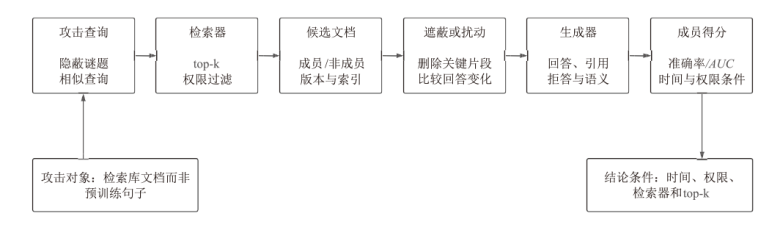
| 阶段/场景 | 代表方法 | 访问 | 核心信号 | 关键依赖与局限 |
|---|---|---|---|---|
| 预训练 | PPL/Zlib[ | 灰盒 | 全局可预测性 | 混淆样本难度 |
| 预训练 | LiRA/校准[ | 黑/灰盒 | 逐样本似然比 | 影子模型或 校准集昂贵 |
| 预训练 | Min-K%/Min-K%++[ | 灰盒 | 低概率token与局部模态 | 需要token概率 |
| 预训练 | MoPe/ReCaLL[ | 灰盒 | 参数扰动/条件似然变化 | 多次推理或 上下文敏感 |
| 数据集级 | Dataset Inference[ | 灰盒 | 多样本统计 聚合 | 要求候选集合 |
| 微调 | SPV/Neighbour/DF-MIA[ | 灰盒 | 自校准与 邻域差异 | 改写质量影响 结果 |
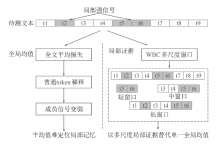
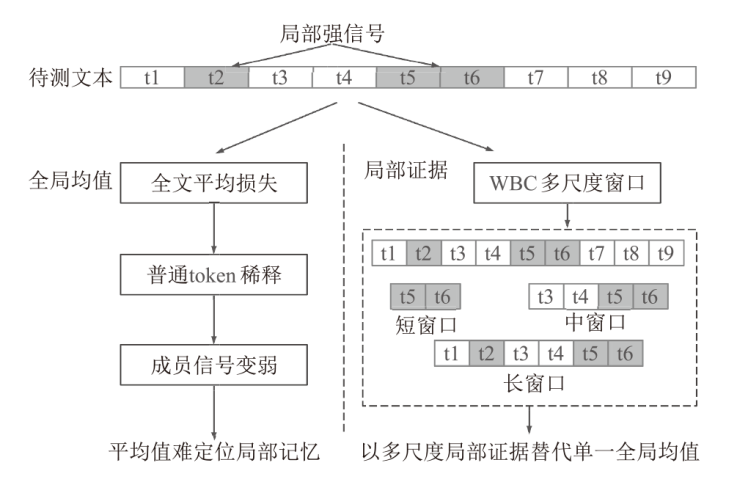
| 微调前沿 | WBC[ | 灰盒 | 多尺度局部 窗口 | — |
| 对齐 | PREMIA[ | 灰盒 | 偏好损失 | — |
| 黑盒API | PETAL/SaMIA[ | 黑盒 | 语义近似/采样伪似然 | 查询成本高 |
| 多模态 | CLIP/VLLM/Self-Comparison[ | 灰/黑盒 | 跨模态匹配与集合内参照 | 成员单位需明确 |
| RAG | RAG-MIA/GIB/RAG-leaks/MBA[ | 黑盒 | 检索触发、 生成依赖、 掩码恢复 | 受检索召回和常识影响 |
| RAG前沿 | Riddle/E-MIA[ | 黑盒 | 隐蔽题目/ 事实考试 | 预印本需复核 |
| 基准/协议 | 模型与设置 | 方法 | ROC-AUC | 低FPR结果 |
|---|---|---|---|---|
| WikiMIA,32 token | 6类模型平均 | Min-K%++[ | 0.753 | TPR@1%FPR=6.6% |
| WikiMIA,32 token | 6类模型平均 | ReCaLL[ | 0.901 | TPR@1%FPR=17.5% |
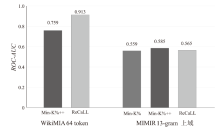
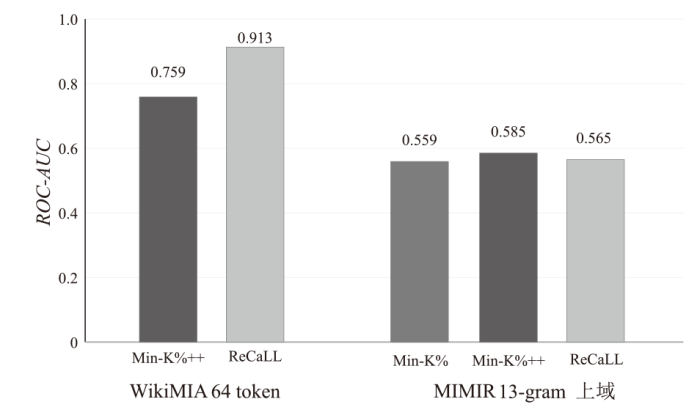
| WikiMIA,64 token | 6类模型平均 | Min-K%++[ | 0.759 | TPR@1%FPR=10.6% |
| WikiMIA,64 token | 6类模型平均 | ReCaLL[ | 0.913 | TPR@1%FPR=15.4% |
| WikiMIA,128 token | 6类模型平均 | Min-K%++[ | 0.752 | TPR@1%FPR=3.2% |
| WikiMIA,128 token | 6类模型平均 | ReCaLL[ | 0.900 | TPR@1%FPR=16.9% |
| MIMIR,13-gram, 七域宏平均 | Pythia-12B | Min-K%[ | 0.559 | TPR@1%FPR=4.0% |
| MIMIR,13-gram, 七域宏平均 | Pythia-12B | Min-K%++[ | 0.585 | TPR@1%FPR=4.3% |
| MIMIR,13-gram, 七域宏平均 | Pythia-12B | ReCaLL[ | 0.565 | TPR@1%FPR=4.4% |
| Pile,单方法设置 | Pythia-160M | MoPe[ | 0.646 | TPR@5%FPR=4.9% |
| RAG,Health-CareMagic/MS-MARCO/NQ | GPT-4o-mini+BGE | MBA[ | 0.880/ 0.860/ 0.900 | 成员为检索库文档 |
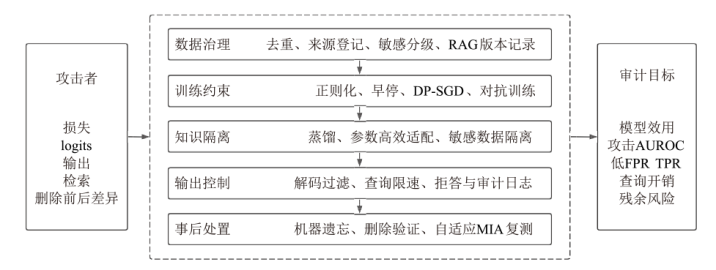
| 防御类别 | 适用阶段 | 代表机制 | 隐私保证 | 主要代价 | 局限 |
|---|---|---|---|---|---|
| 去重与 数据治理 | 训练前 | 多粒度去重、PII清洗、数据血缘[ | 经验 | 索引与 误删 | 不消除单次罕见记忆 |
| 正则化 | 训练中 | 早停、dropout、标签平滑、对抗正则[ | 经验 | 低至中 | 依赖已知 攻击 |
| 差分隐私 | 训练/ 微调 | DP-SGD、DP-Forward[ | 形式化 | 效用与 算力 | 预算选择 困难 |
| 知识蒸馏 | 训练后 | 知识迁移、 交叉蒸馏[ | 通常经验 | 教师推理与学生 训练 | 教师输出仍可泄露 |
| 输出扰动/过滤 | 部署 | MemGuard、相似 片段过滤[ | 经验 | 延迟与 误拒 | 不移除参数记忆 |
| 查询控制/拒答 | 部署 | MIA-Tuner、速率限制、日志[ | 经验 | 可用性 | 提示改写可绕过 |
| 机器遗忘 | 退出 | 去记忆化、知识遗忘、双用途训练[ | 方法相关 | 再训练与能力损失 | 拒答不等于遗忘 |
| RAG访问控制 | 检索/ 生成 | 权限过滤、最小返回、索引审计[ | 系统 | 召回与 答案质量 | 侧信道仍 存在 |
| [1] | Hu Hongsheng, Salcic Z, Sun Lichao, et al. Membership inference attacks on machine learning: a survey[J]. ACM Computing Surveys, 2022, 54(11): 1-37. |
| [2] | 王鹏焱. 机器学习中的成员推断攻击与防御研究[J]. 信息技术与网络安全, 2021, 40(8): 65-70, 83. |
| [3] |
Niu Jun, Liu Peng, Zhu Xiaoyan, et al. A survey on membership inference attacks and defenses in machine learning[J]. Journal of Information and Intelligence, 2024, 2(5): 404-454.
doi: 10.1016/j.jiixd.2024.02.001 URL |
| [4] | Hu Li, Yan Anli, Yan Hongyang, et al. Defenses to membership inference attacks: a survey[J]. ACM Computing Surveys, 2023, 56(4): 1-34. |
| [5] | Shokri R, Stronati M, Song Congzheng, et al. Membership inference attacks against machine learning models[C]// The 38th IEEE Symposium on Security and Privacy. New York: IEEE, 2017: 3-18. |
| [6] | Yeom S, Giacomelli I, Fredrikson M, et al. Privacy risk in machine learning: analyzing the connection to overfitting[C]// The 31st IEEE Computer Security Foundations Symposium. New York: IEEE, 2018: 268-282. |
| [7] | Carlini N, Tramer F, Wallace E, et al. Extracting training data from large language models[C]// The 30th USENIX Security Symposium (USENIX Security 21). Berkeley: USENIX, 2021: 2633-2650. |
| [8] | Carlini N, Ippolito D, Jagielski M, et al. Quantifying memorization across neural language models[C]// International Conference on Learning Representations. Kigali: ICLR, 2023: 1-19. |
| [9] | Brown H, Lee K, Mireshghallah F, et al. What does it mean for a language model to preserve privacy?[C]// The 5th ACM Conference on Fairness, Accountability, and Transparency. New York: ACM, 2022: 2280-2292. |
| [10] | Pan Xudong, Zhang Mi, Ji Shouling, et al. Privacy risks of general-purpose language models[C]// The 41st IEEE Symposium on Security and Privacy. New York: IEEE, 2020: 1314-1331. |
| [11] | Mireshghallah F, Goyal K, Uniyal A, et al. Quantifying privacy risks of masked language models using membership inference attacks[C]// The 27th Conference on Empirical Methods in Natural Language Processing. Stroudsburg: ACL, 2022: 8332-8347. |
| [12] |
Hisamoto S, Post M, Duh K. Membership inference attacks on sequence-to-sequence models: is my data in your machine translation system?[J]. Transactions of the Association for Computational Linguistics, 2020, 8: 49-63.
doi: 10.1162/tacl_a_00299 |
| [13] | 杨盼盼, 张信明. 基于标签的无数据的成员推理攻击[J]. 网络安全与数据治理, 2023, 42(5): 44-49. |
| [14] | Wu Hengyu, Cao Yang. Membership inference attacks on large-scale models: a survey[EB/OL]. (2025-08-31)[2026-04-28]. https://arxiv.org/abs/2503.19338v3. |
| [15] |
Feretzakis G, Papaspyridis K, Gkoulalas-divanis A, et al. Privacy-preserving techniques in generative AI and large language models: a narrative review[J]. Information, 2024, 15(11): 1-25.
doi: 10.3390/info15010001 URL |
| [16] | Li Jiacheng, Li Ning, Ribeiro B. Membership inference attacks and defenses in classification models[C]// The 11th ACM Conference on Data and Application Security and Privacy. New York: ACM, 2021: 5-16. |
| [17] | Carlini N, Chien S, Nasr M, et al. Membership inference attacks from first principles[C]// The 43rd IEEE Symposium on Security and Privacy. New York: IEEE, 2022: 1897-1914. |
| [18] | Kandpal N, Wallace E, Raffel C. Deduplicating training data mitigates privacy risks in language models[C]// The 39th International Conference on Machine Learning. Baltimore: PMLR, 2022: 10697-10707. |
| [19] | Lee K, Ippolito D, Nystrom A, et al. Deduplicating training data makes language models better[C]// The 60th Annual Meeting of the Association for Computational Linguistics. Stroudsburg: ACL, 2022: 8424-8445. |
| [20] | Ye Jiayuan, Maddi A, Murakonda S K, et al. Enhanced membership inference attacks against machine learning models[C]// The 29th ACM SIGSAC Conference on Computer and Communications Security. New York: ACM, 2022: 3093-3106. |
| [21] | Shi Weijia, Ajith A, Xia Mengzhou, et al. Detecting pretraining data from large language models[C]// International Conference on Learning Representations. Vienna: ICLR, 2024: 1-18. |
| [22] | Zhang Jingyang, Sun Jingwei, Yeats E, et al. Min-K%++: improved baseline for detecting pre-training data from large language models[C]// International Conference on Learning Representations. Singapore: ICLR, 2025: 1-18. |
| [23] | Duan M, Suri A, Mireshghallah N, et al. Do membership inference attacks work on large language models?[C]// The 1st Conference on Language Modeling. Philadelphia: COLM, 2024: 1-33. |
| [24] | Li M, Wang J, Wang J, et al. MoPe: Model perturbation based privacy attacks on language models[C]// The 28th Conference on Empirical Methods in Natural Language Processing. Stroudsburg: ACL, 2023: 13647-13660. |
| [25] | Xie R, Wang Junlin, Huang Ruomin, et al. ReCaLL: membership inference via relative conditional log-likelihoods[C]// The 29th Conference on Empirical Methods in Natural Language Processing. Stroudsburg: ACL, 2024: 8671-8689. |
| [26] | Anderson M, Amit G, Goldsteen A.Is my data in your retrieval database? membership inference attacks against retrieval-augmented generation[C]// The 11th International Conference on Information Systems Security and Privacy. Heidelberg: Springer, 2025: 474-485. |
| [27] | Li Yuying, Liu Gaoyang, Wang Chen, et al. Generating is believing: membership inference attacks against retrieval-augmented generation[C]// The 50th IEEE International Conference on Acoustics, Speech and Signal Processing. New York: IEEE, 2025: 1-5. |
| [28] | Wang Guangshuo, He Jiajun, Li Hao, et al. RAG-leaks: difficulty-calibrated membership inference attacks on retrieval-augmented generation[J]. Science China Information Sciences, 2025, 68(6): 1-18. |
| [29] | Liu Mingrui, Zhang Sixiao, Long Cheng. Mask-based membership inference attacks for retrieval-augmented generation[C]// The 34th Web Conference. New York: ACM, 2025: 2894-2907. |
| [30] | Salem A, Zhang Yang, Humbert M, et al. ML-Leaks: model and data independent membership inference attacks and defenses on machine learning models[C]// Network and Distributed System Security Symposium. Reston: NDSS, 2019: 1-15. |
| [31] | He Yu, Li Boheng, Liu Liu, et al. Towards label-only membership inference attack against pre-trained large language models[C]// The 34th USENIX Security Symposium. Berkeley: USENIX, 2025: 1609-1628. |
| [32] | Kaneko M, Ma Y, Wata Y, et al. Sampling-based pseudo-likelihood for membership inference attacks[C]// Findings of the Association for Computational Linguistics. Stroudsburg: ACL, 2025: 8894-8907. |
| [33] | Hui Bo, Yang Yuchen, Yuan Haolin, et al. Practical blind membership inference attack via differential comparisons[C]// Network and Distributed System Security Symposium. Reston: NDSS, 2021: 1-17. |
| [34] | Maini P, Jia Hengrui, Papernot N, et al. LLM dataset inference: did you train on my dataset?[C]// Advances in Neural Information Processing Systems. Red Hook: NeurIPS, 2024: 124069-124092. |
| [35] | Meeus M, Shilov I, Faysse M, et al. Copyright traps for large language models[EB/OL]. (2024-06-04)[2026-04-28]. https://arxiv.org/abs/2402.09363v2. |
| [36] | Mireshghallah F, Uniyal A, Wang Tianhao, et al. An empirical analysis of memorization in fine-tuned autoregressive language models[C]// The 27th Conference on Empirical Methods in Natural Language Processing. Stroudsburg: ACL, 2022: 1816-1826. |
| [37] | Fu Wenjie, Wang Huandong, Gao Chen, et al. Membership inference attacks against fine-tuned large language models via self-prompt calibration[C]// Advances in Neural Information Processing Systems. Red Hook: NeurIPS, 2024: 134981-135010. |
| [38] | Mattern J, Mireshghallah F, Jin Zhijing, et al. Membership inference attacks against language models via neighbourhood comparison[C]// Findings of the Association for Computational Linguistics. Stroudsburg: ACL, 2023: 11330-11343. |
| [39] | Huang Zhiheng, Liu Yannan, He Daojing, et al. DF-MIA: a distribution-free membership inference attack on fine-tuned large language models[C]// The AAAI Conference on Artificial Intelligence. Palo Alto: AAAI, 2025: 343-351. |
| [40] | Puerto H, Gubri M, Yun S, et al. Scaling up membership inference: when and how attacks succeed on large language models[C]// Findings of the Association for Computational Linguistics. Stroudsburg: ACL, 2025: 4165-4182. |
| [41] | Chen Yuetian, Du Yuntao, Zhang Kaiyuan, et al. Window-based membership inference attacks against fine-tuned large language models[C]// The 35th USENIX Security Symposium. Berkeley: USENIX, 2026: 1187-1206. |
| [42] | Meeus M, Shilov I, Jain S, et al. SoK: membership inference attacks on LLMs are rushing nowhere (and how to fix it)[C]// The 3rd IEEE Conference on Secure and Trustworthy Machine Learning (SaTML). New York: IEEE, 2025: 385-401. |
| [43] | Chen Bowen, Han N, Miyao Y. A statistical and multi-perspective revisiting of the membership inference attack in large language models[C]// The 63rd Annual Meeting of the Association for Computational Linguistics. Stroudsburg: ACL, 2025: 22854-22874. |
| [44] | Feng Qizhang, Kasa S R, Kasa S K, et al. Exposing privacy gaps: membership inference attack on preference data for LLM alignment[C]// The 28th International Conference on Artificial Intelligence and Statistics. San Diego: PMLR, 2025: 5221-5229. |
| [45] | Ko M, Jin Ming, Wang Chenguang, et al. Practical membership inference attacks against large-scale multi-modal models: a pilot study[C]// The 18th IEEE/CVF International Conference on Computer Vision. New York: IEEE, 2023: 4848-4858. |
| [46] | Li Zhan, Wu Yongtao, Chen Yihang, et al. Membership inference attacks against large vision-language models[C]// Advances in Neural Information Processing Systems. Red Hook: NeurIPS, 2024: 98645-98674. |
| [47] | Ren Jie, Chen Kangrui, Chen Chen, et al. Self-Comparison for dataset-level membership inference in large (vision-)language model[C]// The 34th Web Conference. New York: ACM, 2025: 910-920. |
| [48] | Naseh A, Peng Yuefeng, Suri A, et al. Riddle me this! stealthy membership inference for retrieval-augmented generation[C]// The 32nd ACM SIGSAC Conference on Computer and Communications Security. New York: ACM, 2025: 1245-1259. |
| [49] | Guan Zelin, Zhuo Shengda, Li Zeyan, et al. E-MIA: exam-style black-box membership inference attacks against RAG systems[EB/OL]. (2026-05-01)[2026-04-28]. https://arxiv.org/abs/2605.00955v1. |
| [50] | Nasr M, Shokri R, Houmansadr A. Machine learning with membership privacy using adversarial regularization[C]// The 25th ACM SIGSAC Conference on Computer and Communications Security. New York: ACM, 2018: 634-646. |
| [51] | Jayaraman B, Evans D. Evaluating differentially private machine learning in practice[C]// The 28th USENIX Security Symposium (USENIX Security 19). Berkeley: USENIX, 2019: 1895-1912. |
| [52] | Du Minxin, Yue Xiang, Chow S S M, et al. DP-Forward: fine-tuning and inference on language models with differential privacy in forward pass[C]// The 30th ACM SIGSAC Conference on Computer and Communications Security. New York: ACM, 2023: 2665-2679. |
| [53] | Shejwalkar V, Houmansadr A. Membership privacy for machine learning models through knowledge transfer[C]// The AAAI Conference on Artificial Intelligence. Palo Alto: AAAI, 2021: 9549-9557. |
| [54] |
Zheng Junxiang, Cao Yongzhi, Wang Hanpin. Resisting membership inference attacks through knowledge distillation[J]. Neurocomputing, 2021, 452: 114-126.
doi: 10.1016/j.neucom.2021.04.082 URL |
| [55] | Chourasia R, Enkhtaivan B, Ito K, et al. Knowledge cross-distillation for membership privacy[J]. Proceedings on Privacy Enhancing Technologies, 2022(2): 362-377. |
| [56] | Jia Jinyuan, Salem A, Backes M, et al. Memguard: defending against black-box membership inference attacks via adversarial examples[C]// The 26th ACM SIGSAC Conference on Computer and Communications Security. New York: ACM, 2019: 259-274. |
| [57] | Fu Wenjie, Wang Huandong, Gao Chen, et al. MIA-Tuner: adapting large language models as pre-training text detector[C]// The AAAI Conference on Artificial Intelligence. Palo Alto: AAAI, 2025: 27295-27303. |
| [58] | Ippolito D, Tramer F, Nasr M, et al. Preventing generation of verbatim memorization in language models gives a false sense of privacy[C]// The 16th International Natural Language Generation Conference. Stroudsburg: ACL, 2023: 28-53. |
| [59] | Kassem A, Mahmoud O, Saad S. Preserving privacy through dememorization: an unlearning technique for mitigating memorization risks in language models[C]// The 28th Conference on Empirical Methods in Natural Language Processing. Stroudsburg: ACL, 2023: 4360-4379. |
| [60] | Jang J, Yoon D, Yang S, et al. Knowledge unlearning for mitigating privacy risks in language models[C]// The 61st Annual Meeting of the Association for Computational Linguistics. Stroudsburg: ACL, 2023: 14389-14408. |
| [61] | Yao Jin, Chien E, Du Minxin, et al. Machine unlearning of pre-trained large language models[C]// The 62nd Annual Meeting of the Association for Computational Linguistics. Stroudsburg: ACL, 2024: 8403-8419. |
| [62] |
Liu Sijia, Yao Yuanshun, Jia Jinghan, et al. Rethinking machine unlearning for large language models[J]. Nature Machine Intelligence, 2025, 7(2): 181-194.
doi: 10.1038/s42256-025-00985-0 |
| [63] | Tran T, Liu Ruixuan, Xiong Li. Tokens for learning, tokens for unlearning: mitigating membership inference attacks in large language models via dual-purpose training[C]// Findings of the Association for Computational Linguistics. Stroudsburg: ACL, 2025: 22872-22888. |
| [64] | Xu Heng, Zhu Tianqing, Zhang Lefeng, et al. Machine unlearning: a survey[J]. ACM Computing Surveys, 2024, 56(1): 1-36. |
| [1] | Ma Wenfei, Long Chun, Li Jing, Yang Fan, Fu Yuhao. Backdoor poisoning in the fine-tuning stage of large language models: attacks, defenses, and evaluation [J]. Netinfo Security, 2026, 26(9): 1354-1368. |
| [2] | Song Zheng, Yang Ruiqi, Li Huacheng. Survey of repository-level static vulnerability detection: from rule-driven to LLM and agent [J]. Netinfo Security, 2026, 26(9): 1369-1382. |
| [3] | Yao Wuhuang, Wang Jiapeng, Chen Kangbing, Zheng Zhihan, Tan Yu’an. An LLM-assisted firmware memory leak analysis based on instruction translation instrumentation [J]. Netinfo Security, 2026, 26(7): 1087-1100. |
| [4] | Yang Qiaoyang, Fan Ximing, Jia Peng. LLM-based semantic-aware fuzz driver generation [J]. Netinfo Security, 2026, 26(7): 1128-1148. |
| [5] | SUN Yu, ZHANG Xuanrui, LIU Xinyu. Advances in Advanced Persistent Threat Detection and Provenance Research [J]. Netinfo Security, 2026, 26(6): 833-853. |
| [6] | MIAO Bo, YUAN Deyu, ZHANG Teng, YANG Yi, HUANG Zan. Chain-of-Thought Poisoning Based Retrieval-Augmented Generation Backdoor Attack [J]. Netinfo Security, 2026, 26(6): 977-998. |
| [7] | CUI Jinhua, DONG Liang, YANG Xin. A Survey of Privacy-Preserving Techniques for Large Language Model Inference [J]. Netinfo Security, 2026, 26(4): 503-520. |
| [8] | LI Yan, YANG Wenzhang, XUE Yinxing. Cross-Language Compiler Fuzzing Based on LLM Translation and Differential Testing [J]. Netinfo Security, 2026, 26(4): 591-604. |
| [9] | HU Mianning, LI Xin, LI Mingfeng, YUAN Deyu. Research on Multi-Strategy Enhanced Chinese Network Threat Intelligence Entity Extraction Based on Large Language Model [J]. Netinfo Security, 2026, 26(4): 615-625. |
| [10] | YUAN Ming, ZOU Qilin, YUAN Wenqi, WANG Qun. A Survey on Prompt Injection Attacks and Defenses in Large Language Models [J]. Netinfo Security, 2026, 26(3): 341-354. |
| [11] | GU Zhaojun, LI Li, SUI He. A Payload Generation Method for SQL Injection Vulnerability Detection Based on Large Language Models [J]. Netinfo Security, 2026, 26(2): 274-290. |
| [12] | TONG Xin, JIAO Qiang, WANG Jingya, YUAN Deyu, JIN Bo. A Survey on the Trustworthiness of Large Language Models in the Public Security Domain: Risks, Countermeasures, and Challenges [J]. Netinfo Security, 2026, 26(1): 24-37. |
| [13] | WANG Yajie, LU Jinbiao, TAN Dongli, FAN Qing, ZHU Liehuang. Member Inference Risk Assessment for Capsule Network [J]. Netinfo Security, 2026, 26(1): 38-48. |
| [14] | HU Yucui, GAO Haotian, ZHANG Jie, YU Hang, YANG Bin, FAN Xuejian. Automated Exploitation of Vulnerabilities in Vehicle Network Security [J]. Netinfo Security, 2025, 25(9): 1348-1356. |
| [15] | LIU Hui, ZHU Zhengdao, WANG Songhe, WU Yongcheng, HUANG Linquan. Jailbreak Detection for Large Language Model Based on Deep Semantic Mining [J]. Netinfo Security, 2025, 25(9): 1377-1384. |
| Viewed | ||||||
|
Full text |
|
|||||
|
Abstract |
|
|||||