Netinfo Security ›› 2026, Vol. 26 ›› Issue (1): 38-48.doi: 10.3969/j.issn.1671-1122.2026.01.003
Previous Articles Next Articles
Member Inference Risk Assessment for Capsule Network
WANG Yajie1, LU Jinbiao1, TAN Dongli2, FAN Qing3( ), ZHU Liehuang1
- 1. School of Cyberspace Science and Technology, Beijing Institute of Technology, Beijing 100081, China
2. School of Computer Science and Technology, Beijing Institute of Technology, Beijing 100081, China
3. School of Control and Computer Engineering, North China Electric Power University, Beijing 102206, China
-
Received:2025-07-07Online:2026-01-10Published:2026-02-13

CLC Number:
Cite this article
WANG Yajie, LU Jinbiao, TAN Dongli, FAN Qing, ZHU Liehuang. Member Inference Risk Assessment for Capsule Network[J]. Netinfo Security, 2026, 26(1): 38-48.
share this article
Add to citation manager EndNote|Ris|BibTeX
URL: http://netinfo-security.org/EN/10.3969/j.issn.1671-1122.2026.01.003
| 参数 | 含义 |
|---|---|
| 目标模型f的输入 | |
| f | 目标模型 |
| xi对应的真实标签 | |
| θ | 目标模型的内部参数 |
| P | 目标模型预测置信度向量 |
| A | 攻击模型 |
| θ* | 攻击模型的内部参数 |
| 目标模型训练集 | |
| bij | 胶囊i连接到胶囊j的先验概率 |
| cij | 胶囊i连接到胶囊j的概率 |
| sj | L层胶囊的总输入 |
| 预测胶囊 | |
| Wij | 转化矩阵 |
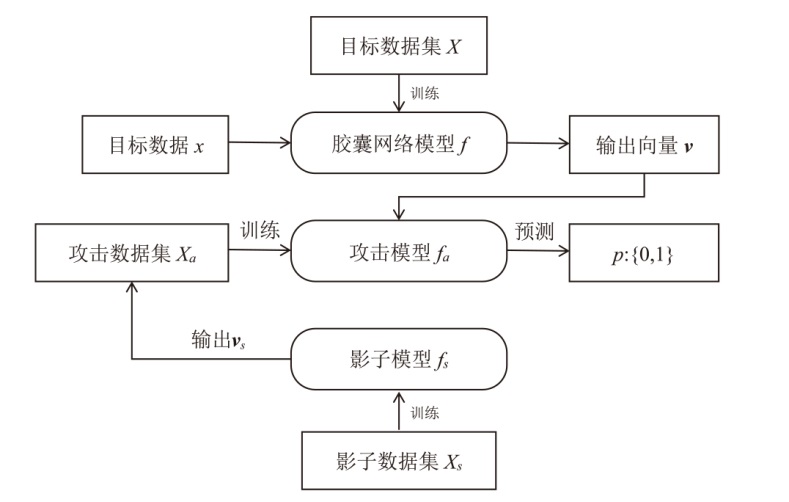
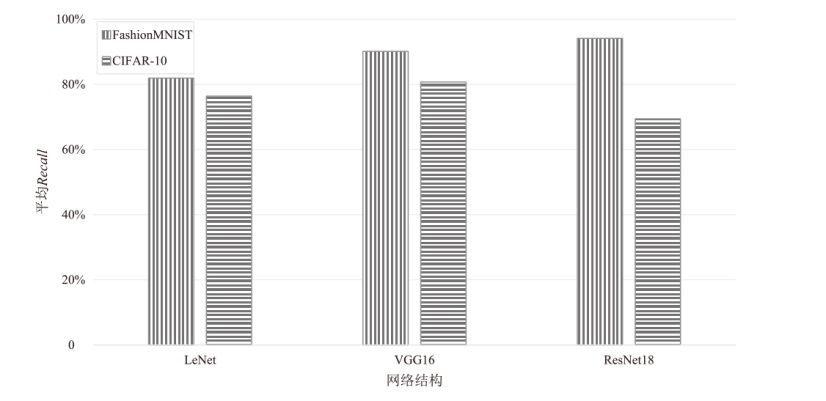
| 网络结构 | 胶囊网络 | LeNet | VGG16 | ResNet18 |
|---|---|---|---|---|
| 准确率 | 46.6% | 59.3% | 53.4% | 77.4% |
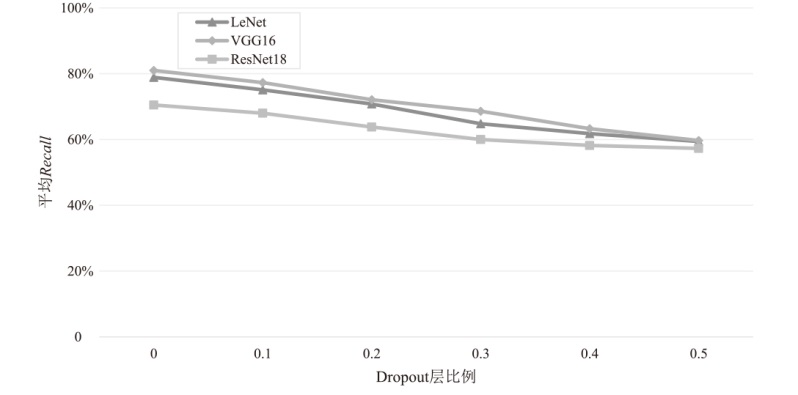
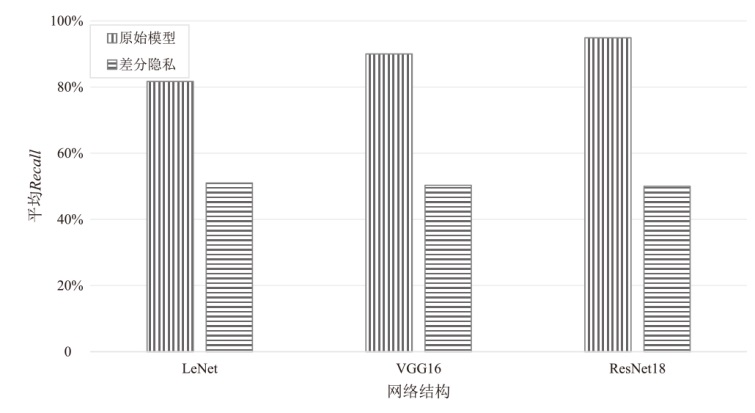
| [1] | AL-RUBAIE M, CHANG J M. Privacy-Preserving Machine Learning: Threats and Solutions[J]. IEEE Security & Privacy, 2019, 17(2): 49-58. |
| [2] | SABOUR S, FROSST N, HINTON G E. Dynamic Routing between Capsules[C]// ACM. The 31st International Conference on Neural Information Processing Systems. New York: ACM, 2017: 3856-3866. |
| [3] |
YADAV S, DHAGE S. TE-CapsNet: Time Efficient Capsule Network for Automatic Disease Classification from Medical Images[J]. Multimedia Tools and Applications, 2024, 83(16): 49389-49418.
doi: 10.1007/s11042-023-17458-4 |
| [4] |
DHALLA S, MITTAL A, GUPTA S. LeukoCapsNet: A Resource-Efficient Modified CapsNet Model to Identify Leukemia from Blood Smear Images[J]. Neural Computing and Applications, 2024, 36(5): 2507-2524.
doi: 10.1007/s00521-023-09157-w |
| [5] | LEI Yongjia, WU Zujian, LI Zhiying, et al. BP-CapsNet: An Image-Based Deep Learning Method for Medical Diagnosis[EB/OL]. (2023-10-01)[2025-05-23]. https://doi.org/10.1016/j.asoc.2023.110683. |
| [6] | SHOKRI R, STRONATI M, SONG Congzheng, et al. Membership Inference Attacks Against Machine Learning Models[C]// IEEE. 2017 IEEE Symposium on Security and Privacy (SP). New York: IEEE, 2017: 3-18. |
| [7] | BACKES M, BERRANG P, HUMBERT M, et al. Membership Privacy in MicroRNA-Based Studies[C]// ACM. The 2016 ACM SIGSAC Conference on Computer and Communications Security. New York: ACM, 2016: 319-330. |
| [8] | HAGESTEDT I, ZHANG Yang, HUMBERT M, et al. MBeacon: Privacy-Preserving Beacons for DNA Methylation Data[C]// IEEE. 2019 Network and Distributed System Security Symposium. New York: IEEE, 2019: 21-27. |
| [9] | PYRGELIS A, TRONCOSO C, DE C E. Knock Knock, Who’s There? Membership Inference on Aggregate Location Data[C]// IEEE. 2018 Network and Distributed System Security Symposium. New York: IEEE, 2018: 35-42. |
| [10] | HU Hongsheng, SALCIC Z, SUN Lichao, et al. Membership Inference Attacks on Machine Learning: A Survey[J]. ACM Computing Surveys, 2022, 54(11s): 1-37. |
| [11] | LONG Yunhui, BINDSCHAEDLER V, WANG Lei, et al. Understanding Membership Inferences on Well-Generalized Learning Models[EB/OL]. (2018-02-13)[2025-05-23]. https://doi.org/10.48550/arXiv.1802.04889. |
| [12] | IROLLA P, CHATEL G. Demystifying the Membership Inference Attack[C]// IEEE. 2019 12th CMI Conference on Cybersecurity and Privacy (CMI). New York: IEEE, 2019: 1-7. |
| [13] | LEINO K, FREDRIKSON M. Stolen Memories: Leveraging Model Memorization for Calibrated White-Box Membership Inference[C]// USENIX. The 29th USENIX Conference on Security Symposium. Berkeley: USENIX, 2020: 291-313. |
| [14] | CHOO C A C, TRAMER F, CARLINI N, et al. Label-Only Membership Inference Attacks[C]// ACM. The 38th International Conference on Machine Learning. New York: ACM, 2021: 1964-1974. |
| [15] | LI Zheng, ZHANG Yang. Membership Leakage in Label-Only Exposures[C]// ACM. The 2021 ACM SIGSAC Conference on Computer and Communications Security. New York: ACM, 2021: 880-895. |
| [16] | YEOM S, GIACOMELLI I, FREDRIKSON M, et al. Privacy Risk in Machine Learning: Analyzing the Connection to Overfitting[C]// IEEE. 2018 IEEE 31st Computer Security Foundations Symposium (CSF). New York: IEEE, 2018: 268-282. |
| [17] | REZAEI S, SHAFIQ Z, LIU Xin. Accuracy-Privacy Trade-Off in Deep Ensembles[C]// IEEE. 2023 IEEE Symposium on Security and Privacy (SP). New York: IEEE, 2023: 364-381. |
| [18] | SRIVASTAVA N, HINTON G, KRIZHEVSKY A, et al. Dropout: A Simple Way to Prevent Neural Networks from Overfitting[J]. Journal of Machine Learning Research, 2014, 15(1): 1929-1958. |
| [19] | KAYA Y, DUMITRAS T. When Does Data Augmentation Help with Membership Inference Attacks[C]// ACM. The 38th International Conference on Machine Learning. New York: ACM, 2021: 5345-5355. |
| [20] | CARUANA R, LAWRENCE S, GILES C. Overfitting in Neural Nets:Backpropagation, Conjugate Gradient, and Early Stopping[C]// NIPS. The 14th International Conference on Neural Information Processing Systems. Cambridge: MIT Press, 2000: 381-387. |
| [21] | NASR M, SHOKRI R, HOUMANSADR A. Machine Learning with Membership Privacy Using Adversarial Regularization[C]// ACM. The 2018 ACM SIGSAC Conference on Computer and Communications Security. New York: ACM, 2018: 634-646. |
| [22] | SALEM A, ZHANG Yang, HUMBERT M, et al. ML-Leaks: Model and Data Independent Membership Inference Attacks and Defenses on Machine Learning Models[C]// IEEE. 2019 Network and Distributed System Security Symposium. New York: IEEE, 2019: 111-115. |
| [23] |
DWORK C, ROTH A. The Algorithmic Foundations of Differential Privacy[J]. Foundations and Trends in Theoretical Computer Science, 2014, 9(3/4): 211-407.
doi: 10.1561/TCS URL |
| [24] | JIA Jinyuan, SALEM A, BACKES M, et al. MemGuard: Defending against Black-Box Membership Inference Attacks via Adversarial Examples[C]// ACM. The 2019 ACM SIGSAC Conference on Computer and Communications Security. New York: ACM, 2019: 259-274. |
| [25] | ZHANG Liheng, EDRAKI M, QI Guojun. CapProNet: Deep Feature Learning via Orthogonal Projections onto Capsule Subspaces[C]// ACM. The 32nd International Conference on Neural Information Processing Systems. New York: ACM, 2018: 5819-5828. |
| [26] | PHAYE S S R, SIKKA A, DHALL A, et al. Dense and Diverse Capsule Networks: Making the Capsules Learn Better[EB/OL]. (2018-05-10)[2025-05-23]. https://doi.org/10.48550/arXiv.1805.04001. |
| [27] | DELIEGE A, CIOPPA A, VAN D M. HitNet: A Neural Network with Capsules Embedded in a Hit-or-Miss Layer, Extended with Hybrid Data Augmentation and Ghost Capsules[EB/OL]. (2018-06-18)[2025-05-23]. https://doi.org/10.48550/arXiv.1806.06519. |
| [28] | SAHU S K, KUMAR P, SINGH A P. Dynamic Routing Using Inter Capsule Routing Protocol between Capsules[EB/OL]. (2018-05-27)[2025-05-23]. https://ieeexplore.ieee.org/document/8588168. |
| [29] | WANG Dilin, LIU Qiang. An Optimization View on Dynamic Routing between Capsules[C]// ACM. The 6th International Conference on Learning Representations. New York: ACM, 2018: 11-14. |
| [30] | YANG Jucheng, HAN Shujie, MAO Lei, et al. Overview of Capsule Network Model[J]. Journal of Shandong University (Engineering Science), 2019, 49(6): 1-10. |
| 杨巨成, 韩书杰, 毛磊, 等. 胶囊网络模型综述[J]. 山东大学学报(工学版), 2019, 49(6): 1-10. | |
| [31] | HINTON G E, SABOUR S, FROSST N. Matrix Capsules with EM Routing[C]// ACM. The 6th International Conference on Learning Representations. New York: ACM, 2018: 21-29. |
| [32] | KRIZHEVSKY A, HINTON G. Learning Multiple Layers of Features from Tiny Images[C]// IEEE. The Conference on Computer Vision and Pattern Recognition. New York: IEEE, 2009: 2311-2320. |
| [33] | HAN Xiao, KASHIF R, ROLAND V. Fashion-MNIST: A Novel Image Dataset for Benchmarking Machine Learning Algorithms[EB/OL]. (2017-09-15)[2025-05-23]. https://doi.org/10.48550/arXiv.1708.07747. |
| [1] | ZHAO Wei, REN Xiaoning, XUE Yinxing. Membership Inference Attacks Method Based on Ensemble Learning [J]. Netinfo Security, 2024, 24(8): 1252-1264. |
| [2] | QI Han, WANG Jingtong, ABDULLAH Gani, GONG Changqing. Robustness of Variational Quantum Convolutional Neural Networks Based on Random Quantum Layers [J]. Netinfo Security, 2024, 24(3): 363-373. |
| [3] | FENG Guangsheng, JIANG Shunpeng, HU Xianlang, MA Mingyu. New Research Progress on Intrusion Detection Techniques for the Internet of Things [J]. Netinfo Security, 2024, 24(2): 167-178. |
| [4] | LIN Yihang, ZHOU Pengyuan, WU Zhiqian, LIAO Yong. Federated Learning Backdoor Defense Method Based on Trigger Inversion [J]. Netinfo Security, 2024, 24(2): 262-271. |
| [5] | YIN Jie, CHEN Pu, YANG Guinian, XIE Wenwei, LIANG Guangjun. Detection of DDoS Attacks in the Internet of Things Based on Artificial Intelligence [J]. Netinfo Security, 2024, 24(11): 1615-1623. |
| [6] | CHEN Baogang, ZHANG Yi, YAN Song. Research on Multi-Factor Continuous Trustworthy Identity Authentication for Users in Civil Aviation Air Traffic Control Operational Information Systems [J]. Netinfo Security, 2024, 24(11): 1632-1642. |
| [7] | LAN Haoliang, WANG Qun, XU Jie, XUE Yishi, ZHANG Bo. Review of Research on Blockchain-Based Federated Learning [J]. Netinfo Security, 2024, 24(11): 1643-1654. |
| [8] | WANG Nan, YUAN Ye, YANG Haoran, WEN Zhouzhi, SU Ming, LIU Xiaoguang. Privacy Computing in Environmental Big Data on Blockchain [J]. Netinfo Security, 2024, 24(10): 1515-1527. |
| [9] | ZHANG Zihan, LAI Qingnan, ZHOU Changling. Survey on Fuzzing Test in Deep Learning Frameworks [J]. Netinfo Security, 2024, 24(10): 1528-1536. |
| [10] | SA Qirui, YOU Weijing, ZHANG Yifei, QIU Weiyang, MA Cunqing. A Survey of Ownership Protection Schemes for Federated Learning Models [J]. Netinfo Security, 2024, 24(10): 1553-1561. |
| [11] | SONG Yuhan, ZHU Yuefei, WEI Fushan. An Anomaly Detection Scheme for Blockchain Transactions Based on AdaBoost Model [J]. Netinfo Security, 2024, 24(1): 24-35. |
| [12] | XUE Yu, ZHANG Yixuan. Survey on Deep Neural Architecture Search [J]. Netinfo Security, 2023, 23(9): 58-74. |
| [13] | WANG Juan, ZHANG Chong, GONG Jiaxin, LI Jun’e. Review of Fuzzing Based on Machine Learning [J]. Netinfo Security, 2023, 23(8): 1-16. |
| [14] | XU Chungen, XUE Shaokang, XU Lei, ZHANG Pan. Efficient Neural Network Inference Protocol Based on Secure Two-Party Computation [J]. Netinfo Security, 2023, 23(7): 22-30. |
| [15] | ZHAO Xiaolin, WANG Qiyao, ZHAO Bin, XUE Jingfeng. Research on Anonymous Traffic Classification Method Based on Machine Learning [J]. Netinfo Security, 2023, 23(5): 1-10. |
| Viewed | ||||||
|
Full text |
|
|||||
|
Abstract |
|
|||||