Netinfo Security ›› 2026, Vol. 26 ›› Issue (9): 1369-1382.doi: 10.3969/j.issn.1671-1122.2026.09.004
Previous Articles Next Articles
Survey of repository-level static vulnerability detection: from rule-driven to LLM and agent
Song Zheng1( ), Yang Ruiqi1,2, Li Huacheng1
- 1
The Third Research Institute of Ministry of Public Security ,PRC Shanghai 201204, China
2School of Cyber Science and Engineering ,Wuhan University Wuhan 430072, China
-
Received:2026-05-10Online:2026-09-10Published:2026-09-30 -
Contact:Song Zheng E-mail:songzheng@gass.cn

CLC Number:
Cite this article
Song Zheng, Yang Ruiqi, Li Huacheng. Survey of repository-level static vulnerability detection: from rule-driven to LLM and agent[J]. Netinfo Security, 2026, 26(9): 1369-1382.
share this article
Add to citation manager EndNote|Ris|BibTeX
URL: http://netinfo-security.org/EN/10.3969/j.issn.1671-1122.2026.09.004
| 方法 | 分析机制 | 规则维护 | 上下文范围 | 漏洞覆盖 | 误报机理 | 主要成本 |
|---|---|---|---|---|---|---|
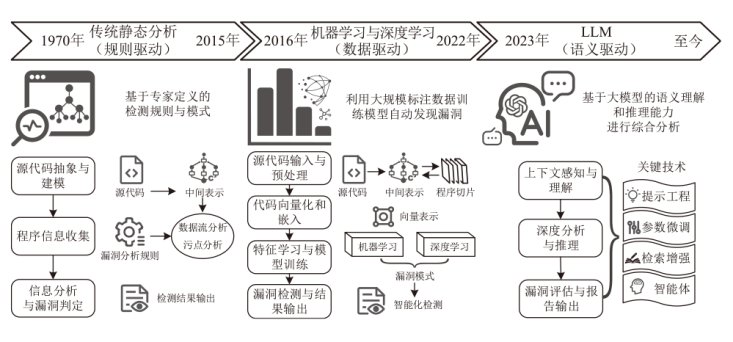
| 传统SAST | 确定性 保证 | 人工规则,成本极高 | 过程内/跨模块受限 | 注入/ 内存/ 指针 | 规则僵化 | 规则维护与误报 治理 |
| 机器学习/深度学习 | 概率性 泛化 | 隐式特征 | 函数级/ 短序列 | 函数 内模式 | 泛化性差/特征提取偏差 | 训练算力与数据 依赖 |
| LLM | 概率性 生成 | 提示/微调,灵活 | 仓库级/ 超长上下文支持 | 逻辑/ 权限/ 配置 | 幻觉/ 注意力 偏差 | Token消耗与模型 开销 |
| 适配技术路线 | 代表方法 | 适用场景 | 存在问题 |
|---|---|---|---|
| 提示工程 | 零/少样本 提示、思维链、结构化模板 | 快速原型验证、 通用语义推理、低算力/低标注场景 | 高度依赖基座能力、结果不 稳定、缺乏形式化保证、易受提示词设计偏差影响、跨文件数据流推理能力有限 |
| 参数微调 | 全量微调、指令微调、LoRA等参数高效微调技术 | 领域知识注入、 检测精度优化、 特定通用缺陷枚举模式学习 | 依赖高质量标注、易过拟合或灾难性遗忘、跨语言泛化受限、训练部署成本较高 |
| 检索增强生成 | 向量检索及重排序、多跳 知识检索 | 动态安全知识更新、缓解记忆滞后、 依赖上下文增强 | 知识库维护成本高、检索噪声干扰推理、延迟影响流水线、易引发注意力稀释 |
| 智能体 | 多智能体协同、ReAct/规划-执行- 反思 | 仓库级跨文件分析、多步推理与工具 调度、自动化审计 | 规划复杂度高、Token与应用程序编程接口成本高昂、缺乏有效终止条件易致探索空间 爆炸、工具误用放大幻觉 |
| 数据集 | 年份 | 规模 (漏洞函数/总计函数) | 语言 | CWE种类 /种 | 粒度 | 主要特点 |
|---|---|---|---|---|---|---|
| Devign[ | 2019 | 27652/58965 | C | — | 函数级 | 4个C项目,人工标注 |
| BigVul[ | 2020 | 11823/264919 | C/C++ | 91 | 函数级 | 规模大,标签噪声高 |
| CWE-Bench-Java[ | 2024 | 120 CVE | Java | 4 | 多粒度 | 包含缺陷和已修复的源代码、文件和函数 信息 |
| PrimeVul[ | 2024 | 6968/235768 | C/C++ | 140 | 函数级 | 严格去重,时间切分 |
| CleanVul[ | 2025 | 8198 | Java/Python/JavaScript/C#/C/C++ | — | 函数级 | LLM辅助清洗,正确率高 |
| BenchVul[ | 2026 | 1050 | 多语言 | 21 | 函数级 | 独立OOD测试集;真实190+合成860;类别平衡 |
| Java CVE Benchmark[ | 2023 | 165程序/165CVE | Java | 8 | 仓库级 | 作者声称为最大的Java漏洞基准数据集 |
| ReposVul[ | 2024 | 6134 CVE | C/C++/Java/Python | 236 | 仓库级 | 作者声称为首个仓库级高质量数据集 |
| VulEval[ | 2026 | 4196 CVE | C/C++ | — | 仓库级 | 过程间+过程内联合评估 |
| CVE-Bench[ | 2025 | 509 CVE/120 repos | Python/Java/JavaScript/PHP | 16+ | 仓库级 | 可执行环境,智能体评估 |
| 集成模式 | 代表工作 | LLM角色 | SAST角色 | 解决 挑战 | 主要优势 |
|---|---|---|---|---|---|
| 规格推断与规则自演化模式 | QLPro[ | 多数投票确定规格推断,生成QL文件,迭代修复 | 提取污点规格,编译执行QL文件 | 挑战3、挑战6 | 缓解上下文偏差影响;显著提升QL文件语法正确性 |
| IRIS[ | 规格推断,上下文分类 | 数据流分析引擎,规则执行器,候选生成器 | 挑战3、挑战6 | 规则自演化、全仓库分析、精度提升、零样本扩展 | |
| CPGHunter[ | 规格生成器 | 精确分析 引擎 | 挑战3、挑战6 | 消除规格 依赖 | |
| 误报过滤与告警归因 裁决模式 | ZeroFalse[ | 语义裁决者 | 证据生成器 | 挑战4 | 高精度保留召回 |
| LLM4SA[ | 扮演人类专家对警告审查 裁决 | 自动化扫 描器 | 挑战4 | 高效、通用、可解释、可扩展;高覆盖率与 自动化 | |
| 语义导向切片与上下文压缩模式 | LLMxCPG[ | 查询生成器(切片)、漏洞分类(检测) | 代码建模、执行引擎、特征提取 | 挑战1、挑战2 | 可解释性强、低假阳性、跨文件分析、抗变换鲁棒性 |
| 标准化查询接口与事实按需检索 模式 | codebadger[ | 智能分析代理 | 知识库和执行引擎 | 挑战2、挑战5 | 语义导航及跨函数分析 |
| Deep VulHunter[ | 基于样例推理判断漏洞类别、触发路径、补丁原理 | 检索相似 代码 (代替SAST) | 挑战5 | 外部知识和多轮推理强化;通过示例-推理-验证减少 偏差 |
| 技术分类 | 代表工作 | 系统能力与适用场景 | 挑战覆盖 |
|---|---|---|---|
| 传统SAST | Joern[ | 确定性语义分析,跨模块依赖建模;适用于安全合规扫描与已知模式检测 | 挑战2、挑战6 |
| 机器学习/深度学习 | Devign[ | 自动特征学习与结构化表示建模;适用于函数级模式泛化 | 挑战3 |
| LLM 原生检测 | 检索增强生成 Vul-RAG[ | 外部知识动态注入:突破模型训练数据截断限制,通过历史漏洞模式增强根因推理能力;适用于依赖历史知识迁移的 检测任务 | 挑战3、挑战5 |
| 轻量化推理 VulnLLM-R[ | 推理能力内化:将Agent调度开销压缩至模型内部,通过蒸馏实现高效检测; 适用于低延迟、成本敏感场景 | 挑战1、挑战2 | |
| SAST与LLM 深度集成 | 规则自演化IRIS[ | 自动化规则生成:解决人工维护成本高与外部库规格缺失 问题; 适用于规则滞后、动态架构适配场景 | 挑战3、挑战6 |
| 误报裁决ZeroFalse[ | 语义级告警过滤:在SAST高精度扫描基础上,降低海量误报人工审计疲劳; 适用于工业级流水线后处理 | 挑战4、挑战5 | |
| 上下文压缩 LLMxCPG[ | 结构化事实注入:利用静态图分析裁剪冗余代码,为LLM 提供高信噪比输入;适用于超长上下文与跨文件依赖追踪 | 挑战1、挑战2、挑战5 | |
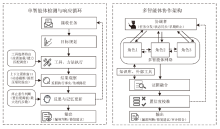
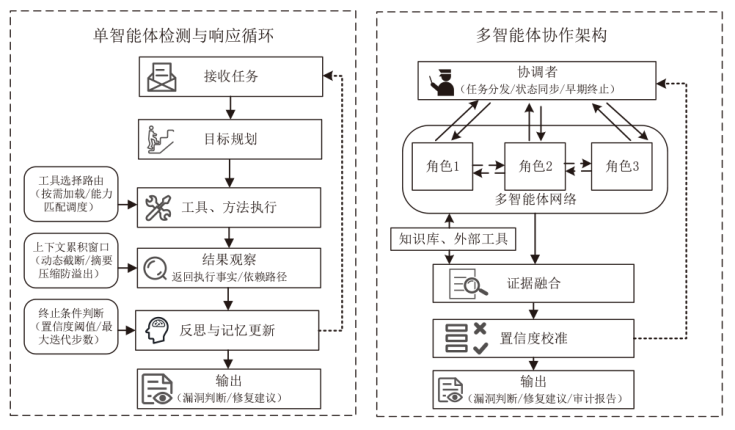
| 智能体自主审计 (系统级自主性) | 单智能体 RepoAudit[ | 自适应规划与探索:通过ReAct或规则导航动态决定 分析深度,无需预设全量流水线;适用于未知漏洞探索与 灵活场景 | 挑战1、挑战2、挑战5 |
| 多智能体协同 Argus[ | 角色分工与对抗验证:通过检测、验证、PoC生成等多角色协同,实现全流程自动化与误报交叉验证;适用于复杂供应链与高精度要求场景 | 挑战2、挑战3、挑战4、挑战5 |
| [1] | 刘嘉勇, 韩家璇, 黄诚. 源代码漏洞静态分析技术[J]. 信息安全学报, 2022, 7(4): 100-113. |
| [2] | Zhou Xin, Cao Sicong, Sun Xiaobing, et al. Large language model for vulnerability detection and repair: literature review and the road ahead[J]. ACM Transactions on Software Engineering and Methodology, 2025, 34(5): 1-31. |
| [3] | Sheng Ze, Chen Zhicheng, Gu Shuning, et al. LLMs in software security: a survey of vulnerability detection techniques and insights[J]. ACM Computing Surveys, 2026, 58(5): 1-35. |
| [4] | Kaniewski S, Schmidt F, Enzweiler M, et al. A systematic literature review on detecting software vulnerabilities with large language models[J/OL]. ACM Transactions on Software Engineering and Methodology, 2026-05-16. https://doi.org/10.1145/3815425. |
| [5] | Yamaguchi F, Golde N, Arp D, et al. Modeling and discovering vulnerabilities with code property graphs[C]// 2014 IEEE Symposium on Security and Privacy. New York: IEEE, 2014: 590-604. |
| [6] | Avgustinov P, Moor O D, Jones M P, et al. QL: object-oriented queries on relational data[EB/OL]. [2026-04-26]. https://drops.dagstuhl.de/storage/00lipics/lipics-vol056-ecoop2016/LIPIcs.ECOOP.2016.2/LIPIcs.ECOOP.2016.2.pdf. |
| [7] |
Distefano D, Fähndrich M, Logozzo F, et al. Scaling static analyses at facebook[J]. Communications of the ACM, 2019, 62(8): 62-70.
doi: 10.1145/3338112 |
| [8] |
Li Zongjie, Liu Zhibo, Wong W K, et al. Evaluating C/C++ vulnerability detectability of query-based static application security testing tools[J]. IEEE Transactions on Dependable and Secure Computing, 2024, 21(5): 4600-4618.
doi: 10.1109/TDSC.2024.3354789 URL |
| [9] | Li Zhen, Zou Deqing, Xu Shouhuai, et al. VulDeePecker: a deep learning-based system for vulnerability detection[EB/OL]. [2026-04-26]. https://www.ndss-symposium.org/wp-content/uploads/2018/02/ndss2018_03A-2_Li_paper.pdf. |
| [10] |
Li Zhen, Zou Deqing, Xu Shouhuai, et al. SySeVR: a framework for using deep learning to detect software vulnerabilities[J]. IEEE Transactions on Dependable and Secure Computing, 2022, 19(4): 2244-2258.
doi: 10.1109/TDSC.2021.3051525 URL |
| [11] | Hanif H, Maffeis S. VulBERTa: simplified source code pre-training for vulnerability detection[C]// 2022 International Joint Conference on Neural Networks (IJCNN). New York: IEEE, 2022: 1-8. |
| [12] | Zhou Yaqin, Liu Shangqing, Siow J, et al. Devign: effective vulnerability identification by learning comprehensive program semantics via graph neural networks[EB/OL]. [2026-04-26]. https://arxiv.org/pdf/1909.03496. |
| [13] | Cheng Xiao, Wang Haoyu, Hua Jiayi, et al. DeepWukong: statically detecting software vulnerabilities using deep graph neural network[J]. ACM Transactions on Software Engineering and Methodology, 2021, 30(3): 1-33. |
| [14] | Chen Yizheng, Ding Zhoujie, Alowain L, et al. DiverseVul: a new vulnerable source code dataset for deep learning based vulnerability detection[C]// The 26th International Symposium on Research in Attacks, Intrusions and Defenses. New York: ACM, 2023: 654-668. |
| [15] |
Zhang Quanjun, Fang Chunrong, Xie Yang, et al. A survey on large language models for software engineering[J]. Science China Information Sciences, 2026, 69(4): 141102.
doi: 10.1007/s11432-025-4670-0 |
| [16] | Bruni M, Gabrielli F, Ghafari M, et al. Benchmarking prompt engineering techniques for secure code generation with GPT models[C]// 2025 IEEE/ACM Second International Conference on AI Foundation Models and Software Engineering (Forge). New York: IEEE, 2025: 93-103. |
| [17] | Shimmi S, Saini Y, Schaefer M, et al. Software vulnerability detection using LLM: does additional information help?[C]// 2024 Annual Computer Security Applications Conference Workshops (ACSAC Workshops). New York: IEEE, 2024: 216-223. |
| [18] | Pandey M, Kumar S. VP-IAFSP: vulnerability prediction using information augmented few-shot prompting with open source LLMs[C]// The 20th International Conference on Evaluation of Novel Approaches to Software Engineering. Porto: SCITEPRESS, 2025: 592-599. |
| [19] | Du Xiaohu, Wen Ming, Zhu Jiahao, et al. Generalization-enhanced code vulnerability detection via multi-task instruction fine-tuning[C]// Findings of the Association for Computational Linguistics ACL 2024. Stroudsburg: ACL, 2024: 10507-10521. |
| [20] | Du Xueying, Zheng Geng, Wang Kaixin, et al. Vul-RAG: enhancing LLM-based vulnerability detection via knowledge-level RAG[J/OL]. ACM Transactions on Software Engineering and Methodology, 2026-02-20. https://doi.org/10.1145/3797277. |
| [21] | Liu Xiangyan, Lan Bo, Hu Zhiyuan, et al. CodexGraph: bridging large language models and code repositories via code graph databases[C]// The 2025 Conference of the Nations of the Americas Chapter of the Association for Computational Linguistics:Human Language Technologies. Stroudsburg: ACL, 2025: 142-160. |
| [22] | Fan Jiahao, Li Yi, Wang Shaohua, et al. A C/C++ code vulnerability dataset with code changes and CVE summaries[C]// The 17th International Conference on Mining Software Repositories. New York: ACM, 2020: 508-512. |
| [23] | Li Yikun, Zhang Ting, Widyasari R, et al. CleanVul: automatic function-level vulnerability detection in code commits using LLM heuristics[EB/OL]. (2025-09-11)[2026-04-26]. http://arxiv.org/abs/2411.17274. |
| [24] | Ding Yangruibo, Fu Yanjun, Ibrahim O, et al. Vulnerability detection with code language models: how far are we?[C]// 2025 IEEE/ACM 47th International Conference on Software Engineering (ICSE). New York: IEEE, 2025: 1729-1741. |
| [25] | Wang Xinchen, Hu Ruida, Gao Cuiyun, et al. ReposVul: a repository-level high-quality vulnerability dataset[C]// The 2024 IEEE/ACM 46th International Conference on Software Engineering:Companion Proceedings. New York: ACM, 2024: 472-483. |
| [26] |
Wen Xincheng, Wang Xinchen, Chen Yujia, et al. From function to repository: towards repository-level evaluation of software vulnerability detection[J]. IEEE Transactions on Software Engineering, 2026, 52(4): 1315-1331.
doi: 10.1109/TSE.2026.3662145 URL |
| [27] | Wang Peiran, Liu Xiaogeng, Xiao Chaowei. CVE-Bench: benchmarking LLM-based software engineering agent’s ability to repair real-world CVE vulnerabilities[C]// The 2025 Conference of the Nations of the Americas Chapter of the Association for Computational Linguistics:Human Language Technologies. Stroudsburg: ACL, 2025: 4207-4224. |
| [28] | Li Ziyang, Dutta S, Naik M. IRIS: LLM-assisted static analysis for detecting security vulnerabilities[C]// The Thirteenth International Conference on Learning Representations. San Diego: ICLR, 2025: 35735-35758. |
| [29] | Li Yikun, Bui N T, Zhang Ting, et al. Out of distribution, out of luck: how well can LLMs trained on vulnerability datasets detect top 25 CWE weaknesses[EB/OL]. (2026-01-15)[2026-04-26]. https://arxiv.org/abs/2507.21817. |
| [30] | Li Kaixuan, Chen Sen, Fan Lingling, et al. Comparison and evaluation on static application security testing (SAST) tools for java[C]// The 31st ACM Joint European Software Engineering Conference and Symposium on the Foundations of Software Engineering. New York: ACM, 2023: 921-933. |
| [31] | Zhou Xin, Tran D M, Le-Cong T, et al. Comparison of static application security testing tools and large language models for repo-level vulnerability detection[EB/OL]. (2024-07-23)[2026-04-26]. https://arxiv.org/abs/2407.16235v1. |
| [32] |
Sovrano F, Bauer A, Bacchelli A. Large language models for in-file vulnerability localization can be “lost in the end”[J]. Proceedings of the ACM on Software Engineering, 2025, 2(FSE): 891-913.
doi: 10.1145/3715758 URL |
| [33] |
Hou Anran, Su Bingjun, Niu Weina, et al. CPGHunter: LLM-guided semantic modeling for scalable vulnerability detection via taint analysis[J]. Empirical Software Engineering, 2026, 31(4): 106.
doi: 10.1007/s10664-026-10842-2 |
| [34] |
Cao Zong, Sun Yuqiang, Xu Zhengzi, et al. Reframing paths as logic: semantic segmentation for vulnerability detection[J]. Proceedings of the ACM on Programming Languages, 2026, 10(OOPSLA1): 1989-2016.
doi: 10.1145/3798272 URL |
| [35] |
Çetin O, Ekmekcioglu E, Arief B, et al. An empirical evaluation of large language models in static code analysis for PHP vulnerability detection[J]. JUCS-Journal of Universal Computer Science, 2024, 30(9): 1163-1183.
doi: 10.3897/jucs.134739 URL |
| [36] | Huang Feiyuan, Sun Yuqiang, Zhang Fan, et al. Do fine-tuned LLMs understand vulnerabilities? An investigation into the semantic trap[EB/OL]. (2026-02-02)[2026-04-26]. http://arxiv.org/abs/2601.22655. |
| [37] |
Wang Le, Chen Chan, Zhu Junyi, et al. CQLLM: a framework for generating CodeQL security vulnerability detection code based on large language model[J]. Applied Sciences, 2026, 16(1): 517.
doi: 10.3390/app16010517 URL |
| [38] | Steenhoek B, Rahman M M, Roy M K, et al. To err is machine: Vulnerability detection challenges LLM reasoning[EB/OL]. (2025-01-07)[2026-04-26]. http://arxiv.org/abs/2403.17218. |
| [39] | Landman D, Serebrenik A, Vinju J J. Challenges for static analysis of java reflection-literature review and empirical study[C]// 2017 IEEE/ACM 39th International Conference on Software Engineering (ICSE). New York: IEEE, 2017: 507-518. |
| [40] | Hu Junze, Jin Xiangyu, Zeng Yizhe, et al. QLPro: automated code vulnerability discovery via LLM and static code analysis integration[EB/OL]. (2025-07-19)[2026-04-26]. http://arxiv.org/abs/2506.23644. |
| [41] | Iranmanesh M, Sabet S M, Marefat S, et al. ZeroFalse: improving precision in static analysis with LLMs[EB/OL]. (2025-10-02)[2026-04-26]. http://arxiv.org/abs/2510.02534. |
| [42] | Wen Cheng, Cai Yuandao, Zhang Bin, et al. Automatically inspecting thousands of static bug warnings with large language model: how far are we?[J]. ACM Transactions on Knowledge Discovery from Data, 2024, 18(7): 1-34. |
| [43] | Lekssays A, Mouhcine H, Tran K, et al. LLMxCPG: context-aware vulnerability detection through code property graph-guided large language models[C]// The 34th USENIX Security Symposium (USENIX Security’25). Berkeley: USENIX, 2025: 489-507. |
| [44] | Lekssays A. Bridging code property graphs and language models for program analysis[C]// The 2026 IEEE/ACM 4th International Workshop on Software Vulnerability Management. New York: ACM, 2026: 33-40. |
| [45] |
Jiao Yutong, Han Jiaxuan, Huang Cheng. DeepVulHunter: enhancing the code vulnerability detection capability of LLMs through multi-round analysis[J]. Journal of Intelligent Information Systems, 2025, 63(6): 2237-2264.
doi: 10.1007/s10844-025-00982-0 |
| [46] | Guo Jinyao, Wang Chengpeng, Xu Xiangzhe, et al. RepoAudit: an autonomous LLM-agent for repository-level code auditing[C]// The 42nd International Conference on Machine Learning. Cambridge: PMLR, 2025: 21083-21100. |
| [47] | Yildiz A, Teo S G, Lou Yiling, et al. Benchmarking LLMs and LLM-based agents in practical vulnerability detection for code repositories[C]// The 63rd Annual Meeting of the Association for Computational Linguistics. Stroudsburg: ACL, 2025: 30848-30865. |
| [48] | Nie Yuzhuo, Li Hongwei, Guo Chengquan, et al. VulnLLM-R: specialized reasoning LLM with agent scaffold for vulnerability detection[EB/OL]. (2025-12-08)[2026-04-26]. http://arxiv.org/abs/2512.07533. |
| [49] | Liang Zi, Xie Qipeng, He Jun, et al. Argus: reorchestrating static analysis via a multi-agent ensemble for full-chain security vulnerability detection[EB/OL]. (2026-04-08)[2026-04-26]. http://arxiv.org/abs/2604.06633. |
| [50] | Chen Yujia. AutoReview: an LLM-based multi-agent system for security issue-oriented code review[C]// The 33rd ACM International Conference on the Foundations of Software Engineering. New York: ACM, 2025: 1022-1024. |
| [51] | Meng Renwei, Wu Haoyi, Wang Jingming. VulnAgent-R2:evidence-calibrated multi-agent auditing for repository-level vulnerability detection[EB/OL]. (2026-03-11)[2026-04-26]. http://arxiv.org/abs/2603.13384. |
| [52] | Marchetto A. Can explainability and deep-learning be used for localizing vulnerabilities in source code?[C]// The 5th ACM/IEEE International Conference on Automation of Software Test (AST 2024). New York: ACM, 2024: 110-119. |
| [1] | Nie Haojie, Sun Degang, Pan Xingbo, Wan Wei, Long Chun. A survey of membership inference attacks and defenses for large language models [J]. Netinfo Security, 2026, 26(9): 1341-1353. |
| [2] | Ma Wenfei, Long Chun, Li Jing, Yang Fan, Fu Yuhao. Backdoor poisoning in the fine-tuning stage of large language models: attacks, defenses, and evaluation [J]. Netinfo Security, 2026, 26(9): 1354-1368. |
| [3] | Yao Wuhuang, Wang Jiapeng, Chen Kangbing, Zheng Zhihan, Tan Yu’an. An LLM-assisted firmware memory leak analysis based on instruction translation instrumentation [J]. Netinfo Security, 2026, 26(7): 1087-1100. |
| [4] | Yang Qiaoyang, Fan Ximing, Jia Peng. LLM-based semantic-aware fuzz driver generation [J]. Netinfo Security, 2026, 26(7): 1128-1148. |
| [5] | SUN Yu, ZHANG Xuanrui, LIU Xinyu. Advances in Advanced Persistent Threat Detection and Provenance Research [J]. Netinfo Security, 2026, 26(6): 833-853. |
| [6] | MIAO Bo, YUAN Deyu, ZHANG Teng, YANG Yi, HUANG Zan. Chain-of-Thought Poisoning Based Retrieval-Augmented Generation Backdoor Attack [J]. Netinfo Security, 2026, 26(6): 977-998. |
| [7] | CUI Jinhua, DONG Liang, YANG Xin. A Survey of Privacy-Preserving Techniques for Large Language Model Inference [J]. Netinfo Security, 2026, 26(4): 503-520. |
| [8] | LI Yan, YANG Wenzhang, XUE Yinxing. Cross-Language Compiler Fuzzing Based on LLM Translation and Differential Testing [J]. Netinfo Security, 2026, 26(4): 591-604. |
| [9] | HU Mianning, LI Xin, LI Mingfeng, YUAN Deyu. Research on Multi-Strategy Enhanced Chinese Network Threat Intelligence Entity Extraction Based on Large Language Model [J]. Netinfo Security, 2026, 26(4): 615-625. |
| [10] | DONG Yingjuan, LYU Ping, LIU Bing. An Automated Penetration Testing System Based on Multi-Agent Architecture [J]. Netinfo Security, 2026, 26(4): 654-664. |
| [11] | YUAN Ming, ZOU Qilin, YUAN Wenqi, WANG Qun. A Survey on Prompt Injection Attacks and Defenses in Large Language Models [J]. Netinfo Security, 2026, 26(3): 341-354. |
| [12] | GU Zhaojun, LI Li, SUI He. A Payload Generation Method for SQL Injection Vulnerability Detection Based on Large Language Models [J]. Netinfo Security, 2026, 26(2): 274-290. |
| [13] | DENG Yuyang, LU Tianliang, LI Zhihao, MENG Haoyang, MA Yuansheng. A SQL Injection Attack Detection Model Integrating GAT and Interpretable DQN [J]. Netinfo Security, 2026, 26(1): 150-167. |
| [14] | TONG Xin, JIAO Qiang, WANG Jingya, YUAN Deyu, JIN Bo. A Survey on the Trustworthiness of Large Language Models in the Public Security Domain: Risks, Countermeasures, and Challenges [J]. Netinfo Security, 2026, 26(1): 24-37. |
| [15] | HU Yucui, GAO Haotian, ZHANG Jie, YU Hang, YANG Bin, FAN Xuejian. Automated Exploitation of Vulnerabilities in Vehicle Network Security [J]. Netinfo Security, 2025, 25(9): 1348-1356. |
| Viewed | ||||||
|
Full text |
|
|||||
|
Abstract |
|
|||||