信息网络安全 ›› 2026, Vol. 26 ›› Issue (7): 1087-1100.doi: 10.3969/j.issn.1671-1122.2026.07.007
基于指令翻译插桩的LLM辅助固件内存泄漏分析
姚戊煌, 王佳鹏, 陈康冰, 郑之涵, 谭毓安( )
)
北京理工大学网络空间安全学院 北京 100081
-
收稿日期:2026-04-29出版日期:2026-07-10发布日期:2026-09-03 -
通讯作者:谭毓安 E-mail:tan2008@bit.edu.cn -
作者简介:姚戊煌(2002—),男,福建,硕士研究生,主要研究方向为固件安全、系统安全|王佳鹏(2000—),男,黑龙江,硕士研究生,主要研究方向为固件安全、系统安全|陈康冰(2000—),男,浙江,博士研究生,主要研究方向为嵌入式安全、固件安全、二进制安全|郑之涵(2000—),男,山西,博士研究生,主要研究方向为固件安全、UEFI安全、模糊测试|谭毓安(1972—),男,重庆,教授,博士,CCF会员,主要研究方向为固件安全、数据安全、网络安全。 -
基金资助:国家自然科学基金(U2336201)
An LLM-assisted firmware memory leak analysis based on instruction translation instrumentation
Yao Wuhuang, Wang Jiapeng, Chen Kangbing, Zheng Zhihan, Tan Yu’an()
School of Cyberspace Science and Technology ,Beijing Institute of Technology Beijing 100081, China
-
Received:2026-04-29Online:2026-07-10Published:2026-09-03 -
Contact:Tan Yu’an E-mail:tan2008@bit.edu.cn

摘要:
随着嵌入式设备在各类关键场景中广泛部署,基于Linux的嵌入式固件中的内存泄漏会导致服务可用性下降。现有针对开源固件程序的内存泄漏漏洞检测方法依赖源代码及符号信息,难以直接推广到闭源固件;而针对闭源固件程序的自动化内存泄漏检测方法则存在对ARM架构固件支持能力不足的问题。为此,文章提出一种面向基于Linux的嵌入式固件程序的内存泄漏分析方法MemLeakFinder,该方法基于QEMU的中间码指令翻译和插桩技术,实现对目标程序内存操作的动态追踪和分析,结合模糊测试和反汇编分析技术定位潜在的内存泄漏漏洞,并引入大语言模型(LLM)对捕获的内存泄漏漏洞现场进行语义理解与根因自动化分析。文章选择BMC固件作为目标环境,选择CGI作为目标协议并进行了综合性实验。实验结果表明,MemLeakFinder在Juliet测试套件上的识别准确率达92.16%,在对7种真实BMC固件的测试中,利用MemLeakFinder工具成功发现并验证了5个实际漏洞,涉及的关键漏洞已获得一项CVE编号,验证了该方法在闭源固件程序内存安全性分析中的有效性。
中图分类号:
引用本文
姚戊煌, 王佳鹏, 陈康冰, 郑之涵, 谭毓安. 基于指令翻译插桩的LLM辅助固件内存泄漏分析[J]. 信息网络安全, 2026, 26(7): 1087-1100.
Yao Wuhuang, Wang Jiapeng, Chen Kangbing, Zheng Zhihan, Tan Yu’an. An LLM-assisted firmware memory leak analysis based on instruction translation instrumentation[J]. Netinfo Security, 2026, 26(7): 1087-1100.
表1
具有写PC语义的ARMv7指令及其行为与状态变化
| 指令/类别 | 改变PC行为 | 状态变化 | 说明 |
|---|---|---|---|
| ADD(Thumb T2), MOV(Thumb T) | 半字节对齐跳转 | 不变 | 忽略最低位, 跳转到对齐地址 |
| B,BL,CBNZ,CBZ | 指定地址跳转 | 不变 | 指令定义保证 对齐 |
| BLX(立即数) | 跳转到立即数 地址 | 切换ARM/Thumb状态 | 地址对齐由指令保证 |
| BLX(寄存器),BX,BXJ | 跳转到寄存器值 | 根据最低位 切换 | LSB=1切Thumb LSB=0切ARM32 |
| LDR(目标寄存器为PC) | 跳转到内存中 取出的地址 | 根据最低位 切换 | 常用于函数返回 |
| POP/LDM(含PC) | 跳转到栈或寄存器列表中的地址 | 根据最低位 切换 | 常见于函数返回 |
| ADD, MOV,ADR等ARM 数据处理指令(Rd=PC,无 S位) | 跳转到计算结果 | 不变 | 仅在ARM32状态下生效 |
表2
测试环境配置
| 组件 | 配置 |
|---|---|
| 宿主机操作系统 | Ubuntu 24.04.1 LTS (64-bit) |
| QEMU版本 | 5.2.0 |
| 交叉编译工具链 | gcc-linaro-4.9-2016.02-x86_64_arm-linux-gnueabi |
| AFL++版本 | 4.32 |
| QASan版本 | AFL++内置QASan(自定义修改) |
| IDA pro版本 | 7.5.201028 Windows x64 (32-bit address size) |
| 宿主机CPU | Intel 11th Gen Core i5-11400 |
| 宿主机内存 | 24 GB DDR3 |
| 宿主机磁盘 | 512 GB NVMe SSD |
| 目标平台架构 | ARMv7(ARM32) |
表3
MemLeakFinder在 Juliet 测试集上的混淆矩阵统计结果
| 检测为泄漏/例 | 检测为正常/例 | 总数/例 | |
|---|---|---|---|
| 实际为泄漏 | 1257(TP) | 107(FN) | 1364 |
| 实际为正常 | 0(FP) | 1364(TN) | 1364 |
表4
对不同漏洞诱发模式的检测性能评估
| 漏洞诱发模式 | TN/例 | TP/例 | FN/例 | FP/例 | 准确率 |
|---|---|---|---|---|---|
| 分支/循环退出 | 596 | 489 | 107 | 0 | 82.05% |
| 指针被覆盖 | 228 | 228 | 0 | 0 | 100% |
| 异常处理路径 | 372 | 372 | 0 | 0 | 100% |
| 忽略返回值 | 112 | 112 | 0 | 0 | 100% |
| 全局变量未释放 | 56 | 56 | 0 | 0 | 100% |
| 总计 | 1364 | 1257 | 107 | 0 | 92.16% |
表5
MemLeakFinder在Juliet测试集上的分类性能评估结果
| 指标名称 | 计算式 | 数值 |
|---|---|---|
| 准确率 | (TP+TN)/(TP+TN+FP+FN) | 92.16% |
| 精确率 | TP/(TP+FP) | 100% |
| 召回率 | TP/(TP+FN) | 92.22% |
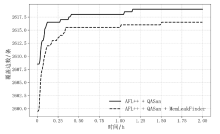
图1
平均覆盖率增长趋势
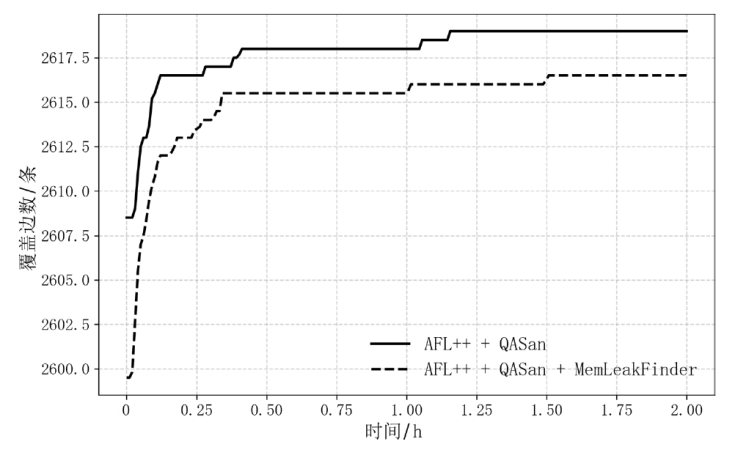
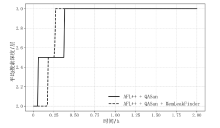
图2
平均模糊测试速度变化
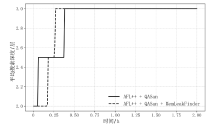
图3
平均搜索深度变化
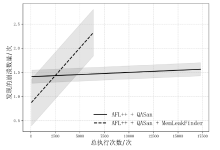
图4
总执行次数与已发现崩溃数量的关系
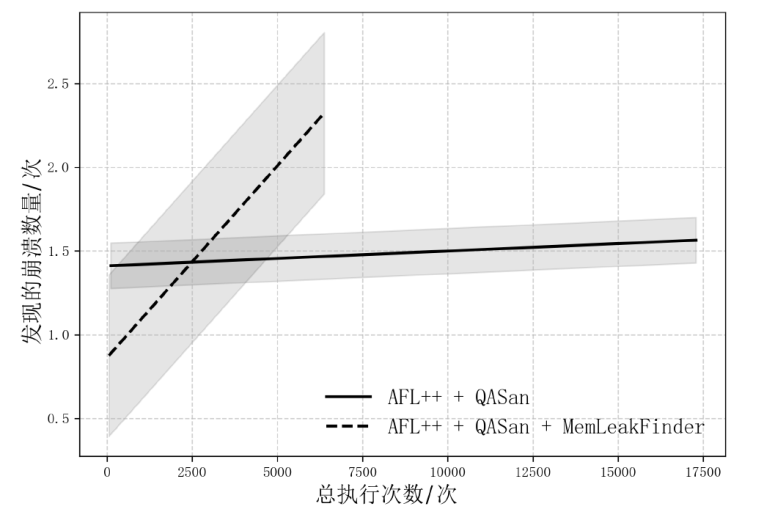
表6
5条泄漏路径的内存泄漏量与触发频率
| 排名 | 每轮平均 泄漏量/B | 每轮平均 触发频率/次 | 泄漏位置 |
|---|---|---|---|
| 1 | 65536 | 2 | libiniparser.so.2.12.0+0x20a0 |
| 2 | 9063 | 172 | libiniparser.so.2.12.0+0x1f40 |
| 3 | 2064 | 172 | libiniparser.so.2.12.0+0x1fd8 |
| 4 | 1202 | 168 | libiniparser.so.2.12.0+0x1f54 |
| 5 | 448 | 1 | libfcgi.so.0.0.0+0x47b4 |
表7
各服务器型号内存泄漏统计与平均运行时间
| 服务器型号 | 未释放次数/次 | 泄漏字节数/B | 平均运行时间/s |
|---|---|---|---|
| SA5212M5 | 528 | 78595 | 1.251 |
| NF8480M5 | 545 | 79277 | 1.240 |
| NF5270M6 | 522 | 78468 | 1.175 |
| NF3280A6 | 496 | 79049 | 0.975 |
| NF5180A6 | 709 | 90847 | 0.952 |
| NF5468A5 | 536 | 79084 | 0.769 |
| NE5260M5 | 525 | 79084 | 0.769 |
表8
MemLeakFinder与当前代表性方案的对比
| 方法 | 目标缺陷 | 核心机制 | 检测能力/性能特征 | 与本文关系 |
|---|---|---|---|---|
| ASan | OOB/UAF | 编译期红区+影子内存 | 运行开销较低,但依赖源码与符号信息 | 源码级基线,难直接应用于闭源固件 |
| QASan | 堆OOB/UAF | QEMU TCG插桩+影子内存/红区 | 无需改写二进制,但主要面向堆内存错误,调用上下文恢复能力有限 | 本文方法所依赖的底层运行时环境 |
| DFirmSan | Silent-MC/内存破坏 | 敏感函数预分析+DBC +不可信 数据跟踪 | 在18个真实固件中协助发现117个 已知CVE,额外开销2.69%~16.43%,误报率低于0.35% | 代表“选择性监控降开销”路线,但不面向泄漏 |
| QMSan | UUM | 机会主义多层检测+按需 精确复检 | 发现44个新的UUM错误;其运行开销为QEMU的1.51倍;实验过程中未观察到误报或漏报 | 代表“多层验证降开销”路线,但不关注泄漏生命周期 |
| 本文方法 | 内存泄漏 | ARM-FRA+LD_PRELOAD生命周期跟踪+CoT根因 研判 | Juliet准确率92.16%;在7种真实BMC固件中发现5个真实漏洞;额外物理内存开销约5.7 MB | — |
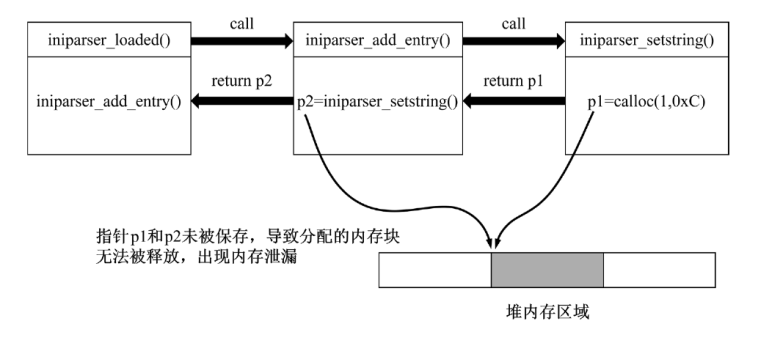
图5
libiniparser库内存泄漏示意图
| [1] | 梁晓兵, 孔令达, 刘岩, 等. 轻量级嵌入式软件动态二进制插桩算法[J]. 信息网络安全, 2021, 21(4): 89-95. |
| [2] | Yang Shanquan, Gao Yansong, Kuang B, et al. DFirmSan: a lightweight dynamic memory sanitizer for linux-based firmware[J]. Computers & Security, 2025, 155: Article 104467. |
| [3] | Seward J, Nethercote N. Using valgrind to detect undefined value errors with bit-precision[C]// 2005 USENIX Annual Technical Conference. Berkeley: USENIX, 2005: 17-30. |
| [4] | 汪小林, 王振林, 孙逸峰, 等. 利用虚拟化平台进行内存泄露探测[J]. 计算机学报, 2010, 33(3): 463-472. |
| [5] | 梅傲寒, 谭毓安, 常振轩, 等. 一种面向开源BMC固件的内生模糊测试框架[J]. 信息安全研究, 2025, 11(7): 611-618. |
| [6] | 常振轩, 郑之涵, 梅傲寒, 等. 一种面向固件网络应用的高效灰盒模糊测试方法[J]. 信息网络安全, 2025, 25(4): 654-663. |
| [7] | Song D, Lettner J, Rajasekaran P, et al. SOK: sanitizing for security[C]// 2019 Symposium on Security and Privacy. New York: IEEE, 2019: 1275-1295. |
| [8] | Bellard F. QEMU, a fast and portable dynamic translator[C]// 2005 USENIX Annual Technical Conference. Berkeley: USENIX, 2005: 41-46. |
| [9] | Marini M, D’elia D C, Payer M, et al. QMSan: efficiently detecting uninitialized memory errors during fuzzing[C]// 2025 Network and Distributed System Security Symposium. San Diego: Internet Society, 2025: 1-17 |
| [10] | Asmita, Oliinyk Y, Scott M, et al. Fuzzing busybox: leveraging LLM and crash reuse for embedded bug unearthing[C]// The 33rd USENIX Security Symposium. Berkeley: USENIX, 2024: 883-900. |
| [11] | 计江安, 井靖, 王奕森, 等. 嵌入式固件模糊测试研究综述[J]. 小型微型计算机系统, 2024, 45(5): 1173-1180. |
| [12] | 孙琪明, 侯刚, 靳文杰, 等. 嵌入式软件模糊测试研究综述[J]. 计算机科学, 2025, 52(7): 13-25. |
| [13] | 王琴应, 许嘉诚, 李宇薇, 等. 智能模糊测试综述:问题探索和方法分类[J]. 计算机学报, 2024, 47(9): 2059-2083. |
| [14] | 李岩, 杨文章, 张翼, 等. 基于大语言模型的模糊测试研究综述[J]. 软件学报, 2025, 36(6): 2404-2431. |
| [15] |
习宁, 周晓琳, 孙聪, 等. 支持物理交互的无人机飞控系统安全测试方法[J]. 电子学报, 2025, 53(3): 765-781.
doi: 10.12263/DZXB.20240890 |
| [16] | Bond M D, Mckinley K S. Tolerating memory leaks[C]// The 23rd ACM SIGPLAN Conference on Object-Oriented Programming Systems Languages and Applications. New York: ACM, 2008: 109-126. |
| [17] | Qin Feng, Lu Shan, Zhou Yuanyuan. SafeMem: exploiting ECC-memory for detecting memory leaks and memory corruption during production runs[C]// The 11th International Symposium on High-Performance Computer Architecture. New York: IEEE, 2005: 291-302. |
| [18] | Serebryany K, Bruening D, Potapenko A, et al. AddressSanitizer: a fast address sanity checker[C]// 2012 USENIX Annual Technical Conference. Berkeley: USENIX Association, 2012: 309-318. |
| [19] | Fioraldi A, D’elia D C, Querzoni L. Fuzzing binaries for memory safety errors with qasan[C]// 2020 IEEE Secure Development. New York: IEEE, 2020: 23-30. |
| [20] | Wei J, Wang Xuezhi, Schuumans D, et al. Chain-of-thought prompting elicits reasoning in large language models[C]// Advances in Neural Information Processing Systems 35 (2022). New York: Curran Associates, 2022: 24824-24837. |
| [21] | ARM. ARM architecture reference manual for a-profile architecture[EB/OL]. (2024-11-30)[2026-04-03]. https://developer.arm.com/documentation/ddi0487/la/?lang=en. |
| [1] | 杨乔炀, 范希明, 贾鹏. 基于大语言模型的语义知晓的模糊测试驱动生成方案[J]. 信息网络安全, 2026, 26(7): 1128-1148. |
| [2] | 孙钰, 张轩瑞, 刘新宇. 高级持续性威胁检测与溯源研究进展[J]. 信息网络安全, 2026, 26(6): 833-853. |
| [3] | 苗博, 袁得嵛, 张腾, 杨懿, 黄赞. 基于思维链污染的检索增强生成后门攻击[J]. 信息网络安全, 2026, 26(6): 977-998. |
| [4] | 胡倾城, 张婉, 袁亚丽, 张静. 基于多视图知识增强的大语言模型事实型幻觉优化方法[J]. 信息网络安全, 2026, 26(5): 772-787. |
| [5] | 崔津华, 董亮, 杨新. 大语言模型推理隐私保护技术综述[J]. 信息网络安全, 2026, 26(4): 503-520. |
| [6] | 李岩, 杨文章, 薛吟兴. 基于LLM翻译与差分测试的跨语言编译器模糊测试[J]. 信息网络安全, 2026, 26(4): 591-604. |
| [7] | 胡勉宁, 李欣, 李明锋, 袁得嵛. 基于大语言模型的多策略增强中文网络威胁情报实体抽取研究[J]. 信息网络安全, 2026, 26(4): 615-625. |
| [8] | 袁明, 邹其霖, 袁文骐, 王群. 大语言模型提示词注入攻击与防御综述[J]. 信息网络安全, 2026, 26(3): 341-354. |
| [9] | 顾兆军, 李丽, 隋翯. 基于大语言模型的SQL注入漏洞检测载荷生成方法[J]. 信息网络安全, 2026, 26(2): 274-290. |
| [10] | 张光华, 李国瑜, 王鹤, 李珩, 武少广. 基于污点流分析的物联网固件高可信度漏洞检测[J]. 信息网络安全, 2026, 26(2): 325-337. |
| [11] | 仝鑫, 焦强, 王靖亚, 袁得嵛, 金波. 公共安全领域大语言模型的可信性研究综述:风险、对策与挑战[J]. 信息网络安全, 2026, 26(1): 24-37. |
| [12] | 胡雨翠, 高浩天, 张杰, 于航, 杨斌, 范雪俭. 车联网安全自动化漏洞利用方法研究[J]. 信息网络安全, 2025, 25(9): 1348-1356. |
| [13] | 刘会, 朱正道, 王淞鹤, 武永成, 黄林荃. 基于深度语义挖掘的大语言模型越狱检测方法研究[J]. 信息网络安全, 2025, 25(9): 1377-1384. |
| [14] | 王磊, 陈炯峄, 王剑, 冯袁. 基于污点分析与文本语义的固件程序交互关系智能逆向分析方法[J]. 信息网络安全, 2025, 25(9): 1385-1396. |
| [15] | 张燕怡, 阮树骅, 郑涛. REST API设计安全性检测研究[J]. 信息网络安全, 2025, 25(8): 1313-1325. |
| 阅读次数 | ||||||
|
全文 |
|
|||||
|
摘要 |
|
|||||