信息网络安全 ›› 2026, Vol. 26 ›› Issue (6): 944-957.doi: 10.3969/j.issn.1671-1122.2026.06.008
基于深度主动学习的联邦半监督入侵检测系统
张浩1,2,3, 叶骏威1,2,3( )
)
- 1
福州大学计算机与大数据学院 福州 350116
2福建省网络计算与智能信息处理重点实验室 福州 350116
3大数据智能教育部工程研究中心 福州 350116
-
收稿日期:2025-04-15出版日期:2026-06-10发布日期:2026-07-27 -
通讯作者:叶骏威 E-mail:xeno73@foxmail.com -
作者简介:张浩(1981—),男,安徽,副教授,博士,CCF高级会员,主要研究方向为信息安全、安全大数据分析、计算智能算法|叶骏威(2000—),男,福建,硕士研究生,主要研究方向为网络入侵检测、联邦学习 -
基金资助:福建省自然科学基金(2021J01616);互联网体系结构全国重点实验室开放课题(HLW2025MS14)
Deep Active Learning Based Federated Semi-Supervised Intrusion Detection System
ZHANG Hao1,2,3, YE Junwei1,2,3()
- 1
College of Computer and Data Science ,Fuzhou University Fuzhou 350116, China
2Fujian Key Laboratory of Network Computing and Intelligent Information Processing Fuzhou 350116, China
3Engineering Research Center of Big Data Intelligence ,Chinese Ministry of Education Fuzhou 350116, China
-
Received:2025-04-15Online:2026-06-10Published:2026-07-27 -
Contact:YE Junwei E-mail:xeno73@foxmail.com

摘要:
随着网络规模的扩大,网络安全问题日益突出,入侵检测系统面临数据标注成本高和数据传输延迟等挑战。联邦学习为分布式入侵检测提供了一种有效解决方案,但仍依赖大量标注数据。为降低标注成本,主动学习常被应用于入侵检测中,但主动学习中用于选择待标注样本的查询策略往往受限于数据分布。文章结合多样性采样与基于深度模型迁移的查询策略,提出一种基于深度主动学习的联邦半监督入侵检测系统。首先,通过K-Means聚类选择多样性样本进行标注。然后,基于迁移学习,利用已标注数据在分类器上的预测结果训练选择器;其中,分类器用于入侵检测,选择器用于筛选有助于提升检测性能的未标注样本进行标注。最后,文章选用NSL-KDD和UNSW-NB15数据集进行实验。实验结果表明,该方案减少了对大量标注数据的需求,并提高了主动学习在不同数据分布与场景下的适应性。
中图分类号:
引用本文
张浩, 叶骏威. 基于深度主动学习的联邦半监督入侵检测系统[J]. 信息网络安全, 2026, 26(6): 944-957.
ZHANG Hao, YE Junwei. Deep Active Learning Based Federated Semi-Supervised Intrusion Detection System[J]. Netinfo Security, 2026, 26(6): 944-957.
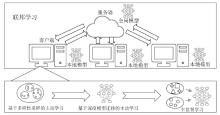
图1
DAFSS-IDS训练阶段整体流程
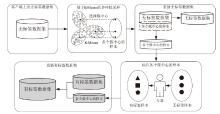
图2
基于多样性采样的主动学习流程
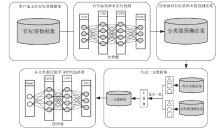
图3
基于深度模型迁移的主动学习的分类器训练流程
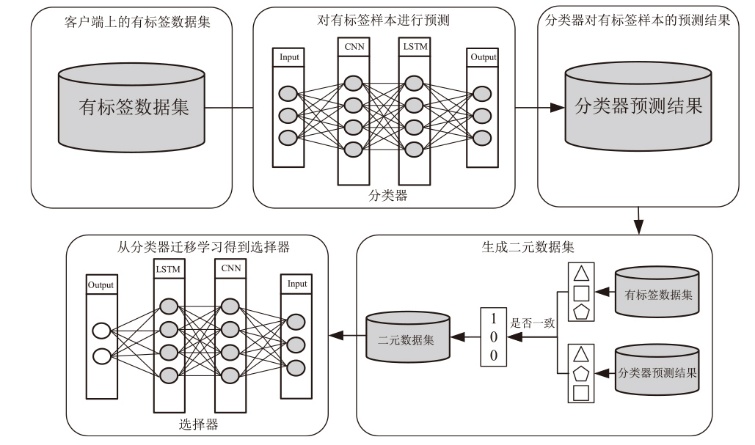
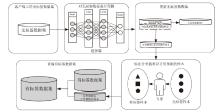
图4
基于深度模型迁移的主动学习的查询样本流程
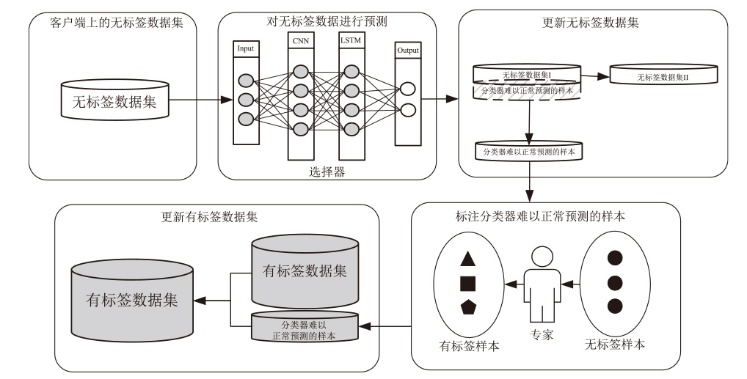
表1
模型结构
| 类型 | 参数设置 |
|---|---|
| 1D-CNN | 卷积核大小为3,卷积核数量为64 |
| LSTM | 隐藏层单元数为64,层数为1 |
| Dropout | 比率为0.1 |
表2
实验超参数设置
| 参数名称 | 描述 | 默认值 | |
|---|---|---|---|
| NSL-KDD | UNSW-NB15 | ||
| CommunicationRound | 联邦学习通信轮次 | 20 | 20 |
| Epoch | 本地迭代次数 | 5 | 10 |
| BatchSize/bit | 批量大小 | 2048 | 512 |
| Lr | 学习率 | 0.0001 | 0.0001 |
表3
基于伪标签的半监督学习算法在NSL-KDD数据集上的消融实验
| 有标签数据量 | 1% | 5% | 10% | 20% |
|---|---|---|---|---|
| 伪标签 | 70.81% | 71.42% | 72.87% | 74.30% |
| 有监督 | 69.90% | 70.76% | 71.77% | 72.77% |
表4
基于伪标签的半监督学习算法在UNSW-NB15数据集上的消融实验
| 有标签数据量 | 1% | 5% | 10% | 20% |
|---|---|---|---|---|
| 伪标签 | 68.48% | 70.79% | 72.55% | 73.16% |
| 有监督 | 67.93% | 70.34% | 71.66% | 72.78% |
表5
本地训练下基于伪标签的半监督学习算法在NSL-KDD数据集上的消融实验
| 有标签数据量 | 1% | 5% | 10% | 20% |
|---|---|---|---|---|
| 伪标签 | 58.08% | 58.82% | 61.84% | 63.04% |
| 有监督 | 57.63% | 58.10% | 61.42% | 62.81% |
表6
本地训练下基于伪标签的半监督学习算法在UNSW-NB15数据集上的消融实验
| 有标签数据量 | 1% | 5% | 10% | 20% |
|---|---|---|---|---|
| 伪标签 | 61.82% | 62.58% | 64.39% | 66.86% |
| 有监督 | 61.31% | 61.94% | 63.82% | 66.29% |
表7
基于多样性采样的查询策略与基于深度模型迁移的查询策略在NSL-KDD数据集上的消融实验
| 方案 | 加权召回率 | 加权精确率 | 加权F1分数 |
|---|---|---|---|
| 本文方案 | 81.01% | 77.68% | 73.79% |
| 多样性采样消融 | 76.35% | 74.60% | 71.82% |
| 深度模型迁移消融 | 79.56% | 73.77% | 71.03% |
表8
基于多样性采样的查询策略与基于深度模型迁移的查询策略在UNSW-NB15数据集上的消融实验
| 方案 | 加权召回率 | 加权精确率 | 加权F1分数 |
|---|---|---|---|
| 本文方案 | 72.98% | 73.04% | 71.68% |
| 多样性采样消融 | 69.34% | 72.67% | 68.65% |
| 深度模型迁移消融 | 69.68% | 73.69% | 69.39% |
表9
NSL-KDD下不同迁移学习策略的检测准确率
| 通信轮次 | 策略1 | 策略2 | 策略3 |
|---|---|---|---|
| 1 | 66.76% | 65.51% | 66.14% |
| 2 | 66.70% | 67.42% | 69.85% |
| 3 | 69.58% | 71.63% | 71.56% |
| 4 | 69.70% | 70.69% | 71.25% |
| 5 | 69.80% | 71.00% | 70.76% |
| 6 | 70.91% | 71.60% | 71.27% |
| 7 | 72.17% | 72.86% | 71.19% |
| 8 | 73.01% | 72.71% | 72.55% |
| 9 | 73.69% | 72.74% | 72.60% |
| 10 | 73.95% | 72.75% | 72.57% |
| 11 | 74.01% | 72.72% | 72.53% |
| 12 | 74.22% | 73.00% | 72.63% |
| 13 | 74.18% | 73.16% | 72.71% |
| 14 | 74.30% | 73.26% | 73.15% |
| 15 | 74.39% | 73.34% | 73.70% |
| 16 | 74.61% | 73.30% | 74.03% |
| 17 | 75.11% | 73.48% | 74.04% |
| 18 | 75.36% | 73.68% | 73.96% |
| 19 | 75.69% | 73.70% | 74.15% |
| 20 | 75.63% | 74.06% | 74.30% |
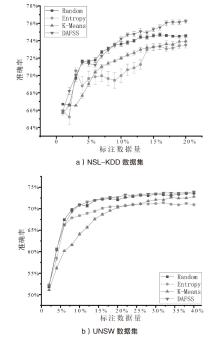
图5
不同主动学习策略的准确率对比
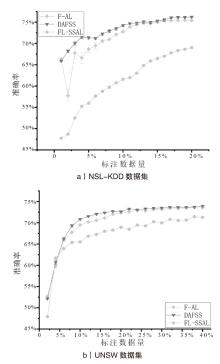
图6
DFASS与先进方案的准确率对比
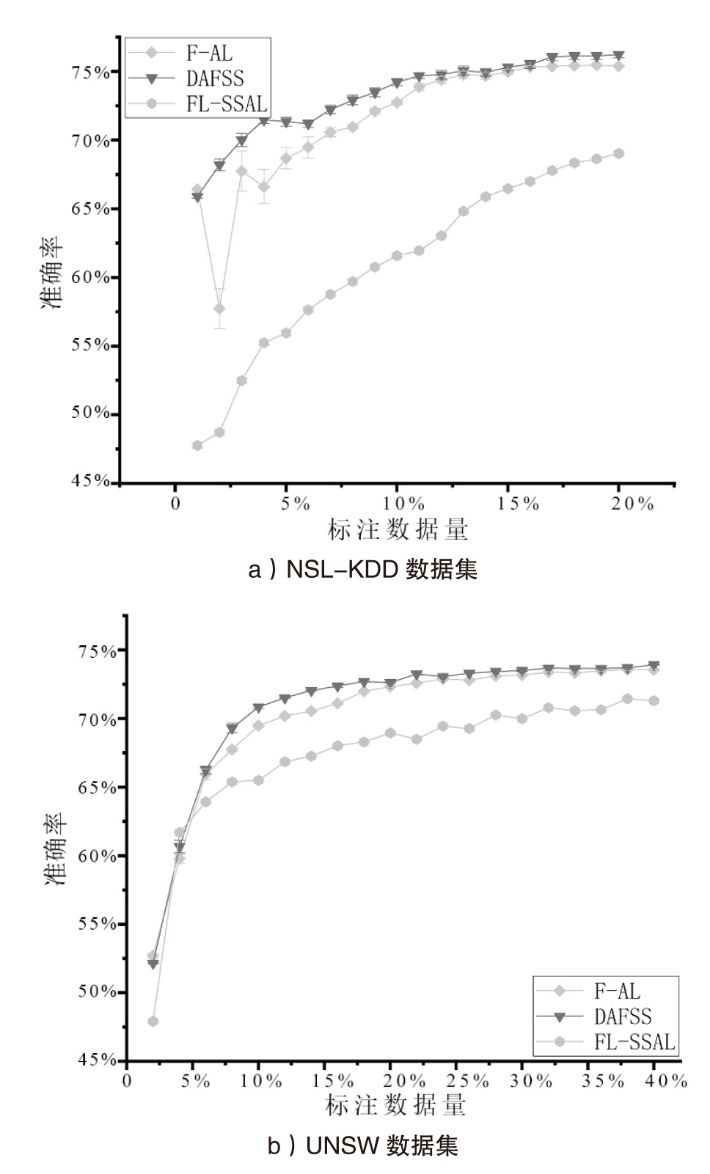
表10
不同主动学习策略在NSL-KDD和UNSW-NB15数据集上的性能对比
| 方案 | 加权召回率 | 加权精确率 | 加权F1分数 | |||
|---|---|---|---|---|---|---|
| NSL-KDD | UNSW-NB15 | NSL-KDD | UNSW-NB15 | NSL-KDD | UNSW-NB15 | |
| DAFSS | 81.01% | 72.98% | 77.68% | 73.04% | 73.79% | 71.68% |
| Random | 79.05% | 71.24% | 73.77% | 73.32% | 69.57% | 69.88% |
| Entropy | 67.79% | 69.36% | 72.03% | 71.20% | 67.26% | 69.04% |
| K-Means | 68.25% | 69.68% | 69.72% | 73.69% | 67.13% | 69.39% |
表11
DFASS与先进方案在NSL-KDD和UNSW-NB15数据集上的性能对比
| 方案 | 加权召回率 | 加权精确率 | 加权F1分数 | |||
|---|---|---|---|---|---|---|
| NSL-KDD | UNSW-NB15 | NSL-KDD | UNSW-NB15 | NSL-KDD | UNSW-NB15 | |
| DAFSS | 81.01% | 72.98% | 77.68% | 73.04% | 73.79% | 71.68% |
| F-AL | 80.68% | 71.20% | 77.14% | 73.07% | 73.35% | 71.21% |
| FL-SSAL | 60.34% | 65.55% | 58.09% | 70.30% | 55.72% | 66.66% |
图7
4种主动学习策略的准确率对比
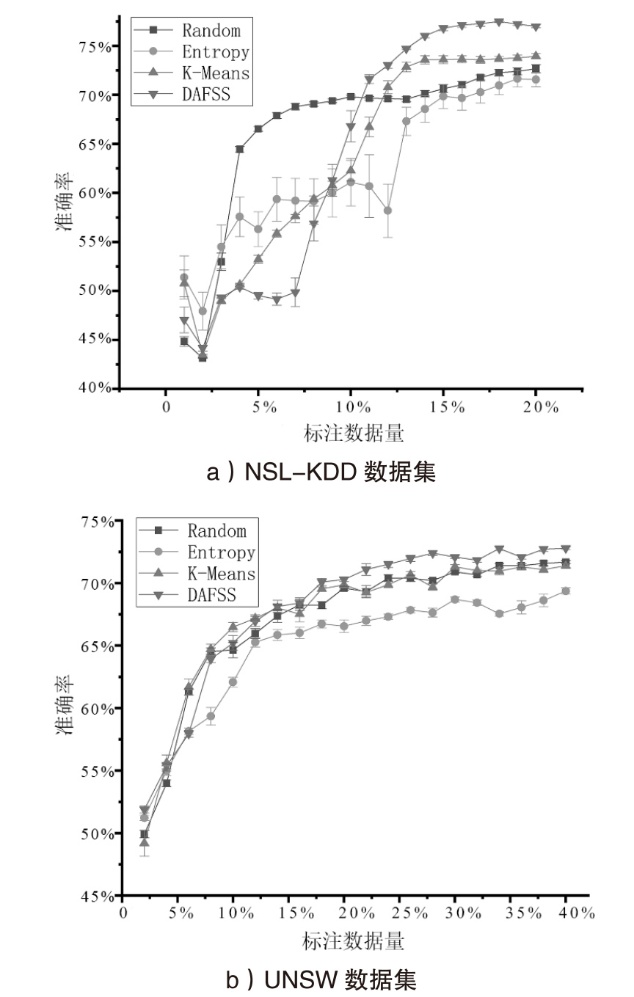
图8
DFASS与先进方案的准确率对比
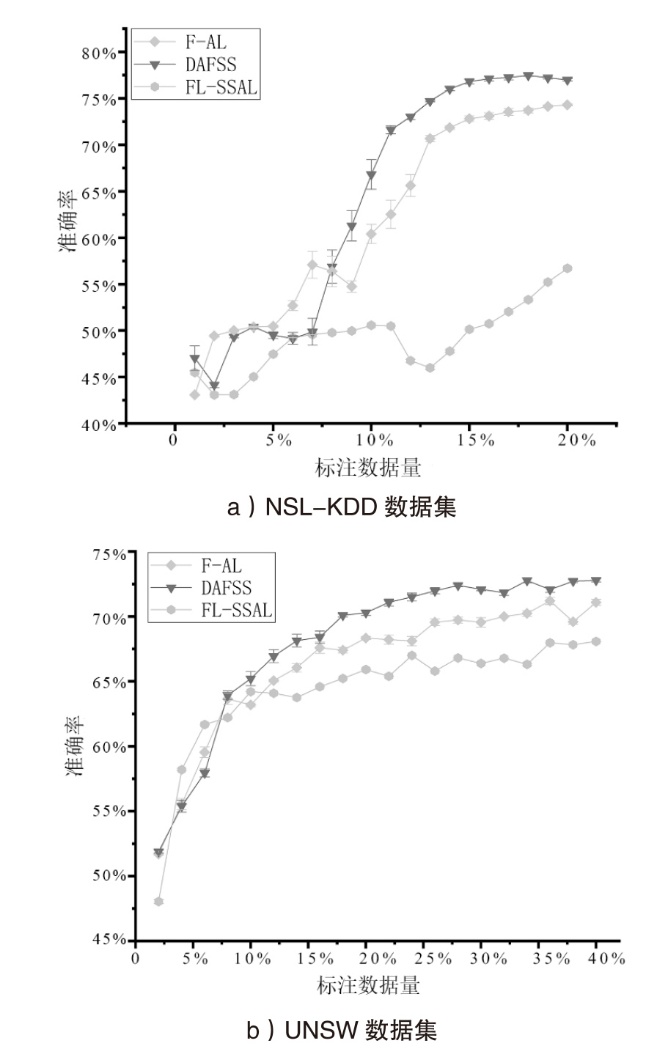
表12
不同主动学习策略在NSL-KDD和UNSW-NB15数据集上的性能对比(Non-IID场景)
| 方案 | 加权召回率 | 加权精确率 | 加权F1分数 | |||
|---|---|---|---|---|---|---|
| NSL-KDD | UNSW-NB15 | NSL-KDD | UNSW-NB15 | NSL-KDD | UNSW-NB15 | |
| DAFSS | 80.88% | 70.76% | 76.90% | 73.81% | 73.28% | 70.11% |
| Random | 76.64% | 70.17% | 72.27% | 73.70% | 68.81% | 69.57% |
| Entropy | 75.73% | 67.79% | 72.61% | 72.03% | 69.10% | 67.26% |
| K-Means | 73.77% | 68.25% | 76.21% | 69.72% | 72.76% | 67.13% |
表13
DFASS与先进方案在NSL-KDD和UNSW-NB15数据集上的性能对比(Non-IID场景)
| 方案 | 加权召回率 | 加权精确率 | 加权F1分数 | |||
|---|---|---|---|---|---|---|
| NSL-KDD | UNSW-NB15 | NSL-KDD | UNSW-NB15 | NSL-KDD | UNSW-NB15 | |
| DAFSS | 80.88% | 70.76% | 76.90% | 73.81% | 73.28% | 70.11% |
| F-AL | 79.81% | 68.47% | 77.31% | 71.38% | 73.18% | 69.07% |
| FL-SSAL | 45.32% | 65.28% | 51.06% | 67.46% | 42.27% | 64.64% |
| [1] | BAI Hongpeng, DENG Dongxu, XU Guangquan, et al. Research onIntrusion Detection Mechanism Based on Federated Learning[J]. NetinfoSecurity, 2022, 22(1): 46-54. |
| 白宏鹏, 邓东旭, 许光全, 等. 基于联邦学习的入侵检测机制研究[J]. 信息网络安全, 2022, 22(1): 46-54. | |
| [2] | MCMAHAN B, MOORE E, RAMAGE D, et al. Communication-Efficient Learning of Deep Networks from Decentralized Data[C]// PMLR. Artificial Intelligence and Statistics. Cambridge: PMLR, 2017: 1273-1282. |
| [3] | XU Jian, XIAO Yongcai, LIN Zejian, et al. Privacy Protection Anomaly Detection in Smart Grids Based on Homomorphic Encryption[J]. Computer Technology and Development, 2025, 35(8): 93-100. |
| 徐健, 肖勇才, 林泽键, 等. 基于同态加密的智能电网隐私保护异常检测技术[J]. 计算机技术与发展, 2025, 35(8): 93-100. | |
| [4] | WEN Z, PIZARRO O, WILLIAMS S. Training from a Better Start Point: Active Self-Semi-Supervised Learning for Few Labeled Samples[EB/OL]. (2022-03-09)[2025-03-27]. https://arxiv.org/abs/2203.04560 |
| [5] | SHEN Yeming, LI Beibei, LIU xiaojie, et al. Research on Intrusion Detection of Industrial Internet Based on Active Learning[J]. Netinfo Security, 2021, 21(1): 80-87. |
| 沈也明, 李贝贝, 刘晓洁, 等. 基于主动学习的工业互联网入侵检测研究[J]. 信息网络安全, 2021, 21(1): 80-87. | |
| [6] | NAEEM F, ALI M, KADDOUM G. Federated-Learning-Empowered Semi-Supervised Active Learning Framework for Intrusion Detection in ZSM[J]. IEEE Communications Magazine, 2023, 61(2): 88-94. |
| [7] | ZHANG Yong, NIU Jie, HE Guojian, et al. Network Intrusion Detection Based on Active Semi-Supervised Learning[C]// IEEE. The 51st Annual IEEE/IFIP International Conference on Dependable Systems and Networks Workshops. New York: IEEE, 2021: 129-135. |
| [8] | LI Beibei, WU Yuhao, SONG Jiarui, et al. DeepFed: Federated Deep Learning for Intrusion Detection in Industrial Cyber-Physical Systems[J]. IEEE Transactions on Industrial Informatics, 2021, 17(8): 5615-5624. |
| [9] | MOTHUKURI V, KHARE P, PARIZI R M, et al. Federated-Learning-Based Anomaly Detection for IoT Security Attacks[J]. IEEE Internet of Things Journal, 2022, 9(4): 2545-2554. |
| [10] | HUONG T T, BAC T P, LONG D M, et al. Detecting Cyberattacks Using Anomaly Detection in Industrial Control Systems: A Federated Learning Approach[J]. Computers in Industry, 2021, 132: 509-518. |
| [11] | ABDEL-BASSET M, MOUSTAFA N, HAWASH H, et al. Federated Intrusion Detection in Blockchain-Based Smart Transportation Systems[J]. IEEE Transactions on Intelligent Transportation Systems, 2022, 23(3): 2523-2537. |
| [12] | MILLER D J, UYAR H. A Mixture of Experts Classifier with Learning Based on Both Labelled and Unlabelled Data[EB/OL]. (1996-09-05)[2025-03-27]. https://proceedings.neurips.cc/paper/1996/hash/a58149d355f02887dfbe55ebb2b64ba3-Abstract.html. |
| [13] | LEE D-H. Pseudo-Label: The Simple and Efficient Semi-Supervised Learning Method for Deep Neural Networks[C]// ICML. The Workshop on Challenges in Representation Learning. Cambridge: PMLR, 2013: 896-906. |
| [14] | RIZVE M N, DUARTE K, RAWAT Y S, et al. In Defense of Pseudo-Labeling: An Uncertainty-Aware Pseudo-Label Selection Framework for Semi-Supervised Learning[EB/OL]. (2021-01-15)[2025-03-27]. https://arxiv.org/abs/2101.06329 |
| [15] | SETTLES B. Active Learning Literature Survey[EB/OL]. (2009-03-16)[2025-03-27]. http://apophenia.wdfiles.com/local-files/start/settles_active_learning.pdf |
| [16] | NIU Zequn, GUO Wenjie, XUE Jingfeng, et al. A Novel Anomaly Detection Approach Based on Ensemble Semi-Supervised Active Learning (ADESSA)[J]. Computers & Security, 2023, 129: 90-99. |
| [17] | CONTARDO G, DENOYER L, ARTIERES T. A Meta-Learning Approach to One-Step Active-Learning[EB/OL]. (2017-07-17)[2025-03-27]. https://arxiv.org/abs/1706.08334 |
| [18] | ZHU Jiajie, BENTO J. Generative Adversarial Active Learning[EB/OL]. (2017-02-25)[2025-03-27]. https://arxiv.org/abs/1702.07956 |
| [19] | LIU Peng, WANG Lizhe, RANJAN R, et al. A Survey on Active Deep Learning: from Model Driven to Data Driven[J]. ACM Computing Surveys (CSUR), 2022, 54(10): 1-34. |
| [20] | ZHAN Xueying, LIU Huan, LI Qing, et al. A Comparative Survey: Benchmarking for Pool-Based Active Learning[C]// IJCAI. The International Joint Conferences on Artificial Intelligence Organization. Amsterdam: IJCAI, 2021: 4679-4686. |
| [21] | DUCOFFE M, PRECIOSO F. Adversarial Active Learning for Deep Networks: A Margin Based Approach[EB/OL]. (2018-02-27)[2025-03-27]. https://arxiv.org/abs/1802.09841 |
| [22] | MUNJAL P, HAYAT N, HAYAT M, et al. Towards Robust and Reproducible Active Learning Using Neural Networks[C]// IEEE. The IEEE/CVF Conference on Computer Vision and Pattern Recognition. New York: IEEE, 2022: 223-232. |
| [23] | ZHANG Yu, YANG Qiang. A Survey on Multi-Task Learning[J]. IEEE Transactions on Knowledge and Data Engineering, 2021, 34(12): 5586-5609. |
| [24] | LECUN Y, BENGIO Y, HINTON G. Deep Learning[J]. Nature, 2015, 521(3): 436-444. |
| [25] | LIU Ming, BUNTINE W, HAFFARI G. Learning How to Actively Learn: A Deep Imitation Learning Approach[C]//ACL. The 56th Annual Meeting of the Association for Computational Linguistics. Cambridge: MIT Press, 2018: 1874-1883. |
| [26] | REVATHI S, MALATHI A. A Detailed Analysis on NSL-KDD Dataset Using Various Machine Learning Techniques for Intrusion Detection[J]. International Journal of Engineering Research & Technology (IJERT), 2013, 2(12): 1848-1853. |
| [27] | MOUSTAFA N, SLAY J. UNSW-NB15: A Comprehensive Data Set for Network Intrusion Detection Systems (UNSW-NB15 Network Data Set)[C]//IEEE. The Military Communications and Information Systems Conference. New York: IEEE, 2015: 1-6. |
| [28] | AHN J H, KIM K, KOH J, et al. Federated Active Learning (F-AL): An Efficient Annotation Strategy for Federated Learning[J]. IEEE Access, 2024(12): 39261-39269. |
| [29] | HSU T-M H, QI H, BROWN M. Measuring the Effects of Non-Identical Data Distribution for Federated Visual Classification[EB/OL]. (2019-09-13)[2025-03-27]. https://arxiv.org/abs/1909.06335 |
| [1] | 李子豪, 张锋巍. 基于可信执行环境的联邦学习平台[J]. 信息网络安全, 2026, 26(5): 788-808. |
| [2] | 郑开发, 骆振鹏, 刘嘉奕, 刘志全, 王赜, 吴云坤. 支持属性更新的轻量级联邦学习节点动态参与方案[J]. 信息网络安全, 2026, 26(1): 102-114. |
| [3] | 施寅生, 包阳, 庞晶晶. 一种对抗GAN攻击的联邦隐私增强方法研究[J]. 信息网络安全, 2026, 26(1): 49-58. |
| [4] | 陈先意, 汪学波, 崔琦, 付章杰, 王茜茜, 曾一福. 面向个性化联邦学习的后门攻击与防御综述[J]. 信息网络安全, 2025, 25(9): 1418-1438. |
| [5] | 金志刚, 李紫梦, 陈旭阳, 刘泽培. 面向数据不平衡的网络入侵检测系统研究综述[J]. 信息网络安全, 2025, 25(8): 1240-1253. |
| [6] | 荀毅杰, 崔嘉容, 毛伯敏, 秦俊蔓. 基于联邦学习的智能汽车CAN总线入侵检测系统[J]. 信息网络安全, 2025, 25(6): 872-888. |
| [7] | 邓东上, 王伟业, 张卫东, 吴宣够. 基于模型特征方向的分层个性化联邦学习框架[J]. 信息网络安全, 2025, 25(6): 889-897. |
| [8] | 朱率率, 刘科乾. 基于掩码的选择性联邦蒸馏方案[J]. 信息网络安全, 2025, 25(6): 920-932. |
| [9] | 李佳东, 曾海涛, 彭莉, 汪晓丁. 一种保护数据隐私的匿名路由联邦学习框架[J]. 信息网络安全, 2025, 25(3): 494-503. |
| [10] | 王亚杰, 陆锦标, 李宇航, 范青, 张子剑, 祝烈煌. 基于可信执行环境的联邦学习分层动态防护算法[J]. 信息网络安全, 2025, 25(11): 1762-1773. |
| [11] | 徐茹枝, 仝雨蒙, 戴理朋. 基于异构数据的联邦学习自适应差分隐私方法研究[J]. 信息网络安全, 2025, 25(1): 63-77. |
| [12] | 郭倩, 赵津, 过弋. 基于分层聚类的个性化联邦学习隐私保护框架[J]. 信息网络安全, 2024, 24(8): 1196-1209. |
| [13] | 张浩, 谢大智, 胡云晟, 叶骏威. 基于半监督学习的网络异常检测研究综述[J]. 信息网络安全, 2024, 24(4): 491-508. |
| [14] | 薛茗竹, 胡亮, 王明, 王峰. 基于联邦学习和区块链技术的TAP规则处理系统[J]. 信息网络安全, 2024, 24(3): 473-485. |
| [15] | 林怡航, 周鹏远, 吴治谦, 廖勇. 基于触发器逆向的联邦学习后门防御方法[J]. 信息网络安全, 2024, 24(2): 262-271. |
| 阅读次数 | ||||||
|
全文 |
|
|||||
|
摘要 |
|
|||||