信息网络安全 ›› 2026, Vol. 26 ›› Issue (2): 236-250.doi: 10.3969/j.issn.1671-1122.2026.02.005
面向分布式学习的多密钥同态加密与差分隐私融合方案
王腾( ), 樊坤渭, 张瑶
西安邮电大学网络空间安全学院 西安 710121
-
收稿日期:2025-04-15出版日期:2026-02-10发布日期:2026-02-23 -
通讯作者:王腾 wangteng@xupt.edu.cn -
作者简介:王腾(1995—),女,陕西,副教授,博士,主要研究方向为数据安全与隐私保护|樊坤渭(2000—),男,陕西,硕士研究生,主要研究方向为机器学习、隐私保护|张瑶(2001—),女,陕西,硕士研究生,主要研究方向为实时数据流隐私保护 -
基金资助:国家自然科学基金(62102311);陕西省科学技术协会青年人才托举计划(20240116);陕西省重点研发计划(2025CY-YBXM-069)
A Fusion Scheme of Multi-Key Homomorphic Encryption and Differential Privacy for Distributed Learning
WANG Teng(), FAN Kunwei, ZHANG Yao
School of Cyberspace Security ,Xi’an University of Posts and Telecommunications Xi’an 710121, China
-
Received:2025-04-15Online:2026-02-10Published:2026-02-23

摘要:
在大数据时代,机器学习领域的数据隐私保护愈发重要。在多方学习场景中,攻击者能够根据梯度和模型参数等信息,反向推导出原始数据特征。此外,部分参与方可能为私利而相互串通,共享本应保密的数据,从而破坏多方学习的公平性和隐私保护需求。为解决上述问题,文章提出面向分布式学习的多密钥同态加密与差分隐私融合方案,即PrivMPL方案,其核心目标是在确保数据隐私安全的前提下,实现高效的模型训练。在该方案中,本地客户端使用聚合公钥加密更新后的模型参数,解密过程需要所有数据使用者协同完成。服务器通过对聚合参数添加高斯噪声实现差分隐私。该方案有效防止多方训练过程中因共享信息导致的隐私泄露,并且对数据使用者与服务器之间的共谋具有鲁棒性。为验证PrivMPL方案的有效性,将PrivMPL方案与基于Paillier的同态加密多方学习方案进行对比,以模型准确率作为评估指标。实验结果表明,PrivMPL方案在模型准确率方面有显著提升,进一步证明了该方案在数据隐私保护和模型性能等方面的优势。
中图分类号:
引用本文
王腾, 樊坤渭, 张瑶. 面向分布式学习的多密钥同态加密与差分隐私融合方案[J]. 信息网络安全, 2026, 26(2): 236-250.
WANG Teng, FAN Kunwei, ZHANG Yao. A Fusion Scheme of Multi-Key Homomorphic Encryption and Differential Privacy for Distributed Learning[J]. Netinfo Security, 2026, 26(2): 236-250.
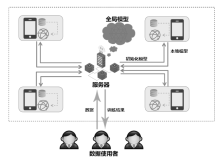
图1
MLaaS模型
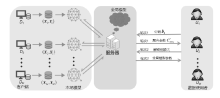
图2
PrivMPL方案流程
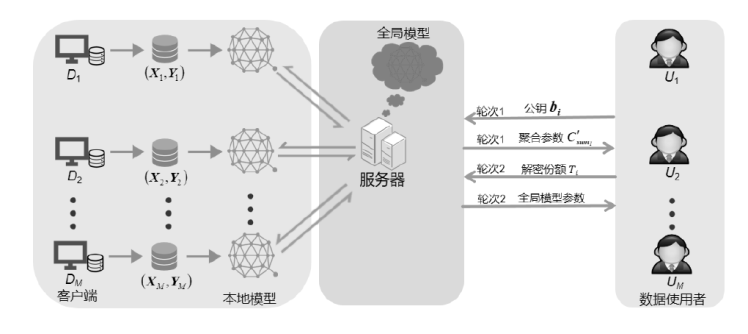
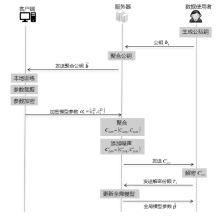
图3
参数交互流程
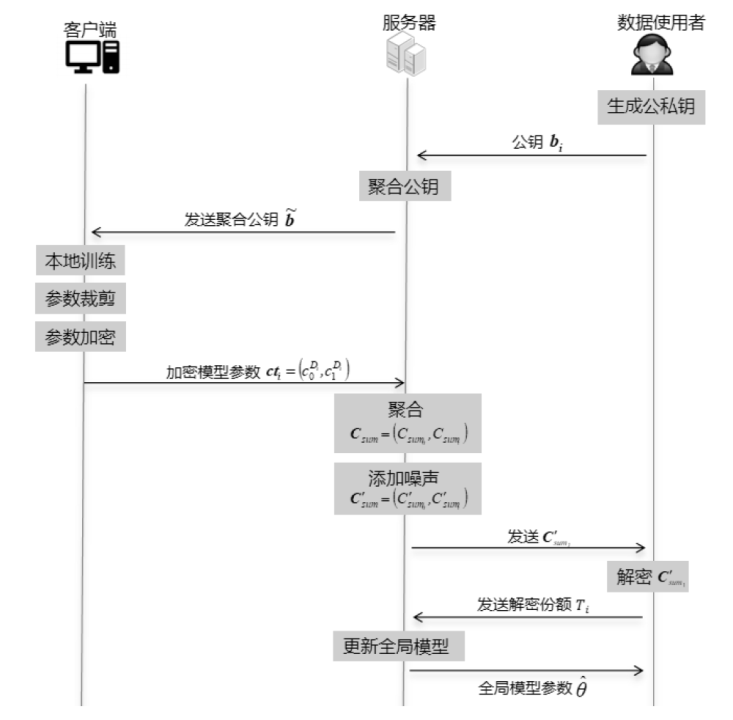
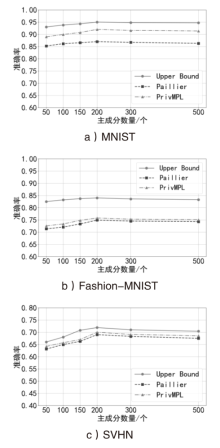
图4
主成分数量与准确率
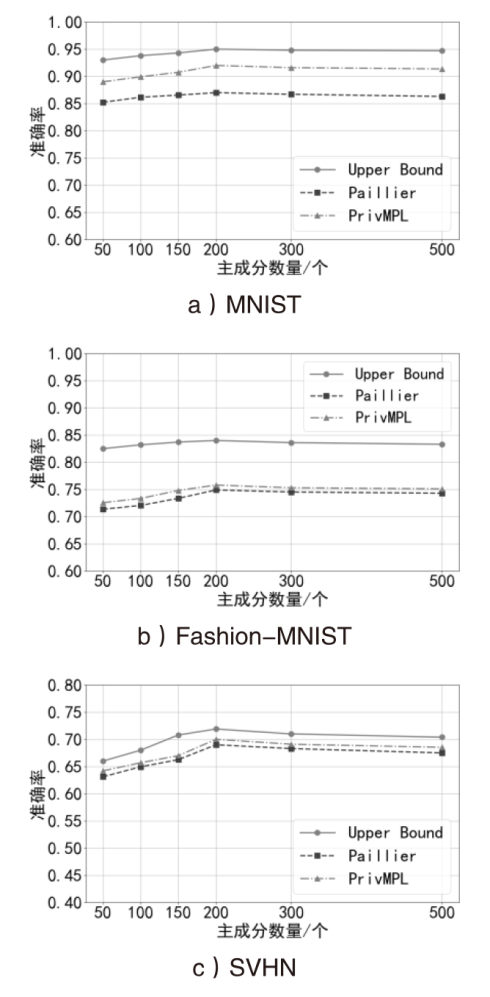
图5
不同隐私预算下的分类结果准确率
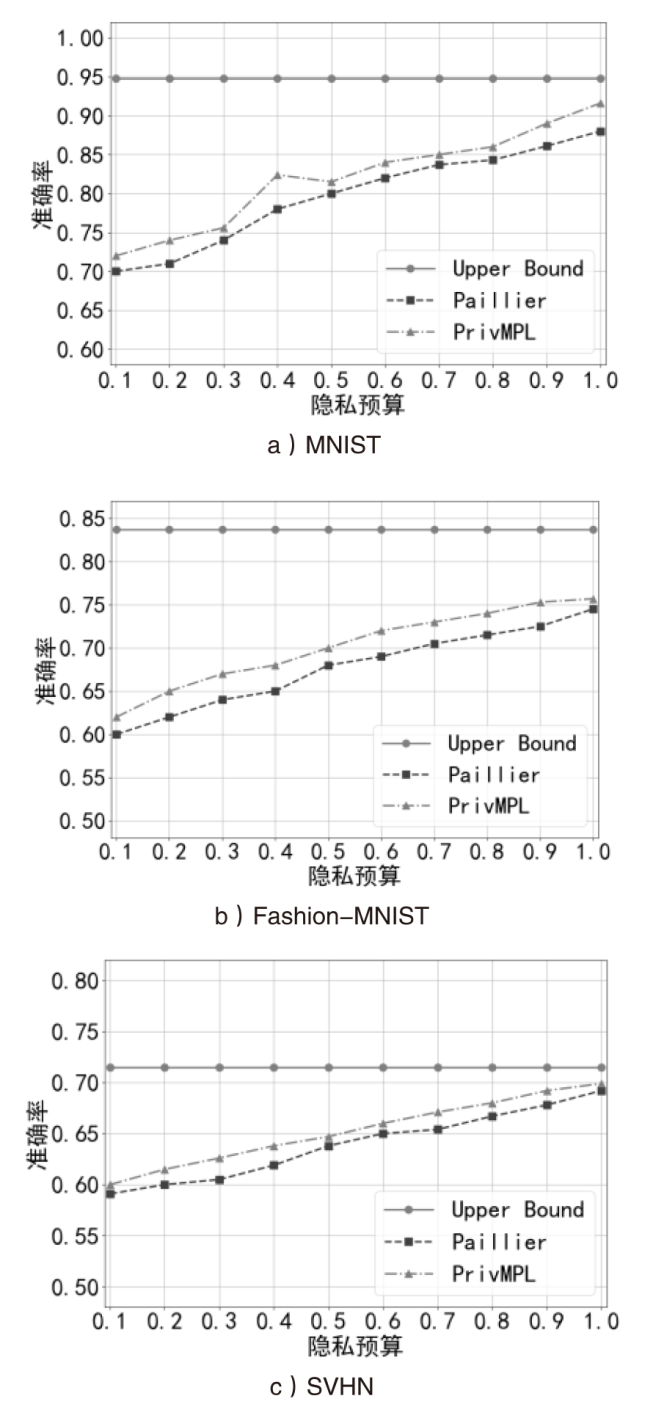
图6
不同隐私预算下的分类结果F1分数
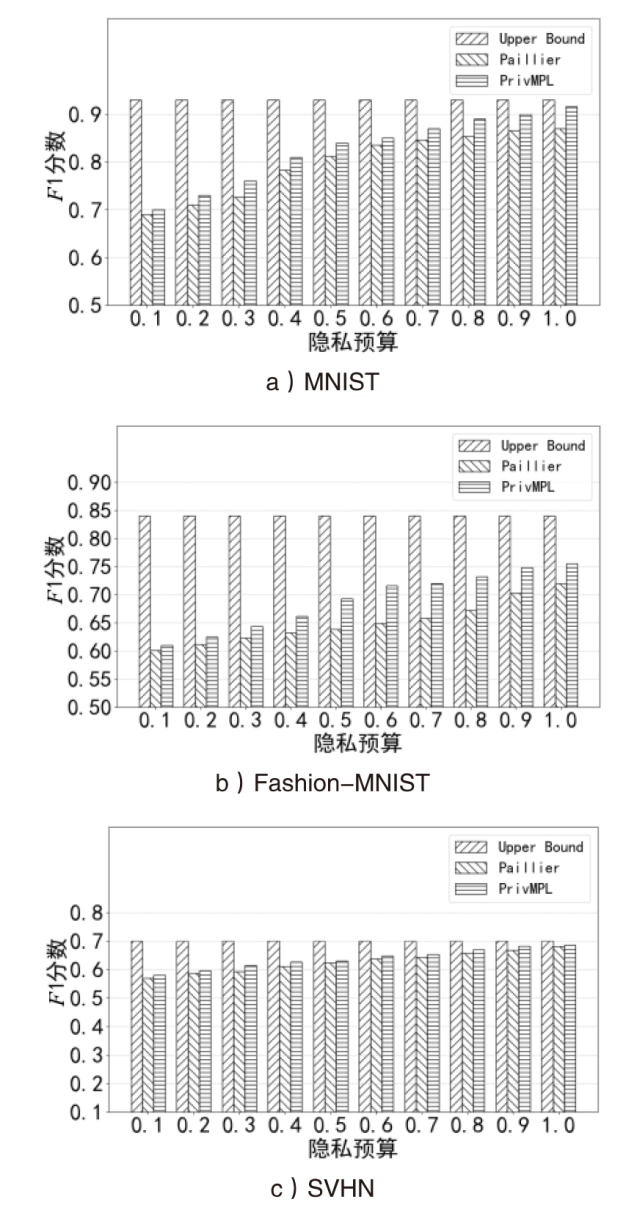
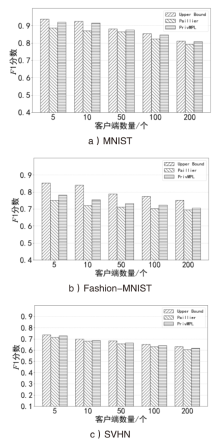
图7
不同数量客户端下的F1分数
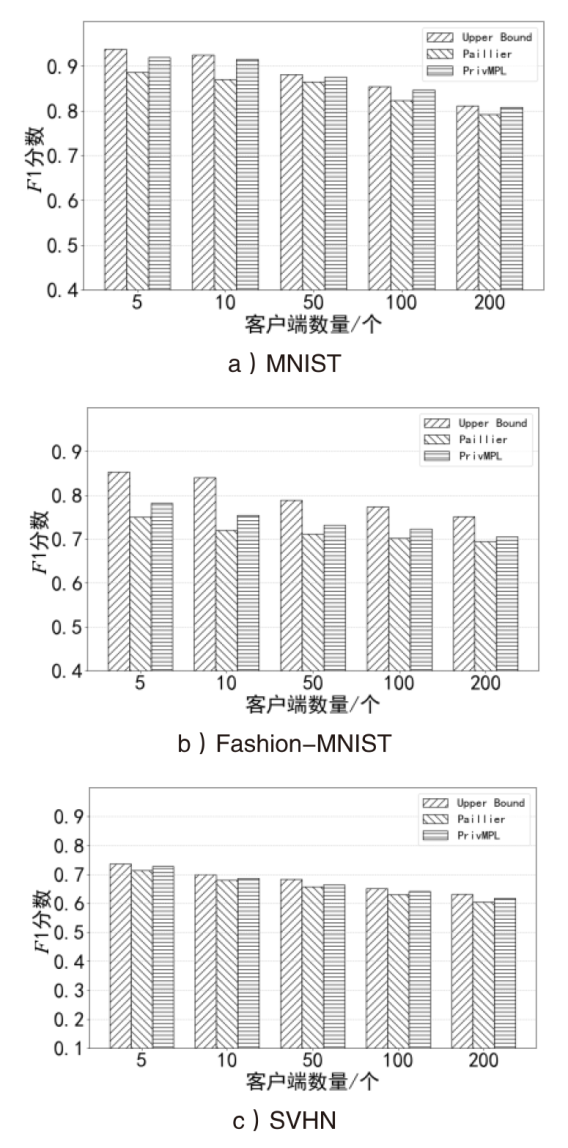
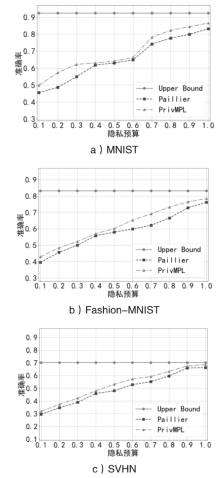
图8
不同隐私预算下的准确率
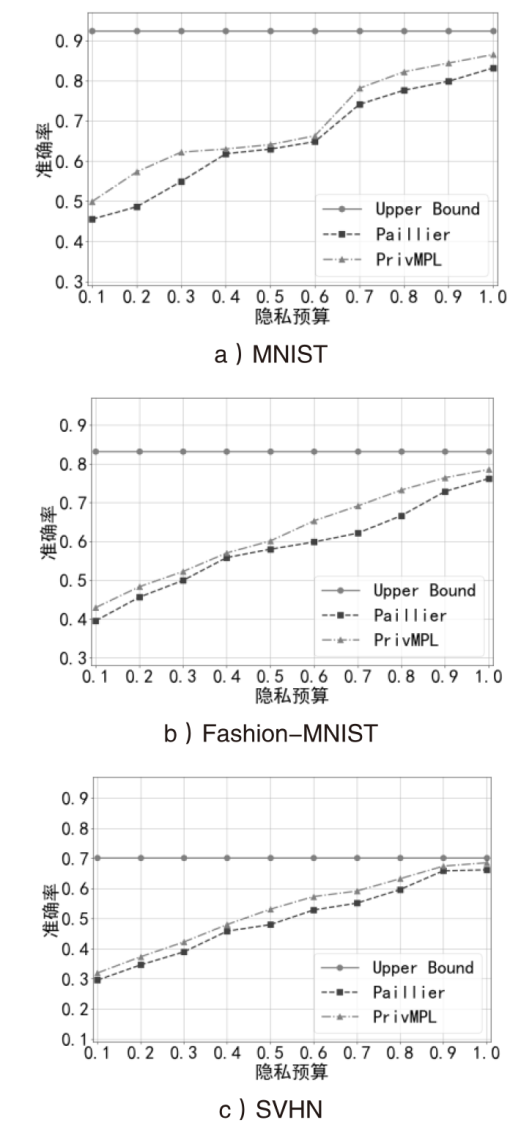
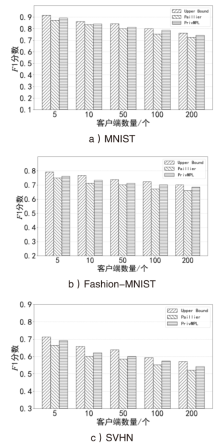
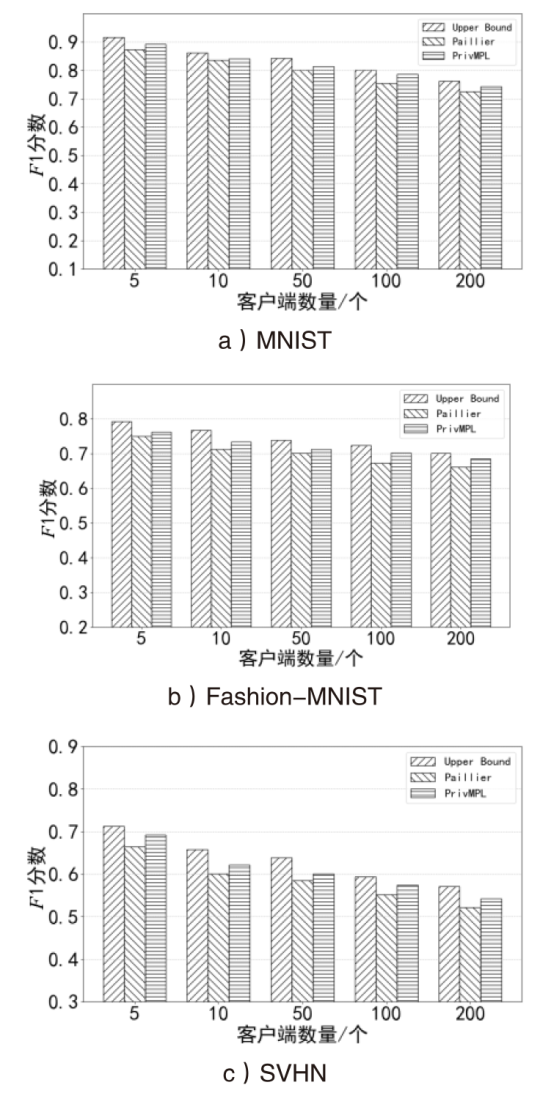
图9
不同客户端数量下的F1分数
| [1] | RIBEIRO M, GROLINGER K, CAPRETZ M A M. MLaaS: Machine Learning as a Service[C]// IEEE. 2015 IEEE 14th International Conference on Machine Learning and Applications (ICMLA). New York: IEEE, 2015: 896-902. |
| [2] | CARLINI N, CHIEN S, NASR M, et al. Membership Inference Attacks from First Principles[C]// IEEE. 2022 IEEE Symposium on Security and Privacy (SP). New York: IEEE, 2022: 50-61. |
| [3] | FREDRIKSON M, JHA S, RISTENPART T. Model Inversion Attacks that Exploit Confidence Information and Basic Countermeasures[C]// ACM.The 22nd ACM SIGSAC Conference on Computer and Communications Security. New York: ACM, 2015: 45-57. |
| [4] | DWORK C. Differential Privacy: A Survey of Results[C]// Springer.International Conference on Theory and Applications of Models of Computation. Heidelberg: Springer, 2008: 1-19. |
| [5] | SUN Yifan, ZHANG Rui, TAO Yang, et al. A Survey on Local Differential Privacy[J]. Frontiers of Data and Computing, 2023, 5(5): 74-97. |
| 孙一帆, 张锐, 陶杨, 等. 本地化差分隐私综述[J]. 数据与计算发展前沿, 2023, 5(5): 74-97. | |
| [6] | ABADI M, CHU A, GOODFELLOW I, et al. Deep Learning with Differential Privacy[C]// ACM. The 2016 ACM SIGSAC Conference on Computer and Communications Security. New York: ACM, 2016: 38-49. |
| [7] | RUAN Wenqiang, XU Mingxin, FANG Wenjing, et al. Private, Efficient, and Accurate: Protecting Models Trained by Multi-Party Learning with Differential Privacy[C]// IEEE. 2023 IEEE Symposium on Security and Privacy (SP). New York: IEEE, 2023: 1926-1943. |
| [8] | FU Jie, YE Qingqing, HU Haibo, et al. DPSUR: Accelerating Differentially Private Stochastic Gradient Descent Using Selective Update and Release[J]. The VLDB Endowment, 2024(7): 1200-1213. |
| [9] | ZHANG Jianqing, HUA Yang, WANG Hao, et al. Fedala: Adaptive Local Aggregation for Personalized Federated Learning[C]// AAAI. The AAAI Conference on Artificial Intelligence. Washington, D. C.: AAAI, 2023, 37(9): 11237-11244. |
| [10] | WANG Zhenya, CHENG Xiang, SU Sen, et al. Atlas: Gan-Based Differentially Private Multi-Party Data Sharing[J]. IEEE Transactions on Big Data, 2023, 9(4): 1225-1237. |
| [11] | XU Depeng, YUAN Shuhan, WU Xintao. Achieving Differential Privacy in Vertically Partitioned Multiparty Learning[C]// IEEE. 2021 IEEE International Conference on Big Data. New York: IEEE, 2021: 5474-5483. |
| [12] | WEN Jinming, LIU Qing, CHEN Jie, et al. Research Current Status and Challenges of Fully Homomorphic Cryptography Based on Learning with Errors[J]. Netinfo Security, 2024, 24(9): 1328-1351. |
| 温金明, 刘庆, 陈洁, 等. 基于错误学习的全同态加密技术研究现状与挑战[J]. 信息网络安全, 2024, 24(9): 1328-1351. | |
| [13] | NAEHRIG M, LAUTER K, VAIKUNTANATHAN V. Can Homomorphic Encryption Be Practical?[C]// ACM. The 3rd ACM Workshop on Cloud Computing Security Workshop. New York: ACM, 2011: 113-124. |
| [14] |
MARCOLLA C, SUCASAS V, MANZANO M, et al. Survey on Fully Homomorphic Encryption, Theory, and Applications[J]. Proceedings of the IEEE, 2022, 110(10): 1572-1609.
doi: 10.1109/JPROC.2022.3205665 URL |
| [15] | TAKABI H, HESAMIFARD E, GHASEMI M. Privacy Preserving Multi-Party Machine Learning with Homomorphic Encryption[C]// NIPS. The 29th Annual Conference on Neural Information Processing Systems (NIPS). Vancouver: NIPS, 2016: 1-4. |
| [16] |
FANG Haokun, QIAN Quan. Privacy Preserving Machine Learning with Homomorphic Encryption and Federated Learning[J]. Future Internet, 2021, 13(4): 94-109.
doi: 10.3390/fi13040094 URL |
| [17] | WANG Sen, CHANG J M. Differentially Private Principal Component Analysis over Horizontally Partitioned Data[C]// IEEE. 2018 IEEE Conference on Dependable and Secure Computing (DSC). New York: IEEE, 2018: 1-8. |
| [18] | LOPEZ-ALT A, TROMER E, VAIKUNTANATHAN V. On-The-Fly Multiparty Computation on the Cloud via Multikey Fully Homomorphic Encryption[C]// ACM. The Forty-Fourth Annual ACM Symposium on Theory of Computing. New York: ACM, 2012: 1219-1234. |
| [19] | CLEAR M, MCGOLDRICK C. Multi-Identity and Multi-Key Leveled FHE from Learning with Errors[C]// Springer. Annual Cryptology Conference. Heidelberg: Springer, 2015: 630-656. |
| [20] |
CAI Yuxuan, DING Wenxiu, XIAO Yuxuan, et al. Secfed: A Secure and Efficient Federated Learning Based on Multi-Key Homomorphic Encryption[J]. IEEE Transactions on Dependable and Secure Computing, 2023, 21(4): 3817-3833.
doi: 10.1109/TDSC.2023.3336977 URL |
| [21] |
LI Yanling, LAI Junzuo, ZHANG Rong, et al. Secure and Efficient Multi-Key Aggregation for Federated Learning[J]. Information Sciences, 2024, 654: 119830-119856.
doi: 10.1016/j.ins.2023.119830 URL |
| [22] |
MA Jing, NAAS S A, SIGG S, et al. Privacy-Preserving Federated Learning Based on Multi-Key Homomorphic Encryption[J]. International Journal of Intelligent Systems, 2022, 37(9): 5880-5901.
doi: 10.1002/int.v37.9 URL |
| [23] |
JIA Bin, ZHANG Xiaosong, LIU Jiewen, et al. Blockchain-Enabled Federated Learning Data Protection Aggregation Scheme with Differential Privacy and Homomorphic Encryption in IIoT[J]. IEEE Transactions on Industrial Informatics, 2021, 18(6): 4049-4058.
doi: 10.1109/TII.2021.3085960 URL |
| [24] | LI Yujie, SUN Yi, LIN Wei. Efficient End to End Privacy Preserving Federated Learning Scheme[J]. Journal of Chinese Computer Systems, 2025, 46(8): 1818-1828. |
| 李宇杰, 孙奕, 林玮. 一种高效的全流程隐私保护联邦学习方案[J]. 小型微型计算机系统, 2025, 46(8): 1818-1828. | |
| [25] | JAYARAMAN B, WANG Lingxiao, EVANS D, et al. Distributed Learning without Distress: Privacy-Preserving Empirical Risk Minimization[J]. Advances in Neural Information Processing Systems, 2018(6), 31-48. |
| [26] | MCMAHAN H B, RAMAGE D, TALWAR K, et al. Learning Differentially Private Recurrent Language Models[C]// ICLR. International Conference on Learning Representations. Vancouver: ICLR, 2018: 1-14. |
| [27] | TRUEX S, LIU Ling, CHOW K H, et al. LDP-Fed: Federated Learning with Local Differential Privacy[C]// ACM. The Third ACM International Workshop on Edge Systems, Analytics and Networking. New York: ACM, 2020: 61-66. |
| [28] | BOHLER J, KERSCHBAUM F. Secure Multi-Party Computation of Differentially Private Heavy Hitters[C]// ACM. The 2021 ACM SIGSAC Conference on Computer and Communications Security. New York: ACM, 2021: 2361-2377. |
| [29] | CHEN Hao, CHILLOTTI I, SONG Y. Multi-Key Homomorphic Encryption from TFHE[C]// Springer. International Conference on the Theory and Application of Cryptology and Information Security. Heidelberg: Springer, 2019: 446-472. |
| [30] | BRAKERSKI Z. Fully Homomorphic Encryption without Modulus Switching from Classical GapSVP[C]// Springer. Annual Cryptology Conference. Heidelberg: Springer, 2012: 868-886. |
| [31] | FAN Junfeng, VERCAUTEREN F. Somewhat Practical Fully Homomorphic Encryption[EB/OL]. (2012-03-22)[2025-04-02]. https://eprint.iacr.org/2012/144. |
| [32] | CHEON J H, KIM A, KIM M, et al. Homomorphic Encryption for Arithmetic of Approximate Numbers[C]// Springer. International Conference on the Theory and Application of Cryptology and Information Security. Heidelberg: Springer, 2017: 409-437. |
| [33] | SUN Han, ZHANG Yan, XU Zhen, et al. MK-FLFHNN: A Privacy-Preserving Vertical Federated Learning Framework for Heterogeneous Neural Network via Multi-Key Homomorphic Encryption[C]// IEEE. The 26th International Conference on Computer Supported Cooperative Work in Design (CSCWD). New York: IEEE, 2023: 552-558. |
| [34] |
LI Ping, LI Jin, HUANG Zhengan, et al. Multi-Key Privacy-Preserving Deep Learning in Cloud Computing[J]. Future Generation Computer Systems, 2017, 74: 76-85.
doi: 10.1016/j.future.2017.02.006 URL |
| [1] | 施寅生, 包阳, 庞晶晶. 一种对抗GAN攻击的联邦隐私增强方法研究[J]. 信息网络安全, 2026, 26(1): 49-58. |
| [2] | 闫宇坤, 唐朋, 陈睿, 都若尘, 韩启龙. 面向数据投毒后门攻击的随机性增强双层优化防御方法[J]. 信息网络安全, 2025, 25(7): 1074-1091. |
| [3] | 赵锋, 范淞, 赵艳琦, 陈谦. 基于本地差分隐私的可穿戴医疗设备流数据隐私保护方法[J]. 信息网络安全, 2025, 25(5): 700-712. |
| [4] | 李骁, 宋晓, 李勇. 基于知识蒸馏的医疗诊断差分隐私方法研究[J]. 信息网络安全, 2025, 25(4): 524-535. |
| [5] | 徐茹枝, 仝雨蒙, 戴理朋. 基于异构数据的联邦学习自适应差分隐私方法研究[J]. 信息网络安全, 2025, 25(1): 63-77. |
| [6] | 张洋, 魏荣, 尤启迪, 蒋小彤. 基于多密钥同态加密的电子投票协议[J]. 信息网络安全, 2025, 25(1): 88-97. |
| [7] | 尹春勇, 贾续康. 基于策略图的三维位置隐私发布算法研究[J]. 信息网络安全, 2024, 24(4): 602-613. |
| [8] | 徐茹枝, 戴理朋, 夏迪娅, 杨鑫. 基于联邦学习的中心化差分隐私保护算法研究[J]. 信息网络安全, 2024, 24(1): 69-79. |
| [9] | 尹春勇, 蒋奕阳. 基于个性化时空聚类的差分隐私轨迹保护模型[J]. 信息网络安全, 2024, 24(1): 80-92. |
| [10] | 刘刚, 杨雯莉, 王同礼, 李阳. 基于云联邦的差分隐私保护动态推荐模型[J]. 信息网络安全, 2023, 23(7): 31-43. |
| [11] | 陈晶, 彭长根, 谭伟杰, 许德权. 基于差分隐私和秘密共享的多服务器联邦学习方案[J]. 信息网络安全, 2023, 23(7): 98-110. |
| [12] | 赵佳, 高塔, 张建成. 基于改进贝叶斯网络的高维数据本地差分隐私方法[J]. 信息网络安全, 2023, 23(2): 19-25. |
| [13] | 刘峰, 杨成意, 於欣澄, 齐佳音. 面向去中心化双重差分隐私的谱图卷积神经网络[J]. 信息网络安全, 2022, 22(2): 39-46. |
| [14] | 晏燕, 张雄, 冯涛. 大数据统计划分发布的等比差分隐私预算分配方法[J]. 信息网络安全, 2022, 22(11): 24-35. |
| [15] | 路宏琳, 王利明. 面向用户的支持用户掉线的联邦学习数据隐私保护方法[J]. 信息网络安全, 2021, 21(3): 64-71. |
| 阅读次数 | ||||||
|
全文 |
|
|||||
|
摘要 |
|
|||||