Netinfo Security ›› 2026, Vol. 26 ›› Issue (4): 566-578.doi: 10.3969/j.issn.1671-1122.2026.04.005
Previous Articles Next Articles
Model Inversion Defense Method Based on Knowledge Transfer and Freezing
YI Wenzhe1,2, XU Xiaoyang1,2, SHI Lei3, ZHUANG Yong1,2, WANG Juan1,2( )
)
- 1
School of Cyber Science and Engineering ,Wuhan University Wuhan 430072, China
2Key Laboratory of Aerospace Information Security and Trusted Computing of Ministry of Education Wuhan 430072, China
3Beijing Yuhong Xin’an Technology Co. ,Ltd. Beijing 100101, China
-
Received:2025-06-16Online:2026-04-10Published:2026-04-29

CLC Number:
Cite this article
YI Wenzhe, XU Xiaoyang, SHI Lei, ZHUANG Yong, WANG Juan. Model Inversion Defense Method Based on Knowledge Transfer and Freezing[J]. Netinfo Security, 2026, 26(4): 566-578.
share this article
Add to citation manager EndNote|Ris|BibTeX
URL: http://netinfo-security.org/EN/10.3969/j.issn.1671-1122.2026.04.005
| 分辨率 | 攻击 方法 | 训练 数据集 | 辅助 数据集 | 目标模型 架构 | 评估模型 架构 | 防御 方法 | 评估 指标 |
|---|---|---|---|---|---|---|---|
| 64×64 | GMI | CelebA | CelebA | VGG-16、 FaceNet64、 ResNet-152 | FaceNet-112 | MID、 BiDO、 NLS、 TLDMI | 攻击准确率、特征距离 |
| KEDMI | |||||||
| LOMMA | |||||||
| PLGMI | |||||||
| 224× 224 | PPA | FaceScrub | FFHQ | ResNet-152 | InceptionV3 |
| 目标模型 | 攻击方法 | 防御方法 | 测试准确率 | 攻击准确率 | 特征距离 |
|---|---|---|---|---|---|
| VGG-16 | GMI | 无防御 | 85.39% | 5.97% | 1893.23 |
| MID | 86.84% | 7.99% | 1821.10 | ||
| BiDO | 86.42% | 7.33% | 1841.95 | ||
| NLS | 85.54% | 3.93% | 1927.11 | ||
| TLDMI | 85.74% | 5.79% | 1916.22 | ||
| TF | 86.62% | 2.93% | 2140.34 | ||
| KEDMI | 无防御 | 85.39% | 36.12% | 1378.43 | |
| MID | 86.84% | 45.73% | 1308.22 | ||
| BiDO | 86.42% | 42.06% | 1350.15 | ||
| NLS | 85.54% | 25.53% | 1487.14 | ||
| TLDMI | 85.74% | 34.79% | 1378.00 | ||
| TF | 86.62% | 17.13% | 1813.13 | ||
| LOMMA | 无防御 | 85.39% | 59.56% | 1241.25 | |
| MID | 86.84% | 63.73% | 1224.74 | ||
| BiDO | 86.42% | 64.13% | 1229.07 | ||
| NLS | 85.54% | 61.73% | 1154.26 | ||
| TLDMI | 85.74% | 62.19% | 1224.45 | ||
| TF | 86.62% | 53.13% | 1408.93 | ||
| PLGMI | 无防御 | 85.39% | 85.25% | 1038.55 | |
| MID | 86.84% | 69.86% | 1189.83 | ||
| BiDO | 86.42% | 74.53% | 1166.52 | ||
| NLS | 85.54% | 62.40% | 1339.57 | ||
| TLDMI | 85.74% | 80.80% | 1080.82 | ||
| TF | 86.62% | 46.06% | 1549.52 |
| 目标模型 | 攻击方法 | 防御方法 | 测试准确率 | 攻击准确率 | 特征距离 |
|---|---|---|---|---|---|
| FaceNet64 | GMI | 无防御 | 87.41% | 11.33% | 1783.41 |
| MID | 84.74% | 17.86% | 1815.32 | ||
| BiDO | 82.76% | 5.06% | 1908.71 | ||
| NLS | 86.07% | 5.06% | 1840.55 | ||
| TLDMI | 83.18% | 4.73% | 1910.75 | ||
| TF | 87.34% | 4.26% | 2035.10 | ||
| KEDMI | 无防御 | 87.41% | 39.46% | 1355.96 | |
| MID | 84.74% | 55.06% | 1280.27 | ||
| BiDO | 82.76% | 30.59% | 1458.41 | ||
| NLS | 86.07% | 27.59% | 1465.72 | ||
| TLDMI | 83.18% | 35.73% | 1385.97 | ||
| TF | 87.34% | 23.00% | 1747.04 | ||
| LOMMA | 无防御 | 87.41% | 60.92% | 1262.41 | |
| MID | 84.74% | 55.00% | 1341.44 | ||
| BiDO | 82.76% | 51.93% | 1355.91 | ||
| NLS | 86.07% | 58.13% | 1236.25 | ||
| TLDMI | 83.18% | 62.40% | 1226.23 | ||
| TF | 87.34% | 36.26% | 1552.27 | ||
| PLGMI | 无防御 | 87.41% | 89.98% | 996.34 | |
| MID | 84.74% | 62.66% | 1328.30 | ||
| BiDO | 82.76% | 55.93% | 1361.91 | ||
| NLS | 86.07% | 90.39% | 958.19 | ||
| TLDMI | 83.18% | 82.59% | 1060.09 | ||
| TF | 87.34% | 50.19% | 1482.70 |
| 目标模型 | 攻击方法 | 防御方法 | 测试准确率 | 攻击准确率 | 特征距离 |
|---|---|---|---|---|---|
| ResNet-152 | GMI | 无防御 | 92.22% | 18.00% | 1737.80 |
| MID | 92.06% | 28.26% | 1613.31 | ||
| BiDO | 84.16% | 7.59% | 1871.73 | ||
| NLS | 90.14% | 8.60% | 1792.02 | ||
| TLDMI | 87.70% | 8.20% | 1841.32 | ||
| TF | 89.17% | 6.46% | 2050.48 | ||
| KEDMI | 无防御 | 92.22% | 52.39% | 1261.05 | |
| MID | 92.06% | 70.66% | 1156.38 | ||
| BiDO | 84.16% | 34.20% | 1406.98 | ||
| NLS | 90.14% | 35.26% | 1372.31 | ||
| TLDMI | 87.70% | 48.33% | 1323.27 | ||
| TF | 89.17% | 20.93% | 1810.63 | ||
| LOMMA | 无防御 | 92.22% | 72.06% | 1181.79 | |
| MID | 92.06% | 79.73% | 1085.46 | ||
| BiDO | 84.16% | 45.53% | 1359.48 | ||
| NLS | 90.14% | 71.73% | 1146.22 | ||
| TLDMI | 87.70% | 70.80% | 1185.46 | ||
| TF | 89.17% | 39.53% | 1553.92 | ||
| PLGMI | 无防御 | 92.22% | 95.13% | 925.34 | |
| MID | 92.06% | 92.79% | 980.15 | ||
| BiDO | 84.16% | 63.99% | 1265.38 | ||
| NLS | 90.14% | 95.13% | 892.71 | ||
| TLDMI | 87.70% | 94.13% | 911.18 | ||
| TF | 89.17% | 62.93% | 1341.79 |
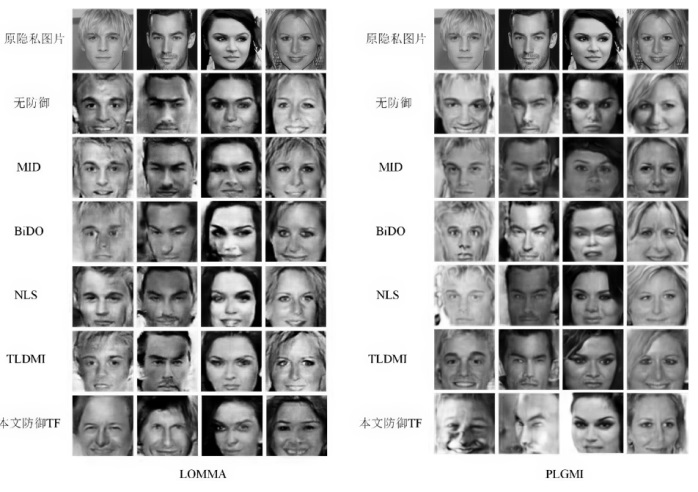
| 目标模型 | 攻击方法 | 防御方法 | 测试准确率 | 攻击准确率 | 特征距离 |
|---|---|---|---|---|---|
| ResNet-152 | PPA | 无防御 | 94.02% | 96.13% | 143.48 |
| MID | 90.99% | 55.93% | 155.29 | ||
| BiDO | 93.58% | 96.26% | 141.35 | ||
| NLS | 91.06% | 61.86% | 160.21 | ||
| TLDMI | 93.14% | 67.93% | 159.68 | ||
| TF | 90.55% | 45.86% | 162.15 |
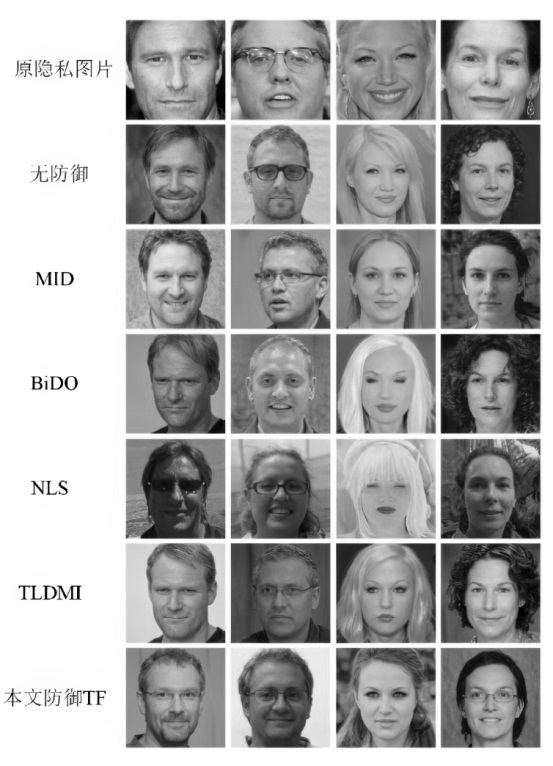
| 目标模型 | 防御方法 | 训练开销/h | 额外开销比例 |
|---|---|---|---|
| FaceNet64 | 无防御 | 1.12 | - |
| MID | 1.18 | 5.35% | |
| BiDO | 1.35 | 20.53% | |
| NLS | 1.17 | 4.46% | |
| TLDMI | 1.75 | 56.25% | |
| TF | 1.14 | 1.78% |
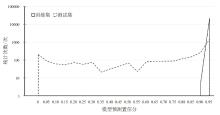
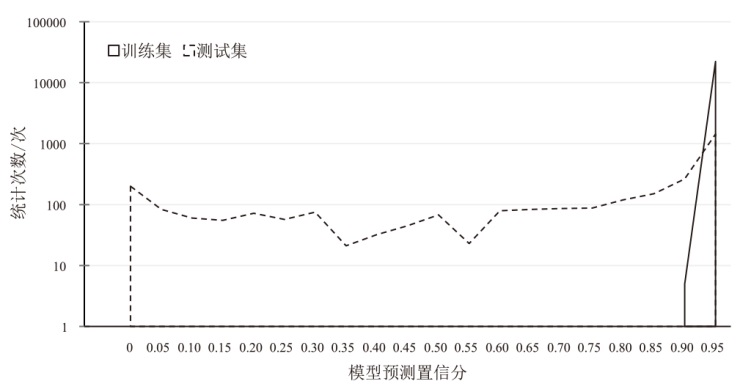
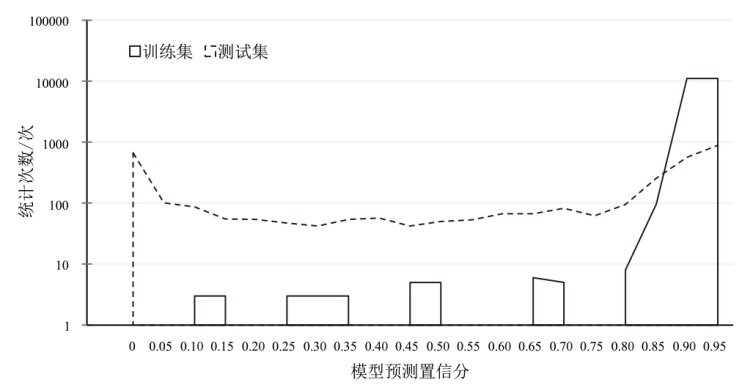
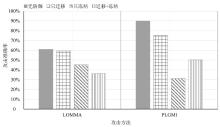
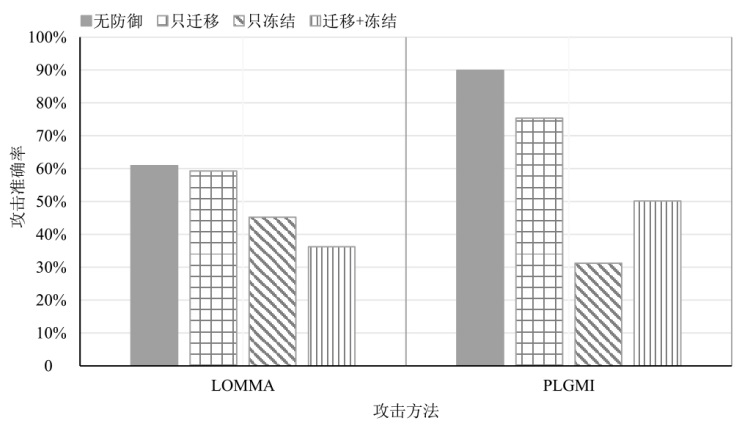
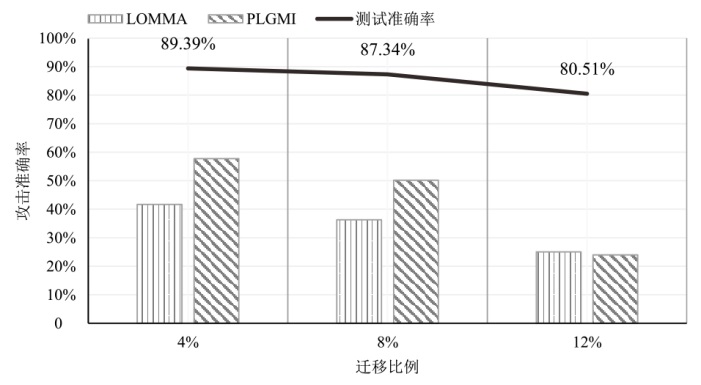
| 方法 | 测试准确率 | LOMMA | PLGMI | ||
|---|---|---|---|---|---|
| 攻击准确率 | 特征距离 | 攻击准确率 | 特征距离 | ||
| 无防御 | 87.41% | 60.92% | 1262.41 | 89.98% | 996.34 |
| 冻结前半 部分 | 88.12% | 65.33% | 1218.04 | 79.93% | 1122.13 |
| 冻结后半 部分 | 90.50% | 71.86% | 1153.55 | 94.93% | 924.96 |
| 冻结 全连接层 | 88.74% | 45.26% | 1512.84 | 31.26% | 1735.76 |
| [1] | CHENG Yu, ZHAO Jian, WANG Zhecan, et al. Know You at One Glance: A Compact Vector Representation for Low-Shot Learning[C]// IEEE. 2017 IEEE International Conference on Computer Vision Workshops (ICCVW). New York: IEEE, 2017: 1924-1932. |
| [2] | RAJPURKAR P, IRVIN J, ZHU K, et al. CheXNet: Radiologist-Level Pneumonia Detection on Chest X-Rays with Deep Learning[EB/OL].(2017-12-25)[2025-05-23]. https://arxiv.org/abs/1711.05225. |
| [3] | MA Fenglong, CHITTA R, ZHOU Jing, et al. Dipole: Diagnosis Prediction in Healthcare via Attention-Based Bidirectional Recurrent Neural Networks[C]// ACM. The 23rd ACM SIGKDD International Conference on Knowledge Discovery and Data Mining. New York: ACM, 2017: 1903-1911. |
| [4] | MELIS L, SONG Congzheng, DE C E, et al. Exploiting Unintended Feature Leakage in Collaborative Learning[C]// IEEE. 2019 IEEE Symposium on Security and Privacy (SP). New York: IEEE, 2019: 691-706. |
| [5] | SHOKRI R, STRONATI M, SONG Congzheng, et al. Membership Inference Attacks against Machine Learning Models[C]// IEEE. 2017 IEEE Symposium on Security and Privacy (SP). New York: IEEE, 2017: 3-18. |
| [6] | FREDRIKSON M, LANTZ E, JHA S, et al. Privacy in Pharmacogenetics: An {End-to-End} Case Study of Personalized Warfarin Dosing[C]// USENIX. 23rd USENIX Security Symposium (USENIX Security 14). Berkeley: USENIX, 2014: 17-32. |
| [7] | FREDRIKSON M, JHA S, RISTENPART T. Model Inversion Attacks that Exploit Confidence Information and Basic Countermeasures[C]// ACM. The 22nd ACM SIGSAC Conference on Computer and Communications Security. New York: ACM, 2015: 1322-1333. |
| [8] | ZHANG Yuheng, JIA Ruoxi, PEI Hengzhi, et al. The Secret Revealer: Generative Model-Inversion Attacks against Deep Neural Networks[C]// IEEE. 2020 IEEE/CVF Conference on Computer Vision and Pattern Recognition (CVPR). New York: IEEE, 2020: 253-261. |
| [9] | GOODFELLOW I, POUGET-ABADIE J, MIRZA M, et al. Generative Adversarial Nets[C]// ACM. The 28th International Conference on Neural Information Processing Systems (NIPS’14). New York: ACM, 2014: 2672-2680. |
| [10] | CHEN Si, KAHLA M, JIA Ruoxi, et al. Knowledge-Enriched Distributional Model Inversion Attacks[C]// IEEE. 2021 IEEE/CVF International Conference on Computer Vision (ICCV). New York: IEEE, 2021: 16178-16187. |
| [11] | NGUYEN N B, CHANDRASEGARAN K, ABDOLLAHZADEH M, et al. Re-Thinking Model Inversion Attacks against Deep Neural Networks[C]// IEEE. 2023 IEEE/CVF Conference on Computer Vision and Pattern Recognition (CVPR). New York: IEEE, 2023: 16384-16393. |
| [12] | MIYATO T, KOYAMA M. CGANs with Projection Discriminator[EB/OL].(2018-08-15)[2025-05-23]. https://arxiv.org/abs/1802.05637. |
| [13] | YUAN Xiaojian, CHEN Kejiang, ZHANG Jie, et al. Pseudo Label-Guided Model Inversion Attack via Conditional Generative Adversarial Network[C]// ACM. The Thirty-Seventh AAAI Conference on Artificial Intelligence. New York: ACM, 2023: 3349-3357. |
| [14] | KARRAS T, LAINE S, AILA T. A Style-Based Generator Architecture for Generative Adversarial Networks[EB/OL].(2019-03-29)[2025-05-23]. https://arxiv.org/abs/1812.04948. |
| [15] | KARRAS T, LAINE S, AITTALA M, et al. Analyzing and Improving the Image Quality of StyleGAN[C]// IEEE. 2020 IEEE/CVF Conference on Computer Vision and Pattern Recognition (CVPR). New York: IEEE, 2020: 8110-8119. |
| [16] | AN Shengwei, TAO Guanhong, XU Qiuling, et al. MIRROR: Model Inversion for Deep Learning Network with High Fidelity[EB/OL].(2022-01-01)[2025-05-23]. https://www.ndss-symposium.org/ndss-paper/mirror-model-inversion-for-deep-learning-network-with-high-fidelity/. |
| [17] | STRUPPEK L, HINTERSDORF D, CORREIRA A D A, et al. Plug & Play Attacks: Towards Robust and Flexible Model Inversion Attacks[EB/OL].(2022-06-09)[2025-05-23]. https://arxiv.org/abs/2201.12179. |
| [18] | WANG Tianhao, ZHANG Yuheng, JIA Ruoxi. Improving Robustness to Model Inversion Attacks via Mutual Information Regularization[EB/OL].(2020-09-22)[2025-05-23]. https://arxiv.org/abs/2009.05241. |
| [19] | PENG Xiong, LIU Feng, ZHANG Jingfeng, et al. Bilateral Dependency Optimization: Defending against Model-Inversion Attacks[C]// ACM. The 28th ACM SIGKDD Conference on Knowledge Discovery and Data Mining. New York: ACM, 2022: 1358-1367. |
| [20] | STRUPPEK L, HINTERSDORF D, KERSTING K. Be Careful What You Smooth for: Label Smoothing Can be a Privacy Shield but also a Catalyst for Model Inversion Attacks[EB/OL].(2024-07-08)[2025-05-23]. https://arxiv.org/abs/2310.06549. |
| [21] | HO S T, HAO K J, CHANDRASEGARAN K, et al. Model Inversion Robustness: Can Transfer Learning Help[C]// IEEE. 2024 IEEE/CVF Conference on Computer Vision and Pattern Recognition (CVPR). New York: IEEE, 2024: 12183-12193. |
| [22] | WANG Dong, QIN Qianqian, GUO Kaitian, et al. Survey on Model Inversion Attack and Defense in Federated Learning[J]. Journal on Communications, 2023, 44(11): 94-109. |
| 王冬, 秦倩倩, 郭开天, 等. 联邦学习中的模型逆向攻防研究综述[J]. 通信学报, 2023, 44(11): 94-109. | |
| [23] | HAN G, CHOI J, LEE H, et al. Reinforcement Learning-Based Black-Box Model Inversion Attacks[C]// IEEE. 2023 IEEE/CVF Conference on Computer Vision and Pattern Recognition (CVPR). New York: IEEE, 2023: 20504-20513. |
| [24] | KAHLA M, CHEN Si, JUST H A, et al. Label-Only Model Inversion Attacks via Boundary Repulsion[C]// IEEE. 2022 IEEE/CVF Conference on Computer Vision and Pattern Recognition (CVPR). New York: IEEE, 2022: 15045-15053. |
| [25] | NGUYEN B N, CHANDRASEGARAN K, ABDOLLAHZADEH M, et al. Label-Only Model Inversion Attacks via Knowledge Transfer[C]// ACM. The 37th International Conference on Neural Information Processing Systems Article (NIPS’23). New York: ACM, 2023: 68895-68907. |
| [26] | ZHUANG Fuzhen, QI Zhiyuan, DUAN Keyu, et al. A Comprehensive Survey on Transfer Learning[J]. Proceedings of the IEEE, 2021, 109(1): 43-76. |
| [27] | LIU Ziwei, LUO Ping, WANG Xiaogang, et al. Deep Learning Face Attributes in the Wild[C]// IEEE. 2015 IEEE International Conference on Computer Vision (ICCV). New York: IEEE, 2015: 3730-3738. |
| [28] | NG H W, WINKLER S. A Data-Driven Approach to Cleaning Large Face Datasets[C]// IEEE. 2014 IEEE International Conference on Image Processing (ICIP). New York: IEEE, 2014: 343-347. |
| [29] | SIMONYAN K, ZISSERMAN A. Very Deep Convolutional Networks for Large-Scale Image Recognition[EB/OL].(2015-04-10)[2025-05-23]. https://arxiv.org/abs/1409.1556. |
| [30] | HE Kaiming, ZHANG Xiangyu, REN Shaoqing, et al. Deep Residual Learning for Image Recognition[C]// IEEE. 2016 IEEE Conference on Computer Vision and Pattern Recognition (CVPR). New York: IEEE, 2016: 770-778. |
| [31] | DENG Jia, DONG Wei, SOCHER R, et al. ImageNet: A Large-Scale Hierarchical Image Database[C]// IEEE. 2009 IEEE Conference on Computer Vision and Pattern Recognition. New York: IEEE, 2009: 248-255. |
| [32] | GUO Yandong, ZHANG Lei, HU Yuxiao, et al. MS-Celeb-1M: A Dataset and Benchmark for Large-Scale Face Recognition[C]// Springer. Computer Vision-ECCV 2016. Heidelberg:Springer, 2016: 87-102. |
| [33] | SZEGEDY C, VANHOUCKE V, IOFFE S, et al. Rethinking the Inception Architecture for Computer Vision[C]// IEEE. 2016 IEEE Conference on Computer Vision and Pattern Recognition (CVPR). New York: IEEE, 2016: 2818-2826. |
| [1] | CUI Jinhua, DONG Liang, YANG Xin. A Survey of Privacy-Preserving Techniques for Large Language Model Inference [J]. Netinfo Security, 2026, 26(4): 503-520. |
| [2] | GUO Yi, LI Xuqing, ZHANG Zijiao, ZHANG Hongtao, ZHANG Liancheng, ZHANG Xiangli. A Review of Data Security Sharing Based on Blockchain [J]. Netinfo Security, 2026, 26(1): 1-23. |
| [3] | WANG Zhengyang, LIU Xiaolu, SHEN Zhuowei, WEI Mengli. Review of Security Protection Technologies for Multi-Agent Systems [J]. Netinfo Security, 2025, 25(7): 1138-1152. |
| [4] | ZHU Shuaishuai, LIU Keqian. A Masking-Based Selective Federated Distillation Scheme [J]. Netinfo Security, 2025, 25(6): 920-932. |
| [5] | ZHAO Feng, FAN Song, ZHAO Yanqi, CHEN Qian. Privacy-Preserving Methods for Streaming Data in Wearable Medical Devices Based on Local Differential Privacy [J]. Netinfo Security, 2025, 25(5): 700-712. |
| [6] | HU Yuhan, YANG Gao, CAI Hongye, FU Junsong. Privacy Protection of Data Transmission Paths in 3D Distributed Wireless Intelligent Systems [J]. Netinfo Security, 2025, 25(4): 536-549. |
| [7] | HE Ke, WANG Jianhua, YU Dan, CHEN Yongle. Adaptive Sampling-Based Machine Unlearning Method [J]. Netinfo Security, 2025, 25(4): 630-639. |
| [8] | LI Jiadong, ZENG Haitao, PENG Li, WANG Xiaoding. An Anonymous Routing Federated Learning Framework for Data Privacy Protection [J]. Netinfo Security, 2025, 25(3): 494-503. |
| [9] | WANG Yajie, LU Jinbiao, LI Yuhang, FAN Qing, ZHANG Zijian, ZHU Liehuang. Hierarchical Dynamic Protection Algorithm for Federated Learning Based on Trusted Execution Environment [J]. Netinfo Security, 2025, 25(11): 1762-1773. |
| [10] | WEN Jinming, LIU Qing, CHEN Jie, WU Yongdong. Research Current Status and Challenges of Fully Homomorphic Cryptography Based on Learning with Errors [J]. Netinfo Security, 2024, 24(9): 1328-1351. |
| [11] | LIN Zhanhang, XIANG Guangli, LI Zhenpeng, XU Ziyi. Privacy Protection Scheme of Feedforward Neural Network Based on Homomorphic Encryption [J]. Netinfo Security, 2024, 24(9): 1375-1385. |
| [12] | FU Yanming, LU Shenglin, CHEN Jiayuan, QIN Hua. Dynamic Task Allocation for Crowd Sensing Based on Deep Reinforcement Learning and Privacy Protection [J]. Netinfo Security, 2024, 24(3): 449-461. |
| [13] | XU Jianfeng, ZHANG Wei, TU Min, WEI Qingting, LAI Zhanqing, WANG Qianqian. A k-Anonymity Completion Method Generated Based on Semantic Fusion Trajectories [J]. Netinfo Security, 2024, 24(12): 1911-1921. |
| [14] | GU Haiyan, LIU Qi, MA Zhuo, ZHU Tao, QIAN Hanwei. Research on Data Noise Addition Method Based on Availability [J]. Netinfo Security, 2024, 24(11): 1731-1738. |
| [15] | SONG Yuhan, ZHU Yuefei, WEI Fushan. An Anomaly Detection Scheme for Blockchain Transactions Based on AdaBoost Model [J]. Netinfo Security, 2024, 24(1): 24-35. |
| Viewed | ||||||
|
Full text |
|
|||||
|
Abstract |
|
|||||