Netinfo Security ›› 2026, Vol. 26 ›› Issue (8): 1194-1208.doi: 10.3969/j.issn.1671-1122.2026.08.003
Previous Articles Next Articles
Survey on the research status, key issues, and development directions of trusted execution environment in privacy computing
Shi Jun1,2,3, Wang Hao1, Li Zengpeng1,4, Gu Yiyu5( ), Ma Huiling6
- 1
School of Cyber Science and Technology ,Shandong University Qingdao 266237, China
2National Graduate School for Elite Engineers ,Shandong University Jinan 250102, China
3KylinSoft Co. ,Ltd. Tianjin 300459, China
4State Key Laboratory of Cryptography and Digital Economy Security Qingdao 266237, China
5School of Computer and Communication Engineering ,University of Science and Technology Beijing Beijing 100083, China
6Guizhou Provincial Information Center Guiyang 550001, China
-
Received:2026-02-27Online:2026-08-10Published:2026-09-23 -
Contact:Gu Yiyu E-mail:guyy0808@163.com

CLC Number:
Cite this article
Shi Jun, Wang Hao, Li Zengpeng, Gu Yiyu, Ma Huiling. Survey on the research status, key issues, and development directions of trusted execution environment in privacy computing[J]. Netinfo Security, 2026, 26(8): 1194-1208.
share this article
Add to citation manager EndNote|Ris|BibTeX
URL: http://netinfo-security.org/EN/10.3969/j.issn.1671-1122.2026.08.003
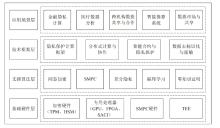
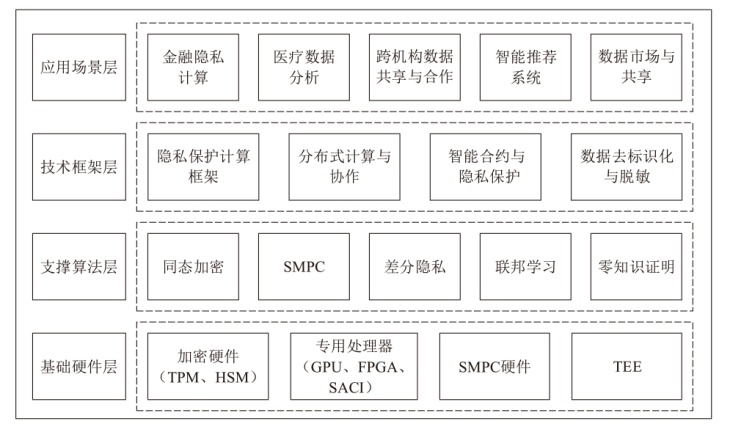
| 技术 | 功能描述 | 安全特性 | 适用场景 | 性能代价 |
|---|---|---|---|---|
| TEE | 硬件级隔离和 安全执行环境 | 高安全性,远程证明和加密保护 | 金融、云计算、AI计算 | 低 |
| 同态加密[ | 加密数据计算,数据隐私保护 | 强隐私保护,加密 计算,计算性能差 | 数据共享、 计算分析 | 高 |
| SMPC[ | 多方共同计算,数据不泄露 | 高隐私性,涉及多方数据 | 多方协作计算 | 高 |
| 差分隐私[ | 噪声保护数据 隐私,数据不泄露 | 隐私保护,依赖算法的噪声强度与准确性 | 数据发布、 报告生成 | 中 |
| 零知识 证明[ | 无须泄露信息 即可证明声明的 正确性 | 高隐私性,防止计算过程中信息泄露 | 高级身份验证、合规验证 | 中 |
| 主流TEE 架构 | 隔离机制 | 内存保护 | 侧信道攻击防护 | 远程证明 | 密钥管理 |
|---|---|---|---|---|---|
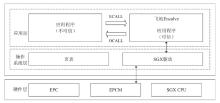
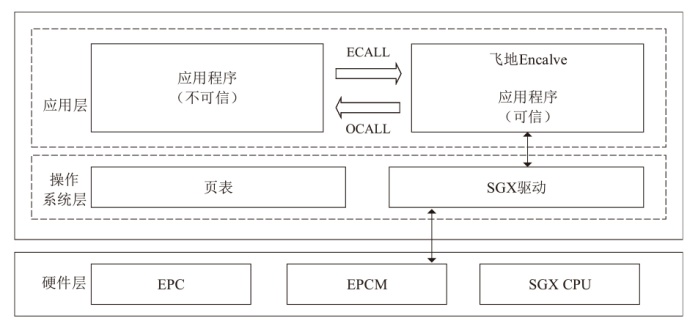
| Intel SGX[ | 用户态 飞地隔离 | AES+ Merkle树 | 弱,软件 辅助防护 | Intel统一认证 | CPU内置密钥 |
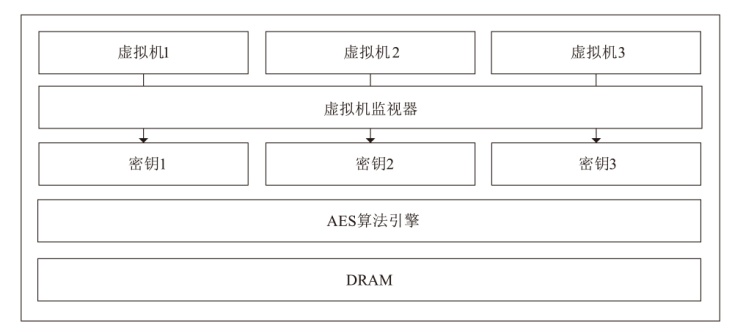
| Intel TDX[ | 虚拟机 隔离 | AES内存 加密 | 中,硬件 辅助防护 | Intel统一认证 | CPU动态管理 |
| AMD SEV[ | 虚拟机 隔离 | AES内存 加密 | 弱,软件 策略辅助 防护 | AMD统一认证 | PSP集中 管理 |
| ARM TrustZone[ | 安全世界隔离 | 默认无内存 加密 | 弱,额外策略辅助防护 | 缺乏统一标准 | 根密钥+TEE软件 |
| RISC-V Keystone[ | PMP隔离 | 可选AES 加密 | 弱,实验 阶段防护 | 开放自定义实现 | 设备密钥+监控器 |
| GPU/FPGA TEE[ | 异构资源隔离 | 显存/逻辑 资源加密 | 弱,定制 隔离措施 | 厂商初步阶段 | 厂商密钥 体系 |
| 主流TEE架构 | 性能损耗 | 内存扩展能力 | 部署复杂性 |
|---|---|---|---|
| Intel SGX[ | 高 | 低 | 高 |
| Intel TDX[ | 中低 | 高 | 中 |
| AMD SEV[ | 中低 | 高 | 低 |
| ARM TrustZone[ | 较低 | 低 | 较高 |
| RISC-V Keystone[ | 低 | 中 | 中高 |
| GPU/FPGA TEE[ | 中 | 中(硬件规模) | 中(环境要求) |
| 主流TEE架构 | 工具链成熟度 | 商业生态 |
|---|---|---|
| Intel SGX[ | 成熟,但开发难度大 | 成熟 |
| Intel TDX[ | 快速发展 | 快速发展 |
| AMD SEV[ | 成熟 | 广泛部署 |
| ARM TrustZone[ | 成熟,碎片化严重 | 嵌入式生态成熟 |
| RISC-V Keystone[ | 初期研究导向 | 边缘计算研究导向 |
| GPU/FPGA TEE[ | 发展阶段 | 新兴AI计算领域 |
| 主流TEE架构 | 典型应用场景 |
|---|---|
| Intel SGX[ | 云端小规模应用 |
| Intel TDX[ | 云端整体迁移 |
| AMD SEV[ | 企业机密计算 |
| ARM TrustZone[ | 移动与嵌入式安全 |
| RISC-V Keystone[ | 边缘研究型应用 |
| GPU/FPGA TEE[ | AI机密高性能计算 |
| 主流TEE架构 | AI场景适应性 | AI应用场景 |
|---|---|---|
| Intel SGX[ | 中 | AI模型的安全推理 |
| Intel TDX[ | 高 | 多租户AI应用 |
| AMD SEV[ | 高 | 多租户AI应用 |
| ARM TrustZone[ | 中 | 轻量级AI模型推理 |
| RISC-V Keystone[ | 中 | 可运行AI模型,但生态系统尚在发展中 |
| GPU/FPGA TEE[ | 非常高 | 大规模AI模型的安全推理 |
| [1] | Liu Bo, Ding Ming, Shaham S, et al. When machine learning meets privacy: a survey and outlook[J]. ACM Computing Surveys (CSUR), 2021, 54(2): 1-36. |
| [2] | Al-Rubaie M, Chang J M. Privacy-preserving machine learning: threats and solutions[J]. IEEE Security & Privacy, 2019, 17(2): 49-58. |
| [3] | Costan V, Devadas S. Intel SGX explained[EB/OL]. (2016-01-31)[2026-02-09]. https://eprint.iacr.org/2016/086.pdf. |
| [4] | Jang I, Tang A, Kim T, et al. Heterogeneous isolated execution for commodity GPUs[C]// The Twenty-Fourth International Conference on Architectural Support for Programming Languages and Operating Systems. New York: ACM, 2019: 455-468. |
| [5] | Tanuwidjaja H C, Choi R, Baek S, et al. Privacy-preserving deep learning on machine learning as a service-a comprehensive survey[J]. IEEE Access, 2020(8): 167425-167447. |
| [6] | GPD_SPE_009 TEE system architecture v1.3[S]. |
| [7] | Mckeen F, Alexandrovich I, Berenzon A, et al. Innovative instructions and software model for isolated execution[C]// The 2nd International Workshop on Hardware and Architectural Support for Security and Privacy. New York: ACM, 2013: 1-8. |
| [8] | Intel Corporation. Intel TDX module 1.0 specification: 344425-005US[R]. 2023: 19-46. |
| [9] | AMD. AMD memory encryption[EB/OL]. (2025-09-17)[2026-02-09]. https://cn.bing.com/search?q=AMD%20memory%20encryption&qs=n&form=QBRE&sp=-1&lq=0&pq=amd%20memory%20encryption&sc=11-21&sk=&cvid=DD77FEC37A6D4BABB4F86973ABA8825C. |
| [10] | ARM Limited. ARM security technology: building a secure system using TrustZone technology[EB/OL]. (2009-04-26)[2026-02-09]. https://support.arm.com/documentation/PRD29-GENC-009492/c/. |
| [11] | Lee D, Kohlbrenner D, Shinde S, et al. Keystone: an open framework for architecting trusted execution environments[C]// The Fifteenth European Conference on Computer Systems. New York: ACM, 2020: 1-16. |
| [12] | Volos S, Vaswani K, Bruno R. Graviton: trusted execution environments on GPUs[C]// The 13th USENIX Symposium on Operating Systems Design and Implementation (OSDI 18). Berkeley: USENIX, 2018: 681-696. |
| [13] | Acar A, Aksu H, Uluagac A S, et al. A survey on homomorphic encryption schemes: theory and implementation[J]. ACM Computing Surveys (CSUR), 2018, 51(4): 1-35. |
| [14] | Lindell Y. Secure multiparty computation[J]. Communications of the ACM, 2021, 64(1): 86-96. |
| [15] | Dwork C, Roth A. The algorithmic foundations of differential privacy[J]. Foundations and Trends® in Theoretical Computer Science, 2014, 9(3): 211-277. |
| [16] | Goldwasser S, Micali S, Rackoff C. The knowledge complexity of interactive proof-systems[C]// The Seventeenth Annual ACM Symposium on Theory of Computing. New York: ACM, 2019: 291-304. |
| [17] | Sabt M, Achemlal M, Bouabdallah A. Trusted execution environment: what it is, and what it is not[C]// 2015 IEEE Trustcom/BigDataSE/ISPA. New York: IEEE, 2015: 57-64. |
| [18] | GPD_SPE_021 TEE protection profile v1.3[S]. |
| [19] | Sinha R, Costa M, Lal A, et al. A design and verification methodology for secure isolated regions[J]. ACM SIGPLAN Notices, 2016, 51(6): 665-681. |
| [20] | Fei Shufan, Yan Zheng, Ding Wenxiu, et al. Security vulnerabilities of SGX and countermeasures: a survey[J]. ACM Computing Surveys (CSUR), 2021, 54(6): 1-36. |
| [21] | Sinha R, Rajamani S, Seshia S, et al. Moat: verifying confidentiality of enclave programs[C]// The 22nd ACM SIGSAC Conference on Computer and Communications Security. New York: ACM, 2015: 1169-1184. |
| [22] | Subramanyan P, Sinha R, Lebedev I, et al. A formal foundation for secure remote execution of enclaves[C]// The 2017 ACM SIGSAC Conference on Computer and Communications Security. New York: ACM, 2017: 2435-2450. |
| [23] | Baumann A, Peinado M, Hunt G. Shielding applications from an untrusted cloud with haven[J]. ACM Transactions on Computer Systems (TOCS), 2015, 33(3): 1-26. |
| [24] | Costan V, Lebedev I, Devadas S. Sanctum: minimal hardware extensions for strong software isolation[C]// The 25th USENIX Security Symposium (USENIX Security’ 16). Berkeley: USENIX, 2016: 857-874. |
| [25] | Strackx R, Piessens F. Ariadne: a minimal approach to state continuity[C]// The 25th USENIX Security Symposium (USENIX Security’ 16). Berkeley: USENIX, 2016: 875-892. |
| [26] | Parno B, Lorch J R, Douceur J R, et al. Memoir: practical state continuity for protected modules[C]// 2011 IEEE Symposium on Security and Privacy. New York: IEEE, 2011: 379-394. |
| [27] | Matetic S, Ahmed M, Kostiainen K, et al. ROTE: rollback protection for trusted execution[C]// The 26th USENIX Security Symposium (USENIX Security’ 17). Berkeley: USENIX, 2017: 1289-1306. |
| [28] | Angel S, Basu A, Cui Weidong, et al. Nimble: rollback protection for confidential cloud services[C]// The 17th USENIX Symposium on Operating Systems Design and Implementation (OSDI 23). Berkeley: USENIX, 2023: 193-208. |
| [29] | Coker G, Guttman J, Loscocco P, et al. Principles of remote attestation[J]. International Journal of Information Security, 2011, 10(2): 63-81. |
| [30] | Sailer R, Zhang Xiaolan, Jaeger T, et al. Design and implementation of a TCG-based integrity measurement architecture[C]// USENIX Security Symposium. Berkeley: USENIX, 2004: 223-238. |
| [31] | GP_REQ_025 Root of trust definitions and requirements v1.1.1[S]. |
| [32] | Chen Guoxing, Zhang Yinqian, Lai T H. Opera: open remote attestation for intel’s secure enclaves[C]// The 2019 ACM SIGSAC Conference on Computer and Communications Security. New York: ACM, 2019: 2317-2331. |
| [33] | Hu Jilin, Zhao Yongwang, Pan Shuangquan, et al. Tacco: a framework for ensuring the security of real-world TEEs via formal verification[J]. IEEE Transactions on Dependable and Secure Computing, 2025, 22(6): 6983-6997. |
| [34] | Gueron S. A memory encryption engine suitable for general purpose processors[EB/OL]. (2016-02-25)[2026-02-09]. https://eprint.iacr.org/2016/204. |
| [35] | Sardar M U, Faqeh R, Fetzer C. Formal foundations for intel SGX data center attestation primitives[C]// International Conference on Formal Engineering Methods. Heidelberg: Springer, 2020: 268-283. |
| [36] | Sinha R, Rajamani S, Seshia S A. A compiler and verifier for page access oblivious computation[C]//2017 11th Joint Meeting on Foundations of Software Engineering. New York: ACM, 2017: 649-660. |
| [37] | Brandenburger M, Cachin C, Lorenz M, et al. Rollback and forking detection for trusted execution environments using lightweight collective memory[C]// 2017 47th Annual IEEE/IFIP International Conference on Dependable Systems and Networks (DSN). New York: IEEE, 2017: 157-168. |
| [38] | Ferraiuolo A, Baumann A, Hawblitzel C, et al. Komodo: using verification to disentangle secure-enclave hardware from software[C]// The 26th Symposium on Operating Systems Principles. New York: ACM, 2017: 287-305. |
| [39] | Noorman J, Agten P, Daniels W, et al. Sancus: low-cost trustworthy extensible networked devices with a zero-software trusted computing base[C]// The 22nd USENIX Security Symposium (USENIX Security’ 13). Berkeley: USENIX, 2013: 479-498. |
| [40] | Schuster F, Costa M, Fournet C, et al. VC3: trustworthy data analytics in the cloud using SGX[C]// 2015 IEEE Symposium on Security and Privacy. New York: IEEE, 2015: 38-54. |
| [41] | Gueron S. Memory encryption for general-purpose processors[J]. IEEE Security & Privacy, 2016, 14(6): 54-62. |
| [42] | Datta A, Franklin J, Garg D, et al. A logic of secure systems and its application to trusted computing[C]// 2009 30th IEEE Symposium on Security and Privacy. New York: IEEE, 2009: 221-236. |
| [43] | Lind J, Priebe C, Muthukumaran D, et al. Glamdring: automatic application partitioning for intel SGX[C]// 2017 USENIX Annual Technical Conference (USENIX ATC’ 17). Berkeley: USENIX, 2017: 285-298. |
| [44] | Van B J, Minkin M, Weisse O, et al. Foreshadow: extracting the keys to the intel SGX kingdom with transient out-of-order execution[C]// The 27th USENIX Security Symposium (USENIX Security’ 18). Berkeley: USENIX, 2018: 991-1008. |
| [45] | ARM Limited. TrustZone for cortex-a product support[EB/OL]. (2015-11-10)[2026-02-09]. https://developer.arm.com/dev2/compute-ip/trustzone-for-cortex-a. |
| [46] | Moghimi A, Irazoqui G, Eisenbarth T. Cachezoom: how SGX amplifies the power of cache attacks[C]// International Conference on Cryptographic Hardware and Embedded Systems. Heidelberg: Springer, 2017: 69-90. |
| [47] | Borrello P, Kogler A, Schwarzl M, et al. ÆPIC leak: architecturally leaking uninitialized data from the microarchitecture[C]// The 31st USENIX Security Symposium (USENIX Security’ 22). Berkeley: USENIX, 2022: 3917-3934. |
| [48] | Shih M W, Lee S, Kim T, et al. T-SGX: eradicating controlled-channel attacks against enclave programs[C]//NDSS Symposium 2017. Reston: Internet Society, 2017: 16-43. |
| [49] | Oleksenko O, Trach B, Krahn R, et al. Varys: protecting SGX enclaves from practical side-channel attacks[C]// 2018 USENIX Annual Technical Conference (USENIX ATC’ 18). Berkeley: USENIX, 2018: 227-240. |
| [50] | Seo J, Lee B, Kim S M, et al. SGX-shield: enabling address space layout randomization for SGX programs[C]//NDSS Symposium 2017. Reston: Internet Society, 2017: 1-15. |
| [51] | Dessouky G, Frassetto T, Sadeghi A R. HybCache: hybrid side-channel-resilient caches for trusted execution environments[C]// The 29th USENIX Security Symposium (USENIX Security’ 20). Berkeley: USENIX, 2020: 451-468. |
| [52] | Van S S, Seto A, Yurek T, et al. SoK:SGX. fail: how stuff gets eXposed[C]// 2024 IEEE Symposium on Security and Privacy (SP). New York: IEEE, 2024: 4143-4162. |
| [53] | Scarlata V, Johnson S, Beaney J, et al. Supporting third party attestation for intel SGX with intel data center attestation primitives[EB/OL]. (2019-04-19)[2026-02-09]. https://www.intel.com/content/www/us/en/content-details/671314/supporting-third-party-attestation-for-intel-software-guard-extensions-data-center-attestation-primitives.html. |
| [54] | GPD_SPE_010 TEE internal core API specification v1.1.2[S]. |
| [55] | Intel Corporation. Intel software guard extensions (intel SGX): key management reference application (KMRA) on intel Xeon scalable processors user guide[EB/OL]. (2023-10-30)[2026-02-09]. https://www.intel.com/content/www/us/en/content-details/635272/intel-software-guard-extensions-intel-sgx-key-management-reference-application-kmra-on-intel-xeon-scalable-processors.html. |
| [56] | FIPS 203 Module-lattice-based key-encapsulation mechanism standard[S]. |
| [57] | Version 0.22 Secure encrypted virtualization API[S]. |
| [58] | Pinto S, Santos N. Demystifying ARM TrustZone: a comprehensive survey[J]. ACM Computing Surveys (CSUR), 2019, 51(6): 1-36. |
| [59] | 中国信息通信研究院. 隐私计算应用研究报告(2023年)[EB/OL]. (2023-08-19)[2026-02-09]. https://dsj.guizhou.gov.cn/xwzx/gnyw/202308/t20230819_86427334.html. |
| [60] | 亿欧智库. 2022中国隐私计算产业研究报告[EB/OL]. (2022-06-02)[2026-02-09]. https://www.yunbaogao.cn/index/partFile/1/iresearch/2022-03/1_39729.pdf. |
| [61] | 北京金融科技产业联盟. 隐私计算技术金融应用研究报告[EB/OL]. (2022-03-10)[2026-02-09]. https://mp.weixin.qq.com/s/Tu8OX-gKXf2DUo3TLt9OZw. |
| [62] | Bahmani R, Barbosa M, Brasser F, et al. Secure multiparty computation from SGX[C]// International Conference on Financial Cryptography and Data Security. Heidelberg: Springer, 2017: 477-497. |
| [63] | Karanjai R, Collier R, Gao Zhimin, et al. Decentralized translator of trust: supporting heterogeneous TEE for critical infrastructure protection[C]// The 5th ACM International Symposium on Blockchain and Secure Critical Infrastructure. New York: ACM, 2023: 85-94. |
| [64] | Wang Huibo, Wang Pei, Ding Yu, et al. Towards memory safe enclave programming with rust-SGX[C]// 2019 ACM SIGSAC Conference on Computer and Communications Security. New York: ACM, 2019: 2333-2350. |
| [65] | Xu Tianxing, Zhu Konglin, Andrzejak A, et al. Distributed learning in trusted execution environment: a case study of federated learning in SGX[C]// 2021 7th IEEE International Conference on Network Intelligence and Digital Content (IC-NIDC). New York: IEEE, 2021: 450-454. |
| [66] | Raisaro J L, Troncoso-Pastoriza J R, Misbach M, et al. MedCo: enabling secure and privacy-preserving exploration of distributed clinical and genomic data[J]. IEEE/ACM Transactions on Computational Biology and Bioinformatics, 2018, 16(4): 1328-1341. |
| [67] | Li Yi, Xu Wei. PrivPy: general and scalable privacy-preserving data mining[C]// The 25th ACM SIGKDD International Conference on Knowledge Discovery & Data Mining. New York: ACM, 2019: 1299-1307. |
| [68] | Messaoud A A, Mokhtar S B, Simonet-Boulogne A. TEE-based key-value stores: a survey[J]. The VLDB Journal, 2025, 34(1): 1-10. |
| [69] | Zheng Wenting, Dave A, Beekman J G, et al. Opaque: an oblivious and encrypted distributed analytics platform[C]// The 14th USENIX Symposium on Networked Systems Design and Implementation (NSDI 17). Berkeley: USENIX, 2017: 283-298. |
| [70] | Lee T, Lin Zhiqi, Pushp S, et al. Occlumency: privacy-preserving remote deep-learning inference using SGX[C]// The 25th Annual International Conference on Mobile Computing and Networking. New York: ACM, 2019: 1-17. |
| [71] | Ohrimenko O, Schuster F, Fournet C, et al. Oblivious multi-party machine learning on trusted processors[C]// The 25th USENIX Security Symposium (USENIX Security’ 16). Berkeley: USENIX, 2016: 619-636. |
| [72] | Tramer F, Boneh D. Slalom: fast, verifiable and private execution of neural networks in trusted hardware[EB/OL]. (2019-02-27)[2026-02-09]. https://arxiv.org/abs/1806.03287. |
| [73] | Fan Shulin, Hua Zhichao, Xia Yubin, et al. XpuTEE: a high-performance and practical heterogeneous trusted execution environment for GPUs[J]. ACM Transactions on Computer Systems, 2025, 43(2): 1-27. |
| [74] | Kato F, Cao Yang, Yoshikawa M. Olive: oblivious federated learning on trusted execution environment against the risk of sparsification[J]. Proceedings of the VLDB Endowment, 2023, 16(10): 2404-2417. |
| [75] | Liu Yang, Fan Tao, Chen Tianjian, et al. FATE: an industrial grade platform for collaborative learning with data protection[J]. Journal of Machine Learning Research, 2021, 22(1): 1-6. |
| [76] | Mo F, Shamsabadi A S, Katevas K, et al. DarkneTZ: towards model privacy at the edge using trusted execution environments[C]// The 18th International Conference on Mobile Systems, Applications, and Services. New York: ACM, 2020: 161-174. |
| [77] | Cerdeira D, Santos N, Fonseca P, et al. SoK: understanding the prevailing security vulnerabilities in trustzone-assisted TEE systems[C]// 2020 IEEE Symposium on Security and Privacy (SP). New York: IEEE, 2020: 1416-1432. |
| [78] | Apple Incorporation. The secure enclave[EB/OL]. (2024-12-19)[2026-02-09]. https://support.apple.com/guide/security/sec59b0b31ff/web. |
| [79] | Samsung Electronics. Knox platform for enterprise[EB/OL]. (2023-12-22)[2026-02-09]. https://docs.samsungknox.com/admin/knox-platform-for-enterprise/. |
| [80] | Munoz A, Rios R, Roman R, et al. A survey on the (in) security of trusted execution environments[EB/OL]. (2023-06-01)[2026-02-09]. https://www.sciencedirect.com/science/article/pii/S0167404823000901. |
| [81] | Boyens J, Smith A, Bartol N, et al. Cybersecurity supply chain risk management practices for systems and organizations[EB/OL]. (2022-05-05)[2026-02-09]. https://doi.org/10.6028/NIST.SP.800-161r1. |
| [82] | Fiolhais L, Sousa L. QR TPM in programmable low-power devices[EB/OL]. (2023-09-29)[2026-02-09]. https://arxiv.org/abs/2309.17414. |
| [83] | 中山市人民政府新闻办公室. “黑科技”齐亮相,2024中山市网络安全科普体验展持续至本月底[EB/OL]. (2024-09-10)[2026-02-09]. https://zsxwfbt.zs.gov.cn/news/index/view/cateid/1193/id/716496.html. |
| [84] | RFC 9334 Remote attestation procedures architecture[S]. |
| [85] | Zou Yu, Li Yiran, Wang Sheng, et al. Salus: a practical trusted execution environment for CPU-FPGA heterogeneous cloud platforms[C]// The 29th ACM International Conference on Architectural Support for Programming Languages and Operating Systems. New York: ACM, 2024: 252-266. |
| [86] | Hunt T, Jia Zhipeng, Miller V, et al. Telekine: secure computing with cloud GPUs[C]// The 17th USENIX Symposium on Networked Systems Design and Implementation (NSDI 20). Berkeley: USENIX, 2020: 817-833. |
| [87] | Yudha A W B, Meyer J, Yuan Shougang, et al. LITE: a low-cost practical inter-operable GPU TEE[C]// The 36th ACM International Conference on Supercomputing. New York: ACM, 2022: 1-13. |
| [88] | Zhu Jianping, Hou Rui, Wang Xiaofeng, et al. Enabling rack-scale confidential computing using heterogeneous trusted execution environment[C]// 2020 IEEE Symposium on Security and Privacy (SP). New York: IEEE, 2020: 1450-1465. |
| [89] | Han Husheng, Zheng Xinyao, Wen Yuanbo, et al. TensorTEE: unifying heterogeneous TEE granularity for efficient secure collaborative tensor computing[C]// The 29th ACM International Conference on Architectural Support for Programming Languages and Operating Systems. New York: ACM, 2024: 282-297. |
| [90] | Koga Y, Kourai K. SSdetector: secure and manageable host-based IDS with SGX and SMM[C]// 2023 IEEE 22nd International Conference on Trust, Security and Privacy in Computing and Communications (TrustCom). New York: IEEE, 2023: 539-548. |
| [91] | Arnautov S, Trach B, Gregor F, et al. SCONE: secure Linux containers with intel {SGX}[C]// The 12th USENIX Symposium on Operating Systems Design and Implementation (OSDI 16). Berkeley: USENIX, 2016: 689-703. |
| [92] | Shinde S, Le T D, Tople S, et al. Panoply: low-TCB Linux applications with SGX enclaves[C]//NDSS Symposium 2017. Reston: Internet Society, 2017: 56-77. |
| [93] | Tian Hongliang, Zhang Qiong, Yan Shoumeng, et al. Switchless calls made practical in intel SGX[C]// The 3rd Workshop on System Software for Trusted Execution. New York: ACM, 2018: 22-27. |
| [94] | Mckeen F, Alexandrovich I, Anati I, et al. Intel® software guard extensions (Intel® SGX) support for dynamic memory management inside an enclave[C]//The Hardware and Architectural Support for Security and Privacy 2016. New York: ACM, 2016: 1-9. |
| [95] | AMD. AMD SEV-SNP: strengthening VM isolation with integrity protection and more[EB/OL]. (2020-01-01)[2026-02-09]. https://docs.amd.com/v/u/en-US/SEV-SNP-strengthening-vm-isolation-with-integrity-protection-and-more. |
| [96] | Tsai C C, Porter D E, Vij M. Graphene-SGX: a practical library OS for unmodified applications on SGX[C]// 2017 USENIX Annual Technical Conference (USENIX ATC’ 17). Berkeley: USENIX, 2017: 645-658. |
| [97] | Open Enclave SDK. Open enclave SDK documentation[EB/OL]. (2023-04-29)[2026-02-09]. https://openenclave.io/. |
| [98] | Google LLC. Asylo: an open and flexible framework for enclave applications[EB/OL]. (2021-06-03)[2026-02-09]. https://github.com/google/asylo. |
| [99] | RFC 9711 The entity attestation token (EAT)[S]. |
| [100] | Confidential Computing Consortium. Confidential computing: hardware-based trusted execution for applications and data[EB/OL]. (2022-11-01)[2026-02-09]. https://confidentialcomputing.io/resources/white-papers-reports/. |
| [101] | Bennett C H, Brassard G. Quantum cryptography: public key distribution and coin tossing[J]. Theoretical Computer Science, 2014(560): 7-11. |
| [1] | LI Zihao, ZHANG Fengwei. TEE-Based Federated Learning Platform [J]. Netinfo Security, 2026, 26(5): 788-808. |
| [2] | CUI Jinhua, DONG Liang, YANG Xin. A Survey of Privacy-Preserving Techniques for Large Language Model Inference [J]. Netinfo Security, 2026, 26(4): 503-520. |
| [3] | LIN Tiantian, WANG Yitian, WANG Xiaohang, ZHU Ting, REN Kui. CCASim: Research on Performance Simulator for Arm Confidential Compute Architecture [J]. Netinfo Security, 2026, 26(2): 189-210. |
| [4] | ZHAO Jia, WANG Yanchun, MA Hongliang, LI Qi. Hierarchical Role-Based Encryption Scheme Based on Trusted Execution Environment [J]. Netinfo Security, 2026, 26(2): 315-324. |
| [5] | SHI Yijuan, ZHOU Danping, FAN Lei, LIU Yin. Secure Multi-Party Computation Protocol Based on Trusted Execution Environment [J]. Netinfo Security, 2025, 25(9): 1439-1446. |
| [6] | HUANG Ke, LI Xuan, ZHOU Qingfei, SHANG Ketong, QIN Yu. A Trusted Runtime Monitoring Method Based on eBPF for Container [J]. Netinfo Security, 2025, 25(2): 306-326. |
| [7] | HAO Meng, LI Jiayong, YANG Hongwei, ZHANG Weizhe. Heterogeneous CPU-GPU System Confidential Computing Survey [J]. Netinfo Security, 2025, 25(11): 1658-1672. |
| [8] | GUAN Zhi, HU Jianbin, LI Yue, CHEN Zhong. A Comprehensive Survey of Blockchain Technologies and Applications Based on Trusted Execution Environments [J]. Netinfo Security, 2025, 25(11): 1673-1690. |
| [9] | XUE Kaiping, ZHANG Chunyi, LIU Feng, WANG Feng. Security-Enhanced Index Scheme in Encrypted Database Based on Trusted Execution Environment [J]. Netinfo Security, 2025, 25(11): 1718-1731. |
| [10] | ZHAO Bo, LYU Jiamin, WANG Yixuan. A Multidimensional Security Measurement Architecture for the Container Lifecycle [J]. Netinfo Security, 2025, 25(11): 1745-1761. |
| [11] | WANG Yajie, LU Jinbiao, LI Yuhang, FAN Qing, ZHANG Zijian, ZHU Liehuang. Hierarchical Dynamic Protection Algorithm for Federated Learning Based on Trusted Execution Environment [J]. Netinfo Security, 2025, 25(11): 1762-1773. |
| [12] | LU Di, LIU Yujia, LYU Chaoyue, SUN Mengna, ZHANG Qingwen, YANG Li. Cloud-Native TEE Service Sharing Mechanism for Secure Edge Computing [J]. Netinfo Security, 2025, 25(11): 1774-1791. |
| [13] | HU Yuyi, CAI Wei, CHEN Jingfan, LIU Mohan, WANG Juan, HE Yun. Research on Unified Remote Attestation Mechanism for Confidential Containers Devices [J]. Netinfo Security, 2025, 25(11): 1811-1823. |
| [14] | YU Fajiang, WANG Chaozhou. Implementation Mechanism for TrustZone Paravirtualization and Containerization [J]. Netinfo Security, 2025, 25(10): 1523-1536. |
| [15] | WEN Wen, LIU Qinju, KUANG Lin, REN Xuejing. Research and Scheme Design of Cyber Threat Intelligence Sharing under Privacy Protection System [J]. Netinfo Security, 2024, 24(7): 1129-1137. |
| Viewed | ||||||
|
Full text |
|
|||||
|
Abstract |
|
|||||