Netinfo Security ›› 2026, Vol. 26 ›› Issue (8): 1264-1276.doi: 10.3969/j.issn.1671-1122.2026.08.008
Previous Articles Next Articles
Argus6: an IPv6 DDoS threat detection model
Zhang Hongtao1,2, Wang Qingtao1,2, Zhang Liancheng3( ), Wang Jichang3
- 1
School of Cyber Science and Engineering ,Zhengzhou University Zhengzhou 450002, China
2Network Management Center ,Zhengzhou University Zhengzhou 450001, China
3School of Cyberspace Security ,Cyberspace Force Information Engineering University Zhengzhou 450001, China
-
Received:2025-12-25Online:2026-08-10Published:2026-09-23 -
Contact:Zhang Liancheng E-mail:liancheng17@aliyun.com

CLC Number:
Cite this article
Zhang Hongtao, Wang Qingtao, Zhang Liancheng, Wang Jichang. Argus6: an IPv6 DDoS threat detection model[J]. Netinfo Security, 2026, 26(8): 1264-1276.
share this article
Add to citation manager EndNote|Ris|BibTeX
URL: http://netinfo-security.org/EN/10.3969/j.issn.1671-1122.2026.08.008
| 层名 | 输出形状 | 说明 |
|---|---|---|
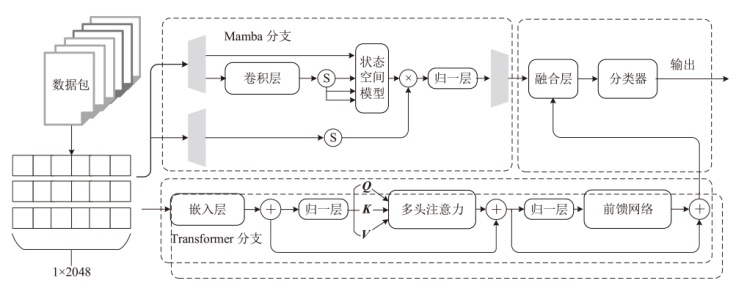
| Input | [128,512,2048] | 2048位定长特征序列 |
| Linear | [128,512,64] | Transformer分支投影 2048→64 |
| TransformerEncoder | [128,512,64] | 全局建模(2×281,152) |
| Mean Pooling | [128,64] | 序列均值池化 |
| Linear | [128,512,64] | Mamba分支投影 2048→64 |
| Mamba | [128,512,64] | 状态空间序列建模 |
| Mean Pooling | [128,64] | 序列均值池化 |
| 特征拼接 | [128,128] | 拼接融合 |
| Fusion:Linear+LN+GeLU(128→64) | [128,64] | 融合降维 |
| Classifier:Linear+ GeLU+Linear(64→32→2) | [128,2] | 分类输出 |
| 序号 | 软硬件环境 | 版本 |
|---|---|---|
| 1 | 操作系统 | Windows 10 |
| 2 | 编程语言 | Python 3.10 |
| 3 | 开发环境 | JetBrains PyCharm2024 |
| 4 | 内存 | 16 GB |
| 5 | 工具包 | Torch、Pandas、Numpy、Sklearn、Mamba_ssm |
| 模型 | ACC | PRE | REC | F1-Score | AUC | FPR | FNR |
|---|---|---|---|---|---|---|---|
| A | 0.9688 | 0.9759 | 0.9625 | 0.9687 | 0.9950 | 0.0200 | 0.0375 |
| B | 0.9588 | 0.9666 | 0.9504 | 0.9585 | 0.9950 | 0.0328 | 0.0496 |
| C | 0.9893 | 0.9910 | 0.9840 | 0.9874 | 0.9986 | 0.0065 | 0.0160 |
| 模型 | ACC | PRE | REC | F1-Score | AUC | FPR | FNR |
|---|---|---|---|---|---|---|---|
| A | 0.9755 | 0.9799 | 0.9981 | 0.9890 | 0.9896 | 0.0477 | 0.0019 |
| B | 0.9791 | 0.9871 | 0.9861 | 0.9866 | 0.9884 | 0.0053 | 0.0139 |
| C | 0.9904 | 0.9935 | 0.9916 | 0.9926 | 0.9995 | 0.0119 | 0.0084 |
| 模型 | FLOPs /GFLOPs | Avg Inference Time/ms | Throughput /samples/s | Memory/MB |
|---|---|---|---|---|
| A | 94.658 | 0.3189 | 6422573.08 | 527.30 |
| B | 21.476 | 0.2491 | 8220662.44 | 521.74 |
| C | 36.550 | 1.6447 | 1110202.25 | 529.58 |
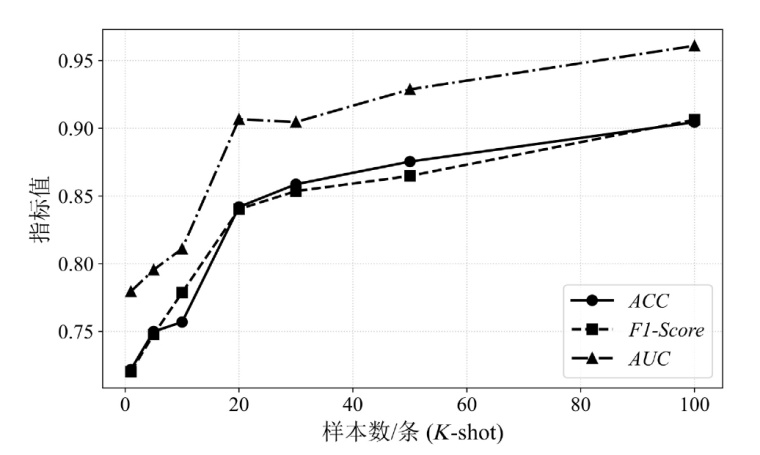
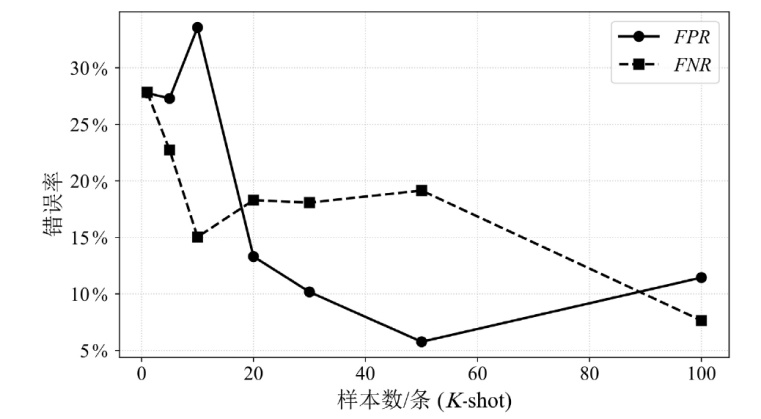
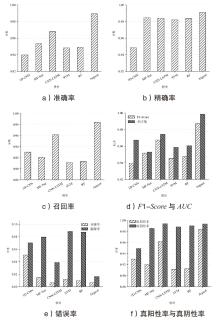
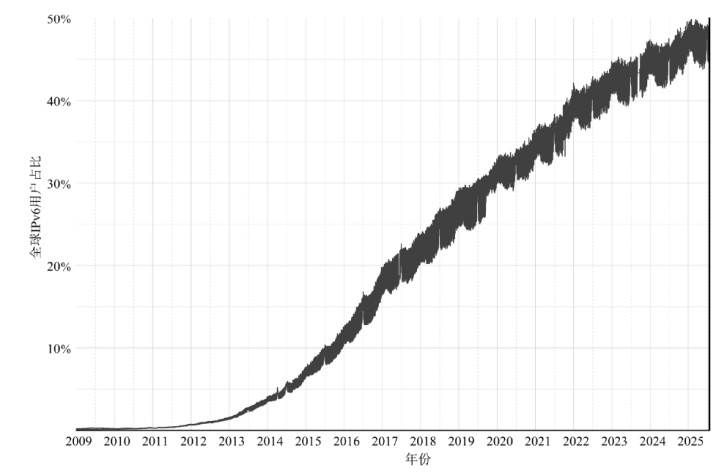
| [1] | Cisco. 6lab IPv6 stats:world users[EB/OL]. (2025-11-30)[2025-12-10]. https://6lab.cisco.com/stats/cible.php?country=world&option=users.s. |
| [2] | IETF. Internet engineering task force[EB/OL]. (2025-09-20)[2025-12-10]. https://www.ietf.org/about/introduction/. |
| [3] | Hnamte V, Najar A A, Nhung-Nguyen H, et al. DDoS attack detection and mitigation using deep neural network in SDN environment[EB/OL]. (2023-12-18)[2025-12-10]. https://doi.org/10.1016/j.cose.2023.103661. |
| [4] | 张连成, 程兰馨, 杜雯雯, 等. IPv6网络安全[M]. 北京: 科学出版社, 2024. |
| [5] | Xia Wenhao, Zhang Liancheng, Guo Yi, et al. P4NSA: P4-based security protection technology for IPv6 neighbor solicitation and advertisement spoofing[EB/OL]. (2025-02-23)[2025-12-10]. https://doi.org/10.1016/j.cose.2025.104400. |
| [6] | Balarezo J F, Wang S, Chavez K G, et al. A survey on DoS/DDoS attacks mathematical modelling for traditional, SDN and virtual networks[EB/OL]. (2021-10-23)[2025-12-10]. https://doi.org/10.1016/j.jestch.2021.09.011. |
| [7] | Guerra J L, Catania C, Veas E. Datasets are not enough: challenges in labeling network traffic[EB/OL]. (2022-06-22)[2025-12-10]. https://doi.org/10.1016/j.cose.2022.102810. |
| [8] | Lee S W, Mohammed Sidqi H, Mohammadi M, et al. Towards secure intrusion detection systems using deep learning techniques: comprehensive analysis and review[EB/OL]. (2021-05-19).[2025-12-10]. https://doi.org/10.1016/j.jnca.2021.103111. |
| [9] | Xu Congyan, Zhang Fan, Yang Ziqi, et al. A few-shot network intrusion detection method based on mutual centralized learning[EB/OL]. (2025-03-21).[2025-12-10]. https://doi.org/10.1038/s41598-025-93185-0. |
| [10] | 蒋英肇, 陈雷, 闫巧. 基于双通道特征融合的分布式拒绝服务攻击检测算法[J]. 信息网络安全, 2023, 23(7): 86-97. |
| [11] | Gu A, Dao T. Mamba: linear-time sequence modeling with selective state spaces[EB/OL]. (2024-05-31).[2025-12-10]. https://arxiv.org/abs/2312.00752. |
| [12] | Wang Tongze, Xie Xiaohui, Wang Wenduo, et al. Netmamba: efficient network traffic classification via pre-training unidirectional mamba[C]// IEEE. 2024 IEEE 32nd International Conference on Network Protocols (ICNP). New York: IEEE, 2024: 1-11. |
| [13] | Fortunati S, Gini F, Greco M S, et al. An improvement of the state-of-the-art covariance-based methods for statistical anomaly detection algorithms[J]. Signal, Image and Video Processing, 2016, 10(4): 687-694. |
| [14] | Hoque N, Kashyap H, Bhattacharyya D K. Real-time DDoS attack detection using FPGA[J]. Computer Communications, 2017, 110: 48-58. |
| [15] | Naiem S, Khedr A E, Idrees A M, et al. Enhancing the efficiency of gaussian naïve bayes machine learning classifier in the detection of DDoS in cloud computing[J]. IEEE Access, 2023, 11: 124597-124608. |
| [16] | Maazalahi M, Hosseini S. K-means and meta-heuristic algorithms for intrusion detection systems[J]. Cluster Computing, 2024, 27(8): 10377-10419. |
| [17] | Sanmorino A, Gustriansyah R, Alie J. DDoS attacks detection method using feature importance and support vector machine[J]. JUITA: Journal Informatika, 2022, 10(2): 167-171. |
| [18] | Hai Tao, Zhou Jincheng, Adetiloye O A, et al. DDoS attack prediction using decision tree and random forest algorithms[C]//Springer. Proceedings of ICACTCE’23-The International Conference on Advances in Communication Technology and Computer Engineering. Heidelberg: Springer, 2023: 37-46. |
| [19] |
徐精诚, 陈学斌, 董燕灵, 等. 融合特征选择的随机森林DDoS攻击检测[J]. 计算机应用, 2023, 43 (11): 3497-3503.
doi: 10.11772/j.issn.1001-9081.2022111792 |
| [20] | 丑义凡, 易波, 王兴伟, 等. IPv6网络中基于MF-DL的DDoS攻击快速防御机制[J]. 计算机学报, 2021, 44(10): 2047-2060. |
| [21] | Alghazzawi D, Bamasag O, Ullah H, et al. Efficient detection of DDoS attacks using a hybrid deep learning model with improved feature selection[EB/OL]. (2021-12-01)[2025-12-10]. https://doi.org/10.3390/app112411634. |
| [22] | Elejla O E, Anbar M, Hamouda S, et al. Deep-learning-based approach to detect ICMPv6 flooding DDoS attacks on IPv6 networks[EB/OL]. (2022-06-16)[2025-12-10]. https://doi.org/10.3390/app12126150. |
| [23] | 王郁夫, 王兴伟, 易波, 等. IPv6中一种基于卷积的DDoS攻击两阶段防御机制[J]. 软件学报, 2024, 35 (5): 2522-2542. |
| [24] | 范明钰, 李珂. 一种基于RNN区分DDoS攻击类型的方法[J]. 信息网络安全, 2022, 22(7): 1-8. |
| [25] | Ouhssini M, Afdel K, Akouhar M, et al. Advancements in detecting, preventing, and mitigating DDoS sttacks in cloud environments: a comprehensive systematic review of state-of-the-art approaches[EB/OL]. (2024-08-26)[2025-12-10]. https://doi.org/10.1016/j.eij.2024.100517. |
| [26] | Li Siyuan, Zhang Liumei, Han Yu. LMIPv6ATK: a labeled dataset containing multiple ICMPv6-DDoS attacks[C]// 2023 International Conference on Networking and Network Applications (NaNA). Qingdao, China: IEEE, 2023: 52-57. |
| [27] | Abinayadevi C, Parvathy M, Manoj Kumar P. IDOS6-ICMPv6 based DDoS attack dataset[EB/OL]. (2024-12-26)[2025-12-10]. https://ieee-dataport.org/documents/idos6-icmpv6-based-ddos-attack-dataset. |
| [28] | Abiramasundari S, Ramaswamy V. Distributed denial-of-service (DDoS) attack detection using supervised machine learning algorithms[J]. Scientific Reports, 2025, 15(1): 13098. |
| [29] | Alduailij M, Khan Q W, Tahir M, et al. Machine-learning-based DDoS attack detection using mutual information and random forest feature importance method[EB/OL]. (2025-05-16).[2025-12-01]. https://doi.org/10.1038/s41598-024-84879-y. |
| [30] | Wang Yufu, Wang Xingwei, Ni Qiang, et al. BCDM: an early-stage DDoS incident monitoring mechanism based on binary-CNN in IPv6 network[J]. IEEE Transactions on Network and Service Management, 2024, 21(5): 5873-5887. |
| [31] | Zabeehullah, Arif F, Qazi M U H, et al. Hybrid CNN-LSTM model for DDoS attack detection in internet of things-based healthcare industry 5.0[J]. IEEE Internet of Things Journal, 2025, 12(22): 46075-46082. |
| [32] | Ding Zhaoxu, Zhong Guoqiang, Qin Xianping, et al. MF-Net: multi-frequency intrusion detection network for internet traffic data[EB/OL]. (2023-09-27).[2025-12-10]. https://doi.org/10.1016/j.patcog.2023.109999. |
| [1] | Zheng Tianming, Liu Shangdong, Li Haitian, Li Hua. Interactive convolution and Transformer based anomaly detection algorithm [J]. Netinfo Security, 2026, 26(7): 1077-1086. |
| [2] | CHEN Yuqi, QIAN Hanwei, XIA Lingling, WANG Qun. FEViT: A Frequency Domain Enhanced ViT for Deepfake Detection [J]. Netinfo Security, 2026, 26(3): 432-441. |
| [3] | ZHAO Wenyu, DANG Chenxi, DU Zhenhua, ZHANG Jian. Research and Implementation of Ransomware Detection Technology Based on Hardware Performance Counters [J]. Netinfo Security, 2025, 25(9): 1397-1406. |
| [4] | SUN Jianwen, ZHANG Bin, SI Nianwen, FAN Ying. Lightweight Malicious Traffic Detection Method Based on Knowledge Distillation [J]. Netinfo Security, 2025, 25(6): 859-871. |
| [5] | WEI Chaoren, XIA Wanxu, QU Gang, BAI Wanrong, YANG Liqun. Research on the Optimization Technology of Open Source Fuzzing Framework for Intelligent Systems [J]. Netinfo Security, 2025, 25(4): 587-597. |
| [6] | ZHANG Xinyou, GAO Zhichao, FENG Li, XING Huanlai. FFT-iTransformer-Based Cybersecurity Situation Awareness Feature Imputation and Prediction [J]. Netinfo Security, 2025, 25(2): 228-239. |
| [7] | LIU Qiang, WANG Jian, WANG Yanan, WANG Shan. A Dynamic Malware Detection Method Based on Ensemble Learning [J]. Netinfo Security, 2025, 25(1): 159-172. |
| [8] | ZHANG Bowen, LI Dong, ZHAO Yizhu, YU Junqing. Research on Endogenous Security Mechanism of Cloud Network Driven by IPv6 Address [J]. Netinfo Security, 2024, 24(1): 113-120. |
| [9] | LI Dong, YU Junqing, WEN Ruibin, XIE Yiding. Endogenous Security Methods for Container Cloud Based on IPv6 [J]. Netinfo Security, 2023, 23(12): 21-28. |
| [10] | YE Huanrong, LI Muyuan, JIANG Bo. Research on DGA Malicious Domain Name Detection Method Based on Transfer Learning and Threat Intelligence [J]. Netinfo Security, 2023, 23(10): 8-15. |
| [11] | DAI Xiang, SUN Haichun, NIU Shuo, ZHU Rongchen. Research on Chinese Question Answering Matching Based on Mutual Attention Mechanism and Bert [J]. Netinfo Security, 2021, 21(12): 102-108. |
| [12] | WANG Tengfei, CAI Manchun, LU Tianliang, YUE Ting. IPv6 Network Attack Source Tracing Method Based on iTrace_v6 [J]. Netinfo Security, 2020, 20(3): 83-89. |
| [13] | JIN Zhi-hu, GAN Yu-xi, JIN Yi, HU Long-bin. Discussion on Constructing Secure and Reliable IPv6 Customer Premise Network [J]. Netinfo Security, 2015, 15(8): 59-66. |
| [14] | . NULL [J]. , 2012, 12(Z): 0-0. |
| [15] | . NULL [J]. , 2012, 12(Z): 0-0. |
| Viewed | ||||||
|
Full text |
|
|||||
|
Abstract |
|
|||||