Netinfo Security ›› 2026, Vol. 26 ›› Issue (7): 1012-1027.doi: 10.3969/j.issn.1671-1122.2026.07.002
Previous Articles Next Articles
Software defect prediction method based on multi-view pruning and optimized random forest
Zhang Dawei1,2, Zhou Yang1( ), Du Ye1,2, Tang Yu1
- 1
School of Cyberspace Science and Technology ,Beijing Jiaotong University Beijing 100044, China
2Tangshan Research Institute of Beijing Jiaotong University Tangshan 063000, China
-
Received:2026-01-26Online:2026-07-10Published:2026-09-03 -
Contact:Zhou Yang E-mail:2521664181@qq.com

CLC Number:
Cite this article
Zhang Dawei, Zhou Yang, Du Ye, Tang Yu. Software defect prediction method based on multi-view pruning and optimized random forest[J]. Netinfo Security, 2026, 26(7): 1012-1027.
share this article
Add to citation manager EndNote|Ris|BibTeX
URL: http://netinfo-security.org/EN/10.3969/j.issn.1671-1122.2026.07.002




| 组 | 数据集 | 特征数 | 模块数/个 | 类别 | 不平衡比 |
|---|---|---|---|---|---|
| AUDI | ProjectK | 12 | 2515 | 2 | 5.71 |
| AEEEM | JDT | 61 | 997 | 2 | 3.84 |
| AEEEM | PDE | 61 | 1497 | 2 | 6.16 |
| PROMISE | PC1 | 22 | 1109 | 2 | 6.94 |
| NASA | MC2 | 39 | 125 | 2 | 1.84 |
| ReLink | apache | 26 | 194 | 2 | 1.02 |
| 参数类别 | 参数名称 | 参数值 |
|---|---|---|
| 多视角融合权重系数 | 0.6 | |
| 冗余判定阈值 | 0.7 | |
| ST | 安全阈值 | 0.8 |
| 类型 | 函数 | 维度 | 范围 | 最优值 |
|---|---|---|---|---|
| 高维单峰函数 | 30 | [-100,100] | 0 | |
| 30 | [-30,30] | 0 | ||
| 高维多峰函数 | 30 | [-32,32] | 0 | |
| 30 | [-50,50] | 0 |
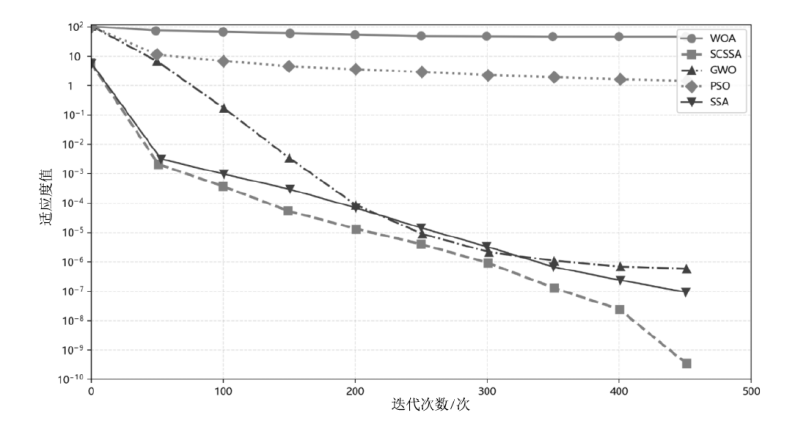
| 函数 | 算法 | 最优值 | 最差值 | 平均值 | 标准差 |
|---|---|---|---|---|---|
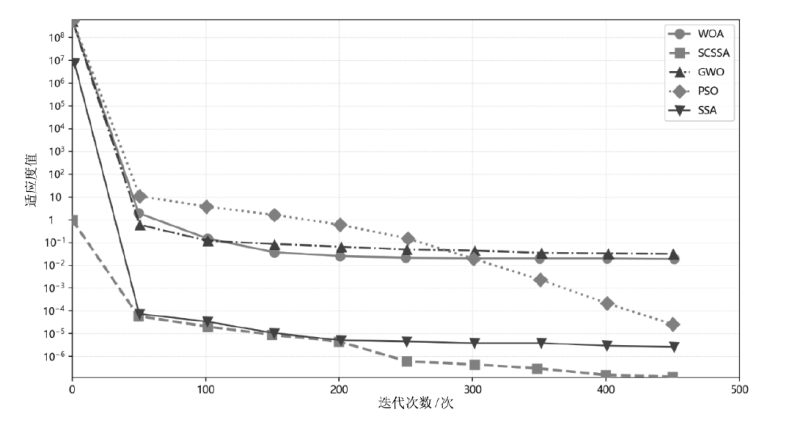
| F1 | SCSSA | 0 | 7.3932×10⁻¹⁰ | 3.2209×10⁻¹¹ | 1.2989×10⁻¹⁰ |
| SSA | 4.9188×10⁻¹⁷ | 8.9397×10⁻⁸ | 5.8409×10⁻⁹ | 1.7085×10⁻⁸ | |
| WOA | 2.1221×10⁻² | 9.0309×10 | 4.1207×10 | 2.5661×10 | |
| GWO | 4.1734×10⁻⁸ | 2.1611×10⁻⁶ | 6.2249×10⁻⁷ | 5.5418×10⁻⁷ | |
| PSO | 7.3670×10⁻² | 1.5808×1 | 1.1511×1 | 2.0960×10⁻¹ | |
| F2 | SCSSA | 2.3899×10⁻¹¹ | 1.4657×10⁻³ | 2.5467×10⁻⁴ | 3.2584×10⁻⁴ |
| SSA | 2.4516×10⁻⁷ | 7.8324×10⁻³ | 1.8652×10⁻³ | 2.2125×10⁻³ | |
| WOA | 2.6363×10 | 2.8801×10 | 2.7894×10 | 4.7531×10⁻¹ | |
| GWO | 2.5858×10 | 2.8540×10 | 2.6902×10 | 6.5391×10⁻¹ | |
| PSO | 2.0128×10 | 2.6970×10² | 8.2491×10 | 4.7653×10 | |
| F3 | SCSSA | 8.8817×10⁻¹⁶ | 8.8817×10⁻¹⁶ | 8.8817×10⁻¹⁶ | 0 |
| SSA | 8.8817×10⁻¹⁶ | 2.9309×10⁻¹⁴ | 3.3959×10⁻¹⁵ | 4.9894×10⁻¹⁵ | |
| WOA | 8.8817×10⁻¹⁶ | 7.9936×10⁻¹⁵ | 4.8588×10⁻¹⁵ | 2.0688×10⁻¹⁵ | |
| GWO | 7.9047×10⁻¹⁴ | 2.4602×10⁻¹³ | 1.4958×10⁻¹³ | 3.5985×10⁻¹⁴ | |
| PSO | 1.3542×10⁻³ | 1.3423×1 | 1.4487×10⁻¹ | 3.5845×10⁻¹ | |
| F4 | SCSSA | 1.7055×10⁻¹¹ | 9.2728×10⁻⁷ | 1.2786×10⁻⁷ | 2.0958×10⁻⁷ |
| SSA | 5.3193×10⁻⁹ | 2.1406×10⁻⁵ | 2.0275×10⁻⁶ | 3.7874×10⁻⁶ | |
| WOA | 4.5643×10⁻³ | 1.1371×10⁻² | 2.2716×10⁻² | 2.2676×10⁻² | |
| GWO | 6.6768×10⁻³ | 7.3037×10⁻² | 3.2545×10⁻³ | 1.5525×10⁻² | |
| PSO | 6.0767×10⁻⁸ | 4.7868×10⁻⁵ | 4.0319×10⁻⁶ | 9.4008×10⁻⁶ |
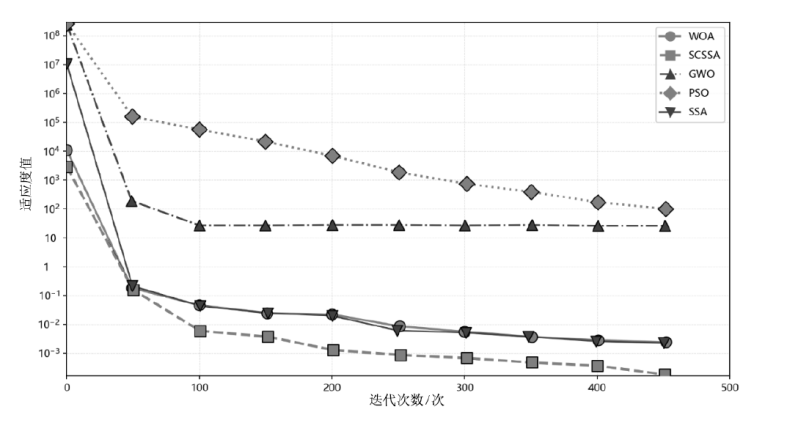
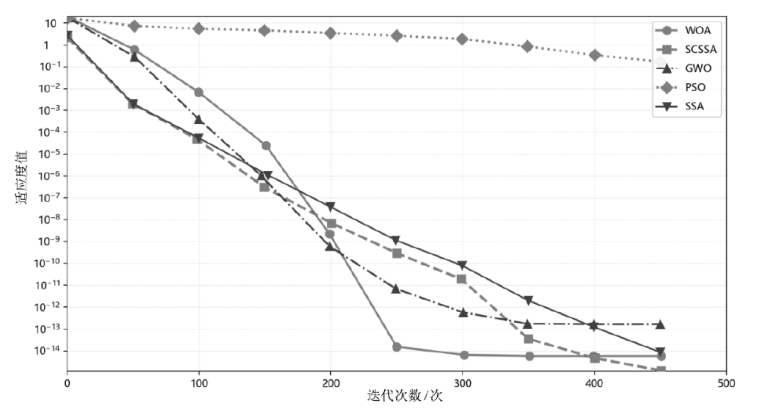
| 数据集 | 评价指标 | RF | PSO-RF | SSA-RF | SCSSA -RF |
|---|---|---|---|---|---|
| ProjectK | AUC | 0.8662 | 0.9268 | 0.9225 | 0.9285 |
| MCC | 0.8039 | 0.8784 | 0.8788 | 0.8835 | |
| JDT | AUC | 0.7150 | 0.7382 | 0.7498 | 0.8105 |
| MCC | 0.5108 | 0.5370 | 0.5644 | 0.5981 | |
| PDE | AUC | 0.5902 | 0.6036 | 0.7412 | 0.7933 |
| MCC | 0.2725 | 0.3099 | 0.4413 | 0.5987 | |
| PC1 | AUC | 0.7012 | 0.7211 | 0.7522 | 0.8014 |
| MCC | 0.4231 | 0.4583 | 0.5122 | 0.6215 | |
| MC2 | AUC | 0.6795 | 0.6764 | 0.7554 | 0.8152 |
| MCC | 0.3426 | 0.4522 | 0.5698 | 0.6920 | |
| apache | AUC | 0.6534 | 0.7304 | 0.7370 | 0.7736 |
| MCC | 0.3107 | 0.4597 | 0.7275 | 0.7943 | |
| 平均性能 | AUC | 0.7008 | 0.7328 | 0.7764 | 0.8204 |
| MCC | 0.4576 | 0.5159 | 0.6323 | 0.6980 |
| 数据集 | DISC | MRMR | XGBBT | WSV | POMRF |
|---|---|---|---|---|---|
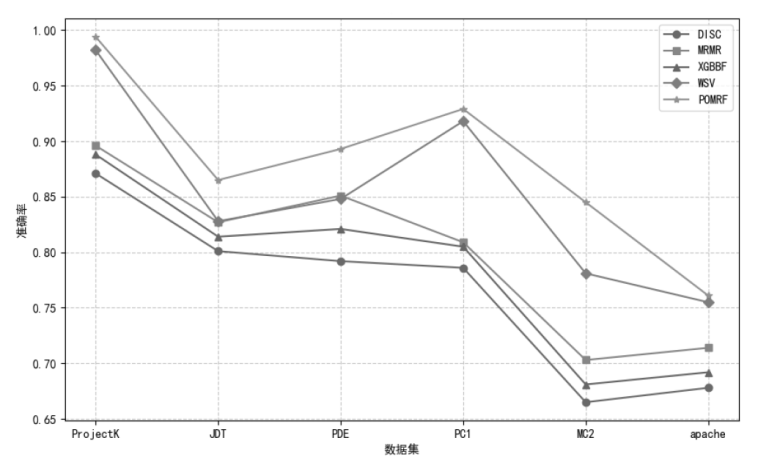
| ProjectK | 0.871 | 0.896 | 0.888 | 0.982 | 0.994 |
| JDT | 0.801 | 0.827 | 0.814 | 0.828 | 0.865 |
| PDE | 0.792 | 0.851 | 0.821 | 0.848 | 0.893 |
| PC1 | 0.786 | 0.809 | 0.805 | 0.918 | 0.929 |
| MC2 | 0.665 | 0.703 | 0.681 | 0.781 | 0.845 |
| apache | 0.678 | 0.714 | 0.692 | 0.755 | 0.761 |
| Average | 0.765 | 0.800 | 0.783 | 0.852 | 0.895 |
| 数据集 | DISC | MRMR | XGBBT | WSV | POMRF |
|---|---|---|---|---|---|
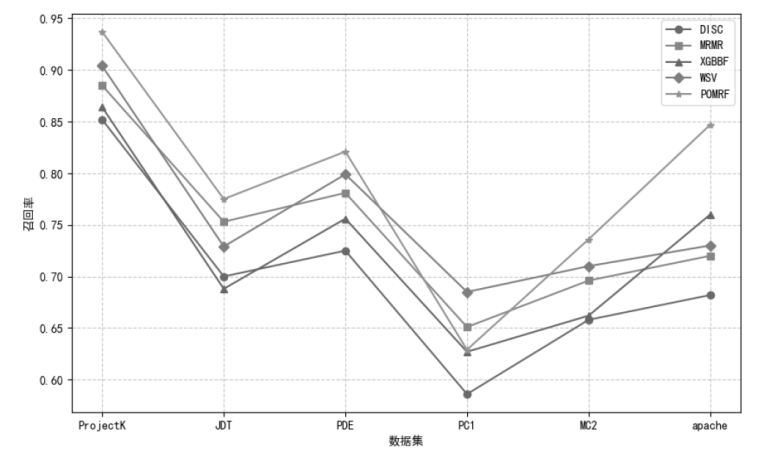
| ProjectK | 0.852 | 0.885 | 0.864 | 0.904 | 0.937 |
| JDT | 0.700 | 0.753 | 0.688 | 0.729 | 0.775 |
| PDE | 0.725 | 0.781 | 0.756 | 0.799 | 0.821 |
| PC1 | 0.586 | 0.651 | 0.627 | 0.685 | 0.629 |
| MC2 | 0.658 | 0.696 | 0.662 | 0.710 | 0.736 |
| apache | 0.682 | 0.720 | 0.760 | 0.730 | 0.847 |
| Average | 0.701 | 0.748 | 0.726 | 0.760 | 0.791 |
| 数据集 | DISC | MRMR | XGBBT | WSV | POMRF |
|---|---|---|---|---|---|
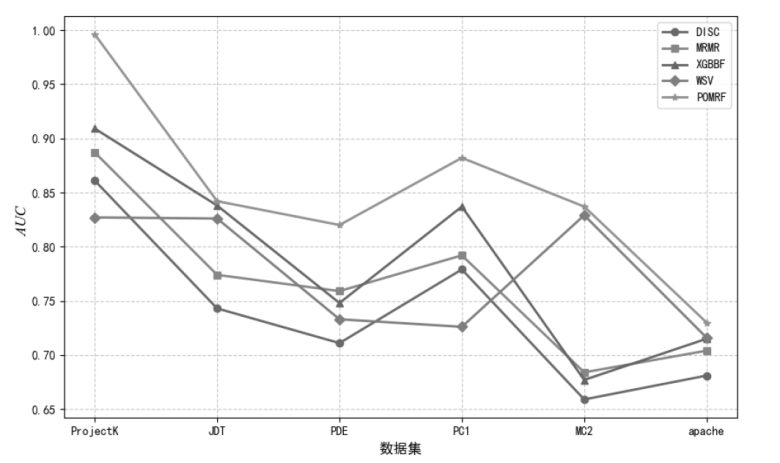
| ProjectK | 0.861 | 0.887 | 0.909 | 0.827 | 0.996 |
| JDT | 0.743 | 0.774 | 0.838 | 0.826 | 0.842 |
| PDE | 0.711 | 0.759 | 0.748 | 0.733 | 0.820 |
| PC1 | 0.779 | 0.792 | 0.837 | 0.726 | 0.882 |
| MC2 | 0.659 | 0.684 | 0.677 | 0.829 | 0.837 |
| apache | 0.681 | 0.704 | 0.715 | 0.716 | 0.730 |
| Average | 0.739 | 0.767 | 0.776 | 0.760 | 0.851 |
| 数据集 | DISC | MRMR | XGBBT | WSV | POMRF |
|---|---|---|---|---|---|
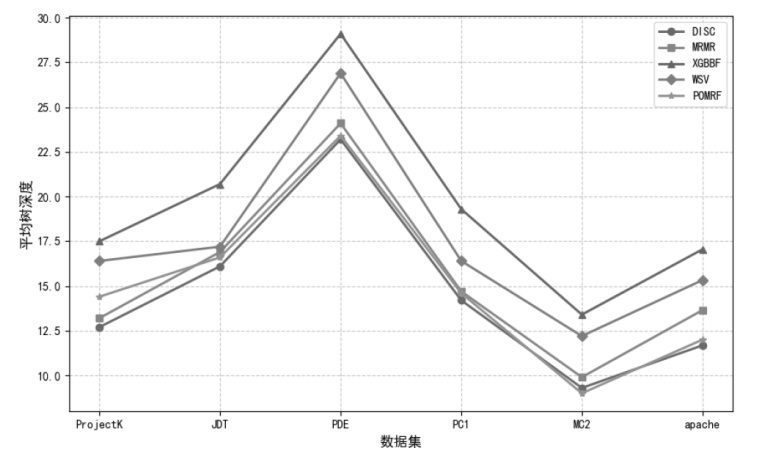
| ProjectK | 12.70 | 13.20 | 17.50 | 16.40 | 14.40 |
| JDT | 16.10 | 16.90 | 20.70 | 17.20 | 16.60 |
| PDE | 23.20 | 24.10 | 29.10 | 26.90 | 23.40 |
| PC1 | 14.20 | 14.70 | 19.30 | 16.40 | 14.60 |
| MC2 | 9.30 | 9.90 | 13.40 | 12.20 | 9.00 |
| apache | 11.68 | 13.65 | 17.05 | 15.33 | 12.00 |
| Average | 14.53 | 15.41 | 19.51 | 17.41 | 15.00 |
| 数据集 | DISC | MRMR | XGBBT | WSV | POMRF |
|---|---|---|---|---|---|
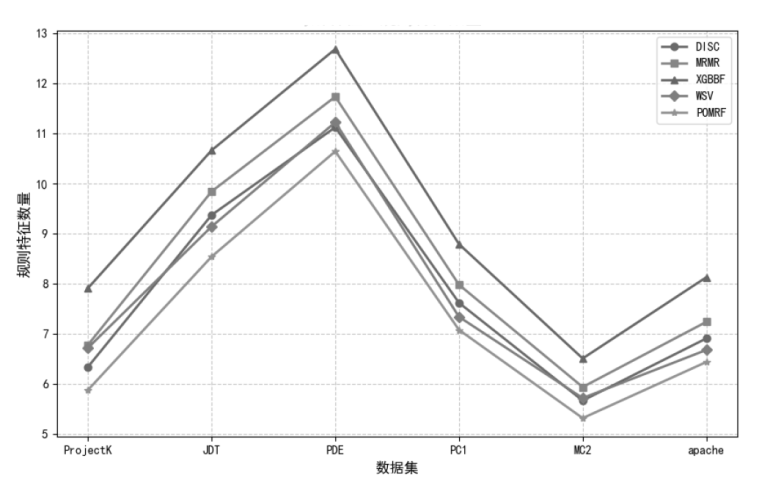
| ProjectK | 6.34 | 6.78 | 7.91 | 6.72 | 5.88 |
| JDT | 9.37 | 9.84 | 10.66 | 9.14 | 8.54 |
| PDE | 11.12 | 11.73 | 12.68 | 11.22 | 10.64 |
| PC1 | 7.62 | 7.98 | 8.79 | 7.34 | 7.08 |
| MC2 | 5.67 | 5.94 | 6.51 | 5.72 | 5.32 |
| apache | 6.91 | 7.24 | 8.13 | 6.68 | 6.44 |
| Average | 7.84 | 8.25 | 9.11 | 7.80 | 7.15 |
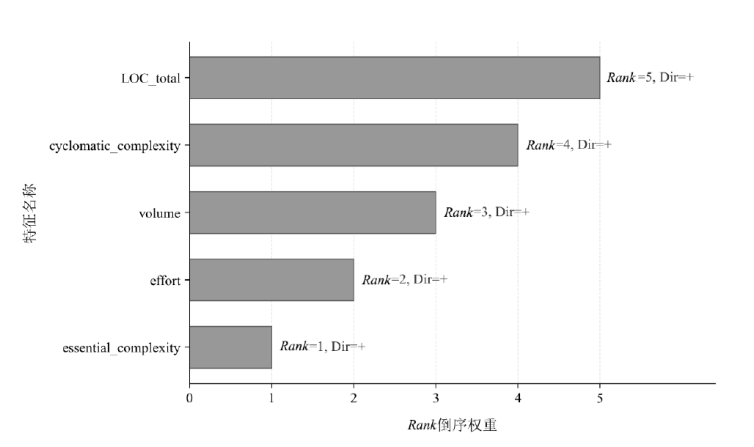
| 特征类别 | 特征名称 | 排序分布情况 | Dir | 说明 |
|---|---|---|---|---|
| LOC counts | LOC_blank | 分散 | (+/?) | 方向不稳定 |
| Misc | parameter_count | 波动大 | (+/?) | 无明确趋势 |
| Misc | percent_comments | 不显著 | (0 / +) | 解释贡献有限 |
| Halstead | level | 分散 | (+/?) | 存在方向冲突 |
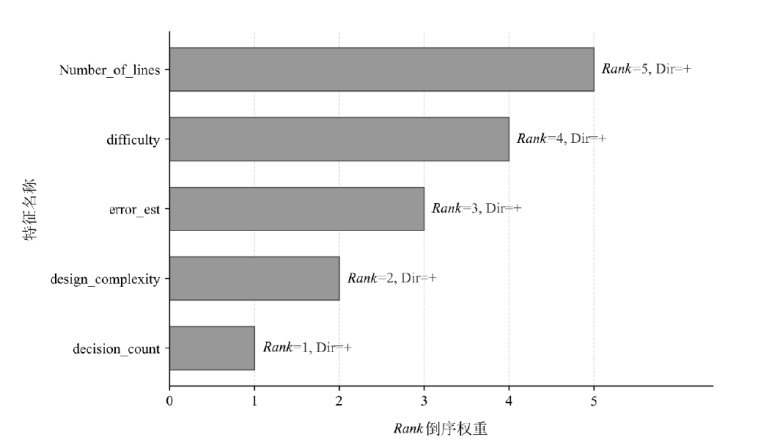
| 特征类别 | 特征名称 | 排序分布情况 | Dir | 说明 |
|---|---|---|---|---|
| LOC counts | LOC_blank | 分散 | (+/?) | 非核心规模指标 |
| Misc | call_pairs | 波动大 | (+/?) | 语义贡献有限 |
| Halstead | level | 不稳定 | (+/?) | 方向冲突 |
| Misc | percent_comments | 不显著 | (0) | 与缺陷关系弱 |
| 数据集 | RF | MSRP-RF | SCSSA-RF | POMRF |
|---|---|---|---|---|
| ProjectK | 0.954 | 0.982 | 0.974 | 0.994 |
| JDT | 0.836 | 0.852 | 0.858 | 0.865 |
| PDE | 0.861 | 0.878 | 0.885 | 0.893 |
| PC1 | 0.901 | 0.915 | 0.921 | 0.929 |
| MC2 | 0.812 | 0.834 | 0.839 | 0.845 |
| apache | 0.742 | 0.752 | 0.756 | 0.761 |
| 平均数 | 0.851 | 0.869 | 0.872 | 0.895 |
| 数据集 | RF | MSRP-RF | SCSSA-RF | POMRF |
|---|---|---|---|---|
| ProjectK | 0.903 | 0.918 | 0.925 | 0.937 |
| JDT | 0.741 | 0.756 | 0.764 | 0.775 |
| PDE | 0.789 | 0.804 | 0.812 | 0.821 |
| PC1 | 0.600 | 0.615 | 0.622 | 0.629 |
| MC2 | 0.702 | 0.721 | 0.728 | 0.736 |
| apache | 0.801 | 0.826 | 0.836 | 0.847 |
| 平均数 | 0.756 | 0.773 | 0.781 | 0.791 |
| 数据集 | RF | MSRP-RF | SCSSA-RF | POMRF |
|---|---|---|---|---|
| ProjectK | 0.866 | 0.905 | 0.929 | 0.996 |
| JDT | 0.715 | 0.781 | 0.811 | 0.842 |
| PDE | 0.590 | 0.742 | 0.793 | 0.820 |
| PC1 | 0.701 | 0.770 | 0.801 | 0.882 |
| MC2 | 0.680 | 0.791 | 0.815 | 0.837 |
| apache | 0.653 | 0.742 | 0.774 | 0.730 |
| 平均数 | 0.701 | 0.789 | 0.820 | 0.851 |
| 模型 | 平均树深度 | 规则特征数量 |
|---|---|---|
| RF | 18.62 | 8.94 |
| MSRP-RF | 15.46 | 7.41 |
| SCSSA-RF | 17.83 | 8.62 |
| POMRF | 15.00 | 7.15 |
| [1] | Khadijah,Sasongko P S. The comparison of imbalanced data handling method in software defect prediction[J]. Kinetik: Game Technology, Information System, Computer Network, Computing, Electronics, and Control, 2020, 5(3): 203-210. |
| [2] | Zain Z M, Sakri S, Ismail N H A, et al.Software defect prediction harnessing on multi 1-dimensional convolutional neural network structure[J]. Computers, Materials & Continua, 2021, 71(1): 1521-1546. |
| [3] | Zhu Kun, Ying Shi, Zhang Nana, et al.Software defect prediction based on enhanced metaheuristic feature selection optimization and a hybrid deep neural network[J]. Journal of Systems and Software, 2021, 180: 111026. |
| [4] | Alazba A, Aljamaan H.Software defect prediction using stacking generalization of optimized tree-based ensembles[J]. Applied Sciences, 2022, 12(9): 4577. |
| [5] | Khan F, Kanwal S, Alamri S, et al.Hyper-parameter optimization of classifiers using an artificial immune network and its application to software bug prediction[J]. IEEE Access, 2020, 8: 20954-20964. |
| [6] | Thomas N S, Kaliraj S.An improved and optimized random forest based approach to predict software faults[J]. SN Computer Science, 2024, 5: 530. |
| [7] | Ho T K. Random decision forests[C]//The 3rd International Conference on Document Analysis and Recognition. New York:IEEE, 1995: 278-282. |
| [8] | Breiman L.Bagging predictors[J]. Machine Learning, 1996, 24: 123-140. |
| [9] | Ho T K. The random subspace method for constructing decision forests[J]. IEEE Transactions on Pattern Analysis and Machine Intelligence, 1998, 20(8): 832-844. |
| [10] | Usman-hamza F E, Balogun A O, Mamman H, et al.Empirical analysis of data sampling-based decision forest classifiers for software defect prediction[J]. Software, 2025, 4(2): 7. |
| [11] | 孔祥维, 唐鑫泽, 王子明.人工智能决策可解释性的研究综述[J]. 系统工程理论与实践, 2021, 41(2): 524-536. |
| [12] | Wyatt J C, Altman D G.Commentary: prognostic models: clinically useful or quickly forgotten?[J]. BMJ, 1995, 311: 1539. |
| [13] | Heinze G, Wallisch C, Dunkler D.Variable selection-a review and recommendations for the practicing statistician[J]. Biometrical Journal, 2018, 60(3): 431-449. |
| [14] | Banerjee M, Ding Y, Noone A M.Identifying representative trees from ensembles[J]. Statistics in Medicine, 2012, 31(15): 1601-1616. |
| [15] | Laabs B H, Westenberger A, Konig I R.Identification of representative trees in random forests based on a new tree-based distance measure[J]. Advances in Data Analysis and Classification, 2024, 18: 363-380. |
| [16] | Ghosh D, Cabrera J.Enriched random forest for high dimensional genomic data[J]. IEEE/ACM Transactions on Computational Biology and Bioinformatics, 2022, 19(5): 2817-2828. |
| [17] | Mustaqeem M, Mustajab S, Alam M.Enhancing software defect prediction through root cause analysis: a hybrid approach integrating permutation importance with Xgboost (PERMBoost)[C]//2024 International Conference on Communication, Computer Sciences and Engineering (IC3SE). New York:IEEE, 2024: 1-6. |
| [18] | Verdugo E, Abad A, Hurtado R.A structured approach to software defect classification and explanation: random forest and gradient boosting ensembles with a focus on prediction interpretability[C]//The 10th International Congress on Information and Communication Technology (ICICT 2025). Lecture Notes in Networks and Systems, Heidelberg:Springer, 2025: 409-420. |
| [19] | Kaur M, Gianey H K, Singh D, et al.Multi-objective differential evolution based random forest for e-health applications[J]. Modern Physics Letters B, 2019, 33(5): 1950022. |
| [20] | Asadi S, Roshan S E, Kattan M W.Random forest swarm optimization-based method for heart diseases diagnosis[J]. Journal of Biomedical Informatics, 2021, 115: 103690. |
| [21] | Ma Jie, Hao Zhiyuan, Sun Wenjing.Enhancing sparrow search algorithm via multi-strategies for continuous optimization problems[J]. Information Processing & Management, 2022, 59(2): 102854. |
| [22] | 唐宇, 戴琪, 杨梦圆, 等.膜内麻雀优化极限学习机的SDP算法[J]. 北京航空航天大学学报, 2024, 50(2): 643-654. |
| [23] | 胡金昊.基于随机森林和SVM的SDP方法研究[D]. 杭州:浙江工业大学, 2020. |
| [24] | Alzaqebeh M A, Jawarneh S, Mohammad R M A, et al.Hybrid feature selection method based on particle swarm optimization and adaptive local search method[J]. International Journal of Electrical and Computer Engineering, 2020, 11(3): 2414-2422. |
| [25] | Xue Jiankai, Shen Bo.A novel swarm intelligence optimization approach: sparrow search algorithm[J]. Systems Science & Control Engineering, 2020, 8(1): 22-34. |
| [26] | Altinger H, Siegl S, Dajsuren Y, et al.A novel industry grade dataset for fault prediction based on model-driven developed automotive embedded software[C]//2015 IEEE/ACM 12th Working Conference on Mining Software Repositories. New York:IEEE, 2015: 494-497. |
| [27] | D'ambros M, Lanza M, Robbes R.An extensive comparison of bug prediction approaches[C]//2010 7th IEEE Working Conference on Mining Software Repositories. New York:IEEE, 2010: 31-41. |
| [28] | Jureczko M, Madeyski L.Towards identifying software project clusters with regard to defect prediction[C]//The 6th International Conference on Predictive Models in Software Engineering. New York:ACM, 2010: 1-10. |
| [29] | Sayyad Shirabad J, Menzies T.The PROMISE repository of software engineering databases[EB/OL]. [2026-02-13]. http://promise.site.uottawa.ca/SERepository. |
| [30] | Wu Rongxin, Zhang Hongyu, Kim S, et al.Relink: recovering links between bugs and changes[C]//The 19th ACM SIGSOFT Symposium and the 13th European Software Engineering Conference. New York:ACM, 2011: 15-25. |
| [31] | Cao Jingjing, Li Wenfeng, Ma Congcong, et al.Optimizing multi-sensor deployment via ensemble pruning for wearable activity recognition[J]. Information Fusion, 2018, 41: 68-79. |
| [32] | Sagi O, Rokach L.Approximating XGBoost with an interpretable decision tree[J]. Information Sciences, 2021, 572: 522-542. |
| [33] | Lipton Z C. The mythos of model interpretability[J]. Communications of the ACM, 2018, 61(10): 36-43. |
| [1] | ZHANG Zhiqiang, BAO Yadong. Anomaly Traffic Detection Algorithm Integrating RF and CNN [J]. Netinfo Security, 2024, 24(11): 1655-1664. |
| [2] | LYU Guohua, HU Xuexian, YANG Ming, XU Min. Ship AIS Trajectory Classification Algorithm Based on Federated Random Forest [J]. Netinfo Security, 2022, 22(4): 67-76. |
| [3] | CAI Manchun, WANG Tengfei, YUE Ting, LU Tianliang. ARF-based Tor Website Fingerprint Recognition Technology [J]. Netinfo Security, 2021, 21(4): 39-48. |
| [4] | XU Guotian. Android Malicious Process Identification Method Based on Abnormal Encrypted Traffic Annotation [J]. Netinfo Security, 2020, 20(7): 30-41. |
| [5] | Xin SONG, Kai ZHAO, Linlin ZHANG, Wenbo FANG. Research on Android Malware Detection Based on Random Forest [J]. Netinfo Security, 2019, 19(9): 1-5. |
| [6] | Zewen MA, Yang LIU, Hongping XU, Hang YI. DoS Traffic Identification Technology Based on Integrated Learning [J]. Netinfo Security, 2019, 19(9): 115-119. |
| [7] | Yongcheng DUAN, Yuqing WANG, Xin LI, Le YANG. RSAR-based Random Forest Network Security Situation Factor Extraction [J]. Netinfo Security, 2019, 19(7): 75-81. |
| [8] | ZHAI Jiqiang, XIAO Yajun, YANG Hailu, WANG Jian. Reseach on U2R Attacks Detection Based on Improved Artificial Bee Colony Combined with Optimized Random Forest [J]. 信息网络安全, 2018, 18(12): 38-45. |
| [9] | WU Jian, SHA Jing. The Method of Classifying Network Public Opinion Text Based on Random Forest Algorithm [J]. Netinfo Security, 2014, 14(11): 36-40. |
| Viewed | ||||||
|
Full text |
|
|||||
|
Abstract |
|
|||||