Netinfo Security ›› 2025, Vol. 25 ›› Issue (4): 550-563.doi: 10.3969/j.issn.1671-1122.2025.04.004
Previous Articles Next Articles
A Data Augmentation Method Based on Graph Node Centrality and Large Model for Vulnerability Detection
ZHANG Xuewang1( ), LU Hui1, XIE Haofei2
- 1. College of Software Engineering, Chongqing University of Posts and Telecommunications, Chongqing 400065, China
2. College of Automation, Chongqing University of Posts and Telecommunications, Chongqing 400065, China
-
Received:2025-02-28Online:2025-04-10Published:2025-04-25

CLC Number:
Cite this article
ZHANG Xuewang, LU Hui, XIE Haofei. A Data Augmentation Method Based on Graph Node Centrality and Large Model for Vulnerability Detection[J]. Netinfo Security, 2025, 25(4): 550-563.
share this article
Add to citation manager EndNote|Ris|BibTeX
URL: http://netinfo-security.org/EN/10.3969/j.issn.1671-1122.2025.04.004

| 数据集 | 样本总数/个 | 漏洞样本数/个 | 非漏洞样本数/个 | 比例 |
|---|---|---|---|---|
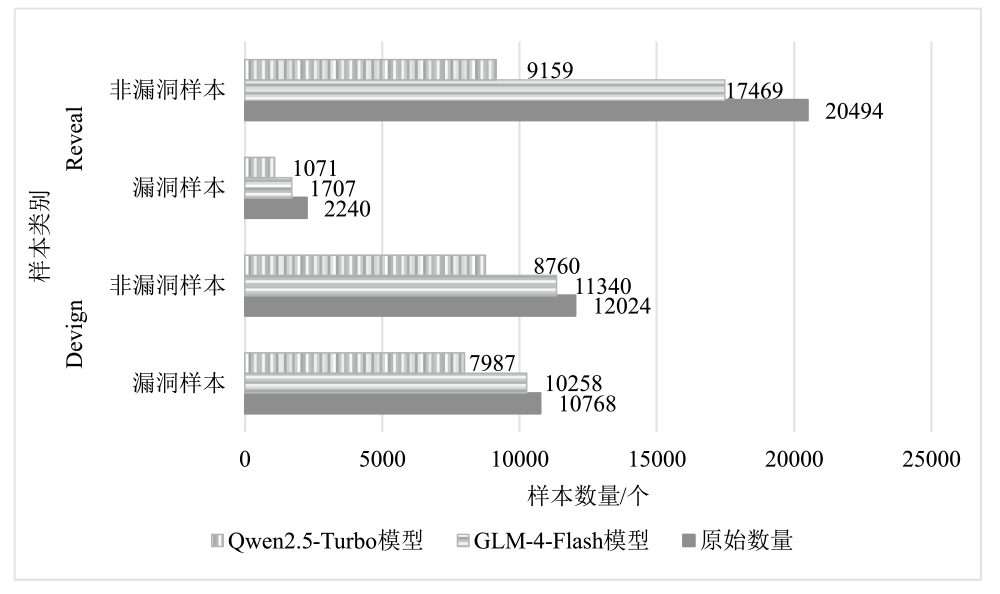
| Devign | 22792 | 10768 | 12024 | 1:1.1 |
| Reveal | 22734 | 2240 | 20494 | 1:9.1 |
| 实际标签 | 预测结果 | |
|---|---|---|
| 1 | 0 | |
| 1 | TP | FN |
| 0 | FP | TN |
| 检测 模型 | 增强 方式 | 大模型 | FPR | FNR | A | P | R | F1 |
|---|---|---|---|---|---|---|---|---|
| Devign | — | — | 48.95% | 45.19% | 51.39% | 10.21% | 54.81% | 17.22% |
| OSS | — | 46.92% | 42.49% | 53.09% | 10.31% | 53.11% | 17.27% | |
| SMOTE | — | 48.89% | 43.25% | 51.63% | 10.55% | 56.75% | 17.79% | |
| VGX | VGX | 63.15% | 30.75% | 39.84% | 10.02% | 69.25% | 17.51% | |
| VulScribeR | ChatGPT3.5 | 56.59% | 39.91% | 44.95% | 9.74% | 60.09% | 16.76% | |
| CodeQwen1.5 | 60.15% | 37.73% | 41.92% | 9.51% | 62.27% | 16.51% | ||
| 本文方法 | GLM-4 | 36.45% | 44.19% | 63.84% | 13.46% | 55.81% | 21.69% | |
| Qwen2.5 | 41.55% | 42.14% | 58.40% | 12.39% | 57.86% | 20.41% | ||
| Reveal | — | — | 33.72% | 65.96% | 63.31% | 9.30% | 34.04% | 14.61% |
| VGX | VGX | 58.82% | 43.13% | 42.63% | 8.94% | 56.87% | 15.46% | |
| VulScribeR | ChatGPT3.5 | 54.81% | 51.00% | 45.55% | 8.33% | 49.00% | 14.23% | |
| CodeQwen1.5 | 58.62% | 47.89% | 42.37% | 8.28% | 52.11% | 14.29% | ||
| 本文方法 | GLM-4 | 38.70% | 56.87% | 59.63% | 10.17% | 43.13% | 16.46% | |
| Qwen2.5 | 43.57% | 57.28% | 55.16% | 9.06% | 42.72% | 14.95% |
| 检测 模型 | 增强 方式 | 大模型 | FPR | FNR | A | P | R | F1 |
|---|---|---|---|---|---|---|---|---|
| Devign | — | — | 2.54% | 97.63% | 52.45% | 52.27% | 3.06% | 5.78% |
| OSS | — | 1.97% | 96.94% | 52.42% | 52.30% | 2.37% | 4.53% | |
| SMOTE | — | 6.36% | 91.76% | 52.92% | 54.14% | 8.24% | 14.30% | |
| VGX | VGX | 27.42% | 72.04% | 51.30% | 48.16% | 27.96% | 35.38% | |
| VulScribeR | ChatGPT3.5 | 26.79% | 73.56% | 50.91% | 47.35% | 26.44% | 33.93% | |
| CodeQwen1.5 | 19.62% | 80.26% | 51.47% | 47.83% | 19.74% | 27.95% | ||
| 本文 方法 | GLM-4 | 34.27% | 62.69% | 52.18% | 49.80% | 37.31% | 42.66% | |
| Qwen2.5 | 18.28% | 80.29% | 52.16% | 49.56% | 19.71% | 28.20% | ||
| Reveal | — | — | 14.35% | 84.57% | 52.17% | 49.48% | 15.43% | 23.53% |
| VGX | VGX | 51.45% | 48.72% | 49.85% | 47.59% | 51.28% | 49.37% | |
| VulScribeR | ChatGPT3.5 | 47.81% | 52.76% | 49.83% | 47.37% | 47.24% | 47.30% | |
| CodeQwen1.5 | 49.10% | 50.50% | 50.23% | 47.88% | 49.50% | 48.67% | ||
| 本文 方法 | GLM-4 | 59.55% | 35.58% | 51.88% | 49.64% | 64.42% | 56.07% | |
| Qwen2.5 | 55.43% | 41.35% | 51.28% | 49.08% | 58.65% | 53.44% |
| [1] | CHEN Yufei, SHEN Chao, WANG Qian, et al. Security and Privacy Risks in Artificial Intelligence Systems[J]. Journal of Computer Research and Development, 2019, 56(10): 2135-2150. |
| 陈宇飞, 沈超, 王骞, 等. 人工智能系统安全与隐私风险[J]. 计算机研究与发展, 2019, 56(10): 2135-2150. | |
| [2] | BLACKDUCK. 2024 Open Source Security and Risk Analysis Report[EB/OL]. (2024-12-05)[2024-12-28]. https://www.blackduck.com/resources/analyst-reports/open-source-security-risk-analysis.html. |
| [3] | Google. Rough-Auditing-Tool-for-Security[EB/OL]. (2014-01-01)[2024-12-28]. https://code.google.com/archive/p/rough-auditing-tool-for-security/. |
| [4] | CHECKMARX. Checkmarx[EB/OL]. (2024-12-12)[2024-12-28]. https://checkmarx.com/. |
| [5] | DWHEELER. Flawfinder[EB/OL]. (2005-03-01)[2024-12-28]. https://dwheeler.com/flawfinder/. |
| [6] | DUAN Xu, WU Jingzheng, LUO Tianyue, et al. Vulnerability Mining Method Based on Code Property Graph and Attention BiLSTM[J]. Journal of Software, 2020, 31(11): 3404-3420. |
| 段旭, 吴敬征, 罗天悦, 等. 基于代码属性图及注意力双向LSTM的漏洞挖掘方法[J]. 软件学报, 2020, 31(11): 3404-3420. | |
| [7] | WU Yueming, ZOU Deqing, DOU Shihan, et al. VulCNN: An Image-Inspired Scalable Vulnerability Detection System[C]// IEEE. 2022 IEEE/ACM 44th International Conference on Software Engineering (ICSE). New York: IEEE, 2022: 2365-2376. |
| [8] | LI Zhen, ZOU Deqing, XU Shouhuai, et al. VulDeePecker: A Deep Learning-Based System for Vulnerability Detection[EB/OL]. (2018-01-05)[2024-12-28]. https://export.arxiv.org/abs/1801.01681. |
| [9] | ZOU Deqing, WANG Sujuan, XU Shouhuai, et al. μVulDeePecker: A Deep Learning-Based System for Multiclass Vulnerability Detection[J]. IEEE Transactions on Dependable and Secure Computing, 2021, 18(5): 2224-2236. |
| [10] | LI Zhen, ZOU Deqing, XU Shouhuai, et al. SySeVR: A Framework for Using Deep Learning to Detect Software Vulnerabilities[J]. IEEE Transactions on Dependable and Secure Computing, 2022, 19(4): 2244-2258. |
| [11] | ZHOU Yaqin, LIU Shangqing, SIOW J K, et al. Devign: Effective Vulnerability Identification by Learning Comprehensive Program Semantics via Graph Neural Networks[EB/OL]. (2019-12-08)[2024-12-28]. https://www.zhangqiaokeyan.com/academic-conference-foreign_meeting-290335_thesis/0705018328210.html. |
| [12] | CHENG Xiao, WANG Haoyu, HUA Jiayi, et al. DeepWukong[J]. ACM Transactions on Software Engineering and Methodology, 2021, 30(3): 1-33. |
| [13] | CHAKRABORTY S, KRISHNA R, DING Yangruibo, et al. Deep Learning Based Vulnerability Detection: Are We There Yet?[J]. IEEE Transactions on Software Engineering, 2022, 48(9): 3280-3296. |
| [14] | SU Xiaohong, ZHENG Weining, JIANG Yuan, et al. Research and Progress on Learning-Based Source Code Vulnerability Detection[J]. Chinese Journal of Computers, 2024, 47(2): 337-374. |
| 苏小红, 郑伟宁, 蒋远, 等. 基于学习的源代码漏洞检测研究与进展[J]. 计算机学报, 2024, 47(2): 337-374. | |
| [15] | YANG Xu, WANG Shaowei, LI Yi, et al. Does Data Sampling Improve Deep Learning-Based Vulnerability Detection?Yeas! and Nays![C]// IEEE. 2023 IEEE/ACM 45th International Conference on Software Engineering (ICSE). New York: IEEE, 2023: 2287-2298. |
| [16] | LU Guilong, JU Xiaolin, CHEN Xiang, et al. GRACE: Empowering LLM-Based Software Vulnerability Detection with Graph Structure and In-Context Learning[EB/OL]. (2024-03-21)[2024-12-28]. https://doi.org/10.1016/j.jss.2024.112031. |
| [17] | ZHANG Chenyuan, LIU Hao, ZENG Jiutian, et al. Prompt-Enhanced Software Vulnerability Detection Using ChatGPT[C]// IEEE. 2024 IEEE/ACM 46th International Conference on Software Engineering:Companion Proceedings (ICSE-Companion). New York: IEEE, 2024: 276-277. |
| [18] | ZHOU Xin, ZHANG Ting, LO D. Large Language Model for Vulnerability Detection: Emerging Results and Future Directions[C]// ACM. Proceedings of the 2024 ACM/IEEE 44th International Conference on Software Engineering:New Ideas and Emerging Results. New York: ACM, 2024: 47-51. |
| [19] | YAMAGUCHI F, GOLDE N, ARP D, et al. Modeling and Discovering Vulnerabilities with Code Property Graphs[C]// IEEE. 2014 IEEE Symposium on Security and Privacy. New York: IEEE, 2014: 590-604. |
| [20] | LI Yun, HUANG Chenlin, WANG Zhongfeng, et al. Survey of Software Vulnerability Mining Methods Based on Machine Learning[J]. Journal of Software, 2020, 31(7): 2040-2061. |
| 李韵, 黄辰林, 王中锋, 等. 基于机器学习的软件漏洞挖掘方法综述[J]. 软件学报, 2020, 31(7): 2040-2061. | |
| [21] | The MITRE Corporation. CVE[EB/OL]. (2024-08-03)[2024-12-28]. https://cve.mitre.org/. |
| [22] | National Institute of Standards and Technology. NVD[EB/OL]. (2024-08-27)[2024-12-28]. https://nvd.nist.gov/. |
| [23] | China Information Technology Security Evaluation Center. China National Vulnerability Database of Information Security[EB/OL]. (2024-12-24)[2024-12-28]. https://www.cnnvd.org.cn. |
| 中国信息安全测评中心. 国家信息安全漏洞库[EB/OL]. (2024-12-24)[2024-12-28]. https://www.cnnvd.org.cn. | |
| [24] | GITHUB. GitHub[EB/OL]. (2024-12-28)[2024-12-28]. https://github.com/. |
| [25] | National Institute of Standards and Technology. NIST Software Assurance Reference Dataset[EB/OL]. (2024-12-28)[2024-12-28]. https://samate.nist.gov/SARD. |
| [26] | KUBÁT M, MATWIN S. Addressing the Curse of Imbalanced Training Sets: One-Sided Selection[EB/OL]. [2024-12-28]. https://www.researchgate.net/publication/2624358_Addressing_the_Curse_of_Imbalanced_Training_Sets_One-Sided_Selection. |
| [27] | CHAWLA N V, BOWYER K W, HALL L O, et al. SMOTE: Synthetic Minority Over-Sampling Technique[J]. Journal of Artificial Intelligence Research, 2002, 16: 321-357. |
| [28] | GANZ T, IMGRUND E, HÄRTERICH M, et al. CodeGraphSMOTE-Data Augmentation for Vulnerability Discovery[C]// Springer. IFIP Annual Conference on Data and Applications Security and Privacy. Heidelberg: Springer, 2023: 282-301. |
| [29] | NONG Yu, OU Yuzhe, PRADEL M, et al. VULGEN: Realistic Vulnerability Generation via Pattern Mining and Deep Learning[C]// IEEE. 2023 IEEE/ACM 45th International Conference on Software Engineering (ICSE). New York: IEEE, 2023: 2527-2539. |
| [30] | NONG Yu, FANG R, YI Guangbei, et al. VGX: Large-Scale Sample Generation for Boosting Learning-Based Software Vulnerability Analyses[C]// ACM. Proceedings of the IEEE/ACM 46th International Conference on Software Engineering. New York: ACM, 2024: 1-13. |
| [31] | DANESHVAR S S, NONG Yu, YANG Xu, et al. Exploring RAG-Based Vulnerability Augmentation with LLMS[EB/OL]. (2024-12-05)[2024-12-28]. https://arxiv.org/abs/2408.04125. |
| [32] | JOERN. Joern[EB/OL]. (2024-12-28)[2024-12-28]. https://joern.io/. |
| [33] | FREEMAN L C. Centrality in Social Networks Conceptual Clarification[J]. Social Networks, 1979, 1(3): 215-239. |
| [34] | BRANDES U. A Faster Algorithm for Betweenness Centrality[J]. The Journal of Mathematical Sociology, 2001, 25(2): 163-177. |
| [35] | KATZ L. A New Status Index Derived from Sociometric Analysis[J]. Psychometrika, 1953, 18(1): 39-43. |
| [36] | YU Shiwen, WANG Ting, WANG Ji. Data Augmentation by Program Transformation[EB/OL]. (2022-03-26)[2024-12-28]. https://doi.org/10.1016/j.jss.2022.111304. |
| [37] | MIKOLOV T, CHEN Kai, CORRADO G, et al. Efficient Estimation of Word Representations in Vector Space[EB/OL]. (2013-09-07)[2024-12-28]. https://arxiv.org/abs/1301.3781v3. |
| [38] | THUDM. GLM-4[EB/OL]. (2024-12-28)[2024-12-28]. https://github.com/THUDM/GLM-4. |
| [39] | QwenLM. Qwen2.5[EB/OL]. (2024-12-24)[2024-12-28]. https://github.com/QwenLM/Qwen2.5. |
| [40] | FAN Jiahao, LI Yi, WANG Shaohua, et al. A C/C++ Code Vulnerability Dataset with Code Changes and CVE Summaries[C]// IEEE. 2020 IEEE/ACM 17th International Conference on Mining Software Repositories (MSR). New York: IEEE, 2020: 508-512. |
| Viewed | ||||||
|
Full text |
|
|||||
|
Abstract |
|
|||||