Netinfo Security ›› 2025, Vol. 25 ›› Issue (4): 664-673.doi: 10.3969/j.issn.1671-1122.2025.04.014
Previous Articles Next Articles
Smart Contract Vulnerability Detection Method Combining Prompt Tuning
ZHANG Yuxuan1, HUANG Cheng1, LIU Rong1, LENG Tao2( )
)
- 1. School of Cyber Science and Engineering, Sichuan University, Chengdu 610207, China
2. Intelligent Policing Key Laboratory of Sichuan Province, Sichuan Police College, Luzhou 646000, China
-
Received:2025-01-15Online:2025-04-10Published:2025-04-25

CLC Number:
Cite this article
ZHANG Yuxuan, HUANG Cheng, LIU Rong, LENG Tao. Smart Contract Vulnerability Detection Method Combining Prompt Tuning[J]. Netinfo Security, 2025, 25(4): 664-673.
share this article
Add to citation manager EndNote|Ris|BibTeX
URL: http://netinfo-security.org/EN/10.3969/j.issn.1671-1122.2025.04.014
| 类型 | 样例 |
|---|---|
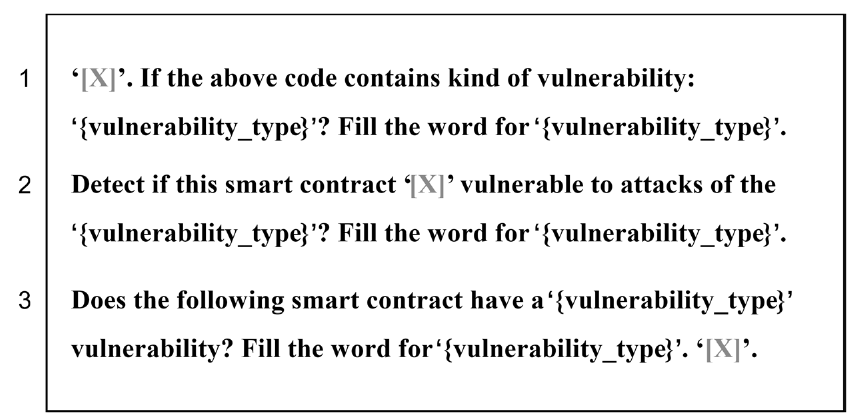
| 直接提问 (1-a) | “[X]”. Does this smart contract have bugs of the ‘{vulnerability_type}’? Fill the word for ‘{vulnerability_type}’. |
| 直接提问 (1-b) | Detect if this smart contract “[X]” vulnerable to attacks of the ‘{vulnerability_type}’? Fill the word for ‘{vulnerability_type}’. |
| 直接提问 (1-c) | Does the following smart contract have a ‘{vulnerability_type}’ vulnerability? Fill the word for ‘{vulnerability_type}’.“[X]”. |
| 漏洞样例参考 (2-a) | This is an example of Solidity code with [VT] vulnerability:“[VE]”. Detect if this code “[X]” has [VT] vulnerability. |
| 漏洞原理描述 (3-a) | This is the cause of the [VT] vulnerability:“[VC]”. Based on the knowledge above detect if this code “[X]” has [VT] vulnerability. |
| 综合原理与样例 (4-a) | This is an example of Solidity code with [VT] vulnerability:“[VE]”. This is the cause of the [VT] vulnerability:“[VC]”. Based on the knowledge above detect if this code “[X]” has [VT] vulnerability. |
| 数据集 | 描述 |
|---|---|
| 数据集Ⅰ[ | 1000余条合约,涉及4种类型的漏洞 |
| 数据集Ⅱ[ | 12000余条合约,涉及8种类型的漏洞 |
| 数据集Ⅲ[ | 100余条合约,涉及9种类型的漏洞 |
| 数据集Ⅳ[ | 9369条数据,涉及7种不同的漏洞类型 |
| 数据集Ⅴ[ | 可重入漏洞和正常合约共计473条的合约地址 |
| 数据集Ⅵ[ | 22634条正常合约在内的29种类型的合约地址 |
| 数据集Ⅶ[ | 1381条正常合约在内的21种类型的合约地址 |
| 数据集Ⅷ[ | 444条4种漏洞类型的合约地址 |
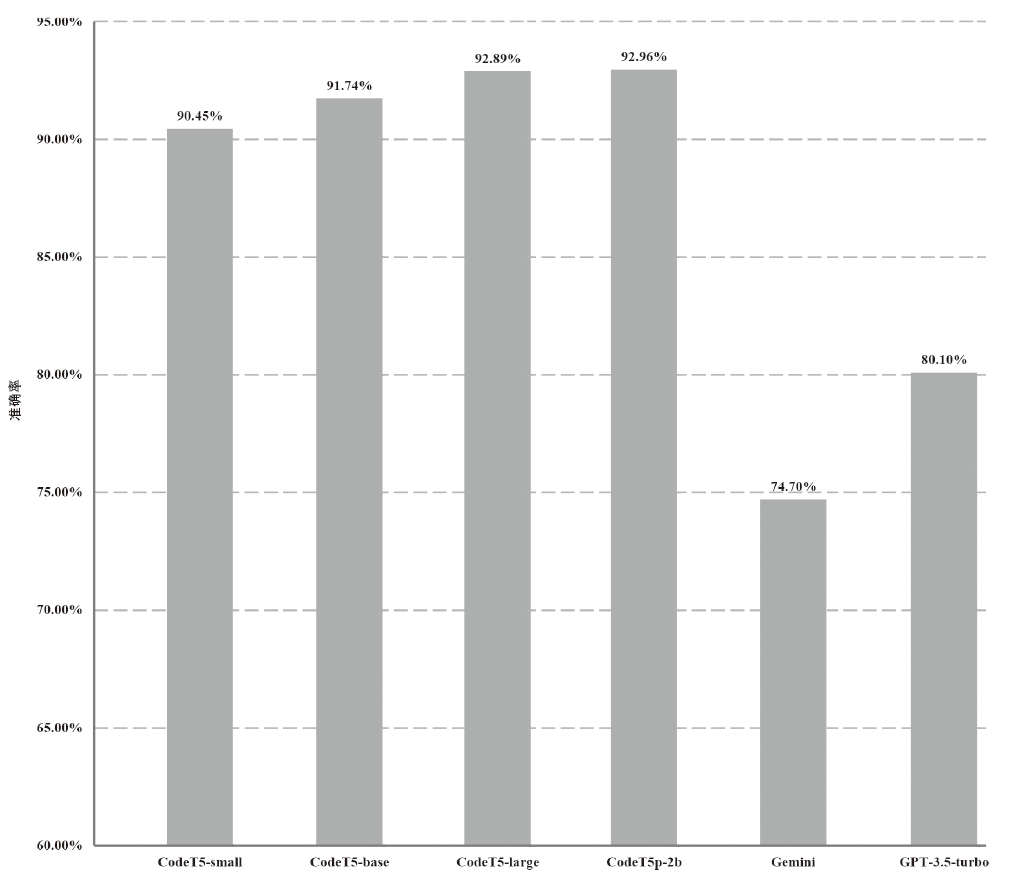
| 方法 | 准确率 | |
|---|---|---|
| CodeT5-small | 微调 | 87.82% |
| 提示词微调 | 90.45% | |
| CodeT5-base | 微调 | 88.34% |
| 提示词微调 | 91.74% | |
| CodeT5-large | 微调 | 88.96% |
| 提示词微调 | 91.89% | |
| 提示词 | 可重入漏洞 | 整数溢出漏洞 | ||||||
|---|---|---|---|---|---|---|---|---|
| 准确率 | 召回率 | 精确率 | F1值 | 准确率 | 召回率 | 精确率 | F1值 | |
| (1-a) | 91.53% | 93.34% | 90.03% | 91.67% | 92.33% | 91.07% | 92.75% | 91.90% |
| (1-b) | 91.63% | 92.42% | 90.50% | 91.44% | 92.42% | 91.62% | 91.68% | 91.65% |
| (1-c) | 90.40% | 86.62% | 93.64% | 89.96% | 91.27% | 92.06% | 89.97% | 91.00% |
| (2-a) | 93.33% | 92.79% | 92.87% | 92.83% | 92.55% | 94.39% | 93.22% | 93.80% |
| (3-a) | 92.83% | 90.11% | 91.75% | 90.91% | 92.70% | 93.60% | 92.98% | 93.29% |
| (4-a) | 94.29% | 96.09% | 93.20% | 94.62% | 93.67% | 95.37% | 93.10% | 94.22% |
| 提示词 | 时间操纵漏洞 | 委托调用漏洞 | ||||||
| 准确率 | 召回率 | 精确率 | F1值 | 准确率 | 召回率 | 精确率 | F1值 | |
| (1-a) | 90.88% | 87.39% | 90.11% | 88.73% | 89.71% | 82.06% | 90.21% | 85.94% |
| (1-b) | 91.12% | 88.09% | 91.69% | 88.58% | 89.73% | 83.22% | 89.98% | 86.47% |
| (1-c) | 90.62% | 87.15% | 88.34% | 87.74% | 88.92% | 82.00% | 86.62% | 84.25% |
| (2-a) | 93.87% | 91.42% | 94.21% | 92.79% | 90.44% | 85.44% | 91.33% | 88.29% |
| (3-a) | 94.65% | 92.71% | 92.98% | 92.84% | 90.02% | 85.49% | 90.42% | 87.89% |
| (4-a) | 94.55% | 92.92% | 94.43% | 93.67% | 91.98% | 86.62% | 91.88% | 89.17% |
| 方法 | 性能 | |||
|---|---|---|---|---|
| 准确率 | 召回率 | 精确率 | F1值 | |
| Slither | 68.50% | 63.31% | 70.26% | 66.60% |
| Mythril | 65.24% | 60.26% | 55.55% | 57.81% |
| Securify | 70.78% | 71.06% | 67.31% | 69.13% |
| Oyente | 64.96% | 56.51% | 51.61% | 53.95% |
| sFuzz | 48.94% | 28.18% | 29.33% | 28.74% |
| PC-Detector | 91.74% | 92.64% | 90.95% | 91.79% |
| 方法 | 性能 | |||
|---|---|---|---|---|
| 准确率 | 召回率 | 精确率 | F1值 | |
| DLVA[ | 89.78% | 90.33% | 87.74% | 89.02% |
| Cross Modality Bug Detection[ | 85.13% | 80.52% | 82.82% | 81.65% |
| GraphDeeSmartContract[ | 68.82% | 68.80% | 69.29% | 69.04% |
| AMEVulDetector[ | 86.91% | 85.03% | 81.67% | 83.32% |
| SmartEmbed[ | 76.45% | 75.09% | 71.36% | 73.18% |
| ReChecker[ | 68.11% | 65.45% | 69.14% | 67.24% |
| PC-Detector | 91.74% | 92.64% | 90.95% | 91.79% |
| [1] | WOOD G. Ethereum: A Secure Decentralized Generalized Transaction Ledger[J]. Ethereum Project Yellow Paper, 2014, 151: 1-32. |
| [2] | BUTERIN V. A Next-Generation Smart Contract and Decentralized Application Platform[EB/OL]. (2022-05-19)[2025-01-02]. https://github.com/ethereum/wiki/wiki/White-Paper. |
| [3] | MENG Bo, LIU Jiabing, LIU Qin, et al. Survey of Smart Contract Security[J]. Chinese Journal of Network and Information Security, 2020, 6(3): 1-13. |
| 孟博, 刘加兵, 刘琴, 等. 智能合约安全综述[J]. 网络与信息安全学报, 2020, 6(3): 1-13. | |
| [4] | DHILLON V, METCALF D, HOOPER M. The DAO Hacked[J]. Blockchain Enabled Applications, 2021: 113-128. |
| [5] | KUSHWAHA S S, JOSHI S, SINGH D, et al. Ethereum Smart Contract Analysis Tools: A Systematic Review[J]. IEEE Access, 2022, 10: 57037-57062. |
| [6] | CONSENSYS. Mythril[EB/OL]. (2024-03-28)[2025-01-02]. https://github.com/ConsenSys/mythril. |
| [7] | TSANKOV P, DAN A, DRACHLERCOHEN D, et al. Securify: Practical Security Analysis of Smart Contracts[C]// ACM. 2018 ACM SIGSAC Conference on Computer and Communications Security. New York: ACM, 2018: 67-82. |
| [8] | BADRUDDOJA S, DANTU R, HE Yanyan, et al. Making Smart Contracts Smarter[C]// IEEE. Proceedings of the 2021 IEEE International Conference on Blockchain and Cryptocurrency. New York: IEEE, 2021: 1-3. |
| [9] | LIU Daifu. Research on Vulnerability Detection Methods for Ethereum Smart Contracts[D]. Nanjing: Southeast University, 2022. |
| 刘代富. 以太坊智能合约漏洞检测方法研究[D]. 南京: 东南大学, 2022. | |
| [10] | COLIN L S H, MOHAN P M, PAN J, et al. An Integrated Smart Contract Vulnerability Detection Tool Using Multi-Layer Perceptron on Real-Time Solidity Smart Contracts[J]. IEEE Access, 2024, 12: 23549-23567. |
| [11] | MIKOLOV T, CHEN Kai, CORRADO G, et al. Efficient Estimation of Word Representations in Vector Space[EB/OL]. (2013-09-07)[2025-01-02]. https://arxiv.org/abs/1301.3781. |
| [12] | ZHANG Xiaosong, NIU Weina, HUANG Shiping, et al. A Survey of Smart Contract Vulnerability Detection Methods Based on Deep Learning[J]. Journal of Sichuan University (Natural Science Edition), 2023, 60(2): 7-18. |
| 张小松, 牛伟纳, 黄世平, 等. 基于深度学习的智能合约漏洞检测方法综述[J]. 四川大学学报(自然科学版), 2023, 60(2): 7-18. | |
| [13] | JIE Wanqing, CHEN Qi, WANG Jiaqi, et al. A Novel Extended Multimodal AI Framework Towards Vulnerability Detection in Smart Contracts[EB/OL]. (2023-03-23)[2025-01-02]. https://doi.org/10.1016/j.ins.2023.03.132. |
| [14] | LE T T H, KIM J, LEE S, et al. Robust Vulnerability Detection in Solidity-Based Ethereum Smart Contracts Using Fine-Tuned Transformer Encoder Models[J]. IEEE Access, 2024, 12: 154700-154717. |
| [15] | HE Fei, LI Fei, LIANG Peili. Enhancing Smart Contract Security: Leveraging Pre-Trained Language Models for Advanced Vulnerability Detection[J]. IET Blockcahin, 2024, 4(1): 543-554. |
| [16] | DUY P T, KHOA N H, QUYEN N H, et al. Vulnsense: Efficient Vulnerability Detection in Ethereum Smart Contracts by Multimodal Learning with Graph Neural Network and Language Model[EB/OL]. (2023-09-05)[2025-01-02]. https://arxiv.org/abs/2309.08474v1. |
| [17] | JAIN V K, TRIPATHI M. An Integrated Deep Learning Model for Ethereum Smart Contract Vulnerability Detection[J]. International Journal of Information Security, 2024, 23(1): 557-575. |
| [18] | ADBELAZIZ T, HOBOR A. Smart Learning to Find Dumb Contracts[C]// USENIX. Proceedings of the 32nd USENIX Security Symposium (USENIX Security 23). Berkeley: USENIX, 2023: 1775-1792. |
| [19] | NGUYEN H H, NGUYEN N M, XIE Chunyao, et al. MANDO-HGT: Heterogeneous Graph Transformers for Smart Contract Vulnerability Detection[C]// IEEE. Proceedings of the 2023 IEEE/ACM 20th International Conference on Mining Software Repositories. New York: IEEE, 2023: 334-346. |
| [20] | CAI Jie, LI Bin, ZHANG Tao, et al. Fine-Grained Smart Contract Vulnerability Detection by Heterogeneous Code Feature Learning and Automated Dataset Construction[EB/OL]. (2023-12-14)[2025-01-02]. https://doi.org/10.1016/j.jss.2023.111919. |
| [21] | LUO Feng, LUO Ruijie, CHEN Ting, et al. SCVHunter: Smart Contract Vulnerability Detection Based on Heterogeneous Graph Attention Network[C]// IEEE. Proceedings of the IEEE/ACM 46th International Conference on Software Engineering. New York: IEEE, 2024: 2098-2110. |
| [22] | QIAN Peng, LIU Zhenguang, YIN Yifang, et al. Cross-Modality Mutual Learning for Enhancing Smart Contract Vulnerability Detection on Bytecode[C]// ACM. Proceedings of the ACM Web Conference. New York: ACM, 2023: 2220-2229. |
| [23] | ZHANG Ningyu, LI Luoqiu, CHEN Xiang, et al. Differentiable Prompt Makes Pre-Trained Language Models Better Few-Shot Learners[EB/OL]. (2022-05-04)[2025-01-02]. https://arxiv.org/abs/2108.13161v7. |
| [24] | LESTER B, ALRFOU R, CONSTANT N. The Power of Scale for Parameter-Efficient Prompt Tuning[C]// ACL. 2021 Conference on Empirical Methods in Natural Language Processing. Stroudsburg: ACL, 2021: 3045-3059. |
| [25] | LI L, LIANG P. Prefix-Tuning: Optimizing Continuous Prompts for Generation[C]// ACL. Proceedings of the 59th Annual Meeting of the Association for Computational Linguistics and the 11th International Joint Conference on Natural Language Processing. Stroudsburg: ACL, 2021: 4582-4597. |
| [26] | WANG Chaozheng, YANG Yuanhang, GAO Cuiyun, et al. Prompt Tuning in Code Intelligence: An Experimental Evaluation[J]. IEEE Transactions on Software Engineering, 2023, 49(11): 4869-4885. |
| [27] | CHEN Yizheng, DING Zhoujie, ALOWAIN L, et al. DiverseVul: A New Vulnerable Source Code Dataset for Deep Learning Based Vulnerability Detection[C]// ACM. 26th International Symposium on Research in Attacks, Intrusions and Defenses. New York: ACM, 2023: 654-668. |
| [28] | THAPA C, JANG S I, AHMED M E, et al. Transformer-Based Language Models for Software Vulnerability Detection[C]// ACM. Proceedings of the 38th Annual Computer Security Applications Conference. New York: ACM, 2022: 481-496. |
| [29] | BROWN T B, MANN B, RYDER N, et al. Language Models are Few-shot Learners[C]// NIPS. 34th International Conference on Neural Information Processing Systems. New York: CAI, 2020: 1877-1901. |
| [30] | PyTorch. PyTorch[EB/OL]. (2024-11-18)[2025-01-02]. https://pytorch.org. |
| [31] | HUGGING F. Hugging Face[EB/OL]. (2024-11-18)[2025-01-02]. https://huggingface.co. |
| [32] | LIU Zhenguang, QIAN Peng, YANG Jiaxu, et al. Rethinking Smart Contract Fuzzing: Fuzzing With Invocation Ordering and Important Branch Revisiting[J]. IEEE Transactions on Information Forensics and Security, 2023, 18: 1237-1251. |
| [33] | SMARTBUGS. SB Curated: A Curated Dataset of Vulnerable Solidity Smart Contracts[EB/OL]. (2024-06-17)[2025-01-02]. https://github.com/smartbugs/smartbugs-curated. |
| [34] | GHALEB A, PATTABIRAMAN K. How Effective are Smart Contract Analysis Tools? Evaluating Smart Contract Static Analysis Tools Using Bug Injection[C]// ACM. Proceedings of the 29th ACM SIGSOFT International Symposium on Software Testing and Analysis. New York: ACM, 2020: 415-427. |
| [35] | ADBELAZIZ T, HOBOR A. Reentrancy Benchmark[EB/OL]. (2023-02-01)[2025-01-02]. https://bit.ly/Reentrancy_benchmark. |
| [36] | ADBELAZIZ T, HOBOR A. EthereumSClarge[EB/OL]. (2023-02-01)[2025-01-02]. https://bit.ly/EthereumSC_Dataset_Large. |
| [37] | ADBELAZIZ T, HOBOR A. EthereumSCsmall[EB/OL]. (2023-02-01)[2025-01-02]. https://bit.ly/EthereumSC_Dataset_Small. |
| [38] | ADBELAZIZ T, HOBOR A. SolidiFI Benchmark[EB/OL]. (2023-02-01)[2025-01-02]. https://bit.ly/SolidiFI_benchmark. |
| [39] | GEMINI T, ROHAN A, SEBASTIAN B, et al. Gemini: A Family of Highly Capable Multimodal Models[EB/OL]. (2024-06-17)[2025-01-02]. https://arxiv.org/abs/2312.11805v4. |
| [40] | NGUYEN T D, PHAM L H, SUN Jun, et al. sFuzz: An Efficient Adaptive Fuzzer for Solidity Smart Contracts[C]// ACM. Proceedings of the ACM/IEEE 42nd International Conference on Software Engineering. New York: ACM, 2020: 778-788. |
| [41] | ZHUANG Yuan, LIU Zhenguang, QIAN Peng, et al. Smart Contract Vulnerability Detection Using Graph Neural Networks[C]// IJCAI. Proceedings of the Twenty-Ninth International Conference on International Joint Conferences on Artificial Intelligence. San Francisco: Morgan Kaufmann, 2021: 3283-3290. |
| [42] | LIU Zhenguang, QIAN Peng, WANG Xiang, et al. Smart Contract Vulnerability Detection: From Pure Neural Network to Interpretable Graph Feature and Expert Pattern Fusion[EB/OL]. (2021-06-17)[2025-01-02]. https://arxiv.org/abs/2106.09282. |
| [43] | GAO Zhipeng, JIANG Lingxiao, XIA Xin, et al. Checking Smart Contracts with Structural Code Embedding[J]. IEEE Transactions on Software Engineering, 2021, 47(12): 2874-2891. |
| [44] | QIAN Peng, LIU Zhenguang, HE Qingming, et al. Towards Automated Reentrancy Detection for Smart Contracts Based on Sequential Models[J]. IEEE Access, 2020, 8: 19685-19695. |
| [1] | ZHANG Xuewang, LU Hui, XIE Haofei. A Data Augmentation Method Based on Graph Node Centrality and Large Model for Vulnerability Detection [J]. Netinfo Security, 2025, 25(4): 550-563. |
| [2] | YANG Yatao, DING Yucheng, LIU Peihe, SANG Peng. Research on Blockchain-Based Privacy Preservation and Digital Authentication [J]. Netinfo Security, 2025, 25(4): 640-653. |
| [3] | WANG Yong, WU Yifan, WAN Qiancheng. Research on Redactable Blockchain Scheme Based on the Chinese Remainder Theorem [J]. Netinfo Security, 2025, 25(1): 36-47. |
| [4] | YU Lisu, LI Biao, YAO Yuanzhi, WEN Jiajin, LI Zipeng, WANG Zhen. Performance Optimization of Blockchain-Assisted Unmanned Aerial Vehicle Mobile Edge Computing System [J]. Netinfo Security, 2024, 24(9): 1432-1443. |
| [5] | LYU Qiuyun, ZHOU Lingfei, REN Yizhi, ZHOU Shifei, SHENG Chunjie. A Lifecycle-Manageable Public Data Sharing Scheme [J]. Netinfo Security, 2024, 24(8): 1291-1305. |
| [6] | ZHANG Jiwei, WANG Wenjun, NIU Shaozhang, GUO Xiangkuo. Blockchain Scaling Solutions: ZK-Rollup Review [J]. Netinfo Security, 2024, 24(7): 1027-1037. |
| [7] | ZHANG Liqiang, LU Mengjun, YAN Fei. A Cross-Contract Fuzzing Scheme Based on Function Dependencies [J]. Netinfo Security, 2024, 24(7): 1038-1049. |
| [8] | GUO Rui, YANG Xin, WANG Junming. Verifiable and Revocable Attribute Encryption Scheme Based on Blockchain [J]. Netinfo Security, 2024, 24(6): 863-878. |
| [9] | LING Zhi, YANG Ming, YU Jiangyin. Research on Power Security Trading Platform Based on IPFS and Blockchain Technology [J]. Netinfo Security, 2024, 24(6): 968-976. |
| [10] | TIAN Zhao, NIU Yajie, SHE Wei, LIU Wei. A Reputation Evaluation Method for Vehicle Nodes in V2X [J]. Netinfo Security, 2024, 24(5): 719-731. |
| [11] | SHI Runhua, YANG Jingyi, WANG Pengbo, LIU Huawei. Online/Off line Cross-Domain Identity Authentication Scheme Based on Blockchain in Vehicle to Grid [J]. Netinfo Security, 2024, 24(4): 587-601. |
| [12] | HU Haiyang, LIU Chang, WANG Dong, WEI Xu. Clean Energy Data Traceability Mechanism Based on Blockchain [J]. Netinfo Security, 2024, 24(4): 626-639. |
| [13] | LIU Feng, JIANG Jiaqi, HUANG Hao. Security Overview of Cryptocurrency Trading Media and Processes [J]. Netinfo Security, 2024, 24(3): 330-351. |
| [14] | XUE Mingzhu, HU Liang, WANG Ming, WANG Feng. TAP Rule Processing System Based on Federated Learning and Blockchain Technology [J]. Netinfo Security, 2024, 24(3): 473-485. |
| [15] | ZHAI Peng, HE Jingsha, ZHANG Yu. An Identity Authentication Method Based on SM9 and Blockchain in the IoT Environment [J]. Netinfo Security, 2024, 24(2): 179-187. |
| Viewed | ||||||
|
Full text |
|
|||||
|
Abstract |
|
|||||