Netinfo Security ›› 2026, Vol. 26 ›› Issue (8): 1169-1182.doi: 10.3969/j.issn.1671-1122.2026.08.001
Previous Articles Next Articles
Face forgery detection method based on high-frequency feature enhancement and key region preservation
Chen Wei1, Tian Bo2, Li Shunchang2, Luo Guangchun1, Qin Ke1( ), Wang Fangyuan3,4
- 1
School of Computer Science and Engineering ,University of Electronic Science and Technology of China Chengdu 611731, China
2Yunnan Telecom Co. ,Ltd. Kunming 650299, China
3School of Cyberspace Security ,Nanjing University of Science and Technology Nanjing 210094, China
4Heng’an Jiaxin (Beijing) Technology Co. ,Ltd. Beijing 100086, China
-
Received:2026-01-25Online:2026-08-10Published:2026-09-23 -
Contact:Qin Ke E-mail:qinke@uestc.edu.cn

CLC Number:
Cite this article
Chen Wei, Tian Bo, Li Shunchang, Luo Guangchun, Qin Ke, Wang Fangyuan. Face forgery detection method based on high-frequency feature enhancement and key region preservation[J]. Netinfo Security, 2026, 26(8): 1169-1182.
share this article
Add to citation manager EndNote|Ris|BibTeX
URL: http://netinfo-security.org/EN/10.3969/j.issn.1671-1122.2026.08.001
| 类别 | 方法名称 | 方法核心特点 |
|---|---|---|
| 传统重建方法 | AutoEncoder (AE) | 基础自编码器,重建误差检测的基线 |
| VAE-GAN | 结合生成对抗机制的重建方法 | |
| 频域分析方法 | F3-Net | 基于频域分解的代表性方法 |
| SRM | 源于隐写分析的高通滤波方法 | |
| 局部不一致性方法 | Face X-ray | 专注检测图像融合边界 |
| Lip Forensics | 专注唇部时序不一致性 | |
| 深度学习特征方法 | XceptionNet | 基于预训练网络的端到端分类基准 |
| EfficientNet-B4 | 轻量化网络结构的代表 | |
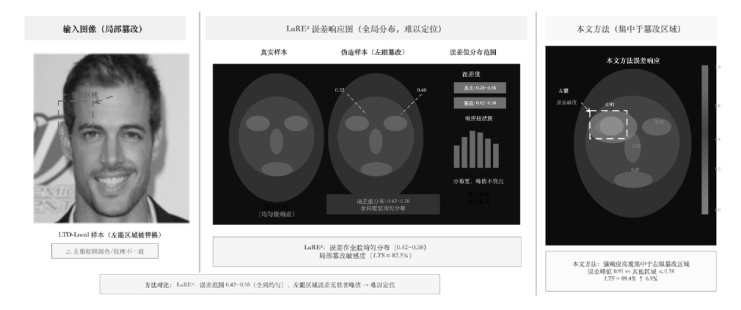
| 扩散模型检测方法 | LaRE2 | 基于扩散模型潜在空间重建误差的标准方法,作为关键对比基线 |
| 本文方法变体 | Ours-S | 仅含关键区域保护机制 |
| Ours-F | 仅含高频特征增强机制 | |
| Ours-Full | 完整融合模型 |
| 方法 | Celeb-DFv2 | FF++(HQ) | 备注 |
|---|---|---|---|
| XceptionNet | 92.9% ± 0.4% | 94.1% ± 0.3% | 深度学习基准 |
| F3-Net | 94.0% ± 0.3% | 94.9% ± 0.4% | 频域方法 |
| Face X-ray | 92.3% ± 0.5% | 93.6% ± 0.4% | 局部不一致性方法 |
| LaRE2 | 96.3% ± 0.2% | 96.8% ± 0.2% | 扩散模型方法 |
| Ours-Full | 96.7% ± 0.2% | 97.2% ± 0.2% | 本文完整方法 |
| 方法 | 总体结果 | 局部换脸 | 纹理扰动 | 局部形变 | 复制粘贴 |
|---|---|---|---|---|---|
| XceptionNet | 72.3%±0.8% | 85.1%±0.6% | 65.4%±1.2% | 62.8%±1.1% | 83.5%±0.7% |
| F3-Net | 77.2%±0.7% | 86.7%±0.5% | 70.1%±0.9% | 68.9%±1.0% | 86.0%±0.6% |
| Face X-ray | 80.1%±0.6% | 90.2%±0.5% | 73.5%±0.8% | 71.0%±0.9% | 88.3%±0.5% |
| LaRE2 | 82.5%±0.5% | 92.8%±0.4% | 75.6%±0.7% | 74.2%±0.8% | 90.9%±0.5% |
| Ours-Full | 89.4%±0.4% | 94.8%±0.3% | 85.2%±0.6% | 83.6%±0.6% | 93.1%±0.4% |
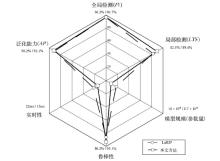
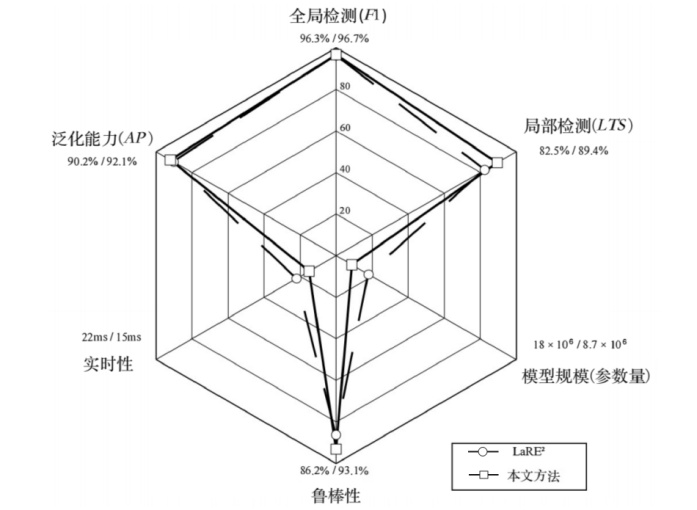
| 对比维度 | 主要挑战 | LaRE2方法 | 本文方法 | 适用场景建议 |
|---|---|---|---|---|
| 全局换脸检测 | 整体分布 一致性 | 强 (扩散先验) | 中等 (重建误差) | 高质量扩散生成内容检测 |
| 局部细微篡改 | 局部纹理异常 | 中等 | 强 (双重增强) | 精细编辑、局部替换检测 |
| 跨数据集泛化 | 分布偏移 | 强 | 强 | 多样化伪造数据 |
| 计算效率 | 实时性要求 | 中等 (22 ms) | 强(15 ms) | 边缘计算、实时检测 |
| 模型配置 | 总体LTS | 相对基线提升 | 模块贡献分析 |
|---|---|---|---|
| 纯自编码器(Baseline) | 68.5% | — | 重建误差基础 |
| + 关键区域保护(Ours-S) | 82.6% | 14.1% | 空间聚焦效应显著 |
| + 高频特征增强(Ours-F) | 84.0% | 15.5% | 频域特征增强有效 |
| + 完整模型(Ours-Full) | 89.4% | 20.9% | 协同增强效应明显 |
| 方法 | DFD(AP/AUC) | WildDeepfake(AP/AUC) |
|---|---|---|
| XceptionNet | 84.3%/86.7% | 82.1%/84.5% |
| F3-Net | 86.5%/88.2% | 85.0%/87.1% |
| Face X-ray | 88.1%/89.7% | 86.4%/88.9% |
| LaRE2 | 90.2%/92.5% | 89.1%/91.8% |
| Ours-Full | 92.1%/94.6% | 90.8%/93.2% |
| 方法 | 参数量 | FLOPs | 推理时间/ms | 适用场景 |
|---|---|---|---|---|
| XceptionNet | 22×106个 | 8.4×10⁹ | 28 | 服务器端 |
| EfficientNet-B4 | 19×106个 | 4.2×10⁹ | 21 | 移动端 |
| LaRE2 | 18×106个 | 6.8×10⁹ | 22 | 服务器端 |
| Ours-Full | 8.7×10⁶个 | 3.2×10⁹ | 15 | 边缘/实时 |
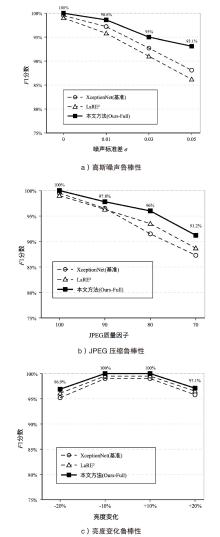
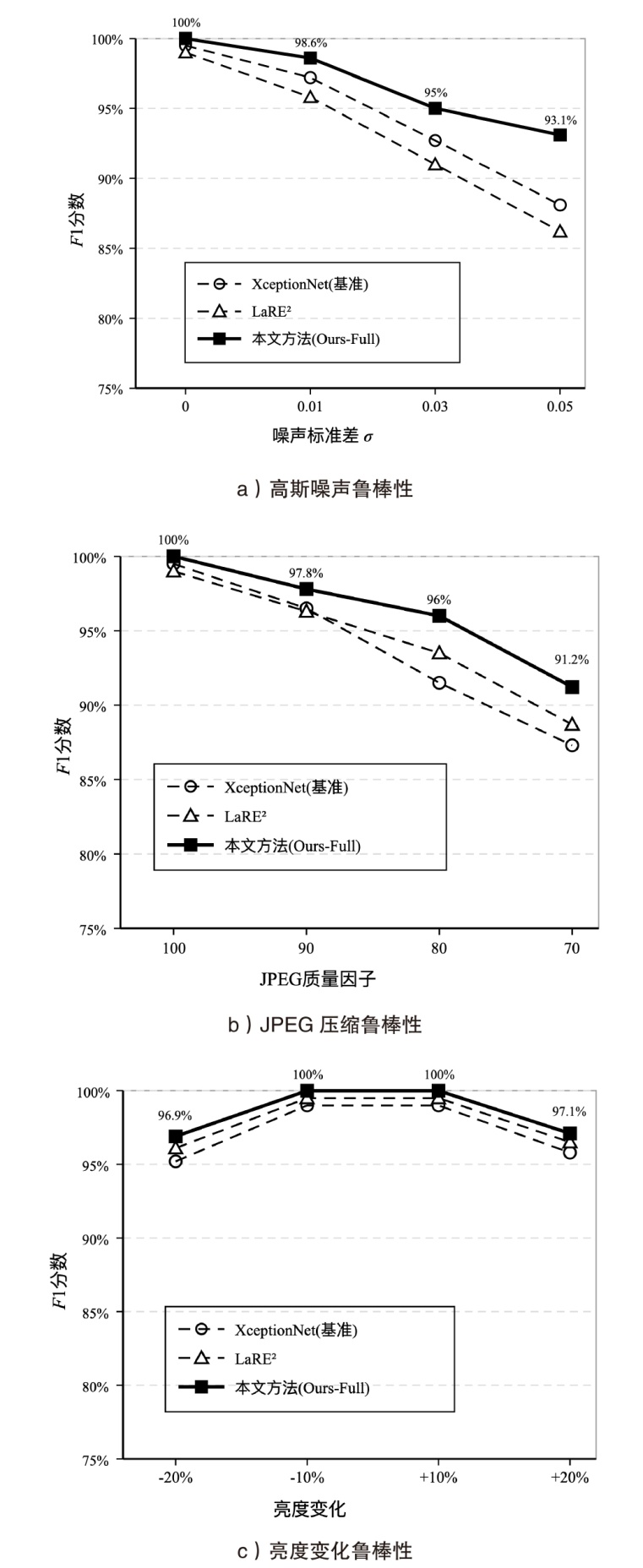
| 方法 | 高斯σ=0.01 | 高斯σ=0.05 | JPEG 质量90 | JPEG 质量70 | 亮度+20% | 亮度-20% |
|---|---|---|---|---|---|---|
| XceptionNet | 97.2% | 88.1% | 96.5% | 87.3% | 95.8% | 95.2% |
| F3-Net | 97.8% | 90.3% | 97.1% | 89.6% | 96.2% | 96.0% |
| Face X-ray | 96.9% | 87.5% | 95.8% | 86.1% | 95.4% | 94.8% |
| LaRE2 | 95.8% | 86.2% | 96.3% | 88.7% | 96.5% | 96.1% |
| Ours-Full | 98.6% | 93.1% | 97.8% | 91.2% | 97.1% | 96.9% |
| [1] | 丁博文, 芦天亮, 彭舒凡, 等. 基于多分类数据集的人脸伪造算法识别模型[J]. 计算机科学, 2025, 52(7):353-362. |
| [2] | 赵泽军, 范振峰, 丁博, 等. 基于增量学习的深度人脸伪造检测[J]. 数据与计算发展前沿, 2023, 5(6):42-57. |
| [3] | 杨珂, 李永亮, 何金栋, 等. 基于掩码图像建模的深度伪造人脸检测[J]. 计算机应用, 2025, 45(S1): 72-77. |
| [4] |
Chesney R M, Citron D K. Deep fakes: a looming challenge for privacy, democracy, and national security[J]. California Law Review, 2019, 107(6): 1753-1820.
doi: 10.15779/Z38RV0D15J |
| [5] | 金世辰, 谭晓阳. 基于困难感知元学习的跨域人脸伪造检测[J]. 南京航空航天大学学报, 2025, 57(2):215-224. |
| [6] | Luo Yunpeng, Du Junlong, Yan Ke, et al. LaRE2: latent reconstruction error based method for diffusion-generated image detection[C]// The IEEE/CVF Conference on Computer Vision and Pattern Recognition (CVPR). New York: IEEE, 2024: 17006-17015. |
| [7] | 钱菲, 李威, 陈鹏, 等. 基于原型解耦的虚假人脸检测和生成方法溯源[J]. 计算机科学与探索, 2025, 19(2):444-454. |
| [8] | 袁程胜, 谢佳薇, 王一力, 等. 特征-频域双判别的对抗样本迁移性增强[J]. 计算机系统应用, 2025, 34(10): 122-132. |
| [9] | 陈傲, 白恩健, 吴贇, 等. 融合CNN与ViT的深度伪造人脸篡改视频检测方法[J]. 东华大学学报(自然科学版), 2025, 51(6):112-120. |
| [10] | Qian Yuyang, Yin Guojun, Sheng Lu, et al. Thinking in frequency: face forgery detection by mining frequency-aware clues[C]// The 16th European Conference on Computer Vision (ECCV 2020). Heidelberg: Springer, 2020: 86-103. |
| [11] | 赵娅, 郜明超, 姚文达, 等. 基于深度学习的伪造人脸检测技术综述[J]. 计算机系统应用, 2025, 34(4):1-17. |
| [12] | 王健, 孙沐毅, 李琦, 等. 基于深度学习的人脸属性编辑研究概述[J]. 计算机应用与软件, 2025, 42(1):11-24. |
| [13] | 李伟, 黄添强, 黄丽清, 等. 面向人脸修复篡改检测的大规模数据集[J]. 中国图象图形学报, 2024, 29(7):1834-1848. |
| [14] | 王玉梅, 胡娟, 武晓帅, 等. 基于面部动作不一致的压缩深度伪造视频检测方法[J]. 重庆邮电大学学报(自然科学版), 2025, 37(3):108-117. |
| [15] | Lanzino R, Fontana F, Diko A, et al. Faster than lies: real-time deepfake detection using binary neural networks[C]// The IEEE/CVF Conference on Computer Vision and Pattern Recognition Workshops(CVPRW). New York: IEEE, 2024: 3771-3780. |
| [16] |
陈咏豪, 蔡满春, 张溢文, 等. 基于参数高效微调及双流网络的人脸伪造检测[J]. 计算机工程与应用, 2025, 61(10): 288-298.
doi: 10.3778/j.issn.1002-8331.2404-0213 |
| [17] | 李梓楷, 王宇飞, 廖广军, 等. 基于帧间量化参数强度值检测深度伪造人像视频[J]. 刑事技术, 2024, 49(1):66-72. |
| [18] | Wu Haoyu, Leng Lingyun, Yu Peipeng. Learning local reconstruction errors for face forgery detection[J]. International Journal of Advanced Computer Science and Applications, 2024, 15(11): 1220-1227. |
| [19] | 杨睿, 胡心如, 黄卓超, 等. 深度网络生成式伪造人脸检测方法研究综述[J]. 计算机辅助设计与图形学学报, 2024, 36(10): 1491-1510. |
| [20] | Larsen A B L, Sonderby S K, Larochelle H, et al. Autoencoding Beyond Pixels Using a Learned Similarity Metric[C]// The 33rd International Conference on Machine Learning. New York: ACM, 2016: 1558-1566. |
| [21] | Frank J, Eisenhofer T, Schonherr L, et al. Leveraging frequency analysis for deep fake image recognition[C]// The 37th International Conference on Machine Learning. New York: ACM, 2020: 3247-3258. |
| [22] | Tan Chuangchuang, Zhao Yao, Wei Shikui, et al. Frequency-aware deepfake detection: improving generalizability through frequency space domain learning[C]// The AAAI Conference on Artificial Intelligence. Menlo Park: AAAI, 2024: 5052-5060. |
| [23] | Fridrich J, Kodovsky J. Rich models for steganalysis of digital images[J]. IEEE Transactions on Information Forensics and Security, 2012, 7(3): 868-882. |
| [24] | Li Lingzhi, Bao Jianmin, Zhang Ting, et al. Face X-ray for more general face forgery detection[C]// 2020 IEEE/CVF Conference on Computer Vision and Pattern Recognition. New York: IEEE, 2020: 5000-5009. |
| [25] | Haliassos A, Vougioukas K, Petridis S, et al. Lips don't lie: a generalisable and robust approach to face forgery detection[C]// The IEEE/CVF Conference on Computer Vision and Pattern Recognition. New York: IEEE, 2021: 5039-5049. |
| [26] | 任奎, 林峰, 霸钟杰, 等. Deepfake检测:关键挑战与技术路线[J]. 中国计算机学会通讯, 2021, 17(5):39-44. |
| [27] | 陈佳丽, 郭华, 姜瑞明. 基于微小运动的人脸活体检测算法[J]. 计算机应用与软件, 2024, 41(7):150-158,191. |
| [28] | 丁峰, 匡仁盛, 周越, 等. 深度伪造及其取证技术综述[J]. 中国图象图形学报, 2024, 29(2):295-317. |
| [29] | 王瑞, 叶晓彤. 基于面部掩码引导的多人场景图像伪造定位算法[J]. 东北大学学报(自然科学版), 2025, 46(5):633-642. |
| [30] | 于晓琳, 于明希. 基于改进YOLOv8的生成式人脸检测算法[J]. 北京邮电大学学报, 2025, 48(3):39-46. |
| [1] | Jin Zhigang, Li Qirui, Ding Yu. A dual-branch intrusion detection method integrated with lightweight attention mechanism [J]. Netinfo Security, 2026, 26(8): 1183-1193. |
| [2] | Shi Jun, Wang Hao, Li Zengpeng, Gu Yiyu, Ma Huiling. Survey on the research status, key issues, and development directions of trusted execution environment in privacy computing [J]. Netinfo Security, 2026, 26(8): 1194-1208. |
| [3] | Fu Zhangjie, Liu Tianyi, Song Fuyuan, Jiang Qin. A blockchain-sharding enabled verifiable cross-chain query scheme [J]. Netinfo Security, 2026, 26(8): 1209-1223. |
| [4] | Feng Jingyu, Yin Jingyi, Zhang Senyong, Li Jinghui. Cross-domain collaborative zero-trust model for industrial Internet to counter APT data theft [J]. Netinfo Security, 2026, 26(8): 1224-1236. |
| [5] | Han Yanyan, Du Yupeng, Yu Zhuozhou, Liu Ang, Liu Wen. Secure blockchain based on semi-quantum network [J]. Netinfo Security, 2026, 26(8): 1237-1249. |
| [6] | Zhao Min, Qu Kangjian. Review of zero trust architecture and its technical applications [J]. Netinfo Security, 2026, 26(8): 1250-1263. |
| [7] | Zhang Hongtao, Wang Qingtao, Zhang Liancheng, Wang Jichang. Argus6: an IPv6 DDoS threat detection model [J]. Netinfo Security, 2026, 26(8): 1264-1276. |
| [8] | Xie Xuesong, Cai Jiakai, Luo Baizhi. Secure model loading mechanism for edge AI based on Chinese commercial cryptography [J]. Netinfo Security, 2026, 26(8): 1277-1289. |
| [9] | Zhu Huimin, Wang Chenlong, Liu Guanghua. An anomaly behavior differentiation method for weak networks based on dual-relation graph temporal modeling [J]. Netinfo Security, 2026, 26(8): 1290-1307. |
| [10] | Liu Zhefan, Guo Yajun, Guo Yimin, Zhao Sufen. ASCON-based lightweight industrial IoT authentication scheme resistant to implicit attacks [J]. Netinfo Security, 2026, 26(8): 1308-1326. |
| [11] | Song Mengyuan, Xia Hui. Federated unlearning via knowledge distillation and adversarial examples [J]. Netinfo Security, 2026, 26(7): 1149-1163. |
| [12] | Yang Qiaoyang, Fan Ximing, Jia Peng. LLM-based semantic-aware fuzz driver generation [J]. Netinfo Security, 2026, 26(7): 1128-1148. |
| [13] | Sun Haoran, Chen Jie, Liu Jun. Multi-path feature enhanced deep learning method for rectangule attack and defense [J]. Netinfo Security, 2026, 26(7): 1115-1127. |
| [14] | Qian Xiaosheng, Wang Liying, Zhao Yu, Liu Guangya, Wang Cheng. Anomaly detection system for computing power networks based on behavioral attention [J]. Netinfo Security, 2026, 26(7): 1101-1114. |
| [15] | Yao Wuhuang, Wang Jiapeng, Chen Kangbing, Zheng Zhihan, Tan Yu’an. An LLM-assisted firmware memory leak analysis based on instruction translation instrumentation [J]. Netinfo Security, 2026, 26(7): 1087-1100. |
| Viewed | ||||||
|
Full text |
|
|||||
|
Abstract |
|
|||||