Netinfo Security ›› 2026, Vol. 26 ›› Issue (8): 1290-1307.doi: 10.3969/j.issn.1671-1122.2026.08.010
Previous Articles Next Articles
An anomaly behavior differentiation method for weak networks based on dual-relation graph temporal modeling
Zhu Huimin, Wang Chenlong, Liu Guanghua( )
)
School of Cyber Science and Engineering ,Huazhong University of Science and Technology Wuhan 430074, China
-
Received:2026-05-31Online:2026-08-10Published:2026-09-23 -
Contact:Liu Guanghua E-mail:guanghualiu@hust.edu.cn

CLC Number:
Cite this article
Zhu Huimin, Wang Chenlong, Liu Guanghua. An anomaly behavior differentiation method for weak networks based on dual-relation graph temporal modeling[J]. Netinfo Security, 2026, 26(8): 1290-1307.
share this article
Add to citation manager EndNote|Ris|BibTeX
URL: http://netinfo-security.org/EN/10.3969/j.issn.1671-1122.2026.08.010
| 符号 | 含义 |
|---|---|
| 第t个时间窗的节点特征矩阵 | |
| 序列样本的时间增强节点特征矩阵 | |
| 节点在时间窗内的特征向量 | |
| 节点丢包、环境丢包、攻击丢包、雨区标记、同步丢包、湿度、信噪比和连续异常特征 | |
| 通信链路质量邻接矩阵、环境协同变化邻接 矩阵 | |
| 第t个时间窗对应的带属性双关系图 | |
| 由连续L个时间窗构成的序列样本 | |
| VGAE输出的节点潜在表示矩阵 | |
| 节点潜在分布的均值和标准差 | |
| 两个非互斥标签的预测概率、环境扰动与攻击异常真值 | |
| 环境协同变化异常标签与攻击异常标签 | |
| 环境协同变化异常与攻击异常的判定阈值 |
| 配置项 | 设置 | 说明 |
|---|---|---|
| NS-3与场景 | ns-3.33;20 m×20 m; 100节点 | 1个汇聚节点,节点为随机静态位置 |
| 仿真时长 | 1800 s/轮;30轮 | RngRun范围为1001~1030 |
| 攻击比例 | BH=0.15/0.20/0.25;SF=0.15/0.20/0.25 | 每轮独立抽取 |
| 攻击起始 | 20~50s,步长5 s | 每轮随机;之前攻击标签恒为0 |
| 雨区 | 宽、高各6~10 m; 概率0.45~0.75 | 位置与范围逐轮随机 |
| 湿/干期 | 湿期:15~55 s; 干期:10~40 s | 雨脉冲0.2~1.0 min,间隔5~25 s |
| 温度 | 基准:13℃~17℃; 振幅:3℃~6℃ | 逐轮随机 |
| 配置项 | 设置 |
|---|---|
| 操作系统 | Ubuntu 20.04.1 LTS |
| Python版本 | Python 3.8.10 |
| PyTorch版本 | PyTorch 2.3.1 CPU版本 |
| NS-3平台 | ns-3.33 |
| CPU | 4 vCPU,Intel(R) Core(TM) Ultra 5 225,VMware虚拟化环境 |
| Linux内核 | 5.15.0-139-generic |
| 模型 | Env F1 | Attack F1 | Exact Match | Hamming Loss |
|---|---|---|---|---|
| DGVT | 0.9693 | 0.9572 | 0.8896 | 0.0581 |
| TimeMixer++-style[ | 0.9298 | 0.9235 | 0.8000 | 0.1111 |
| TimesNet-style[ | 0.9146 | 0.8858 | 0.7370 | 0.1537 |
| iTransformer-style[ | 0.9161 | 0.9173 | 0.7852 | 0.1241 |
| Zhang[ | 0.8025 | 0.9420 | 0.6407 | 0.1889 |
| Cook[ | 0.8154 | 0.9467 | 0.6444 | 0.1778 |
| 场景组 | 场景 | Env F1 | Attack F1 | Exact Match | Hamming Loss |
|---|---|---|---|---|---|
| 基准 | 基准场景 | 0.9693 | 0.9572 | 0.8896 | 0.0581 |
| 环境扰动 | 降雨强度随机 | 0.9219 | 0.8841 | 0.7333 | 0.1444 |
| 环境扰动 | 雨区范围随机 | 0.6517 | 0.7667 | 0.4889 | 0.3278 |
| 环境扰动 | 湿度起始偏移 | 0.8027 | 0.9459 | 0.6111 | 0.2056 |
| 环境扰动 | 湿度变化缩放 | 0.8679 | 0.8741 | 0.6889 | 0.1722 |
| 攻击扰动 | 攻击强度变化 | 0.9508 | 0.8841 | 0.7778 | 0.1222 |
| 攻击扰动 | 攻击行为集中 | 0.9593 | 0.8841 | 0.7889 | 0.1167 |
| 参数/符号 | 设置 | 说明 |
|---|---|---|
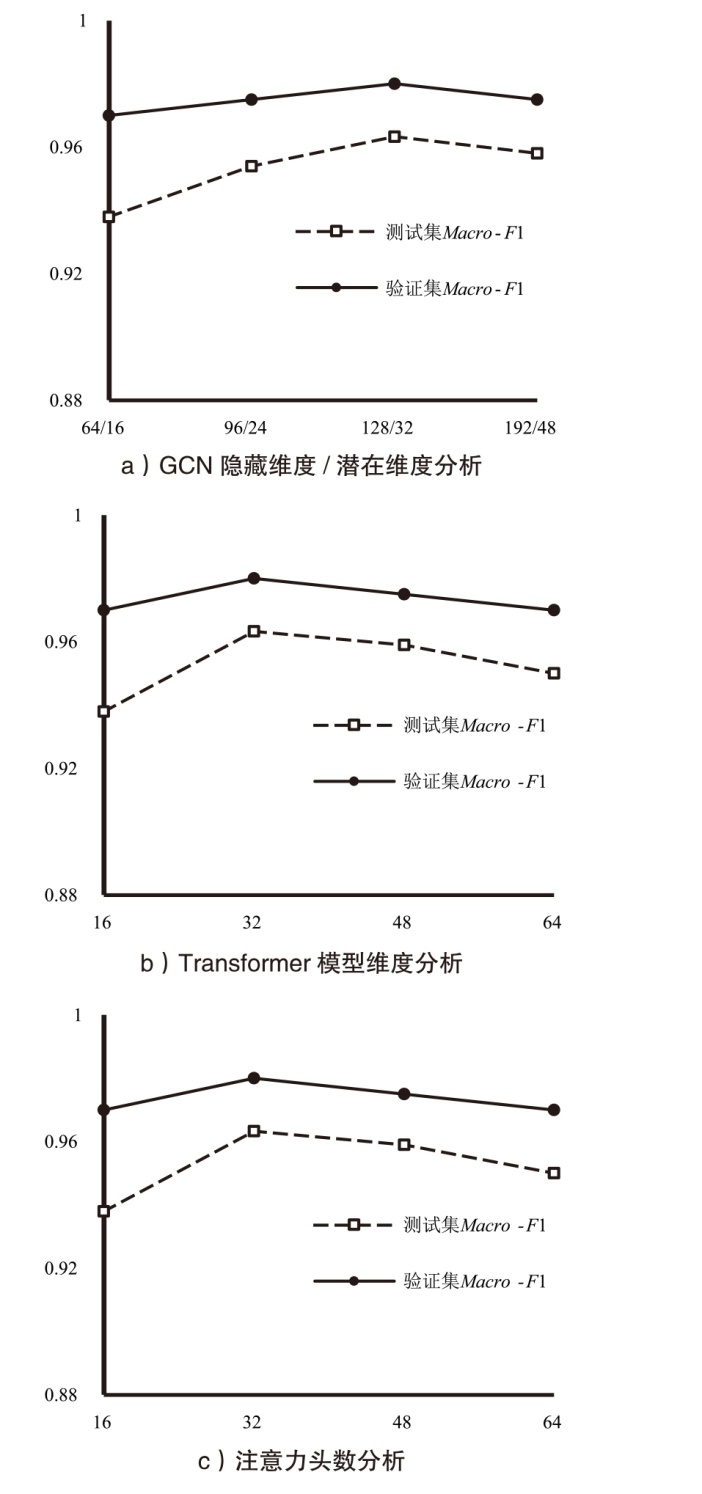
| GCN隐藏维度/潜在维度 | 128/32 | 双关系分支结构一致 |
| 32/4/2 | 前馈层维度128 | |
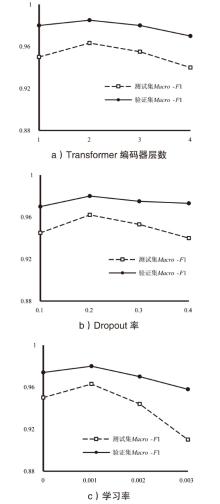
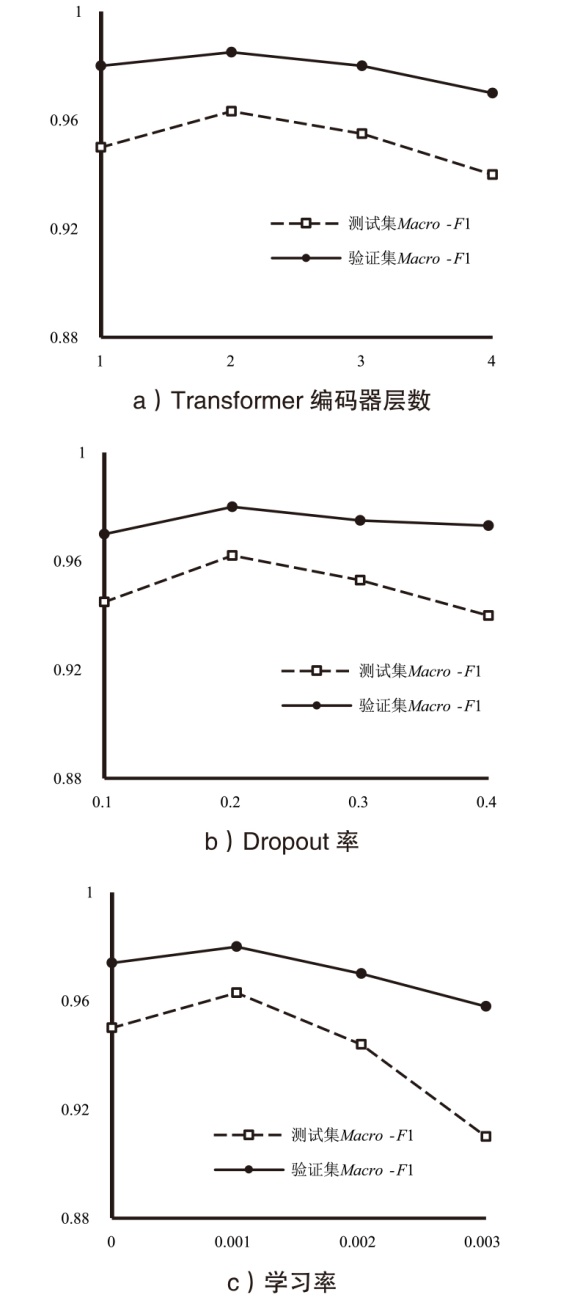
| Dropout/权重衰减 | 0.2/1×10-2 | 抑制小样本过拟合 |
| 批大小/学习率/优化器 | 4/0.001/Adam | 梯度范数裁剪为5 |
| 最大轮数/早停耐心值 | 100/15 | 依据验证Macro-F1早停 |
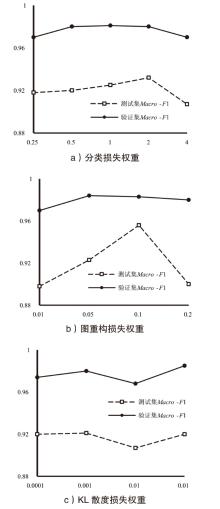
| 1/0.1/0.001 | 由验证集敏感性实验确定 | |
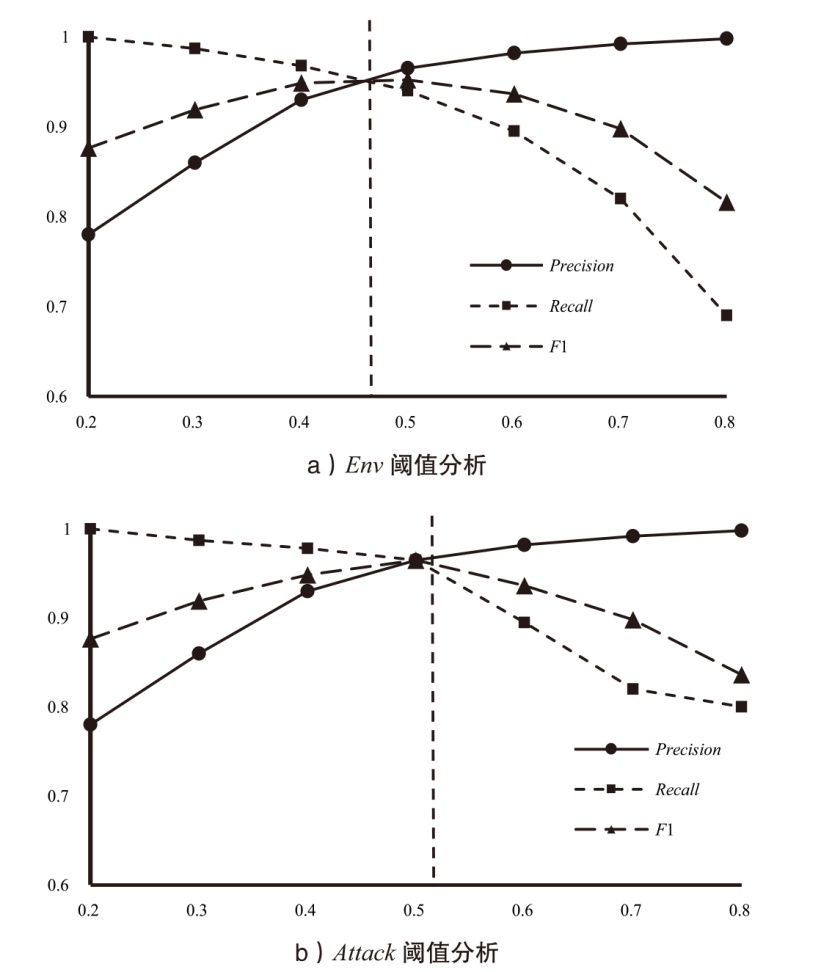
| 0.50/0.40 | 验证集0.20~0.80步长0.05扫描 |
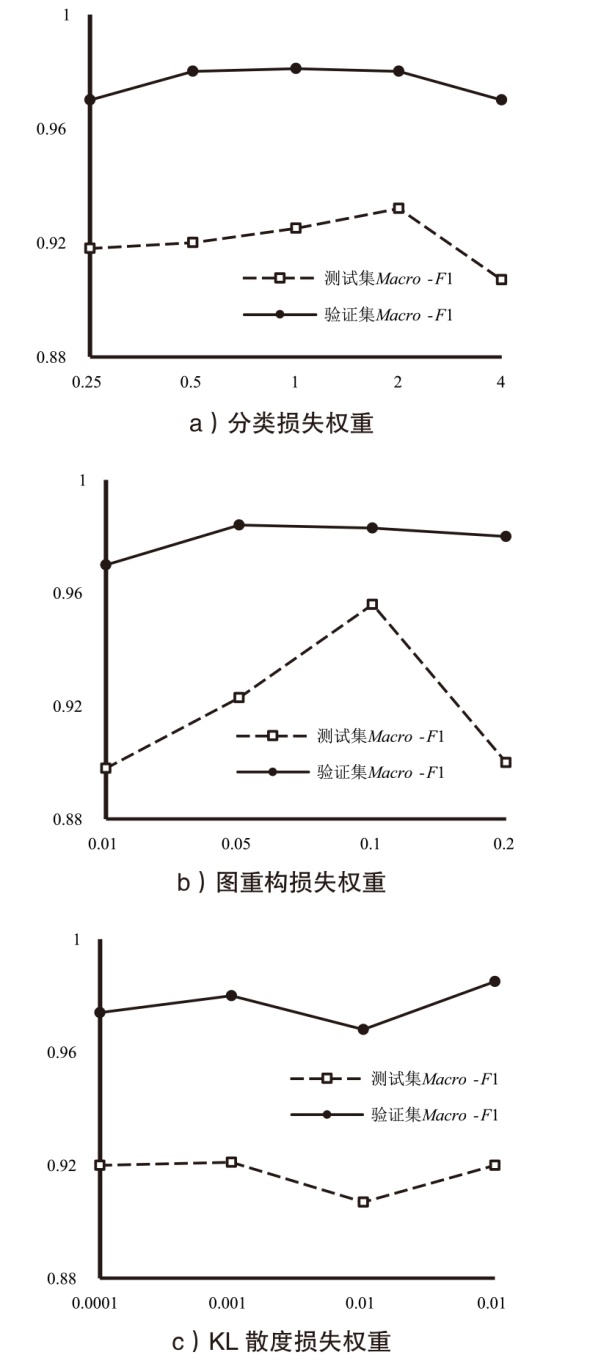
| 模型配置 | Env F1 | Attack F1 | Exact Match | Hamming Loss |
|---|---|---|---|---|
| 完整DGVT | 0.9693 | 0.9572 | 0.8896 | 0.0581 |
| 无环境协同变化图 | 0.9056 | 0.9054 | 0.7435 | 0.1598 |
| 无通信链路质量图 | 0.9231 | 0.8803 | 0.7307 | 0.1878 |
| 无Transformer | 0.8214 | 0.8889 | 0.6889 | 0.2111 |
| 无VGAE | 0.8657 | 0.8406 | 0.7222 | 0.2222 |
| [1] | Liu Guanghua, Wang Chenlong, Tang Shuqi, et al. Security in wireless weak-link sensor networks: directions, recent advances, and challenges[J]. IEEE Network, 2026, 40(1): 322-329. |
| [2] | Liu Guanghua. Data collection in MI-assisted wireless powered underground sensor networks: directions, recent advances, and challenges[J]. IEEE Communications Magazine, 2021, 59(4): 132-138. |
| [3] | Akyildiz I F, Stuntebeck E P. Wireless underground sensor networks: research challenges[J]. Ad Hoc Networks, 2006, 4(6): 669-686. |
| [4] | Yu Xiaoqing, Han Wenting, Zhang Zenglin. Path loss estimation for wireless underground sensor network in agricultural application[J]. Agricultural Research, 2017, 6(1): 97-102. |
| [5] | Liu Guanghua, Wang Zehua, Jiang Tao. QoS-aware throughput maximization in wireless powered underground sensor networks[J]. IEEE Transactions on Communications, 2016, 64(11): 4776-4789. |
| [6] | Rajasegarar S, Leckie C, Palaniswami M. Anomaly detection in wireless sensor networks[J]. IEEE Wireless Communications, 2008, 15(4): 34-40. |
| [7] | Xie Min, Han Song, Tian Bo, et al. Anomaly detection in wireless sensor networks: a survey[J]. Journal of Network and Computer Applications, 2011, 34(4): 1302-1325. |
| [8] | Karlof C, Wagner D. Secure routing in wireless sensor networks: attacks and countermeasures[J]. Ad Hoc Networks, 2003, 1(2): 293-315. |
| [9] | Wood A D, Stankovic J A. Denial of Service in Sensor networks[J]. Computer, 2002, 35(10): 54-62. |
| [10] | Newsome J, Shi E, Song D, et al. The sybil attack in sensor networks: analysis and defenses[C]// The 3rd International Symposium on Information Processing in Sensor Networks. New York: ACM, 2004: 259-268. |
| [11] | Beutel J, Romer K, Ringwald M, et al. Deployment techniques for sensor networks[M]. Heidelberg: Springer, 2010: 219-248. |
| [12] | Branch J W, Giannella C, Szymanski B, et al. In-network outlier detection in wireless sensor networks[C]// The 26th IEEE International Conference on Distributed Computing Systems. New York: IEEE, 2006: 51. |
| [13] | Fawzy A, Mokhtar H, Hegazy O. Outliers detection and classification in wireless sensor networks[J]. Egyptian Informatics Journal, 2013, 14(2): 157-164. |
| [14] | Hong C O, Choi Y H. Proximity-based robust event detection in wireless sensor networks[J]. International Journal of Distributed Sensor Networks, 2014, 2014: 97-106. |
| [15] | Ma Xiaoxiao, Wu Jia, Xue Shan, et al. A comprehensive survey on graph anomaly detection with deep learning[J]. IEEE Transactions on Knowledge and Data Engineering, 2023, 35(12): 12012-12038. |
| [16] | Akoglu L, Tong Hanghang, Koutra D. Graph based anomaly detection and description: a survey[J]. Data Mining and Knowledge Discovery, 2015, 29(3): 626-688. |
| [17] | Kipf T N, Welling M. Semi-supervised classification with graph convolutional networks[C]// International Conference on Learning Representations. Toulon: ICLR, 2017: 1-14. |
| [18] | Kipf T N, Welling M. Variational graph auto-encoders[EB/OL]. (2016-11-21)[2026-03-25]. https://arxiv.org/abs/1611.07308. |
| [19] | Velickovic P, Cucurull G, Casanova A, et al. Graph attention networks[C]// International Conference on Learning Representations. San Diego: ICLR, 2018: 1-12. |
| [20] | Deng Ailin, Hooi B. Graph neural network-based anomaly detection in multivariate time series[C]// The AAAI Conference on Artificial Intelligence. Menlo Park: AAAI, 2021: 4027-4035. |
| [21] | Zhao Hang, Wang Yujing, Duan Juanyong, et al. Multivariate time-series anomaly detection via graph attention network[C]// 2020 IEEE International Conference on Data Mining. New York: IEEE, 2020: 841-850. |
| [22] | Audibert J, Michiardi P, Guyard F, et al. USAD: Unsupervised anomaly detection on multivariate time series[C]// The 26th ACM SIGKDD International Conference on Knowledge Discovery and Data Mining. New York: ACM, 2020: 3395-3404. |
| [23] | Su Ya, Zhao Youjian, Niu Chenhao, et al. Robust anomaly detection for multivariate time series through stochastic recurrent neural network[C]// The 25th ACM SIGKDD International Conference on Knowledge Discovery and Data Mining. New York: ACM, 2019: 2828-2837. |
| [24] | Vaswani A, Shazeer N, Parmar N, et al. Attention is all you need[C]// Advances in Neural Information Processing Systems. New York: Curran Associates, 2017: 5998-6008. |
| [25] | Wang Shiyu, Li Jiawei, Shi Xiaoming, et al. TimeMixer++: a general time series pattern machine for universal predictive analysis[C]// International Conference on Learning Representations. San Diego: ICLR, 2025: 1-22. |
| [26] | Wu Haixu, Hu Tengge, Liu Yong, et al. TimesNet: temporal 2D-variation modeling for general time series analysis[C]// International Conference on Learning Representations. San Diego: ICLR, 2023: 1-17. |
| [27] | Liu Yong, Hu Tengge, Zhang Haoran, et al. iTransformer: inverted transformers are effective for time series forecasting[C]// International Conference on Learning Representations. San Diego: ICLR, 2024: 1-25. |
| [28] | Chung J, Gulcehre C, Cho K, et al. Empirical evaluation of gated recurrent neural networks on sequence modeling[EB/OL]. (2014-12-11)[2026-03-25]. https://arxiv.org/abs/1412.3555. |
| [29] | Zhang Minling, Zhou Zhihua. A review on multi-label learning algorithms[J]. IEEE Transactions on Knowledge and Data Engineering, 2014, 26(8): 1819-1837. |
| [30] | Read J, Pfahringer B, Holmes G, et al. Classifier chains for multi-label classification[J]. Machine Learning, 2011, 85(3): 333-359. |
| [31] | Tsoumakas G, Katakis I. Multi-label classification: an overview[J]. International Journal of Data Warehousing and Mining, 2007, 3(3): 1-13. |
| [32] | Boutell M R, Luo Jiebo, Shen Xipeng, et al. Learning multi-label scene classification[J]. Pattern Recognition, 2004, 37(9): 1757-1771. |
| [33] | Junejo K N, Goh J. Behaviour-based attack detection and classification in cyber physical systems using machine learning[C]// The 2nd ACM International Workshop on Cyber-Physical System Security. New York: ACM, 2016: 34-43. |
| [34] | Cook M, Paterson C, Marnerides A K, et al. Anomaly diagnosis in cyber-physical systems[C]// ICC 2022-IEEE International Conference on Communications. New York: IEEE, 2022: 5445-5450. |
| [35] | Kingma D P, Welling M. Auto-encoding variational bayes[EB/OL]. (2022-12-10)[2026-03-25]. https://arxiv.org/abs/1312.6114. |
| [36] | Kingma D P, Ba J. Adam: a method for stochastic optimization[C]// The 3rd International Conference on Learning Representations. San Diego: ICLR, 2015: 1-13. |
| [37] | Pedregosa F, Varoquaux G, Gramfort A, et al. Scikit-learn: machine learning in Python[J]. Journal of Machine Learning Research, 2011, 12: 2825-2830. |
| [38] | Paszke A, Gross S, Massa F, et al. PyTorch:an imperative style, high-performance deep learning library[C]// Advances in Neural Information Processing Systems. New York: Curran Associates, 2019: 8024-8035. |
| [1] | GAO Guangliang, LIANG Guangjun, HONG Lei, GAO Gugang, WANG Qun. Disambiguation-Based Partial Multi-Label Learning Algorithm Augmented by Fusing Instance and Label Correlations [J]. Netinfo Security, 2024, 24(11): 1763-1772. |
| Viewed | ||||||
|
Full text |
|
|||||
|
Abstract |
|
|||||