信息网络安全 ›› 2026, Vol. 26 ›› Issue (6): 967-976.doi: 10.3969/j.issn.1671-1122.2026.06.010
一种面向主机扫描与抗扫描的随机博弈模型
谢晓敏1,2,3, 李鹏燈1,2,3, 刘园1,2,3( ), 田志宏1,2,3
- 1
广州大学网络空间安全学院 广州 510006
2广东省工业控制系统攻防对抗重点实验室 广州 510006
3广州大学黄埔研究院 广州 510000
-
收稿日期:2025-06-12出版日期:2026-06-10发布日期:2026-07-27 -
通讯作者:刘园 E-mail:yuanliu@gzhu.edu.cn -
作者简介:谢晓敏(2000—),女,广东,博士研究生,主要研究方向为网络空间资产测绘与抗测绘、主动防御|李鹏燈(1992—),男,广东,副教授,博士,CCF会员,主要研究方向为网络空间安全、博弈论、人工智能|刘园(1986—),女,广东,教授,博士,CCF杰出会员,主要研究方向为网络安全、数据安全、区块链安全|田志宏(1978—),男,广东,教授,博士,CCF杰出会员,主要研究方向为网络安全、系统安全、工控安全 -
基金资助:国家重点研发计划(2022YFB3102901)
A Stochastic Game Model for Host Scanning and Anti-Scanning
XIE Xiaomin1,2,3, LI Pengdeng1,2,3, LIU Yuan1,2,3(), TIAN Zhihong1,2,3
- 1
Cyberspace Institute of Advanced Technology ,Guangzhou University Guangzhou 510006, China
2Guangdong Provincial Key Laboratory of Industrial Control System Security Guangzhou 510006, China
3Huangpu Research School of Guangzhou University Guangzhou 510000, China
-
Received:2025-06-12Online:2026-06-10Published:2026-07-27 -
Contact:LIU Yuan E-mail:yuanliu@gzhu.edu.cn

摘要:
在网络空间资产测绘与抗测绘领域,攻击者大多采用广度优先分批扫描策略探测在线活跃主机,进而筛选潜在攻击目标。防御者主要通过设定网络流量阈值,实现恶意扫描行为的检测识别。然而,网络环境具备动态多变特征,且攻击者可灵活调整扫描策略,导致传统静态防御策略的动态适配能力存在明显短板。为解决该问题,文章构建一种面向主机扫描与抗扫描的随机博弈模型,将连续分组扫描过程转化为马尔可夫决策过程,精准刻画攻防双方动态策略的演化机制,并采用改进非对称纳什学习算法求解近似均衡解。实验结果表明,在均衡条件下,文章所提动态策略的综合收益显著优于传统固定策略。
中图分类号:
引用本文
谢晓敏, 李鹏燈, 刘园, 田志宏. 一种面向主机扫描与抗扫描的随机博弈模型[J]. 信息网络安全, 2026, 26(6): 967-976.
XIE Xiaomin, LI Pengdeng, LIU Yuan, TIAN Zhihong. A Stochastic Game Model for Host Scanning and Anti-Scanning[J]. Netinfo Security, 2026, 26(6): 967-976.
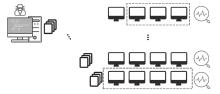
图1
水平扫描与检测的动态博弈模型
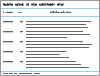
表1
相关符号对应的元素定义
| 符号 | 定义 |
|---|---|
| N | 目标主机范围内主机总数 |
| n | 攻击者当前已扫描主机数量 |
| m | 防御者将合法源地址误报为恶意扫描地址的数量 |
| τ | 扫描一组主机所需的时间 |
| t | 第t个时间步(表示博弈时间进程) |
| G | 分组总数 |
| T | 扫描全部主机所需的总时间步 |
| | 各阶段博弈对抗的状态 |
| | 参与者i的行动 |
| | 参与者i遵循均衡策略 |
| | 博弈状态中,扫描行为被检测成功的标识 |
| | 参与者i的收益函数 |
| | 参与者i的折扣因子(表示耐心程度) |
| | 参与者i的收益函数 |
| | 参与者i的策略 |
| | 参与者i的策略空间 |
| | 第i个主机分组的编号 |
| | 第i个主机分组中包含的主机数量 |
| | 参与者i的最优均衡策略 |
表2
实验参数设置
| 参数 | N | | MAX_A | MAX_D | | | |
|---|---|---|---|---|---|---|---|
| 数值设置 | 100 | 1 | 100 | 100 | 0.15 | 0.82 | 0.20 |
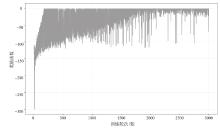
图2
攻击者奖励函数变化
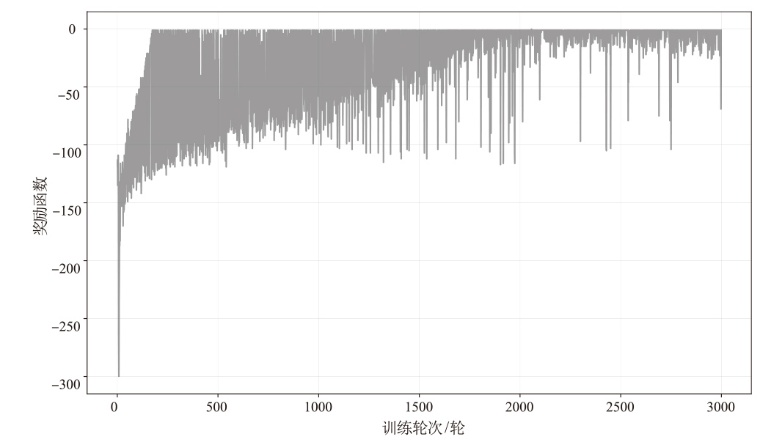
图3
防御者奖励函数变化
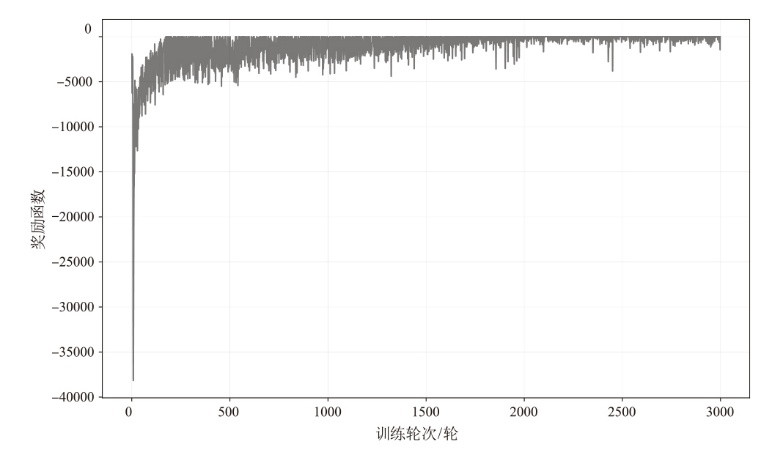
图4
攻击者在各状态下对应的最优行动
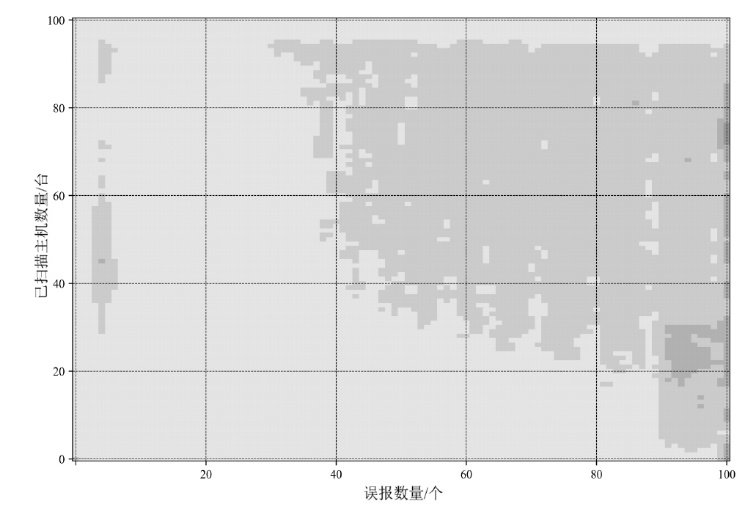
图5
防御者在各状态下对应的最优行动
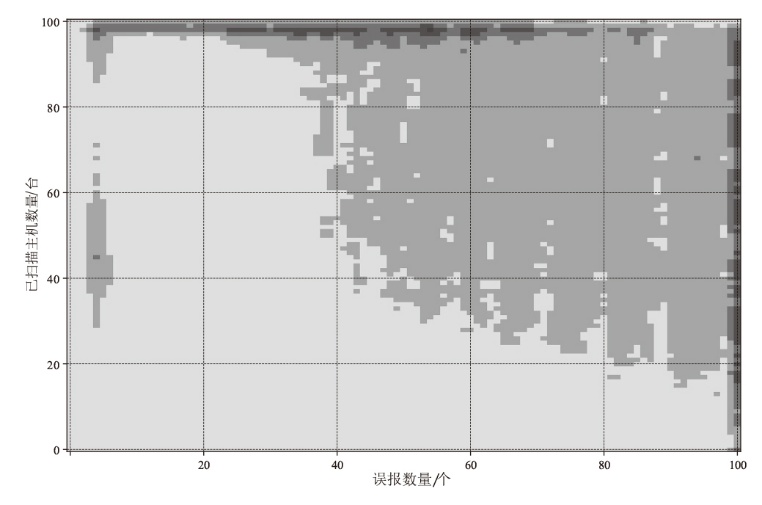
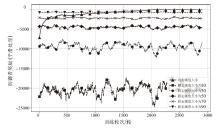
图6
防御者动态均衡策略与固定策略效果对比
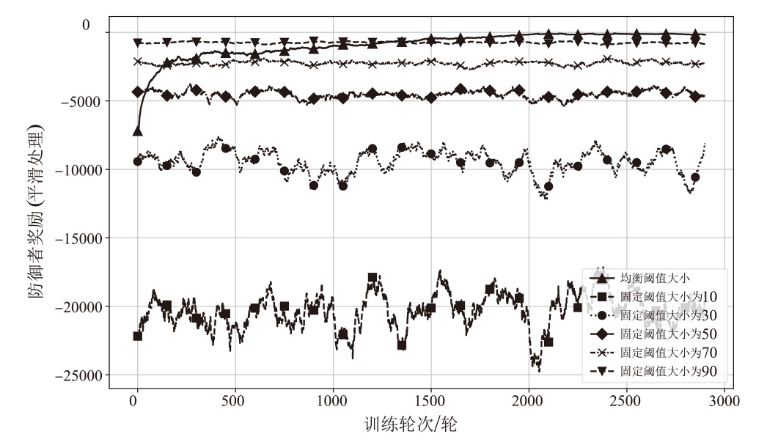
图7
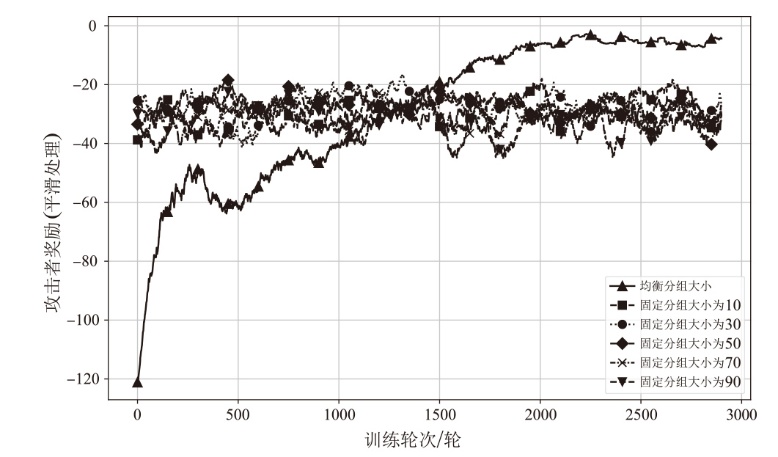
攻击者动态均衡策略与固定策略效果对比
| [1] | ZOU Zhenwan, HOU Yingsa, GUO Qingrui. Research on Cyberspace Surveying and Mapping Technology Based on Asset Detection[C]// IEEE. 2024 IEEE 6th Advanced Information Management, Communicates, Electronic and Automation Control Conference (IMCEC). New York: IEEE, 2024: 946-949. |
| [2] | XUE Xiangyang, ZOU Hong, ZHAO Jin, et al. Advances in Anti-Surveying-and-Mapping Theory and Technologies for Data Infrastructure[J]. Strategic Study of CAE, 2025, 27(1): 72-87. |
| 薛向阳, 邹宏, 赵进, 等. 数据基础设施抗测绘理论与技术发展研究[J]. 中国工程科学, 2025, 27(1): 72-87. | |
| [3] | DURUMERIC Z, BAILEY M, HALDERMAN J A. An {Internet-Wide} View of {Internet-Wide} Scanning[C]// USENIX. The 23rd USENIX Conference on Security Symposium. Berkeley: USENIX, 2014: 65-78. |
| [4] | SHENG Chuan, YAO Yu, ZHAO Lianxiang, et al. Scanner-Hunter: An Effective ICS Scanning Group Identification System[J]. IEEE Transactions on Information Forensics and Security, 2024, 19: 3077-3092. |
| [5] | CASWELL B, FOSTER J C, RUSSELL R, et al. Snort 2.0 Intrusion Detection[M]. Rockland: Syngress Publishing, 2003. |
| [6] | SHAPLEY L S. Stochastic Games[J]. Proceedings of the National Academy of Sciences of the United States of America (PNAS), 1953, 39(10): 1095-1100. |
| [7] | BITIRGEN K, FILIK U B. Markov Game Based on Reinforcement Learning Solution against Cyber-Physical Attacks in Smart Grid[EB/OL]. (2024-12-01)[2025-05-13]. https://www.sciencedirect.com/science/article/abs/pii/S095741742401474X |
| [8] | HU Junling, WELLMAN M P. Nash Q-Learning for General-Sum Stochastic Games[J]. Journal of Machine Learning Research, 2003(4): 1039-1069. |
| [9] | LEONARD D, LOGUINOV D. Demystifying Service Discovery: Implementing an Internet-Wide Scanner[C]// ACM. The 10th ACM SIGCOMM Conference on Internet Measurement. New York: ACM, 2010: 109-122. |
| [10] | LEONARD D, YAO Zhongmei, WANG Xiaoming, et al. Stochastic Analysis of Horizontal IP Scanning[C]// IEEE. 2012 Proceedings IEEE INFOCOM. New York: IEEE, 2012: 2077-2085. |
| [11] | ALI M Q, AL-SHAER E, SAMAK T. Firewall Policy Reconnaissance: Techniques and Analysis[J]. IEEE Transactions on Information Forensics and Security, 2014, 9(2): 296-308. |
| [12] | LEE C B, ROEDEL C, SILENOK E. Detection and Characterization of Port Scan Attacks[EB/OL]. (2003-06-18)[2025-05-13]. https://www.semanticscholar.org/paper/Detection-and-Characterization-of-Port-Scan-Attacks-Lee-Roedel/8830f1780bd7da10fd6090346b83d17fc9b09c97 |
| [13] | RICHTER P, SMARAGDAKIS G, PLONKA D, et al. Beyond Counting: New Perspectives on the Active IPv4 Address Space[C]// ACM. The 2016 Internet Measurement Conference. New York: ACM, 2016: 135-149. |
| [14] | STANIFORD S, PAXSON V, WEAVER N. How to Own the Internet in Your Spare Time[EB/OL]. (2002-08-05)[2025-05-13]. https://www.researchgate.net/publication/238280597_Nicholas_Weaver_How_to_0wn_the_Internet_in_Your_Spare_Time |
| [15] | WANG Pinghui, ZHENG Qinghua, NIU Guolin, et al. Port Scan Detection Algorithms Based on Statistical Traffic Features[J]. Journal on Communications, 2007(12): 14-18. |
| 王平辉, 郑庆华, 牛国林, 等. 基于流量统计特征的端口扫描检测算法[J]. 通信学报, 2007(12): 14-18. | |
| [16] | SAGATOV E S, MAYHOUB S, SUKHOV A M, et al. Proactive Detection for Countermeasures on Port Scanning Based Attacks[C]// IEEE. 2021 17th International Conference on Network and Service Management (CNSM). New York: IEEE, 2021: 402-406. |
| [17] | AFFINITO A, BOTTA A, GALLO L, et al. Spark-Based Port and Net Scan Detection[C]// ACM. The 35th Annual ACM Symposium on Applied Computing. New York: ACM, 2020: 1172-1179. |
| [18] | PATEL S K, SONKER A. Rule-Based Network Intrusion Detection System for Port Scanning with Efficient Port Scan Detection Rules Using Snort[J]. International Journal of Future Generation Communication and Networking, 2016, 9(6): 339-350. |
| [19] | VUGRIN E D, CRUZ J, REEDY C, et al. Cyber Threat Modeling and Validation: Port Scanning and Detection[C]//ACM. The 7th Symposium on Hot Topics in the Science of Security. New York: ACM, 2020: 1-10. |
| [20] | KIKUCHI H, FUKUNO N, KOBORI T, et al. Automated Port-Scan Classification with Decision Tree and Distributed Sensors[J]. Journal of Information Processing, 2008, 16: 165-175. |
| [21] | BOUKEBOUS A A E, FETTACHE M I, BENDIAB G, et al. A Comparative Analysis of Snort3 and Suricata[C]// IEEE. 2023 IEEE IAS Global Conference on Emerging Technologies (GlobConET). New York: IEEE, 2023: 1-6. |
| [22] | NING Zepeng, XIE Lihua. A Survey on Multi-Agent Reinforcement Learning and Its Application[J]. Journal of Automation and Intelligence, 2024, 3(2): 73-91. |
| [23] | MOGHADDAM A R, KEBRIAEI H. Multiagent Reinforcement Learning for Nash Equilibrium Seeking in General-Sum Markov Games[J]. IEEE Transactions on Systems, Man, and Cybernetics: Systems, 2025, 55(1): 221-227. |
| [24] | HU Jueming, PALIWAL Y, KIM H, et al. Reinforcement Learning with Predefined and Inferred Reward Machines in Stochastic Games[EB/OL]. (2024-09-28)[2025-05-13]. https://www.sciencedirect.com/science/article/abs/pii/S092523122400941X |
| [1] | 王钢, 高雲鹏, 杨松儒, 孙立涛, 刘乃维. 基于深度学习的加密恶意流量检测方法研究综述[J]. 信息网络安全, 2025, 25(8): 1276-1301. |
| [2] | 孙剑文, 张斌, 司念文, 樊莹. 基于知识蒸馏的轻量化恶意流量检测方法[J]. 信息网络安全, 2025, 25(6): 859-871. |
| [3] | 耿致远, 许泽轩, 张恒巍. 基于随机博弈和DQN算法的云原生移动目标防御决策方法[J]. 信息网络安全, 2025, 25(6): 967-976. |
| [4] | 郭钰铮, 郭春, 崔允贺, 李显超. 基于随机博弈网的窃密木马诱导式博弈模型[J]. 信息网络安全, 2024, 24(8): 1241-1251. |
| [5] | 李志华, 陈亮, 卢徐霖, 方朝晖, 钱军浩. 面向物联网Mirai僵尸网络的轻量级检测方法[J]. 信息网络安全, 2024, 24(5): 667-681. |
| [6] | 顾国民, 陈文浩, 黄伟达. 一种基于多模型融合的隐蔽隧道和加密恶意流量检测方法[J]. 信息网络安全, 2024, 24(5): 694-708. |
| [7] | 屠晓涵, 张传浩, 刘孟然. 恶意流量检测模型设计与实现[J]. 信息网络安全, 2024, 24(4): 520-533. |
| [8] | 张强, 何俊江, 李汶珊, 李涛. 基于深度度量学习的异常流量检测方法[J]. 信息网络安全, 2024, 24(3): 462-472. |
| [9] | 张志强, 暴亚东. 融合RF和CNN的异常流量检测算法[J]. 信息网络安全, 2024, 24(11): 1655-1664. |
| [10] | 胡文涛, 徐靖凯, 丁伟杰. 基于溯因学习的无监督网络流量异常检测[J]. 信息网络安全, 2024, 24(11): 1675-1684. |
| [11] | 刘宇啸, 陈伟, 张天月, 吴礼发. 基于稀疏自动编码器的可解释性异常流量检测[J]. 信息网络安全, 2023, 23(7): 74-85. |
| [12] | 刘奕, 李建华, 张一瑫, 孟涛. 基于特征属性信息熵的网络异常流量检测方法[J]. 信息网络安全, 2021, 21(2): 78-86. |
| [13] | 张浩, 陈龙, 魏志强. 基于数据增强和模型更新的异常流量检测技术[J]. 信息网络安全, 2020, 20(2): 66-74. |
| [14] | 陈冠衡, 苏金树. 基于深度神经网络的异常流量检测算法[J]. 信息网络安全, 2019, 19(6): 68-75. |
| [15] | 朱毅, 陈兴蜀, 陈敬涵, 邵国林. 基于模糊综合评价模型的DNS健康度评估[J]. 信息网络安全, 2018, 18(4): 65-71. |
| 阅读次数 | ||||||
|
全文 |
|
|||||
|
摘要 |
|
|||||