信息网络安全 ›› 2026, Vol. 26 ›› Issue (9): 1435-1446.doi: 10.3969/j.issn.1671-1122.2026.09.009
程序语义驱动的间接调用目标识别方法
孟辉1( ), 许嘉星2
- 1
中国刑事警察学院公安信息技术与情报学院 沈阳 110854
2北京大学软件与微电子学院 北京 102600
-
收稿日期:2026-05-18出版日期:2026-09-10发布日期:2026-09-30 -
通讯作者:孟辉 E-mail:1441209123@qq.com -
作者简介:孟辉(1981—),男,山东,讲师,硕士,主要研究方向为数据安全、网络与系统安全|许嘉星(2003—),男,福建,硕士研究生,CCF会员,主要研究方向为网络安全、模糊测试、大语言模型 -
基金资助:辽宁省自然科学基金(2025-MS-101)
Program semantics-driven indirect call target recognition method
Meng Hui1(), Xu Jiaxing2
- 1
School of Public Security Information Technology and Intelligence ,Criminal Investigation Police University of China Shenyang 110854, China
2School of Software and Microelectronics ,Peking University Beijing 102600, China
-
Received:2026-05-18Online:2026-09-10Published:2026-09-30 -
Contact:Meng Hui E-mail:1441209123@qq.com

摘要:
系统软件常通过间接调用实现动态程序行为,这使静态分析难以构建精确的控制流图,而控制流图是许多静态分析和系统强化技术的基础。现代编译器默认无法识别间接调用目标,现有方法也多局限于类型信息,容易产生较高的误报率。因此,文章提出一种程序语义驱动的间接调用目标识别方法HRefIC。由于有效目标更容易到达调用点,从Linux内核、Bash和MySQL中随机抽取的1000个有效目标统计结果表明,57.4%有效目标的调用距离为0,81.9%有效目标的调用距离不超过2。调用者与被调用者以及同一间接调用的不同目标之间通常存在相关性,78.95%有效目标的函数名与调用者相似。HRefIC对数据流、路径、语义和文本相似性信息进行综合分析,在类型分析所得的粗粒度目标基础上进一步精炼,同时采用按需设计以控制开销,并借助多层规则降低漏报率。实验结果表明,与基于函数签名的传统类型分析方法相比,HRefIC在Linux内核、Bash和MySQL上的平均目标数量分别减少了98.6%、94.4%和95.0%,相较于MLTA进一步减少了38%~66%。此外,HRefIC还可服务于语义错误检测,利用该方法在Linux内核中发现8个新错误。
中图分类号:
引用本文
孟辉, 许嘉星. 程序语义驱动的间接调用目标识别方法[J]. 信息网络安全, 2026, 26(9): 1435-1446.
Meng Hui, Xu Jiaxing. Program semantics-driven indirect call target recognition method[J]. Netinfo Security, 2026, 26(9): 1435-1446.
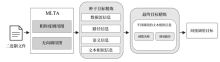
图1
HRefIC方法总体框架
表1
HRefIC规模
| 程序 | 函数数量/个 | 源代码 行数/行 | 第一阶段耗时/s | 第二阶段耗时/s |
|---|---|---|---|---|
| Linux | 552000 | 15579000 | 232 | 375 |
| Bash | 3000 | 115000 | 0.3 | 0.8 |
| MySQL | 114000 | 3936000 | 107 | 149 |
表2
调用距离分布
| 调用距离 | 目标数量/个 |
|---|---|
| 0 | 574 |
| 1 | 145 |
| 2 | 100 |
| 3 | 125 |
| 4 | 43 |
| 5 | 10 |
| 6 | 3 |
| 总计 | 1000 |
表3
不同程序的间接调用目标数量与精炼效果
| 程序 | 间接调用目标 数量/个 | 地址获取函数数量/个 | 平均目标数量/个 | ||
|---|---|---|---|---|---|
| 传统签名分析 | MLTA | HRefIC | |||
| Linux | 63000 | 216000 | 318(96%↓) | 12.7 | 4.3(66%↓) |
| Bash | 133 | 527 | 108(88%↓) | 13 | 6.0(54%↓) |
| MySQL | 14700 | 33500 | 140(92%↓) | 11.2 | 7.0(38%↓) |
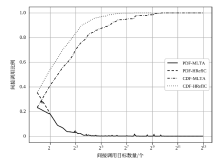
图2
间接调用目标数量分布
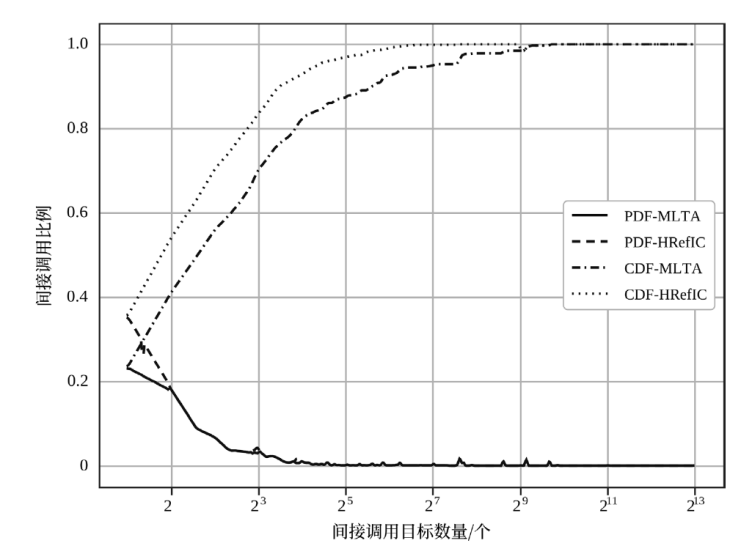
表4
HRefIC发现的新错误
| 文件 | 函数 | 变量 | 影响 |
|---|---|---|---|
| drm/i915/gem/i915_gem_phys.c | i915_gem_object_put_pages_phys | pages | NULL Pointer Deference |
| drivers/gpu/drm/i915/gem/i915_gem_stolen.c | i915_gem_object_put_pages_stolen | pages | NULL Pointer Deference |
| drivers/i2c/i2c_core_base.c | i2c_probe_func_quick_read | adap | NULL Pointer Deference |
| drivers/pci/quirks.c | delay_250ms_after_flr | dev | NULL Pointer Deference |
| drivers/gpu/drm/i915/gt/intel_ggtt.c | i915_gmch_remove | vm | Redundant Code |
| drm/amdgpu_dm_debugfs.c | dp_dsc_clocken_read | rd_buf | Memory Leak |
| drm/amdgpu_dm_debugfs.c | dp_dsc_slice_width_read | rd_buf | Memory Leak |
| drm/amdgpu_dm_debugfs.c | dp_dsc_slice_height_read | rd_buf | Memory Leak |
表5
不同编译选项下Bash的间接调用与目标精炼效果
| 编译选项 | 间接调用目标数量/个 | 地址获取函数数量/个 | 平均目标 数量/个 | HRefIC的目标数量相对MLTA的降幅 | |
|---|---|---|---|---|---|
| MLTA | HRefIC | ||||
| -O0-g-fno-inlining | 133 | 527 | 13.0 | 6.0 | 54% |
| -O2 | 121 | 498 | 11.5 | 5.2 | 55% |
| [1] | Lu Kangjie, Hu Hong. Where does it go?: refining indirect-call targets with multi-layer type analysis[C]// 2019 ACM SIGSAC Conference on Computer and Communications Security. New York: ACM, 2019: 1867-1881. |
| [2] | Blaszczyk Z M, Liang Yanting, Ecker K, et al. On the prevalence of indirect function calls in middleware software systems[C]// 2017 IEEE International Conference on Electro Information Technology (EIT). New York: IEEE, 2017: 86-91. |
| [3] | Liu Yongzhi, Chen Xiarun, Yang Zhou, et al. Automatically constructing peer slices via semantic-and context-aware security checks in the Linux kernel[C]// 2021 51st Annual IEEE/IFIP International Conference on Dependable Systems and Networks Workshops (DSN-W). New York: IEEE, 2021: 108-113. |
| [4] | Kang Yuan, Ray B, Jana S. APEx: automated inference of error specifications for C APIs[C]// The 31st IEEE/ACM International Conference on Automated Software Engineering. New York: ACM, 2016: 472-482. |
| [5] | Saha S, Lozi J P, Thomas G, et al. Hector: detecting resource-release omission faults in error-handling code for systems software[C]// 2013 43rd Annual IEEE/IFIP International Conference on Dependable Systems and Networks (DSN). New York: IEEE, 2013: 1-12. |
| [6] | Xu Meng, Qian Chenxiong, Lu Kangjie, et al. Precise and scalable detection of double-fetch bugs in OS kernels[C]// 2018 IEEE Symposium on Security and Privacy (SP). New York: IEEE, 2018: 661-678. |
| [7] | Lu Kangjie, Pakki A, Wu Qiushi. Detecting missing-check bugs via semantic-and context-aware criticalness and constraints inferences[C]// The 28th USENIX Security Symposium (USENIX Security 19). Berkeley: USENIX, 2019: 1769-1786. |
| [8] | Min C, Kashyap S, Lee B, et al. Cross-checking semantic correctness: the case of finding file system bugs[C]// The 25th Symposium on Operating Systems Principles. New York: ACM, 2015: 361-377. |
| [9] | Yun I, Min C H, Si Xujie, et al. APISan: sanitizing API usages through semantic cross-checking[C]// The 25th USENIX Security Symposium (USENIX Security 16). Berkeley: USENIX, 2016: 363-378. |
| [10] | Boonstoppel P, Cadar C, Engler D. RWset: attacking path explosion in constraint-based test generation[C]// Tools and Algorithms for the Construction and Analysis of Systems. Heidelberg: Springer, 2008: 351-366. |
| [11] | Trabish D, Mattavelli A, Rinetzky N, et al. Chopped symbolic execution[C]// The 40th International Conference on Software Engineering. New York: ACM, 2018: 350-360. |
| [12] | Abadi M, Budiu M, Erlingsson U, et al. Control-flow integrity[C]// The 12th ACM Conference on Computer and Communications Security. New York: ACM, 2005: 340-353. |
| [13] | Burow N, Carr S A, Nash J, et al. Control-flow integrity: precision, security, and performance[J]. ACM Computing Surveys, 2018, 50(1): 1-33. |
| [14] | Niu Ben, Tan Gang. Modular control-flow integrity[C]// The 35th ACM SIGPLAN Conference on Programming Language Design and Implementation. New York: ACM, 2014: 577-587. |
| [15] | Tice C, Roeder T, Collingbourne P, et al. Enforcing forward-edge control-flow integrity in GCC and LLVM[C]// The 23rd USENIX Security Symposium (USENIX Security 14). Berkeley: USENIX, 2014: 941-955. |
| [16] | Zhang Chao, Wei Tao, Chen Zhaofeng, et al. Practical control flow integrity and randomization for binary executables[C]// 2013 IEEE Symposium on Security and Privacy. New York: IEEE, 2013: 559-573. |
| [17] | Zhang Mingwei, Sekar R. Control flow integrity for COTS binaries[C]// The 22nd USENIX Security Symposium (USENIX Security 13). Berkeley: USENIX, 2013: 337-352. |
| [18] | Aigner G, Holzle U. Eliminating virtual function calls in C++ programs[C]// ECOOP’96-Object-Oriented Programming. Heidelberg: Springer, 1996: 142-166. |
| [19] | Carlini N, Barresi A, Payer M, et al. Control-flow bending: on the effectiveness of control-flow integrity[C]// The 24th USENIX Security Symposium (USENIX Security 15). Berkeley: USENIX, 2015: 161-176. |
| [20] | Conti M, Crane S, Davi L, et al. Losing control: on the effectiveness of control-flow integrity under stack attacks[C]// The 22nd ACM SIGSAC Conference on Computer and Communications Security. New York: ACM, 2015: 952-963. |
| [21] | Goktas E, Athanasopoulos E, Bos H, et al. Out of control: overcoming control-flow integrity[C]// 2014 IEEE Symposium on Security and Privacy. New York: IEEE, 2014: 575-589. |
| [22] | Schuster F, Tendyck T, Liebchen C, et al. Counterfeit object-oriented programming: on the difficulty of preventing code reuse attacks in C++ applications[C]// 2015 IEEE Symposium on Security and Privacy. New York: IEEE, 2015: 745-762. |
| [23] | Akritidis P, Cadar C, Raiciu C, et al. Preventing memory error exploits with WIT[C]// 2008 IEEE Symposium on Security and Privacy. New York: IEEE, 2008: 263-277. |
| [24] | Bletsch T, Jiang Xuxian, Freeh V. Mitigating code-reuse attacks with control-flow locking[C]// The 27th Annual Computer Security Applications Conference. New York: ACM, 2011: 353-362. |
| [25] |
Milanova A, Rountev A, Ryder B G. Precise call graphs for C programs with function pointers[J]. Automated Software Engineering, 2004, 11(1): 7-26.
doi: 10.1023/B:AUSE.0000008666.56394.a1 |
| [26] |
Sui Yulei, Xue Jingling. Value-flow-based demand-driven pointer analysis for C and C++[J]. IEEE Transactions on Software Engineering, 2020, 46(8): 812-835.
doi: 10.1109/TSE.32 URL |
| [27] | Biallas S, Olesen M C, Cassez F, et al. PtrTracker: pragmatic pointer analysis[C]// 2013 IEEE 13th International Working Conference on Source Code Analysis and Manipulation (SCAM). New York: IEEE, 2013: 69-73. |
| [28] | Farkhani R M, Jafari S, Arshad S, et al. On the effectiveness of type-based control-flow integrity[C]// The 34th Annual Computer Security Applications Conference. New York: ACM, 2018: 28-39. |
| [29] | Ge Xinyang, Talele N, Payer M, et al. Fine-grained control-flow integrity for kernel software[C]// 2016 IEEE European Symposium on Security and Privacy (EuroS&P). New York: IEEE, 2016: 179-194. |
| [30] | Ding Ren, Qian Chenxiong, Song Chengyu, et al. Efficient protection of path-sensitive control security[C]// The 26th USENIX Security Symposium (USENIX Security 17). Berkeley: USENIX, 2017: 131-148. |
| [31] |
Ge Xinyang, Cui Weidong, Jaeger T. GRIFFIN: guarding control flows using Intel Processor Trace[J]. ACM SIGPLAN Notices, 2017, 52(4): 585-598.
doi: 10.1145/3093336.3037716 URL |
| [32] | Ispoglou K K, Albassam B, Jaeger T, et al. Block-oriented programming: automating data-only attacks[C]// The 2018 ACM SIGSAC Conference on Computer and Communications Security. New York: ACM, 2018: 1868-1882. |
| [33] | Niu Ben, Tan Gang. Per-input control-flow integrity[C]// The 22nd ACM SIGSAC Conference on Computer and Communications Security. New York: ACM, 2015: 914-926. |
| [34] | Van D V V, Andriesse D, Goktas E, et al. Practical context-sensitive CFI[C]// The 22nd ACM SIGSAC Conference on Computer and Communications Security. New York: ACM, 2015: 927-940. |
| [35] | Hu Hong, Qian Chenxiong, Yagemann C, et al. Enforcing unique code target property for control-flow integrity[C]// The 2018 ACM SIGSAC Conference on Computer and Communications Security. New York: ACM, 2018: 1470-1486. |
| [36] | Schumilo S, Aschermann C, Gawlik R, et al. kAFL: hardware-assisted feedback fuzzing for OS kernels[C]// The 26th USENIX Security Symposium (USENIX Security 17). Berkeley: USENIX, 2017: 167-182. |
| [37] | Kuznetsov V, Szekeres L, Payer M, et al. Code-pointer integrity[C]// The Continuing Arms Race: Code-Reuse Attacks and Defenses. New York: ACM, 2018: 81-116. |
| [1] | 宋铮, 杨芮淇, 李化成. 仓库级静态漏洞检测综述:从规则驱动到大语言模型与智能体[J]. 信息网络安全, 2026, 26(9): 1369-1382. |
| [2] | 许朴, 孙心怡, 朱永根. 基于过程间字符串常量分析的Java注入漏洞检测方法[J]. 信息网络安全, 2026, 26(2): 304-314. |
| [3] | 张光华, 李国瑜, 王鹤, 李珩, 武少广. 基于污点流分析的物联网固件高可信度漏洞检测[J]. 信息网络安全, 2026, 26(2): 325-337. |
| [4] | 詹东阳, 黄子龙, 谭凯, 俞兆丰, 贺铮, 张宏莉. 面向Serverless应用的跨函数行为分析与约束技术[J]. 信息网络安全, 2025, 25(9): 1329-1337. |
| [5] | 王磊, 陈炯峄, 王剑, 冯袁. 基于污点分析与文本语义的固件程序交互关系智能逆向分析方法[J]. 信息网络安全, 2025, 25(9): 1385-1396. |
| [6] | 叶佳骏, 高翠凤, 薛吟兴. 基于静态分析的价格预言机操纵源代码检测方法研究[J]. 信息网络安全, 2025, 25(5): 732-746. |
| [7] | 孟辉, 毛琳琳, 彭聚智. 大语言模型驱动的无害化处理识别方法[J]. 信息网络安全, 2025, 25(12): 1990-1998. |
| [8] | 赵波, 吕佳敏, 王一琁. 一种面向容器生命周期的多维安全度量架构[J]. 信息网络安全, 2025, 25(11): 1745-1761. |
| [9] | 王鹃, 张勃显, 张志杰, 谢海宁, 付金涛, 王洋. 基于模糊测试的Java反序列化漏洞挖掘[J]. 信息网络安全, 2025, 25(1): 1-12. |
| [10] | 许良晨, 孟昭逸, 黄文超, 熊焰. 面向程序可达性验证的数组处理循环压缩方法[J]. 信息网络安全, 2024, 24(3): 374-384. |
| [11] | 陈星任, 熊焰, 黄文超, 付贵禄. 一种基于静态分析的多视图硬件木马检测方法[J]. 信息网络安全, 2023, 23(10): 48-57. |
| [12] | 杨铭, 张健. 基于图像识别的恶意软件静态检测模型[J]. 信息网络安全, 2021, 21(10): 25-32. |
| [13] | 李明磊, 黄晖, 陆余良. 面向漏洞挖掘的基于符号分治区的测试用例生成技术[J]. 信息网络安全, 2020, 20(5): 39-46. |
| [14] | 胡建伟, 赵伟, 闫峥, 章芮. 基于机器学习的SQL注入漏洞挖掘技术的分析与实现[J]. 信息网络安全, 2019, 19(11): 36-42. |
| [15] | 陈虎, 周瑶, 赵军锁. 针对特定文件结构和关键指令的符号执行优化方法[J]. 信息网络安全, 2018, 18(9): 86-94. |
| 阅读次数 | ||||||
|
全文 |
|
|||||
|
摘要 |
|
|||||