信息网络安全 ›› 2026, Vol. 26 ›› Issue (10): 1616-1635.doi: 10.3969/j.issn.1671-1122.2026.10.008
通信高效的隐私保护联邦学习方法
韩思源1, 苗银宾1, 张炜斌1, 刘淑英2( ), 刘淑琴3
- 1
西安电子科技大学网络与信息安全学院 西安 710126
2西北大学电子信息学院 西安 710127
3西安邮电大学计算机学院 西安 710121
-
收稿日期:2026-07-20出版日期:2026-10-10发布日期:2026-11-06 -
通讯作者:刘淑英 E-mail:lsynate@163.com -
作者简介:韩思源(2002—),男,陕西,硕士研究生,主要研究方向为联邦学习、隐私保护|苗银宾(1988—),男,河南,教授,博士,CCF会员,主要研究方向为隐私计算、人工智能安全|张炜斌(2000—),男,广东,博士研究生,主要研究方向为人工智能安全、无线感知安全|刘淑英(1982—),女,陕西,教授,博士,主要研究方向为机器学习,数据安全|刘淑琴(1986—),女,陕西,副教授,博士,主要研究方向为隐私保护、加密数据处理与安全检索、智能信息处理 -
基金资助:国家重点研发计划(2024YFB3108700);陕西省自然科学基础研究计划(2024JC-YBQN-0730)
Communication-efficient privacy-preserving federated learning method
Han Siyuan1, Miao Yinbin1, Zhang Weibin1, Liu Shuying2(), Liu Shuqin3
- 1
School of Cyber Engineering ,Xidian University Xi’an 710126, China
2School of Electronic Information ,Northwest University Xi’an 710127, China
3School of Computer Science and Technology ,Xi’an University of Posts and Telecommunications Xi’an 710121, China
-
Received:2026-07-20Online:2026-10-10Published:2026-11-06 -
Contact:Liu Shuying E-mail:lsynate@163.com

摘要:
针对联邦大模型微调中模型更新明文传输带来的隐私泄露风险,以及全量同态加密造成的高通信与计算开销,文章提出一种通信高效的隐私保护联邦学习方法。需要说明的是,数据异质性并不改变单次CKKS加解密的复杂度,其影响主要表现为不同客户端识别出的敏感参数位置及LoRA秩结构不一致,从而扩大待对齐的密文索引集合和聚合重构矩阵,间接增加加密、通信与分解开销。为此,首先利用中心化核对齐(CKA)量化模型层级的表示冗余度,在统一的每层加密列数上限内自适应削减冗余层的加密配额,以压缩非必要密文;然后,设计基于保序加密的三元混合协商机制,在固定层级配额内融合公共高频列、全局高敏感列与客户端长尾列,实现密文索引对齐;最后,对选定的敏感子集采用CKKS聚合,并利用随机化奇异值分解加速异构LoRA的低秩重构。实验结果表明,文章所提方法在保持模型效用的同时有效降低了通信与计算开销。消融实验表明,CKA层级配额机制能够有效减少冗余加密带来的通信开销,三元混合协商机制能够缓解数据异构场景下的密文膨胀问题,RSVD重构方法能够显著降低异构LoRA聚合过程中的计算开销。在隐私保护方面,实验结果表明,在文章设定的DAGER攻击样本与攻击配置下,当加密比例达到0.150% 及以上时,未观察到成功的隐私反演攻击。
中图分类号:
引用本文
韩思源, 苗银宾, 张炜斌, 刘淑英, 刘淑琴. 通信高效的隐私保护联邦学习方法[J]. 信息网络安全, 2026, 26(10): 1616-1635.
Han Siyuan, Miao Yinbin, Zhang Weibin, Liu Shuying, Liu Shuqin. Communication-efficient privacy-preserving federated learning method[J]. Netinfo Security, 2026, 26(10): 1616-1635.
表1
异构LoRA与隐私保护方法比较
| 方案 | 异构秩 | 隐私保护 | 层级相关性 | 选择加密 |
|---|---|---|---|---|
| MaskCrypt[ | × | Paillier同态加密 | • | × |
| SHE-LoRA[ | × | CKKS同态加密 | • | × |
| FFA-LoRA[ | • | 差分隐私 | • | • |
| SLoRA[ | • | • | • | • |
| HeterLoRA[ | × | • | • | • |
| NbAFL[ | • | 差分隐私 | • | • |
| MPCFL[ | × | 多方安全计算 | • | • |
| 本文方法 | × | CKKS同态加密 | × | × |
表2
主要符号及其含义
| 符号 | 含义 |
|---|---|
| 客户端总数、第 | |
| 客户端 | |
| 用于提取层级激活并计算CKA/Wanda指标的本地校准集 | |
| 当前通信轮及总通信轮数 | |
| LoRA层数及层索引 | |
| 客户端 | |
| 第 | |
| 客户端 | |
| 输入第 | |
| 客户端 | |
| 参与客户端层级得分的平均值及服务器据此确定的第 统一层级配额 | |
| 均匀方案的每层加密列数上限及名义总加密列数上限 | |
| 基于权重幅值与输入激活范数计算的Wanda敏感度 | |
| 第 | |
| 三元协商得到的第 | |
| 客户端 | |
| 有效单位密文代价、单位明文标量代价及第 | |
| CKKS多项式模次数、SIMD槽数、单个序列化密文字节数及明文标量字节数 | |
| 客户端 | |
| 客户端第 | |
| 三元协商中公共频次、全局敏感度和客户端长尾的列数配额 | |
| RSVD过采样维数及幂迭代次数 | |
| 名义加密比例上限及第 |
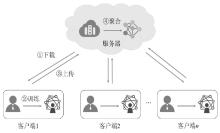
图1
系统模型
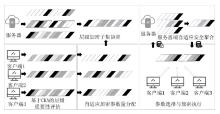
图2
算法流程
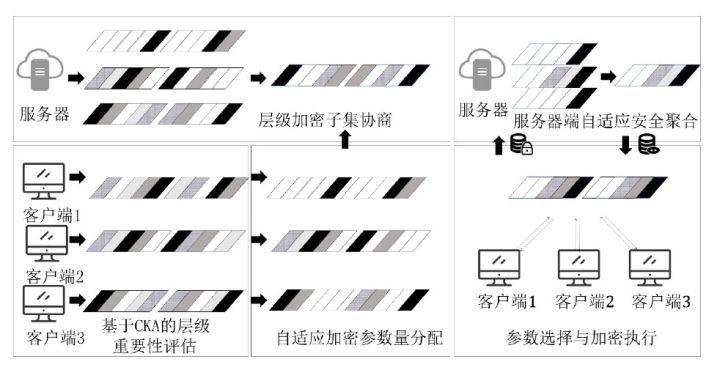
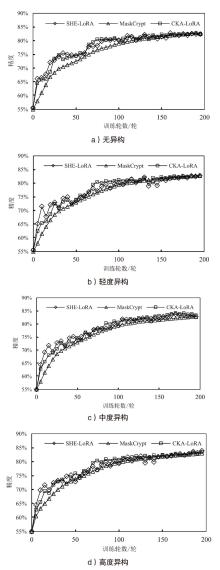
图3
OpenLLaMA-3B在IMDB数据集上的精度对比
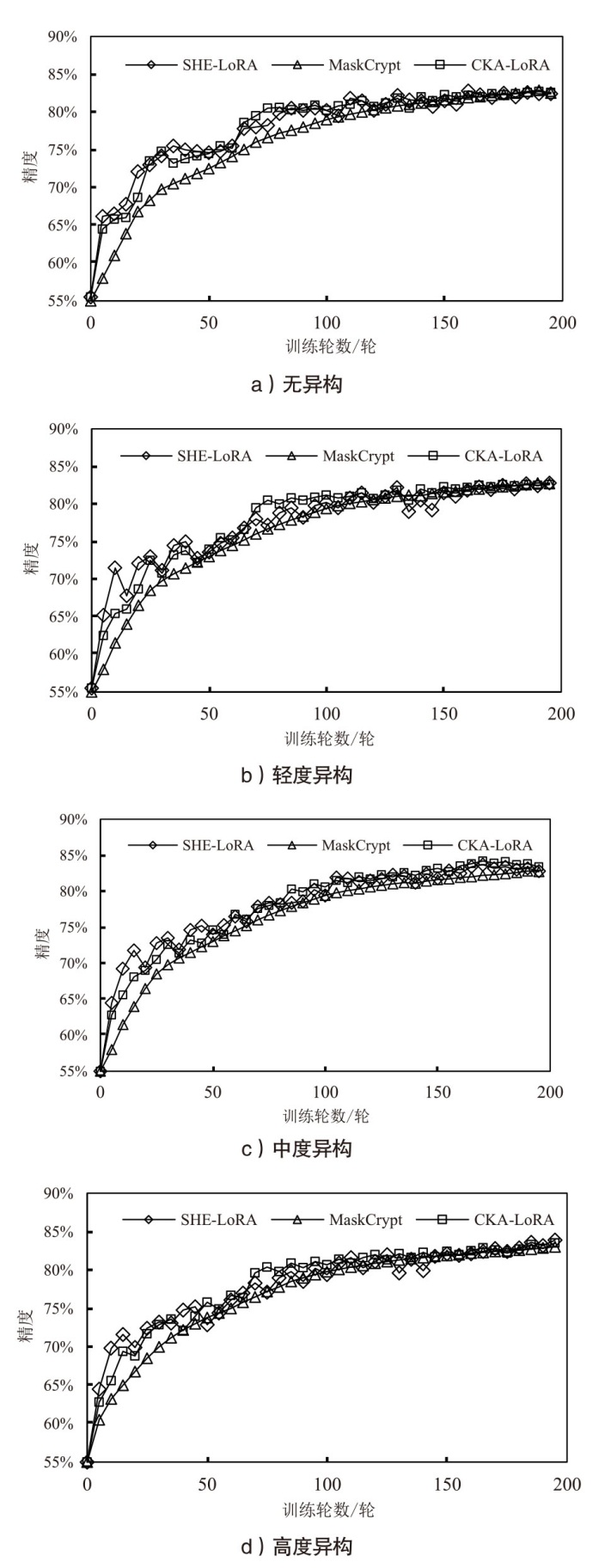
表3
OpenLLaMA-3B在Natural-Instructions数据集上的生成性能对比
| 秩配置 | 方法 | PPL | MMLU | ROUGE-L F1 |
|---|---|---|---|---|
| 无异构(6,6,6,6) | MaskCrypt | 7.136±0.895 | 28.233%±?.???% | 69.919%±?.???% |
| SHE-LoRA | 7.021±0.405 | 28.763%±?.???% | 70.574%±?.???% | |
| CKA-LoRA | 7.018±0.203 | 29.010%±?.???% | 70.931%±?.???% | |
| 轻度异构 (2,4,6,8) | MaskCrypt | 7.284±0.912 | 28.041%±?.???% | 69.672%±?.???% |
| SHE-LoRA | 7.146±0.431 | 28.5125±?.???% | 70.342%±?.???% | |
| CKA-LoRA | 7.108±0.224 | 28.842%±?.???% | 70.716%±?.???% | |
| 中度异构(2,8,16,32) | MaskCrypt | 7.561±0.974 | 27.684%±?.???% | 69.214%±?.???% |
| SHE-LoRA | 7.362±0.462 | 28.207%±?.???% | 69.981%±?.???% | |
| CKA-LoRA | 7.251±0.247 | 28.621%±?.???% | 70.421%±?.???% | |
| 高度异构(2,8,32,64) | MaskCrypt | 7.892±1.086 | 27.201%±?.???% | 68.731%±?.???% |
| SHE-LoRA | 7.648±0.508 | 27.842%±?.???% | 69.562%±?.???% | |
| CKA-LoRA | 7.431±0.286 | 28.394%±?.???% | 70.083%±?.???% |
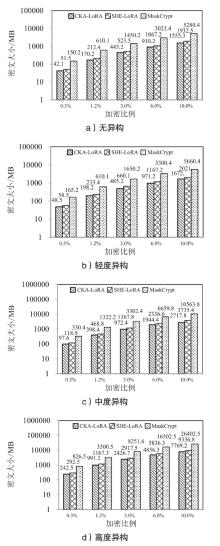
图4
不同异构秩配置下的密文传输开销对比
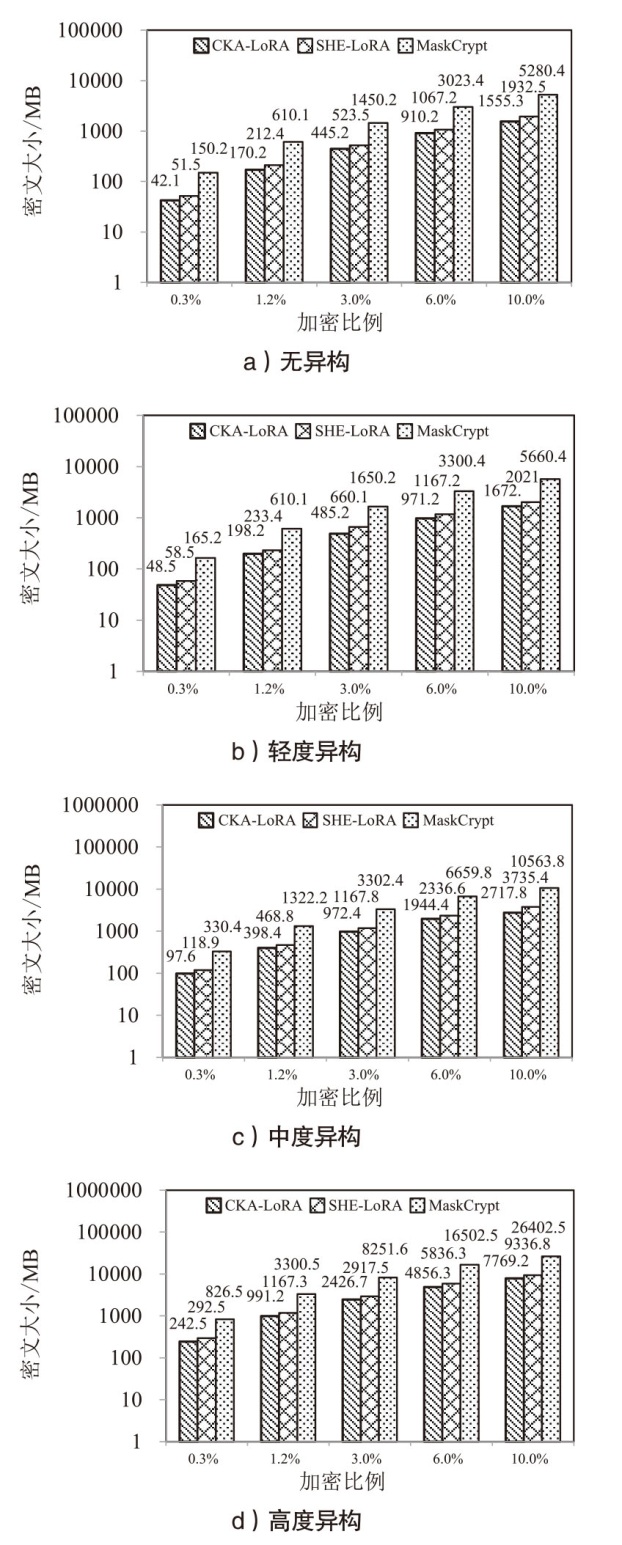
图5
不同异构秩配置下的计算时间对比
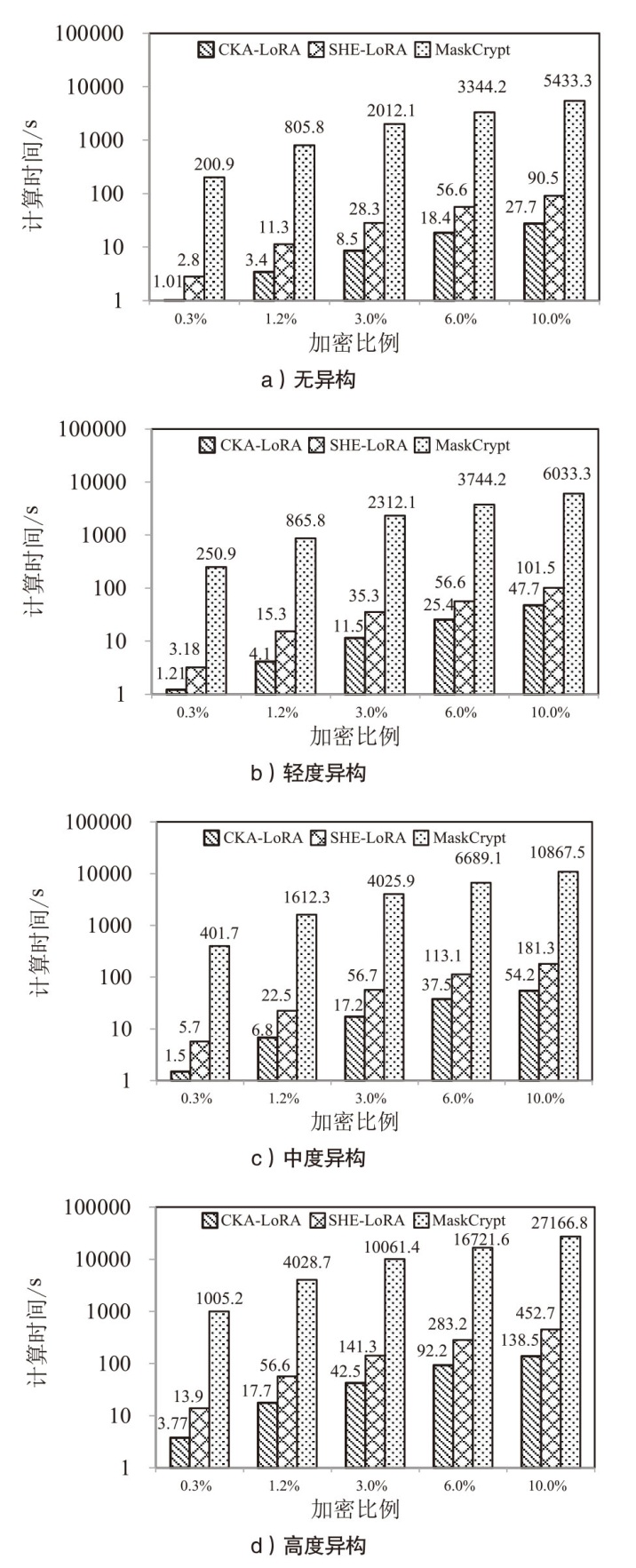
表4
OpenLLaMA-3B上三模块消融结果
| 消融实验 | PPL | MMLU | 实际加密比例 | 每轮密文量/MB | 每轮聚合 时间/s |
|---|---|---|---|---|---|
| A0 | 8.326± 1.026 | 26.23%± 1.22% | 0.2392% | 562.06 | 7.73±4.84 |
| A1 | 8.331± 1.047 | 25.61%± 0.55% | 0.2969% | 697.63 | 11.74±0.85 |
| A2 | 8.307± 1.051 | 25.00%± 0.46% | 1.2889%± 0.0039% | 3028.68± 9.08 | 12.54±0.49 |
| A3 | 8.338± 1.056 | 26.40%± 0.92% | 0.2392% | 562.06 | 1993.10±50.99 |
表5
不同加密比例下的DAGER反演结果
| 加密列数 | 加密比例 | ROUGE-L F1 | Token恢复率 | 攻击成功率 |
|---|---|---|---|---|
| 0 | 0 | 71.830%±?.???% | 56.600%±?.???% | 78.380%±?.???% |
| 1 | 0.015% | 6.780%±?.???% | 4.650%±?.???% | 3.700%±?.???% |
| 3 | 0.045% | 1.010%±?.???% | 0.547%±?.???% | 0.842%±?.???% |
| 10 | 0.150% | 0 | 0 | 0 |
| 20 | 0.300% | 0 | 0 | 0 |
| 32 | 0.500% | 0 | 0 | 0 |
| 64 | 1.000% | 0 | 0 | 0 |
| [1] |
Li Heju, Wang Rui, Wu Jun, et al. Reconfigurable intelligent surface empowered federated edge learning with statistical CSI[J]. IEEE Transactions on Wireless Communications, 2024, 23(6): 6595-6608.
doi: 10.1109/TWC.2023.3334250 URL |
| [2] | Xu Liang, Zhu Lei, Wu Yaotong, et al. SuperCLUE-Fin: graded fine-grained analysis of Chinese LLMs on diverse financial tasks and applications[PP/OL]. V1. arXiv (2024-04-29)[2026-07-10]. https://doi.org/10.48550/arXiv.2404.19063. |
| [3] |
Li Heju, Wang Rui, Jiang Mingyang, et al. STAR-RIS-empowered heterogeneous federated edge learning with flexible aggregation[J]. IEEE Internet of Things Journal, 2025, 12(14): 28374-28389.
doi: 10.1109/JIOT.2025.3565698 URL |
| [4] | Zhao Yue, Li Meng, Lai Liangzhen, et al. Federated learning with non-IID data[PP/OL]. V2. arXiv (2022-07-21)[2026-07-10]. https://doi.org/10.48550/arXiv.1806.00582. |
| [5] | Li Heju, Wang Rui, Wu Jun, et al. Federated edge learning via reconfigurable intelligent surface with one-bit quantization[C]// 2022 IEEE Global Communications Conference. New York: IEEE, 2022: 1055-1060. |
| [6] | Hu E J, Shen Yelong, Wallis P, et al. LoRA: low-rank adaptation of large language models[PP/OL]. V2. arXiv (2021-10-16)[2026-07-10]. https://doi.org/10.48550/arXiv.2106.09685. |
| [7] | Stich S U, Cordonnier J B, Jaggi M. Sparsified SGD with memory[PP/OL]. V2. arXiv (2018-11-28)[2026-07-10]. https://doi.org/10.48550/arXiv.1809.07599. |
| [8] | Lin Yujun, Han Song, Mao Huizi, et al. Deep gradient compression: reducing the communication bandwidth for distributed training[PP/OL]. V3. arXiv (2020-06-23)[2026-07-10]. https://doi.org/10.48550/arXiv.1712.01887. |
| [9] | Zhu Ligeng, Liu Zhijian, Han Song. Deep leakage from gradients[C]// Advances in Neural Information Processing Systems. Red Hook: Curran Associates, 2019: 14774-14784. |
| [10] | Geiping J, Bauermeister H, Dröge H, et al. Inverting gradients—how easy is it to break privacy in federated learning?[C]// Advances in Neural Information Processing Systems. Red Hook: Curran Associates, 2020: 16937-16947. |
| [11] |
Wang Shiqiang, Tuor T, Salonidis T, et al. Adaptive federated learning in resource constrained edge computing systems[J]. IEEE Journal on Selected Areas in Communications, 2019, 37(6): 1205-1221.
doi: 10.1109/JSAC.2019.2904348 |
| [12] |
Hu Chenghao, Li Baochun. MaskCrypt: federated learning with selective homomorphic encryption[J]. IEEE Transactions on Dependable and Secure Computing, 2025, 22(1): 221-233.
doi: 10.1109/TDSC.2024.3392424 URL |
| [13] | Liu Jianmin, Yan Li, Li Borui, et al. SHE-LoRA: selective homomorphic encryption for federated tuning with heterogeneous LoRA[PP/OL]. V2. arXiv (2026-02-21)[2026-07-10]. https://doi.org/10.48550/arXiv.2505.21051. |
| [14] | Sun Youbang, Li Zitao, Li Yaliang, et al. Improving LoRA in privacy-preserving federated learning[PP/OL]. V1. arXiv (2024-03-18)[2026-07-10]. https://doi.org/10.48550/arXiv.2403.12313. |
| [15] | Babakniya S, Elkordy A R, Ezzeldin Y H, et al. SLoRA: federated parameter efficient fine-tuning of language models[PP/OL]. V1. arXiv (2023-08-12)[2026-07-10]. https://doi.org/10.48550/arXiv.2308.06522. |
| [16] | Li Tian, Sahu A K, Zaheer M, et al. Federated optimization in heterogeneous networks[J]. Proceedings of Machine Learning and Systems, 2020(2): 429-450. |
| [17] | Karimireddy S P, Kale S, Mohri M, et al. SCAFFOLD: stochastic controlled averaging for federated learning[C]// The 37th International Conference on Machine Learning. Cambridge: PMLR, 2020: 5132-5143. |
| [18] | Wang Jianyu, Liu Qinghua, Liang Hao, et al. Tackling the objective inconsistency problem in heterogeneous federated optimization[C]// Advances in Neural Information Processing Systems. Red Hook: Curran Associates, 2020: 7611-7623. |
| [19] | Cho Y J, Liu Luyang, Xu Zheng, et al. Heterogeneous LoRA for federated fine-tuning of on-device foundation models[C]// The 2024 Conference on Empirical Methods in Natural Language Processing. Stroudsburg: ACL, 2024: 12903-12913. |
| [20] | Bai Jiamu, Chen Daoyuan, Qian Bingchen, et al. Federated fine-tuning of large language models under heterogeneous tasks and client resources[PP/OL]. V2. arXiv (2024-05-30)[2026-07-10]. https://doi.org/10.48550/arXiv.2402.11505. |
| [21] | Yan Yunlu, Feng Chunmei, Zuo Wangmeng, et al. Federated residual low-rank adaptation of large language models[C]// The 13th International Conference on Learning Representations. San Diego: ICLR, 2025: 30657-30681. |
| [22] |
Wei Kang, Li Jun, Ding Ming, et al. Federated learning with differential privacy: algorithms and performance analysis[J]. IEEE Transactions on Information Forensics and Security, 2020, 15: 3454-3469.
doi: 10.1109/TIFS.2020.2988575 URL |
| [23] | Kaminaga H, Awaysheh F, Alawadi S, et al. MPCFL: towards multi-party computation for secure federated learning aggregation[C]// The 16th IEEE/ACM International Conference on Utility and Cloud Computing. New York: ACM, 2023: 1-10. |
| [24] | Bonawitz K A, Ivanov V, Kreuter B, et al. Practical secure aggregation for privacy-preserving machine learning[C]// The 2017 ACM SIGSAC Conference on Computer and Communications Security. New York: ACM, 2017: 1175-1191. |
| [25] | Zhang Chengliang, Li Suyi, Xia Junming, et al. BatchCrypt: efficient homomorphic encryption for cross-silo federated learning[C]// 2020 USENIX Annual Technical Conference. Berkeley: USENIX, 2020: 493-506. |
| [26] | Jin Weizhao, Yao Yuhang, Han Shanshan, et al. FedML-HE: an efficient homomorphic-encryption-based privacy-preserving federated learning system[PP/OL]. V3. arXiv (2024-06-17)[2026-07-10]. https://doi.org/10.48550/arXiv.2303.10837. |
| [27] | Kornblith S, Norouzi M, Lee H, et al. Similarity of neural network representations revisited[C]// The 36th International Conference on Machine Learning. Cambridge: PMLR, 2019: 3519-3529. |
| [28] | McMahan H B, Moore E, Ramage D, et al. Communication-efficient learning of deep networks from decentralized data[C]// The 20th International Conference on Artificial Intelligence and Statistics. Cambridge: PMLR, 2017: 1273-1282. |
| [29] | Zheng Xiawu, Fei Xiang, Zhang Lei, et al. Neural architecture search with representation mutual information[C]// Proceedings of the IEEE/CVF Conference on Computer Vision and Pattern Recognition. New York: IEEE/CVF, 2022: 11912-11921. |
| [30] | Tishby N, Pereira F C, Bialek W. The information bottleneck method[C]// The 37th Annual Allerton Conference on Communication, Control, and Computing. Monticello: University of Illinois, 1999: 368-377. |
| [31] |
Halko N, Martinsson P G, Tropp J A. Finding structure with randomness: probabilistic algorithms for constructing approximate matrix decompositions[J]. SIAM Review, 2011, 53(2): 217-288.
doi: 10.1137/090771806 URL |
| [32] | Cheon J H, Kim A, Kim M, et al. Homomorphic encryption for arithmetic of approximate numbers[C]// Advances in Cryptology—ASIACRYPT 2017. Heidelberg: Springer, 2017: 409-437. |
| [33] | Petrov I, Dimitrov D I, Baader M, et al. DAGER: exact gradient inversion for large language models[PP/OL]. V2. arXiv (2024-11-13)[2026-07-10]. https://doi.org/10.48550/arXiv.2405.15586. |
| [34] | Boldyreva A, Chenette N, Lee Y, et al. Order-preserving symmetric encryption[C]// Advances in Cryptology—EUROCRYPT 2009. Heidelberg: Springer, 2009: 224-241. |
| [35] | Sun Mingjie, Liu Zhuang, Bair A, et al. A simple and effective pruning approach for large language models[PP/OL]. V3. arXiv (2024-05-06)[2026-07-10]. https://doi.org/10.48550/arXiv.2306.11695. |
| [36] | Geng Xinyang, Liu Hao. OpenLLaMA: an open reproduction of LLaMA[EB/OL]. [2026-07-10]. https://github.com/openlm-research/open_llama. |
| [37] | Mishra S, Khashabi D, Baral C, et al. Cross-task generalization via natural language crowdsourcing instructions[C]// The 60th Annual Meeting of the Association for Computational Linguistics. Stroudsburg: ACL, 2022: 3470-3487. |
| [38] | Maas A L, Daly R E, Pham P T, et al. Learning word vectors for sentiment analysis[C]// The 49th Annual Meeting of the Association for Computational Linguistics: Human Language Technologies. Stroudsburg: ACL, 2011: 142-150. |
| [39] | Benaissa A, Retiat B, Cebere B, et al. TenSEAL: a library for encrypted tensor operations using homomorphic encryption[PP/OL]. V2. arXiv (2021-04-28)[2026-07-10]. https://doi.org/10.48550/arXiv.2104.03152. |
| [40] | Beutel D J, Topal T, Mathur A, et al. Flower: a friendly federated learning research framework[PP/OL]. V5. arXiv (2022-03-05)[2026-07-10]. https://doi.org/10.48550/arXiv.2007.14390. |
| [41] | Hendrycks D, Burns C, Basart S, et al.Measuring massive multitask language understanding[PP/OL]. V1. arXiv (2020-09-07)[2026-07-10]. https://doi.org/10.48550/arXiv.2009.03300. |
| [42] | Wang A, Singh A, Michael J, et al. GLUE: a multi-task benchmark and analysis platform for natural language understanding[C]// The 2018 EMNLP Workshop BlackboxNLP:Analyzing and Interpreting Neural Networks for NLP. Stroudsburg: ACL, 2018: 353-355. |
| [1] | 聂豪杰, 孙德刚, 潘兴博, 万巍, 龙春. 面向大语言模型的成员推理攻击与防御技术综述[J]. 信息网络安全, 2026, 26(9): 1341-1353. |
| [2] | 马文飞, 龙春, 李婧, 杨帆, 付豫豪. 大语言模型微调阶段的后门投毒:攻击、防御与评估[J]. 信息网络安全, 2026, 26(9): 1354-1368. |
| [3] | 宋铮, 杨芮淇, 李化成. 仓库级静态漏洞检测综述:从规则驱动到大语言模型与智能体[J]. 信息网络安全, 2026, 26(9): 1369-1382. |
| [4] | 朱晓强, 林彦孜, 张皓文, 姚英英. 基于多维特征与动态防御的区块链联邦学习鲁棒聚合方法[J]. 信息网络安全, 2026, 26(9): 1391-1407. |
| [5] | 姚戊煌, 王佳鹏, 陈康冰, 郑之涵, 谭毓安. 基于指令翻译插桩的LLM辅助固件内存泄漏分析[J]. 信息网络安全, 2026, 26(7): 1087-1100. |
| [6] | 杨乔炀, 范希明, 贾鹏. 基于大语言模型的语义知晓的模糊测试驱动生成方案[J]. 信息网络安全, 2026, 26(7): 1128-1148. |
| [7] | 宋孟元, 夏辉. 基于知识蒸馏和对抗样本的联邦遗忘方法[J]. 信息网络安全, 2026, 26(7): 1149-1163. |
| [8] | 孙钰, 张轩瑞, 刘新宇. 高级持续性威胁检测与溯源研究进展[J]. 信息网络安全, 2026, 26(6): 833-853. |
| [9] | 张浩, 叶骏威. 基于深度主动学习的联邦半监督入侵检测系统[J]. 信息网络安全, 2026, 26(6): 944-957. |
| [10] | 苗博, 袁得嵛, 张腾, 杨懿, 黄赞. 基于思维链污染的检索增强生成后门攻击[J]. 信息网络安全, 2026, 26(6): 977-998. |
| [11] | 胡倾城, 张婉, 袁亚丽, 张静. 基于多视图知识增强的大语言模型事实型幻觉优化方法[J]. 信息网络安全, 2026, 26(5): 772-787. |
| [12] | 李子豪, 张锋巍. 基于可信执行环境的联邦学习平台[J]. 信息网络安全, 2026, 26(5): 788-808. |
| [13] | 崔津华, 董亮, 杨新. 大语言模型推理隐私保护技术综述[J]. 信息网络安全, 2026, 26(4): 503-520. |
| [14] | 李岩, 杨文章, 薛吟兴. 基于LLM翻译与差分测试的跨语言编译器模糊测试[J]. 信息网络安全, 2026, 26(4): 591-604. |
| [15] | 胡勉宁, 李欣, 李明锋, 袁得嵛. 基于大语言模型的多策略增强中文网络威胁情报实体抽取研究[J]. 信息网络安全, 2026, 26(4): 615-625. |
| 阅读次数 | ||||||
|
全文 |
|
|||||
|
摘要 |
|
|||||