Netinfo Security ›› 2026, Vol. 26 ›› Issue (10): 1595-1615.doi: 10.3969/j.issn.1671-1122.2026.10.007
Previous Articles Next Articles
Privacy-preserving and anti-poisoning method for hierarchical federated learning
Liu Yuanxin, Liang Yihuai( ), Zhou Zhengchun
School of Information Science and Technology ,Southwest Jiaotong University Chengdu 611756, China
-
Received:2026-02-04Online:2026-10-10Published:2026-11-06 -
Contact:Liang Yihuai E-mail:liangyh@swjtu.edu.cn

CLC Number:
Cite this article
Liu Yuanxin, Liang Yihuai, Zhou Zhengchun. Privacy-preserving and anti-poisoning method for hierarchical federated learning[J]. Netinfo Security, 2026, 26(10): 1595-1615.
share this article
Add to citation manager EndNote|Ris|BibTeX
URL: http://netinfo-security.org/EN/10.3969/j.issn.1671-1122.2026.10.007
| 方案 | 分层联邦学习 | 考虑 non-IID | 防范服务器 合谋 | 隐私 保护 | 防范服务器宕机 | 防御 投毒 |
|---|---|---|---|---|---|---|
| GALAXY[ | — | — | √ | √ | √ | √ |
| SHIELD[ | √ | √ | — | — | — | √ |
| RoPPFL[ | √ | √ | — | √ | — | √ |
| PFLS[ | √ | √ | — | √ | — | √ |
| EPIFL[ | √ | √ | — | √ | √ | √ |
| ShieldFL[ | — | √ | — | √ | — | √ |
| ESFL[ | — | √ | — | √ | — | √ |
| MODEL[ | — | √ | — | — | — | √ |
| RoHFL[ | √ | √ | — | — | — | √ |
| BHFL[ | √ | √ | √ | √ | — | √ |
| ApaPRFL[ | √ | — | — | √ | — | √ |
| APFed[ | √ | √ | — | √ | — | √ |
| PDSA[ | √ | √ | √ | √ | — | √ |
| 本文方案 | √ | √ | √ | √ | √ | √ |
| 符号 | 描述 |
|---|---|
| m | 客户端总数 |
| U | HFL中地理区域的集合 |
| N | 单个区域内边缘服务器的总数 |
| T | SSS的门限值 |
| K | GMM聚类中的簇总数 |
| d | 客户端梯度的维度 |
| deg | 精度值 |
| 客户端i在t轮时的梯度向量 | |
| $\boldsymbol{G}_{i}^{t \prime}$ | 客户端i在t轮时整数化后的梯度向量 |
| 客户端i在t轮时的梯度向量份额 | |
| 区域a在第t轮的区域聚合梯度向量份额 | |
| 簇k的权重值 | |
| 簇k的均值向量 | |
| 簇k的对角协方差向量 | |
| GMM迭代停止的收敛阈值 | |
| Imax | GMM的最大迭代次数 |
| i | 客户端索引 |
| j | 维度索引 |
| k | 簇索引 |
| 阶段 | 算法 | 计算复杂度 | 通信复杂度 |
|---|---|---|---|
| 单客户端 本地训练 | GALAXY | O(N·d) | O(N·d) |
| EPIFL | O(d) | O(d) | |
| 本文方案 | O(N·d) | O(N·d) | |
| 边缘服务器 聚合 | GALAXY | O(N2·m·d) | O(N2·m·d) |
| EPIFL | O(m·d) | O(m·d) | |
| 本文方案 | O(N2·m·d) | O(N2·m·d) | |
| 云服务器 全局聚合 | GALAXY | — | — |
| EPIFL | O(U·d) | O(U·d) | |
| 本文方案 | O(U2·N·d) | O(U·N·d) |
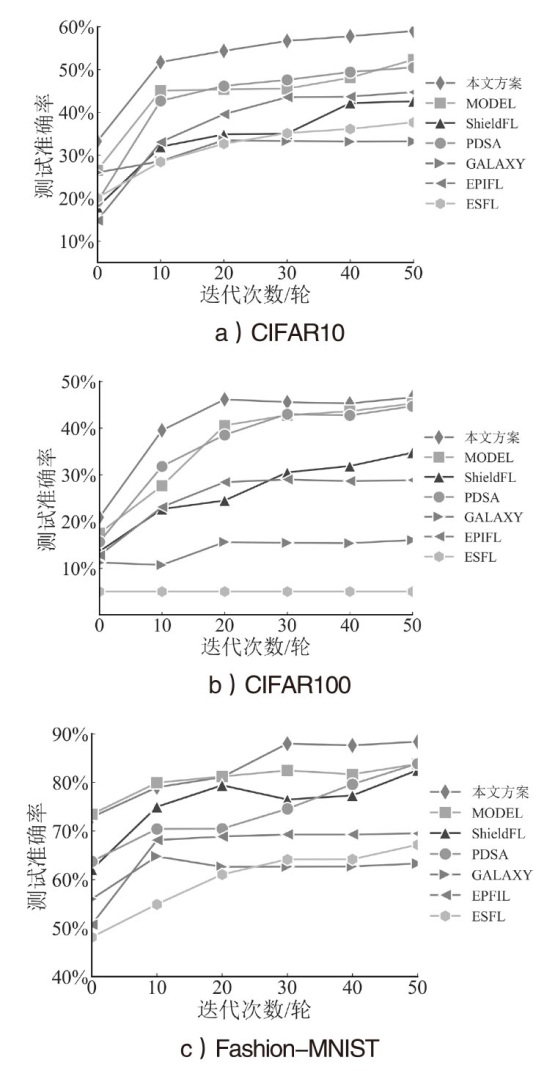
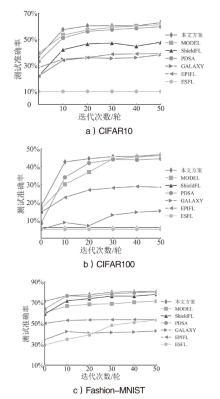
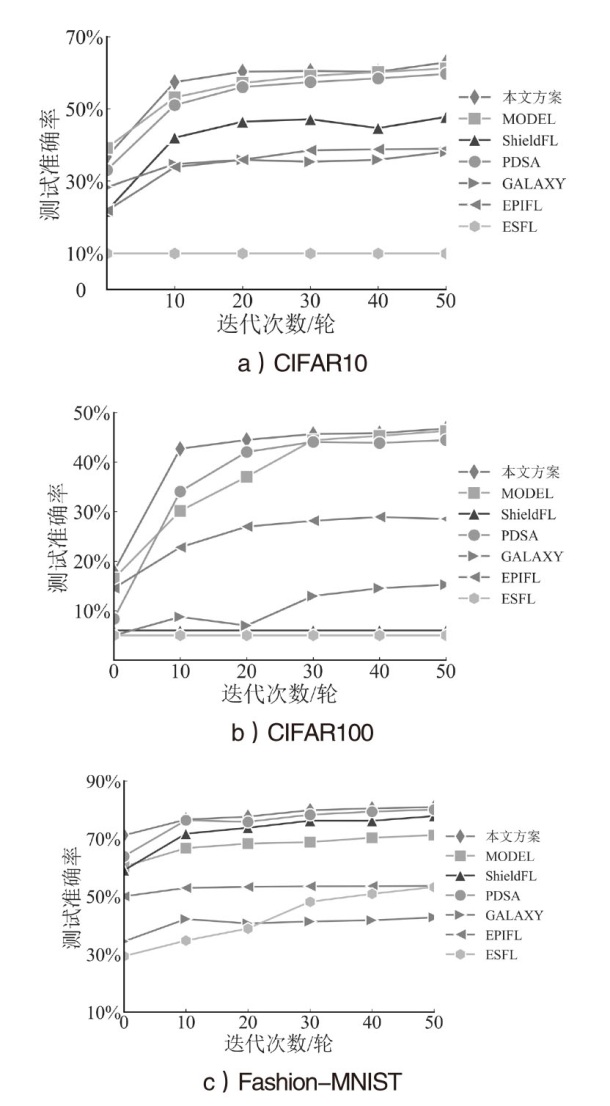
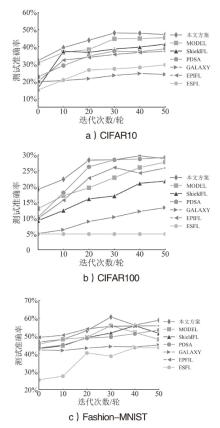
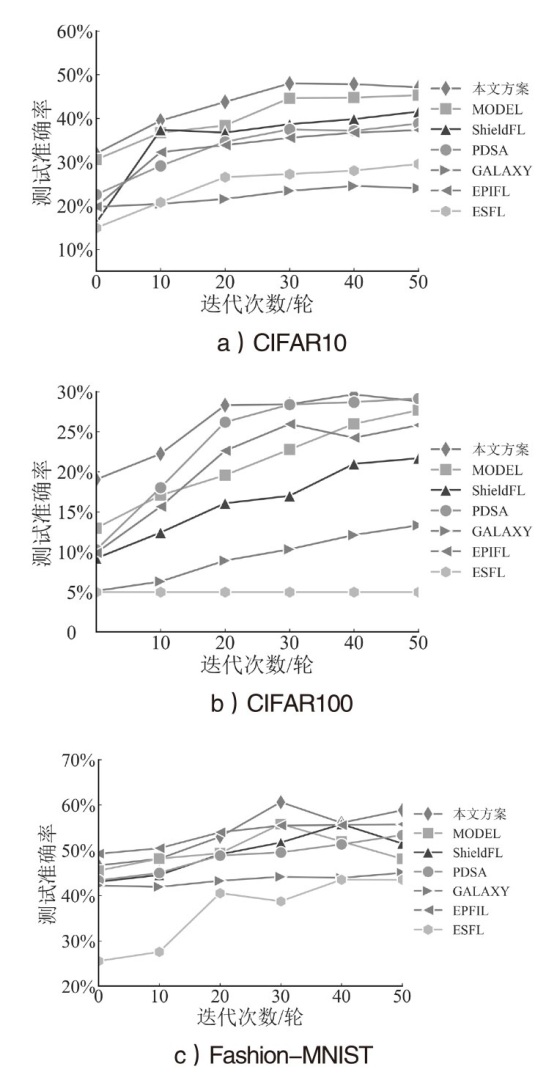
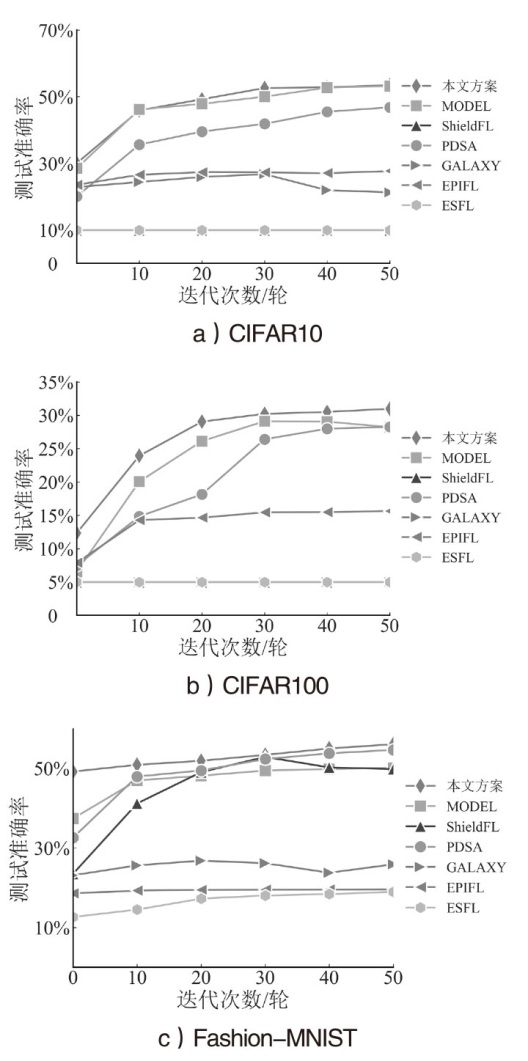
| 方案 | 收敛期准确率方差 (标签翻转攻击下) | 收敛期准确率方差 (后门攻击下) |
|---|---|---|
| 本文方案 | 0.154 | 0.131 |
| MODEL | 0.088 | 1.994 |
| ShieldFL | 1.409 | 0 |
| PDSA | 0.519 | 4.375 |
| GALAXY | 0.203 | 5.907 |
| EPIFL | 0.531 | 0.068 |
| ESFL | 0.912 | 0 |
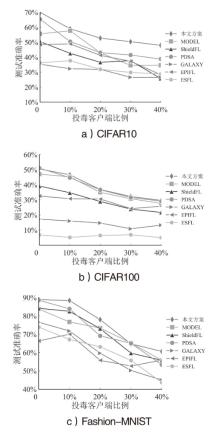
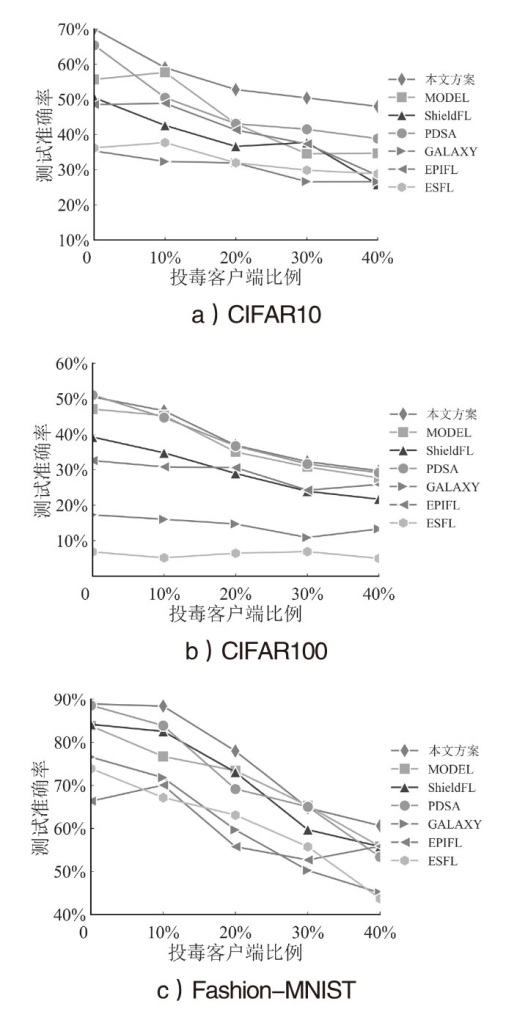
| 投毒 客户端比例 | 仅应用 缩放点积注意力机制 | 仅应用GMM | 本文方案 |
|---|---|---|---|
| 0 | 61.56% | 65.85% | 70.00% |
| 10% | 46.88% | 48.22% | 58.98% |
| 20% | 42.50% | 47.64% | 52.76% |
| 30% | 44.48% | 44.89% | 50.38% |
| 40% | 40.96% | 40.47% | 47.98% |
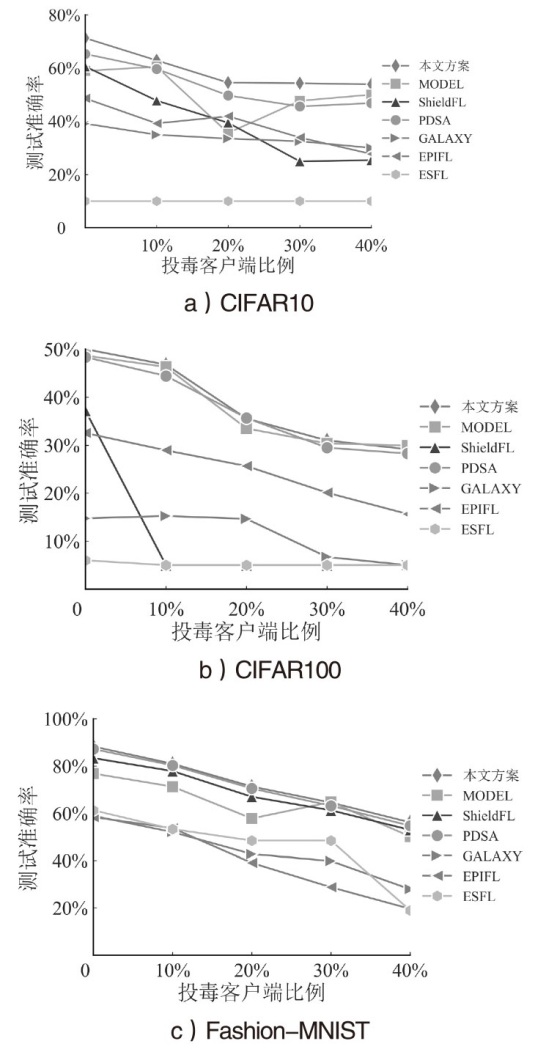
| 投毒 客户端比例 | 仅应用 缩放点积注意力机制 | 仅应用GMM | 本文方案 |
|---|---|---|---|
| 0 | 65.00% | 57.35% | 71.26% |
| 10% | 54.09% | 55.55% | 62.87% |
| 20% | 45.95% | 45.42% | 54.50% |
| 30% | 36.19% | 50.41% | 54.30% |
| 40% | 35.25% | 46.29% | 53.86% |
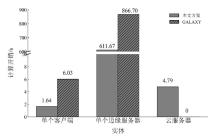
| [1] | Le Junqing, Zhang Di, Lei Xinyu, et al. Privacy-preserving federated learning with malicious clients and honest-but-curious servers[J]. IEEE Transactions on Information Forensics and Security, 2023, 18: 4329-4344. |
| [2] | Zhang Zhuangzhuang, Wu Libing, Ma Chuanguo, et al. LSFL: a lightweight and secure federated learning scheme for edge computing[J]. IEEE Transactions on Information Forensics and Security, 2022, 18: 365-379. |
| [3] | Li Yiran, Li Hongwei, Xu Guowen, et al. Practical privacy-preserving federated learning in vehicular fog computing[J]. IEEE Transactions on Vehicular Technology, 2022, 71(5): 4692-4705. |
| [4] | Hazra A, Rana P, Adhikari M, et al. Fog computing for next-generation internet of things: fundamental, state-of-the-art and research challenges[J]. Computer Science Review, 2023, 48: 100549. |
| [5] | Liu Yi, Nie Jiangtian, Li Xuandi, et al. Federated learning in the sky: aerial-ground air quality sensing framework with uav swarms[J]. IEEE Internet of Things Journal, 2020, 8(12): 9827-9837. |
| [6] | Liu Lumin, Zhang Jun, Song S H, et al. Client-Edge-Cloud hierarchical federated learning[C]// The 2020 IEEE International Conference on Communications (ICC 2020). New York: IEEE, 2020: 1-6. |
| [7] | Lim W Y B, Luong N C, Hoang D T, et al. Federated learning in mobile edge networks: a comprehensive survey[J]. IEEE Communications Surveys & Tutorials, 2020, 22(3): 2031-2063. |
| [8] | Siriwardhana Y, Pawani P, Liyanage M, et al. SHIELD-Secure aggregation against poisoning in hierarchical federated learning[J]. IEEE Transactions on Dependable and Secure Computing, 2025, 22(2): 1845-1863. |
| [9] | Li Yanbin, Wang Xuemei, Sun Runkang, et al. Trustiness-Based hierarchical decentralized federated learning[J]. Knowledge-Based Systems, 2023, 276: 110763. |
| [10] | Zhou Hongliang, Zheng Yifeng, Jia Xiaohua. Towards robust and privacy-preserving federated learning in edge computing[J]. Computer Networks, 2024, 243: 110321. |
| [11] | Li Xiumin, Wen Mi, He Siying, et al. A privacy-preserving federated learning scheme against poisoning attacks in smart grid[J]. IEEE Internet of Things Journal, 2024, 11(9): 16805-16816. |
| [12] | Li Xueyang, Liang Yihuai, Zhou Zhengchun, et al. Efficient privacy-preserving federated learning with integrity in fog computing[J]. IEEE Transactions on Network Science and Engineering, 2026, 13: 391-407. |
| [13] | Xu Guowen, Li Hongwei, Ren Hao, et al. Data security issues in deep learning: attacks, countermeasures, and opportunities[J]. IEEE Communications Magazine, 2019, 57(11): 116-122. |
| [14] | Melis L, Song Congzheng, De C E, et al.Exploiting unintended feature leakage in collaborative learning[C]//2019 IEEE Symposium on Security and Privacy (SP). New York: IEEE, 2019: 691-706. |
| [15] | Miao Yinbin, Yan Xinru, Li Xinghua, et al. RFed: robustness-enhanced privacy-preserving federated learning against poisoning attack[J]. IEEE Transactions on Information Forensics and Security, 2024, 19: 5814-5827. |
| [16] | Bonawitz K, Ivanov V, Kreuter B, et al. Practical secure aggregation for privacy-preserving machine learning[C]// The 2017 ACM SIGSAC Conference on Computer and Communications Security. New York: ACM, 2017: 1175-1191. |
| [17] | Vaswani A, Shazeer N, Parmar N, et al. Attention is all you need[C]// The 31st International Conference on Neural Information Processing Systems. New York: Curran Associates, 2017: 6000-6010. |
| [18] | Ma Zhuoran, Ma Jianfeng, Miao Yinbin, et al. ShieldFL: mitigating model poisoning attacks in privacy-preserving federated learning[J]. IEEE Transactions on Information Forensics and Security, 2022, 17: 1639-1654. |
| [19] | Zeng Honghong, Lou Jiong, Li Kailai, et al. ESFL: accelerating poisonous model detection in privacy-preserving federated learning[J]. IEEE Transactions on Dependable and Secure Computing, 2025, 22(4): 3780-3794. |
| [20] | Wu Minzhe, Zhao Bowen, Xiao Yang, et al. MODEL: a model poisoning defense framework for federated learning via truth discovery[J]. IEEE Transactions on Information Forensics and Security, 2024, 19: 8747-8759. |
| [21] | Li Xueyang, Yang Xue, Zhou Zhengchun, et al. Efficiently achieving privacy preservation and poisoning attack resistance in federated learning[J]. IEEE Transactions on Information Forensics and Security, 2024, 19: 4358-4373. |
| [22] | Zhou Hongliang, Zheng Yifeng, Huang Hejiao, et al. Toward robust hierarchical federated learning in internet of vehicles[J]. IEEE Transactions on Intelligent Transportation Systems, 2023, 24(5): 5600-5614. |
| [23] | Liu Jingwei, Wu Yufeng, Du Wei, et al. Byzantine-Robust hierarchical aggregation for cross-device federated learning in consumer IoT[J]. IEEE Transactions on Consumer Electronics, 2024, 71(2): 6359-6370. |
| [24] | Zuo Shaojun, Xie Yong, Wu Libing, et al. ApaPRFL: robust privacy-preserving federated learning scheme against poisoning adversaries for intelligent devices using edge computing[J]. IEEE Transactions on Consumer Electronics, 2024, 70(1): 725-734. |
| [25] | Chen Xiao, Yu Haining, Jia Xiaohua, et al. APFed: anti-poisoning attacks in privacy-preserving heterogeneous federated learning[J]. IEEE Transactions on Information Forensics and Security, 2023, 18: 5749-5761. |
| [26] | Huang Zixuan, Bi Yuanguo, Zhang Kuan, et al. PDSA-FL: a poisoning-defense secure aggregation in federated learning[J]. IEEE Transactions on Information Forensics and Security, 2025, 20: 7617-7632. |
| [27] | Liang Yihuai, Li Yan, Shin B S. Privacy-Preserving and reliable truth discovery for heterogeneous fog-based crowdsensing[J]. IEEE Transactions on Dependable and Secure Computing, 2025, 22(3): 2338-2351. |
| [28] | Shamir A. How to share a secret[J]. Communications of the ACM, 1979, 22(11): 612-613. |
| [29] | Fu Yinlin, Liu Xiaonan, Sarkar S, et al. Gaussian mixture model with feature selection: an embedded approach[J]. Computers & Industrial Engineering, 2021, 152: 107000. |
| [30] | Xu Lei, Jordan M I. On convergence properties of the EM algorithm for gaussian mixtures[J]. Neural Computation, 1996, 8(1): 129-151. |
| [31] | Zhu Ligeng, Liu Zhijian, Han Song. Deep leakage from gradients[C]// The 33rd International Conference on Neural Information Processing Systems. New York: NeurIPS, 2019, 1323: 14774-14784. |
| [32] | Pasquini D, Ateniese G, Bernaschi M. Unleashing the tiger: inference attacks on split learning[C]// The 2021 ACM SIGSAC Conference on Computer and Communications Security. New York: ACM, 2021: 2113-2129. |
| [33] | Li Guohao, Yang Li, Zhou Lu, et al. Practical and collusion-resistant privacy-preserving aggregation for edge intelligence[J]. IEEE Transactions on Dependable and Secure Computing, 2025, 22(6): 7229-7243. |
| [34] | Liu Yuanxin, Liang Yihuai, Zhang Rui, et al. Secure federated learning with configurable reliability in heterogeneous edge computing[J]. Computer Networks, 2026, 274: 111808. |
| [1] | GUO Qian, ZHAO Jin, GUO Yi. Hierarchical Clustering Federated Learning Framework for Personalized Privacy-Preserving [J]. Netinfo Security, 2024, 24(8): 1196-1209. |
| [2] | LI Zengpeng, WANG Siyang, WANG Mei. Research of Privacy-Preserving Proximity Test [J]. Netinfo Security, 2024, 24(6): 817-830. |
| [3] | LI Xiaohua, WANG Suhang, LI Kai, XU Jian. A Privacy-Preserving Analysis Model of Human-to-Human Transmission of Infectious Diseases [J]. Netinfo Security, 2023, 23(3): 35-44. |
| [4] | WANG Jingyu, MA Zhaofeng, XU Danheng, DUAN Pengfei. Blockchain Transaction Data Privacy-Preserving Scheme Supporting National Cryptographic Algorithm [J]. Netinfo Security, 2023, 23(3): 84-95. |
| [5] | SUN Yongqi, SONG Zewen, ZHU Weiguo, ZHAO Sicong. Image Classification Method Based on Secure Multiparty Computation [J]. Netinfo Security, 2023, 23(11): 27-37. |
| [6] | WANG Sidie, MA Zhaofeng, LUO Shoushan, XU Danheng. Data Privacy-Preserving Scheme on Blockchain for Heterogeneous Multi-Chain [J]. Netinfo Security, 2022, 22(12): 67-75. |
| [7] | TANG Chunming, LIN Xuhui. Protocol of Privacy-preserving Set Intersection Computation [J]. Netinfo Security, 2020, 20(1): 9-15. |
| [8] | Zhiyan ZHAO, Jian WU, Kai KANG. Privacy Preserving Provenance Publishing Method Accommodating Business Data Security [J]. Netinfo Security, 2019, 19(12): 29-37. |
| [9] | Hong JIANG, Baoyuan KANG, Chunqing LI. Improved Auditing Schemes with Identity-preserving for the Integrity of Shared Data in the Cloud [J]. Netinfo Security, 2018, 18(10): 85-91. |
| [10] | Xixi YAN, Yuan LIU, Zichen Li, Qinlong Huang. A Privacy-preserving Multi-authority Attribute-based Encryption Scheme on Ideal Lattices in the Cloud Environment [J]. Netinfo Security, 2017, 17(8): 19-25. |
| [11] | Xu-dong SHAO, Yang LIU. A Framework Design for Preventing Android from Apps Privilege-Escalation Attacks [J]. Netinfo Security, 2015, 15(9): 89-92. |
| [12] | TANG Chun-ming, ZHENG Xiao-long. [J]. Netinfo Security, 2015, 15(2): 19-25. |
| Viewed | ||||||
|
Full text |
|
|||||
|
Abstract |
|
|||||