Netinfo Security ›› 2025, Vol. 25 ›› Issue (12): 1847-1862.doi: 10.3969/j.issn.1671-1122.2025.12.002
Previous Articles Next Articles
Research on Protocol Fuzzing Technology Guided by Large Language Models
YANG Liqun1,2,3( ), LI Zhen1, WEI Chaoren1, YAN Zhimin1, QIU Yongxin1
- 1. School of Cyber Science and Technology, Beihang University, Beijing 100191, China
2. School of Civil Aviation Safety Engineering, Civil Aviation Flight University of China, Guanghan 618307, China
3. Engineering Research Center of Key Technologies for All-Electric General Aviation Aircraft of Sichuan Province, Guanghan 618307, China
-
Received:2025-08-23Online:2025-12-10Published:2026-01-06 -
Contact:YANG Liqun E-mail:lqyang@buaa.edu.cn

CLC Number:
Cite this article
YANG Liqun, LI Zhen, WEI Chaoren, YAN Zhimin, QIU Yongxin. Research on Protocol Fuzzing Technology Guided by Large Language Models[J]. Netinfo Security, 2025, 25(12): 1847-1862.
share this article
Add to citation manager EndNote|Ris|BibTeX
URL: http://netinfo-security.org/EN/10.3969/j.issn.1671-1122.2025.12.002
| 服务器软件 | 协议名称 | 版本号 |
|---|---|---|
| ProFTPD | FTP | 6903c5e |
| Live555 | RTSP | 2c92a57 |
| Lighttpd1 | HTTP | 51d48de |
| Exim | SMTP | e3c7712 |
| Kamailio | SIP | 8d482b1 |
| 大模型 | 参数规模/B | 准确率 | 缺失率 | 超出率 |
|---|---|---|---|---|
| GPT-4 | 1760 | 96.7% | 3.3% | 4.7% |
| Qwen3 | 235 | 94.8% | 5.2% | 7.9% |
| Code Llama | 34 | 91.2% | 8.8% | 10.4% |
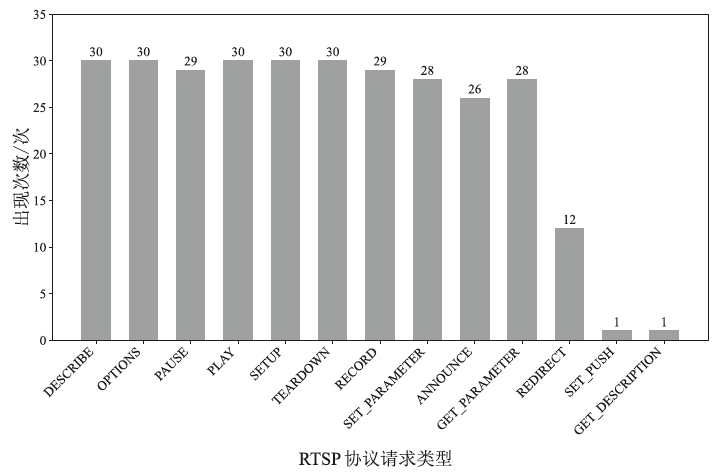
| 测试对象 | LPF | AFLNet | StateAFL | ||
|---|---|---|---|---|---|
| 覆盖分支数 /个 | 覆盖分支数 /个 | 提升率 | 覆盖分支数 /个 | 提升率 | |
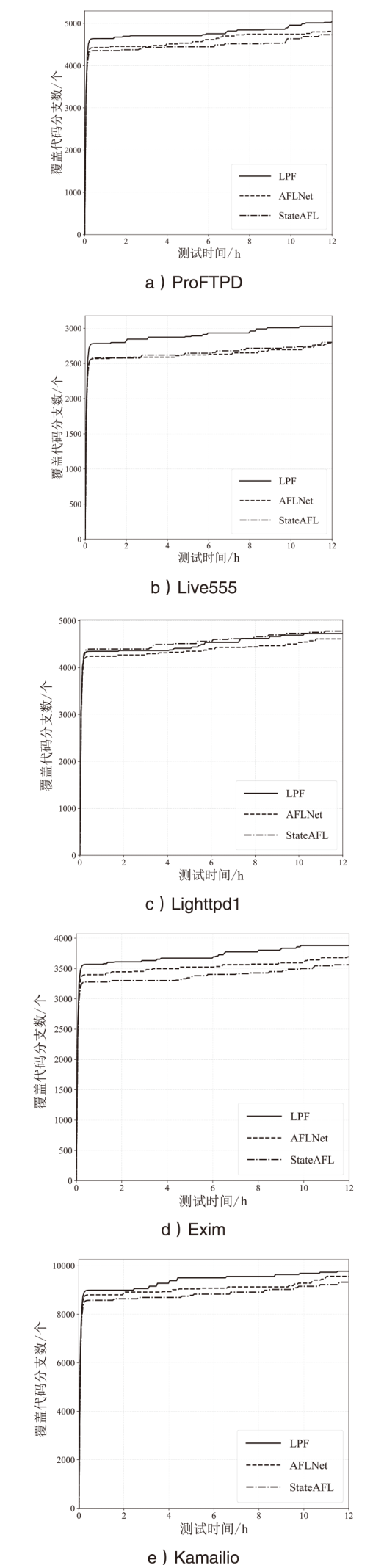
| ProFTPD | 5043 | 4812 | 4.80% | 4733 | 6.55% |
| Live555 | 3026 | 2792 | 8.38% | 2801 | 8.03% |
| Lighttpd1 | 4726 | 4610 | 2.52% | 4778 | -1.09% |
| Exim | 3880 | 3694 | 5.04% | 3564 | 8.87% |
| Kamailio | 9775 | 9565 | 2.20% | 9323 | 4.85% |
| 测试对象 | LPF | AFLNet | StateAFL | ||
|---|---|---|---|---|---|
| 覆盖状态数 /个 | 覆盖状态数 /个 | 提升率 | 覆盖状态数 /个 | 提升率 | |
| ProFTPD | 23.5 | 20.4 | 15.20% | 21.2 | 10.85% |
| Live555 | 11.3 | 8.8 | 28.41% | 11.0 | 2.73% |
| Lighttpd1 | 8.5 | 7.2 | 18.06% | 8.7 | -2.30% |
| Exim | 14.4 | 11.0 | 30.91% | 12.1 | 19.01% |
| Kamailio | 10.1 | 9.5 | 6.32% | 11.7 | -13.68% |
| 测试对象 | 崩溃时间/s | ||
|---|---|---|---|
| AFLNet | StateAFL | LPF | |
| ProFTPD | — | — | 5845.4 |
| Live555 | 2427.5 | 4618.7 | 2213.6 |
| Lighttpd1 | — | 9228.3 | 4845.4 |
| Exim | 1880.0 | 594.9 | 864.6 |
| Kamailio | 1977.5 | 3250.6 | 1893.2 |
| [1] | BA J, BÖHME M, MIRZAMOMEN Z, et al. Stateful Greybox Fuzzing[C]// USENIX. The 31st USENIX Security Symposium. Berkely: USENIX Association, 2022: 3255-3272. |
| [2] | LU Liyu, LIU Yuan, HONG Chao, et al. Screening Method of Fuzzy Test Seeds Based on Impact Orientation[J]. Network Security Technology & Application, 2024(2): 44-46. |
| 陆力瑜, 刘媛, 洪超, 等. 基于影响性导向的模糊测试种子筛选方法[J]. 网络安全技术与应用, 2024(2):44-46. | |
| [3] |
MILLER B P, ZHANG Mengxiao, HEYMANN E R. The Relevance of Classic Fuzz Testing: Have We Solved this One?[J]. IEEE Transactions on Software Engineering, 2022, 48(6): 2028-2039.
doi: 10.1109/TSE.2020.3047766 URL |
| [4] |
MANÈS V J M, HAN H, HAN C, et al. The Art, Science, and Engineering of Fuzzing: A Survey[J]. IEEE Transactions on Software Engineering, 2021, 47(11): 2312-2331.
doi: 10.1109/TSE.2019.2946563 URL |
| [5] | ZHANG Xiaohan, ZHANG Cen, LI Xinghua, et al. A Survey of Protocol Fuzzing[J]. ACM Computing Surveys, 2024, 57(2): 1-36. |
| [6] |
ZHAO Yiru, GAO Long, WEI Qiang, et al. Towards Tightly-Coupled Hybrid Fuzzing via Excavating Input Specifications[J]. IEEE Transactions on Dependable and Secure Computing, 2024, 21(5): 4801-4814.
doi: 10.1109/TDSC.2024.3361008 URL |
| [7] | PHAM V, BÖHME M, ROYCHOUDHURY A. AFLNet: A Greybox Fuzzer for Network Protocols[C]// IEEE. The 13th IEEE International Conference on Software Testing, Verification and Validation (ICST). New York: IEEE, 2020: 460-465. |
| [8] |
LUO Zhengxiong, YU Junze, DU Qingpeng, et al. Parallel Fuzzing of IoT Messaging Protocols through Collaborative Packet Generation[J]. IEEE Transactions on Computer-Aided Design of Integrated Circuits and Systems, 2024, 43(11): 3431-3442.
doi: 10.1109/TCAD.2024.3444705 URL |
| [9] |
MENG Ruijie, PHAM V-T, BÖHME M, et al. AFLNet Five Years Later: On Coverage-Guided Protocol Fuzzing[J]. IEEE Transactions on Software Engineering, 2025, 51(4): 960-974.
doi: 10.1109/TSE.2025.3535925 URL |
| [10] | Website. American Fuzzy Lop (AFL) Fuzzer[EB/OL]. [2025-07-30]. http://lcamtuf.coredump.cx/afl. |
| [11] |
LI Junqiang, LI Senyi, SUN Gang, et al. SNPSFuzzer: A Fast Greybox Fuzzer for Stateful Network Protocols Using Snapshots[J]. IEEE Transactions on Information Forensics and Security, 2022, 17: 2673-2687.
doi: 10.1109/TIFS.2022.3192991 URL |
| [12] | ANDRONIDIS A, CADAR C. SnapFuzz: High-Throughput Fuzzing of Network Applications[C]// ACM. The 31st ACM SIGSOFT International Symposium on Software Testing and Analysis. New York: ACM, 2022: 340-351. |
| [13] | QIN Shisong, HU Fan, MA Zheyu, et al. NSFuzz: Towards Efficient and State-Aware Network Service Fuzzing[J]. ACM Transactions on Software Engineering and Methodology, 2023, 32(6): 1-26. |
| [14] |
HUANG Tao, GAO Yansong, ZHENG Yifeng, et al. FineBID: Fine-Grained Protocol Reverse Engineering for Bit-Level Field Identification[J]. IEEE Transactions on Dependable and Secure Computing, 2025, 22(3): 2670-2686.
doi: 10.1109/TDSC.2024.3521592 URL |
| [15] |
KIM J, SEO M, MARIN E, et al. Ambusher: Exploring the Security of Distributed SDN Controllers through Protocol State Fuzzing[J]. IEEE Transactions on Information Forensics and Security, 2024, 19: 6264-6279.
doi: 10.1109/TIFS.2024.3402967 URL |
| [16] |
ZHANG Qingyu, LIN Jiayi, SUN Chenxin, et al. CherryPicker: A Parallel Solving and State Sharing Hybrid Fuzzing System[J]. IEEE Transactions on Dependable and Secure Computing, 2025, 22(4): 3324-3336.
doi: 10.1109/TDSC.2025.3530010 URL |
| [17] | HONG Xuanquan, JIA Peng, LIU Jiayong. AFLNeTrans: Fuzzing of Protocols with State Relationship Awareness[J]. Netinfo Security, 2024, 24(1): 121-132. |
| 洪玄泉, 贾鹏, 刘嘉勇. AFLNeTrans:状态间关系感知的网络协议模糊测试[J]. 信息网络安全, 2024, 24(1):121-132. | |
| [18] | VASWANI A, SHAZEER N, PARMAR N, et al. Attention is All You Need[C]// ACM. The 31st International Conference on Neural Information Processing Systems (NIPS’17). New York: ACM, 2017: 6000-6010. |
| [19] | BROWN T, MANN B, RYDER N, et al. Language Models are Few-Shot Learners[C]// ACM. The 34th International Conference on Neural Information Processing Systems (NIPS ‘20). New York: ACM, 2020: 1877-1901. |
| [20] |
ZHU Xiaogang, ZHOU Wei, HAN Q, et al. When Software Security Meets Large Language Models: A Survey[J]. IEEE/CAA Journal of Automatica Sinica, 2025, 12(2): 317-334.
doi: 10.1109/JAS.2024.124971 URL |
| [21] | LEMIEUX C, INALA J, LAHIRI S, et al. Codamosa: Escaping Coverage Plateaus in Test Generation with Pre-Trained Large Language Models[C]// IEEE. The 45th IEEE/ACM International Conference on Software Engineering (ICSE). New York: IEEE, 2023: 919-931. |
| [22] | DENG Yinlin, XIA C S, PENG Haoran, et al. Large Language Models are Zero-Shot Fuzzers: Fuzzing Deep-Learning Libraries via Large Language Models[C]// ACM. The 32nd ACM SIGSOFT International Symposium on Software Testing and Analysis(ISSTA 2023). New York: ACM, 2023: 423-435. |
| [23] | DENG Yinlin, XIA C S, YANG Chenyuan, et al. Large Language Models are Edge-Case Generators: Crafting Unusual Programs for Fuzzing Deep Learning Libraries[C]// ACM. The IEEE/ACM 46th International Conference on Software Engineering (ICSE’24). New York: ACM, 2024: 1-13. |
| [24] |
ZHANG Qiang, SHEN Yuheng, LIU Jianzhong, et al. ECG: Augmenting Embedded Operating System Fuzzing via LLM-Based Corpus Generation[J]. IEEE Transactions on Computer-Aided Design of Integrated Circuits and Systems, 2024, 43(11): 4238-4249.
doi: 10.1109/TCAD.2024.3447220 URL |
| [25] |
SHAHRIAR A, HISHAM S J, RAHMAN K M A, et al. 5GPT: 5G Vulnerability Detection by Combining Zero-Shot Capabilities of GPT-4 with Domain Aware Strategies through Prompt Engineering[J]. IEEE Transactions on Information Forensics and Security, 2025, 20: 7045-7060.
doi: 10.1109/TIFS.2025.3586480 URL |
| [26] |
ZHENG Tao, SHAO Jiang, DAI Jinqiao, et al. RESTLess: Enhancing State-of-the-Art REST API Fuzzing with LLMs in Cloud Service Computing[J]. IEEE Transactions on Services Computing, 2024, 17(6): 4225-4238.
doi: 10.1109/TSC.2024.3489441 URL |
| [27] | WANG Jincheng, YU Le, LUO Xiapu. LLMIF: Augmented Large Language Model for Fuzzing IoT Devices[C]// IEEE. The 2024 IEEE Symposium on Security and Privacy (SP). New York: IEEE, 2024: 881-896. |
| [28] | YANG Liqun, WEI Chaoren, YANG Jian, et al. Code Large Language Model-Based Fuzz Testing for Industrial IoT Programs[J]. IEEE Internet of Things Journal, 2024: 1-11. |
| [29] | PIYUSH J, JOSEPH S, JAYA S G, et al. BertRLFuzzer: A BERT and Reinforcement Learning Based Fuzzer[C]// ACM. The Thirty-Eighth AAAI Conference on Artificial Intelligence and Thirty-Sixth Conference on Innovative Applications of Artificial Intelligence and Fourteenth Symposium on Educational Advances in Artificial Intelligence (AAAI’24/IAAI’24/EAAI’24). New York: ACM, 2024: 23521-23522. |
| [30] | YANG Chenyuan, DENG Yinlin, LU Runyu, et al. WhiteFox: White-Box Compiler Fuzzing Empowered by Large Language Models[C]// ACM. The ACM on Programming Languages. New York: ACM, 2024, 8(2): 709-735. |
| [31] | EOM J, JEONG S, KWON T. Fuzzing JavaScript Interpreters with Coverage-Guided Reinforcement Learning for LLM-Based Mutation[C]// ACM. The 33rd ACM SIGSOFT International Symposium on Software Testing and Analysis (ISSTA 2024). New York: ACM, 2024: 1656-1668. |
| [32] | XIA C S, PALTENGHI M, TIAN Jiale, et al. Fuzz4All: Universal Fuzzing with Large Language Models[C]// ACM. The 46th International Conference on Software Engineering. New York: ACM, 2024: 1-13. |
| [33] |
YE Kai, ZHU Xiaogang, XIAO Xi, et al. BazzAFL: Moving Fuzzing Campaigns towards Bugs via Grouping Bug-Oriented Seeds[J]. IEEE Transactions on Dependable and Secure Computing, 2025, 22(1): 179-191.
doi: 10.1109/TDSC.2024.3391795 URL |
| [34] |
LI Yuwei, JI Shouling, LYU Chenyang, et al. V-Fuzz: Vulnerability Prediction-Assisted Evolutionary Fuzzing for Binary Programs[J]. IEEE Transactions on Cybernetics, 2022, 52(5): 3745-3756.
doi: 10.1109/TCYB.2020.3013675 URL |
| [1] | WANG Lei, CHEN Jiongyi, WANG Jian, FENG Yuan. Intelligent Reverse Analysis Method of Firmware Program Interaction Relationships Based on Taint Analysis and Textual Semantics [J]. Netinfo Security, 2025, 25(9): 1385-1396. |
| [2] | FENG Wei, XIAO Wenming, TIAN Zheng, LIANG Zhongjun, JIANG Bin. Research on Semantic Intelligent Recognition Algorithms for Meteorological Data Based on Large Language Models [J]. Netinfo Security, 2025, 25(7): 1163-1171. |
| [3] | ZHANG Xuewang, LU Hui, XIE Haofei. A Data Augmentation Method Based on Graph Node Centrality and Large Model for Vulnerability Detection [J]. Netinfo Security, 2025, 25(4): 550-563. |
| [4] | CHANG Zhenxuan, ZHENG Zhihan, MEI Aohan, TAN Yu’an. An Efficient Gray-Box Fuzzing Approach for Firmware Network Applications [J]. Netinfo Security, 2025, 25(4): 654-663. |
| [5] | XIE Mengfei, FU Jianming, YAO Renyi. Research on LLM-Based Fuzzing of Native Multimedia Libraries [J]. Netinfo Security, 2025, 25(3): 403-414. |
| [6] | HU Longhui, SONG Hong, WANG Weiping, YI Jia, ZHANG Zhixiong. Research on the Application of Large Language Model in False Positive Handling for Managed Security Services [J]. Netinfo Security, 2025, 25(10): 1570-1578. |
| [7] | WANG Juan, ZHANG Boxian, ZHANG Zhijie, XIE Haining, FU Jintao, WANG Yang. Java Deserialization Vulnerability Mining Based on Fuzzing [J]. Netinfo Security, 2025, 25(1): 1-12. |
| [8] | ZHANG Liqiang, LU Mengjun, YAN Fei. A Cross-Contract Fuzzing Scheme Based on Function Dependencies [J]. Netinfo Security, 2024, 24(7): 1038-1049. |
| [9] | WANG Juan, GONG Jiaxin, LIN Ziqing, ZHANG Xiaojuan. Multidimensional Depth Oriented Fuzzing Method of Java Web Applications [J]. Netinfo Security, 2024, 24(2): 282-292. |
| [10] | MA Rupo, WANG Qun, YIN Qiang, GAO Gugang. Analysis of Security Risks and Countermeasures for Modbus TCP Protocol [J]. Netinfo Security, 2024, 24(11): 1710-1720. |
| [11] | ZHANG Zihan, LAI Qingnan, ZHOU Changling. Survey on Fuzzing Test in Deep Learning Frameworks [J]. Netinfo Security, 2024, 24(10): 1528-1536. |
| [12] | ZHANG Zhanpeng, WANG Juan, ZHANG Chong, WANG Jie, HU Yuyi. The Research on Efficient Web Fuzzing Technology Based on Graph Isomorphic Network [J]. Netinfo Security, 2024, 24(10): 1544-1552. |
| [13] | HONG Xuanquan, JIA Peng, LIU Jiayong. AFLNeTrans: Fuzzing of Protocols with State Relationship Awareness [J]. Netinfo Security, 2024, 24(1): 121-132. |
| [14] | WANG Juan, ZHANG Chong, GONG Jiaxin, LI Jun’e. Review of Fuzzing Based on Machine Learning [J]. Netinfo Security, 2023, 23(8): 1-16. |
| [15] | ZHONG Yuanxin, LIU Jiayong, JIA Peng. Directed Fuzzing Based on Dynamic Time Slicing and Efficient Mutation [J]. Netinfo Security, 2023, 23(8): 99-108. |
| Viewed | ||||||
|
Full text |
|
|||||
|
Abstract |
|
|||||