Netinfo Security ›› 2026, Vol. 26 ›› Issue (10): 1581-1594.doi: 10.3969/j.issn.1671-1122.2026.10.006
Previous Articles Next Articles
Construction and empirical study of a quality assessment framework for statecharts generated by LLM
Wu Runfang1, Du Ye1,2( ), Tang Yu1, Kong Tong3
- 1
School of Cyberspace Science and Technology ,Beijing Jiaotong University Beijing 100044, China
2Tangshan Research Institute of Beijing Jiaotong University Tangshan 063000, China
3China Industrial Control Systems Cyber Emergency Response Team Beijing 100040, China
-
Received:2026-03-02Online:2026-10-10Published:2026-11-06 -
Contact:Du Ye E-mail:ydu@bjtu.edu.cn

CLC Number:
Cite this article
Wu Runfang, Du Ye, Tang Yu, Kong Tong. Construction and empirical study of a quality assessment framework for statecharts generated by LLM[J]. Netinfo Security, 2026, 26(10): 1581-1594.
share this article
Add to citation manager EndNote|Ris|BibTeX
URL: http://netinfo-security.org/EN/10.3969/j.issn.1671-1122.2026.10.006
| 符号 | 含义 |
|---|---|
| 可执行性 | |
| 语法质量 | |
| 语义质量 | |
| 实用质量 | |
| K | 状态集合 |
| E | 事件集合 |
| T | 转移关系 |
| G | 条件集合 |
| A | 动作集合 |
| SC | 语义覆盖率 |
| Comp | 可理解性 |
| δ(·) | 指示函数 |
| μ(·) | 违规比例函数 |
| σ(·) | 状态映射函数 |
| 分值 | 描述 |
|---|---|
| 5 | 状态层次结构分明,逻辑关系高度清晰;命名完全符合领域术语标准;布局规整,无冗余交叉线,确保信息完整且易于理解 |
| 4 | 整体结构清晰,仅个别局部需额外阅读才能完全理解;命名基本遵循领域惯例,较少出现不直观的术语;布局合理,交叉线较少,对理解影响较小 |
| 3 | 总体可理解,但需要一定UML知识基础;命名尚可接受,但有改进空间;布局一般,存在一定复杂性或紊乱情况,影响阅读效率 |
| 2 | 可理解性较差,需要较强的专业背景才能理解主要内容;命名不规范或存在歧义;布局较紊乱,对阅读和理解造成明显影响 |
| 1 | 难以理解,逻辑关系不清晰,命名错误或无意义,布局高度混乱,无法有效传递信息 |
| 质量维度 | 权重 | 依据 | 有效性 | 敏感性 |
|---|---|---|---|---|
| 0.20 | UML生命周期、层次结构和可维护性 | 全体一致 | 低 | |
| 0.40 | UML核心逻辑 | 全体一致 | 中 | |
| 0.20 | ISO/IEC 25010软件质量模型 | 基本一致 | 低 | |
| β | 0.20 | 可追溯性 | 全体一致 | 中 |
| 0.25 | 用户体验 | 全体一致 | 低 | |
| 0.20 | 用户体验、实用性 | 条件一致 (随场景调整) | 高 | |
| 0.40 | 正确性 | 全体一致 | 高 |
| 权重参数 | 扰动范围 | 排名保持率 | Spearman 相关系数 | 排名逆转案例 |
|---|---|---|---|---|
完备性) | 0.28~0.52 | 96% | 0.96(p<0.001) | 8/200 |
| β(覆盖率因子) | 0.14~0.26 | 92% | 0.94(p<0.001) | 16/200 |
质量) | 0.28~0.52 | 92% | 0.93(p<0.001) | 16/200 |
| 综合(所有扰动) | 0.70~1.30(基准权重) | 92% | 大于0.93(p<0.001) | 2/200 |
| 错误类型 | 发生频率 |
|---|---|
| 语法解析失败 | 低 |
| 静态检查错误 | 中 |
| 渲染异常 | 低 |
| 初始/终止状态错误 | 高 |
| 转移不完整 | 高 |
| 复合状态结构错误 | 中 |
| 命名不规范 | 高 |
| 可达性错误 | 中 |
| 因果错误 | 高 |
| 守护条件矛盾 | 低 |
| 结构不一致 | 中 |
| 覆盖率不足 | 高 |
| 转移复杂度高 | 高 |
| 嵌套过深 | 中 |
| 命名不一致 | 高 |
| 布局混乱 | 高 |
| 编号 | GPT-4.0模型 | DeepSeek-R1模型 | ||
|---|---|---|---|---|
| 错误数量/个 | 通过率 | 错误数量/个 | 通过率 | |
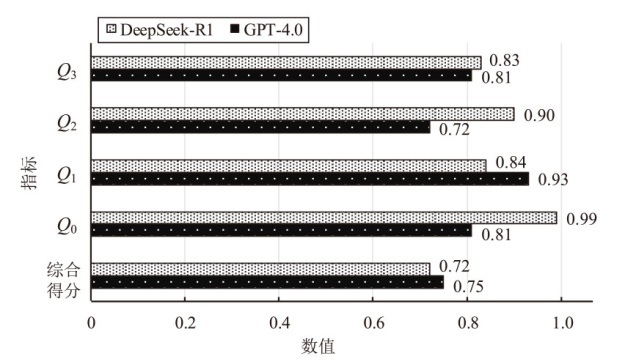
| Q0 | 1 | 99% | 19 | 81% |
| V1 | 14 | 86% | 2 | 98% |
| V2 | 42 | 58% | 27 | 73% |
| V3 | 16 | 84% | 11 | 89% |
| V4 | 32 | 68% | 17 | 83% |
| U1 | 29 | 71% | 16 | 84% |
| U2 | 51 | 49% | 11 | 89% |
| U3 | 4 | 96% | 1 | 99% |
| U4 | 37 | 63% | 16 | 84% |
| 测量指标 | GPT-4.0模型 | DeepSeek-R1模型 | ||||
|---|---|---|---|---|---|---|
| 平均值 | 高分率 | 低分率 | 平均值 | 高分率 | 低分率 | |
| SC | 0.82 | 76% | 10% | 0.91 | 93% | 2% |
| M1 | 0.81 | 64% | 7% | 0.79 | 51% | 7% |
| M2 | 0.77 | 43% | 15% | 0.78 | 45% | 13% |
| M3 | 0.89 | 69% | 2% | 0.95 | 91% | 1% |
| M4 | 0.76 | 62% | 1% | 0.79 | 80% | 1% |
| Comp | 0.51 | 38% | 39% | 0.42 | 18% | 67% |
| 质量 维度 | 零假设 | F值 | p值 | 效应量 (η2) | Cohen’s d | 显著性 (α = 0.01) | 结论 |
|---|---|---|---|---|---|---|---|
| 不同LLM在可执行性上无差异 | 20.25 | 小于0.001 | 0.092 | 0.640 | 显著 | 拒绝 零假设 | |
| 不同LLM在语法质量上无差异 | 26.13 | 小于0.001 | 0.116 | 0.730 | 显著 | 拒绝 零假设 | |
| 不同LLM在语义质量上无差异 | 49.85 | 小于0.001 | 0.201 | 1.000 | 显著 | 拒绝 零假设 | |
| 不同LLM在实用质量上无差异 | 5.71 | 0.018 | 0.028 | 0.340 | 不显著 | 接受 零假设 | |
| Comp | 不同LLM在可理解性上无差异 | 17.23 | 小于0.001 | 0.080 | 0.590 | 显著 | 拒绝 零假设 |
| 方法 | 目标模型 | 语义覆盖率 | 训练需求 | 规则需求 |
|---|---|---|---|---|
| 传统混合方法(规则+ 朴素贝叶斯)[ | 类图 | 89.44% | 需要 | 需要 |
| 早期LLM方法 (GPT-3.5/4.0)[ | 类图 | 64.44% | 零样本 | 无 |
| 序列图 | 74.81% | 零样本 | 无 | |
| 本文方法(GPT-4.0) | 状态图 | 82.00% | 零样本 | 无 |
| 本文方法(DeepSeek-R1) | 状态图 | 91.00% | 零样本 | 无 |
| 复杂度 | 模型 | ||||
|---|---|---|---|---|---|
| 简单 | GPT-4.0 | 1.00 | 0.92 | 0.81 | 0.84 |
| DeepSeek-R1 | 0.85 | 0.95 | 0.93 | 0.86 | |
| 中等 | GPT-4.0 | 0.99 | 0.85 | 0.72 | 0.81 |
| DeepSeek-R1 | 0.83 | 0.93 | 0.90 | 0.83 | |
| 复杂 | GPT-4.0 | 0.98 | 0.77 | 0.64 | 0.77 |
| DeepSeek-R1 | 0.79 | 0.90 | 0.86 | 0.80 |
| [1] | Kruchten P. The rational unified process: an introduction[M]. Boston: Addison-Wesley Professional, 2004. |
| [2] | Latella D, Majzik I, Massink M. Towards a formal operational semantics of UML statechart diagrams[C]// Formal Methods for Open Object-Based Distributed Systems (FMOODS 1999). Heidelberg: Springer, 1999: 331-347. |
| [3] | Bates A, Vavricka R, Carleton S, et al. Unified modeling language code generation from diagram images using multimodal large language models[EB/OL]. (2025-06-01)[2026-02-17]. https://www.sciencedirect.com/science/article/pii/S266682702500043X. |
| [4] | Calamo M, Mecella M, Snoeck M. Assessing the suitability of large language models in generating UML class diagrams as conceptual models[C]// Business Process Modeling, Development and Support (BPMDS 2025). Heidelberg: Springer, 2025: 211-226. |
| [5] | Rolland C, Proix C. A natural language approach for requirements engineering[C]// International Conference on Advanced Information Systems Engineering (CAiSE 1992). Heidelberg: Springer, 1992: 257-277. |
| [6] | Mich L, Giuliani M P. From natural language to object oriented requirements: an annotated bibliography[EB/OL]. (1995-07-01)[2026-02-17]. https://www.researchgate.net/publication/264081630_From_Natural_Language_to_Object_Oriented_requirements_An_annotated_bibliography. |
| [7] | Guizzardi G. Ontological foundations for structural conceptual models[EB/OL]. (2005-01-01)[2026-02-17]. https://www.researchgate.net/publication/215697579_Ontological_Foundations_for_Structural_Conceptual_Models. |
| [8] | Kahya H, Saeki M. Ontology based requirements analysis:lightweight semantic processing approach[C]//The 5th International Conference on Quality Software (QSIC’05). New York: IEEE, 2005: 223-230. |
| [9] | Alaswad F, Poovammal E, Aljaddouh B, et al. Software requirements to UML class diagrams using machine learning and rule-based approach[C]// Intelligent Systems in Computing and Communication. Heidelberg: Springer, 2025: 86-101. |
| [10] | Meng Yang, Ban A. Automated UML class diagram generation from textual requirements using NLP techniques[J]. International Journal on Informatics Visualization, 2024, 8(3): 1905-1915. |
| [11] | Babaalla Z, Jakimi A, Oualla M, et al. Towards an automatic extracting UML class diagram from system’s textual specification[C]// The 7th International Conference on Networking, Intelligent Systems and Security. New York: ACM, 2024: 1-5. |
| [12] | Hao Yilun, Zhang Yang, Fan Chuchu. Planning anything with rigor: general-purpose zero-shot planning with LLM-based formalized programming[EB/OL]. (2024-10-17)[2026-02-17]. https://arxiv.org/abs/2410.12112. |
| [13] | De B D, Garaccione G, Coppola R, et al. Evaluating large language models in exercises of UML class diagram modeling[C]// The 18th ACM/IEEE International Symposium on Empirical Software Engineering and Measurement. New York: ACM, 2024: 393-399. |
| [14] | Camara J, Troya J, Burgueno L, et al. On the assessment of generative AI in modeling tasks: an experience report with ChatGPT and UML[J]. Software and Systems Modeling, 2023, 22(3): 781-793. |
| [15] | Wang Beian, Wang Chong, Liang Peng, et al. How LLMS aid in UML modeling:an exploratory study with novice analysts[C]//2024 IEEE International Conference on Software Services Engineering (SSE). New York: IEEE, 2024: 249-257. |
| [16] | Roques P. UML in practice: the art of modeling software systems demonstrated through worked examples and solutions[M]. Chichester: John Wiley & Sons, 2004. |
| [17] | Harel D. Statecharts: a visual formalism for complex systems[J]. Science of Computer Programming, 1987, 8(3): 231-274. |
| [18] | Rumbaugh J, Blaha M, Premerlani W, et al. Object-oriented modeling and design[M]. London: Prentice-Hall, 1991. |
| [19] | Fowler M. UML distilled: a brief guide to the standard object modeling language[M]. Boston: Addison-Wesley Professional, 2004. |
| [20] | ISO/IEC 25002: 2024 Systems and software engineering-systems and software quality requirements and evaluation (SQuaRE)- system and software quality models: ISO/IEC 25010: 2011[S]. Geneva: ISO, 2024. |
| [21] | Shneiderman B. Software psychology: human factors in computer and information systems[M]. Cambridge: Winthrop, 1980. |
| Viewed | ||||||
|
Full text |
|
|||||
|
Abstract |
|
|||||