信息网络安全 ›› 2026, Vol. 26 ›› Issue (8): 1169-1182.doi: 10.3969/j.issn.1671-1122.2026.08.001
基于高频特征增强与关键区域保护的人脸伪造检测方法
陈玮1, 田波2, 李顺畅2, 罗光春1, 秦科1( ), 王方圆3,4
- 1
电子科技大学计算机科学与工程学院 成都 611731
2云南电信股份有限公司 昆明 650299
3南京理工大学网络空间安全学院 南京 210094
4恒安嘉新(北京)科技股份公司 北京 100086
-
收稿日期:2026-01-25出版日期:2026-08-10发布日期:2026-09-23 -
通讯作者:秦科 E-mail:qinke@uestc.edu.cn -
作者简介:陈玮(1980—),男,四川,工程师,博士研究生,主要研究方向为人工智能、网络运营、网信安全和反诈|田波(1981—),男,云南,正高级工程师,本科,主要研究方向为反诈、网络信息安全和人工智能|李顺畅(1979—),男,四川,工程师,本科,主要研究方向为人工智能|罗光春(1974—),男,四川,教授,博士,主要研究方向为云计算与大数据、智能决策|秦科(1980—),男,四川,教授,博士,主要研究方向为人工智能|王方圆(1985—),男,江苏,高级工程师,博士研究生,主要研究方向为大模型网络安全、人工智能 -
基金资助:江苏省前沿技术研发计划(BF2025004)
Face forgery detection method based on high-frequency feature enhancement and key region preservation
Chen Wei1, Tian Bo2, Li Shunchang2, Luo Guangchun1, Qin Ke1(), Wang Fangyuan3,4
- 1
School of Computer Science and Engineering ,University of Electronic Science and Technology of China Chengdu 611731, China
2Yunnan Telecom Co. ,Ltd. Kunming 650299, China
3School of Cyberspace Security ,Nanjing University of Science and Technology Nanjing 210094, China
4Heng’an Jiaxin (Beijing) Technology Co. ,Ltd. Beijing 100086, China
-
Received:2026-01-25Online:2026-08-10Published:2026-09-23 -
Contact:Qin Ke E-mail:qinke@uestc.edu.cn

摘要:
随着人脸识别技术在身份认证、金融支付等关键领域的广泛部署,人脸数据的真实性与安全性已成为数据安全治理过程中的核心挑战。现有方法如基于潜空间重建误差依赖扩散模型先验,对仅影响局部区域的细微篡改敏感性不足,局部伪造误差信号易被全局重建误差稀释。因此,文章提出一种基于自编码器的改进重建误差检测方法,区别于扩散模型驱动的潜空间重建误差,该方法融合高频特征增强与关键区域保护双重机制,针对局部篡改检测进行轻量化优化。首先,通过多任务级联卷积神经网络生成空间权重掩码,引导模型关注五官等关键区域;然后,设计轻量化的可学习高通滤波器,自适应地提取并强化图像中的高频伪造痕迹;最后,将二者融合进重建误差计算,实现对误差信号在空间和频域上的协同增强。实验结果表明,该方法在局部篡改检测任务中性能显著提升,局部篡改敏感度达89.4%;在跨数据集测试中,在DeepFakeDetection和WildDeepfake上平均精度分别为92.1%和90.8%,展现出良好的泛化能力;同时,在噪声与压缩扰动下性能下降幅度较小,展现出较强的鲁棒性。
中图分类号:
引用本文
陈玮, 田波, 李顺畅, 罗光春, 秦科, 王方圆. 基于高频特征增强与关键区域保护的人脸伪造检测方法[J]. 信息网络安全, 2026, 26(8): 1169-1182.
Chen Wei, Tian Bo, Li Shunchang, Luo Guangchun, Qin Ke, Wang Fangyuan. Face forgery detection method based on high-frequency feature enhancement and key region preservation[J]. Netinfo Security, 2026, 26(8): 1169-1182.
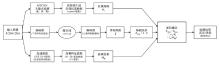
图1
整体框架
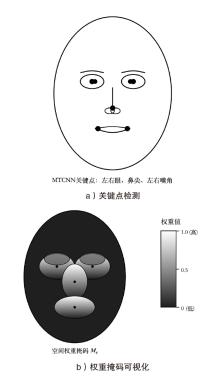
图2
关键区域权重掩码的生成效果
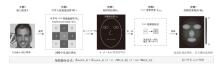
图3
高频特征提取与增强过程
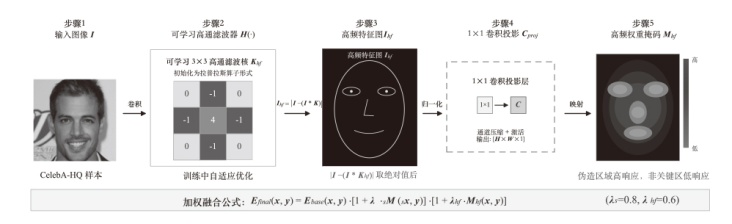
表1
人脸伪造检测对比方法分类及特点
| 类别 | 方法名称 | 方法核心特点 |
|---|---|---|
| 传统重建方法 | AutoEncoder (AE) | 基础自编码器,重建误差检测的基线 |
| VAE-GAN | 结合生成对抗机制的重建方法 | |
| 频域分析方法 | F3-Net | 基于频域分解的代表性方法 |
| SRM | 源于隐写分析的高通滤波方法 | |
| 局部不一致性方法 | Face X-ray | 专注检测图像融合边界 |
| Lip Forensics | 专注唇部时序不一致性 | |
| 深度学习特征方法 | XceptionNet | 基于预训练网络的端到端分类基准 |
| EfficientNet-B4 | 轻量化网络结构的代表 | |
| 扩散模型检测方法 | LaRE2 | 基于扩散模型潜在空间重建误差的标准方法,作为关键对比基线 |
| 本文方法变体 | Ours-S | 仅含关键区域保护机制 |
| Ours-F | 仅含高频特征增强机制 | |
| Ours-Full | 完整融合模型 |
表2
各方法在两个数据集上的F1分数
| 方法 | Celeb-DFv2 | FF++(HQ) | 备注 |
|---|---|---|---|
| XceptionNet | 92.9% ± 0.4% | 94.1% ± 0.3% | 深度学习基准 |
| F3-Net | 94.0% ± 0.3% | 94.9% ± 0.4% | 频域方法 |
| Face X-ray | 92.3% ± 0.5% | 93.6% ± 0.4% | 局部不一致性方法 |
| LaRE2 | 96.3% ± 0.2% | 96.8% ± 0.2% | 扩散模型方法 |
| Ours-Full | 96.7% ± 0.2% | 97.2% ± 0.2% | 本文完整方法 |
表3
各方法在LTD-Local数据集上的LTS
| 方法 | 总体结果 | 局部换脸 | 纹理扰动 | 局部形变 | 复制粘贴 |
|---|---|---|---|---|---|
| XceptionNet | 72.3%±0.8% | 85.1%±0.6% | 65.4%±1.2% | 62.8%±1.1% | 83.5%±0.7% |
| F3-Net | 77.2%±0.7% | 86.7%±0.5% | 70.1%±0.9% | 68.9%±1.0% | 86.0%±0.6% |
| Face X-ray | 80.1%±0.6% | 90.2%±0.5% | 73.5%±0.8% | 71.0%±0.9% | 88.3%±0.5% |
| LaRE2 | 82.5%±0.5% | 92.8%±0.4% | 75.6%±0.7% | 74.2%±0.8% | 90.9%±0.5% |
| Ours-Full | 89.4%±0.4% | 94.8%±0.3% | 85.2%±0.6% | 83.6%±0.6% | 93.1%±0.4% |
表4
本文方法与LaRE2跨任务性能对比
| 对比维度 | 主要挑战 | LaRE2方法 | 本文方法 | 适用场景建议 |
|---|---|---|---|---|
| 全局换脸检测 | 整体分布 一致性 | 强 (扩散先验) | 中等 (重建误差) | 高质量扩散生成内容检测 |
| 局部细微篡改 | 局部纹理异常 | 中等 | 强 (双重增强) | 精细编辑、局部替换检测 |
| 跨数据集泛化 | 分布偏移 | 强 | 强 | 多样化伪造数据 |
| 计算效率 | 实时性要求 | 中等 (22 ms) | 强(15 ms) | 边缘计算、实时检测 |
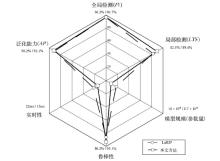
图4
本文方法和LaRE2特性多维度对比
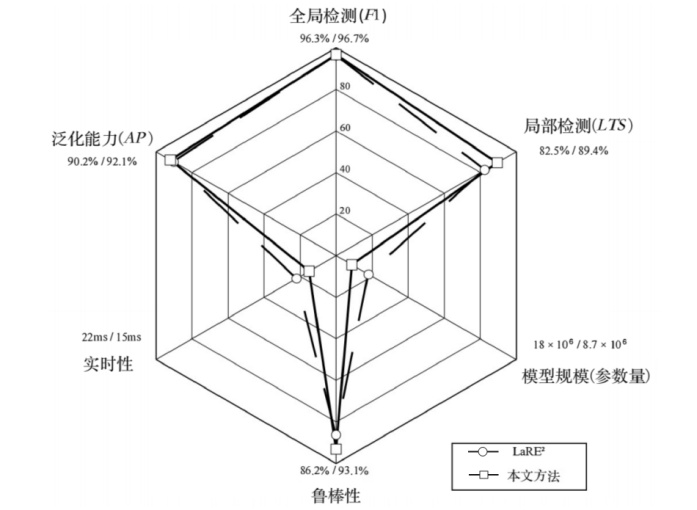
表5
消融实验结果
| 模型配置 | 总体LTS | 相对基线提升 | 模块贡献分析 |
|---|---|---|---|
| 纯自编码器(Baseline) | 68.5% | — | 重建误差基础 |
| + 关键区域保护(Ours-S) | 82.6% | 14.1% | 空间聚焦效应显著 |
| + 高频特征增强(Ours-F) | 84.0% | 15.5% | 频域特征增强有效 |
| + 完整模型(Ours-Full) | 89.4% | 20.9% | 协同增强效应明显 |
表6
跨数据集泛化性能
| 方法 | DFD(AP/AUC) | WildDeepfake(AP/AUC) |
|---|---|---|
| XceptionNet | 84.3%/86.7% | 82.1%/84.5% |
| F3-Net | 86.5%/88.2% | 85.0%/87.1% |
| Face X-ray | 88.1%/89.7% | 86.4%/88.9% |
| LaRE2 | 90.2%/92.5% | 89.1%/91.8% |
| Ours-Full | 92.1%/94.6% | 90.8%/93.2% |
表7
计算效率对比
| 方法 | 参数量 | FLOPs | 推理时间/ms | 适用场景 |
|---|---|---|---|---|
| XceptionNet | 22×106个 | 8.4×10⁹ | 28 | 服务器端 |
| EfficientNet-B4 | 19×106个 | 4.2×10⁹ | 21 | 移动端 |
| LaRE2 | 18×106个 | 6.8×10⁹ | 22 | 服务器端 |
| Ours-Full | 8.7×10⁶个 | 3.2×10⁹ | 15 | 边缘/实时 |
表8
鲁棒性测试定量结果
| 方法 | 高斯σ=0.01 | 高斯σ=0.05 | JPEG 质量90 | JPEG 质量70 | 亮度+20% | 亮度-20% |
|---|---|---|---|---|---|---|
| XceptionNet | 97.2% | 88.1% | 96.5% | 87.3% | 95.8% | 95.2% |
| F3-Net | 97.8% | 90.3% | 97.1% | 89.6% | 96.2% | 96.0% |
| Face X-ray | 96.9% | 87.5% | 95.8% | 86.1% | 95.4% | 94.8% |
| LaRE2 | 95.8% | 86.2% | 96.3% | 88.7% | 96.5% | 96.1% |
| Ours-Full | 98.6% | 93.1% | 97.8% | 91.2% | 97.1% | 96.9% |
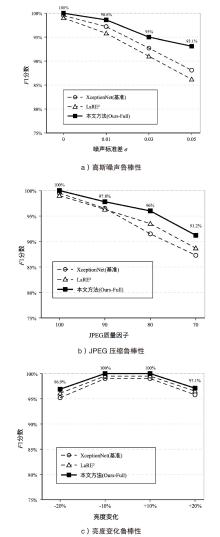
图5
在不同扰动条件下各方法的F1分数变化情况
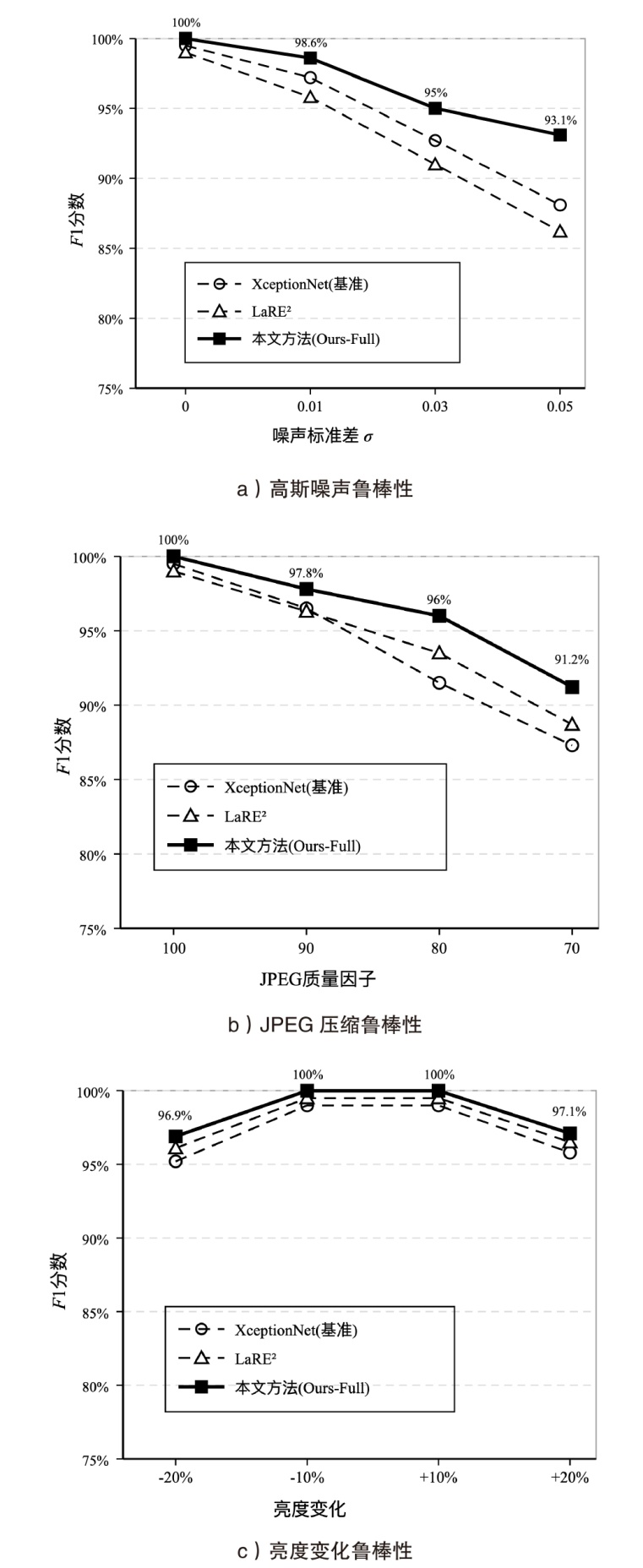
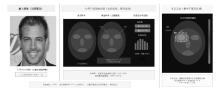
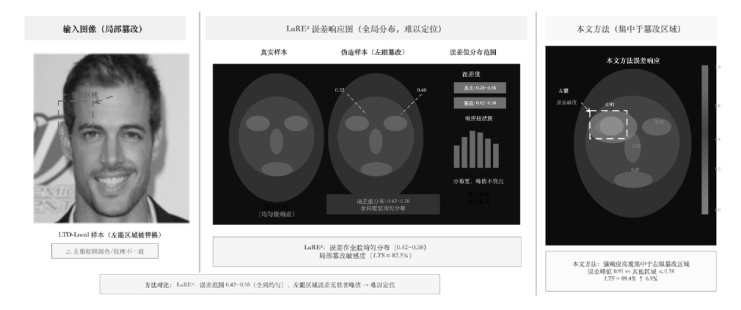
图6
LaRE2 与本文方法误差响应可视化对比
| [1] | 丁博文, 芦天亮, 彭舒凡, 等. 基于多分类数据集的人脸伪造算法识别模型[J]. 计算机科学, 2025, 52(7):353-362. |
| [2] | 赵泽军, 范振峰, 丁博, 等. 基于增量学习的深度人脸伪造检测[J]. 数据与计算发展前沿, 2023, 5(6):42-57. |
| [3] | 杨珂, 李永亮, 何金栋, 等. 基于掩码图像建模的深度伪造人脸检测[J]. 计算机应用, 2025, 45(S1): 72-77. |
| [4] |
Chesney R M, Citron D K. Deep fakes: a looming challenge for privacy, democracy, and national security[J]. California Law Review, 2019, 107(6): 1753-1820.
doi: 10.15779/Z38RV0D15J |
| [5] | 金世辰, 谭晓阳. 基于困难感知元学习的跨域人脸伪造检测[J]. 南京航空航天大学学报, 2025, 57(2):215-224. |
| [6] | Luo Yunpeng, Du Junlong, Yan Ke, et al. LaRE2: latent reconstruction error based method for diffusion-generated image detection[C]// The IEEE/CVF Conference on Computer Vision and Pattern Recognition (CVPR). New York: IEEE, 2024: 17006-17015. |
| [7] | 钱菲, 李威, 陈鹏, 等. 基于原型解耦的虚假人脸检测和生成方法溯源[J]. 计算机科学与探索, 2025, 19(2):444-454. |
| [8] | 袁程胜, 谢佳薇, 王一力, 等. 特征-频域双判别的对抗样本迁移性增强[J]. 计算机系统应用, 2025, 34(10): 122-132. |
| [9] | 陈傲, 白恩健, 吴贇, 等. 融合CNN与ViT的深度伪造人脸篡改视频检测方法[J]. 东华大学学报(自然科学版), 2025, 51(6):112-120. |
| [10] | Qian Yuyang, Yin Guojun, Sheng Lu, et al. Thinking in frequency: face forgery detection by mining frequency-aware clues[C]// The 16th European Conference on Computer Vision (ECCV 2020). Heidelberg: Springer, 2020: 86-103. |
| [11] | 赵娅, 郜明超, 姚文达, 等. 基于深度学习的伪造人脸检测技术综述[J]. 计算机系统应用, 2025, 34(4):1-17. |
| [12] | 王健, 孙沐毅, 李琦, 等. 基于深度学习的人脸属性编辑研究概述[J]. 计算机应用与软件, 2025, 42(1):11-24. |
| [13] | 李伟, 黄添强, 黄丽清, 等. 面向人脸修复篡改检测的大规模数据集[J]. 中国图象图形学报, 2024, 29(7):1834-1848. |
| [14] | 王玉梅, 胡娟, 武晓帅, 等. 基于面部动作不一致的压缩深度伪造视频检测方法[J]. 重庆邮电大学学报(自然科学版), 2025, 37(3):108-117. |
| [15] | Lanzino R, Fontana F, Diko A, et al. Faster than lies: real-time deepfake detection using binary neural networks[C]// The IEEE/CVF Conference on Computer Vision and Pattern Recognition Workshops(CVPRW). New York: IEEE, 2024: 3771-3780. |
| [16] |
陈咏豪, 蔡满春, 张溢文, 等. 基于参数高效微调及双流网络的人脸伪造检测[J]. 计算机工程与应用, 2025, 61(10): 288-298.
doi: 10.3778/j.issn.1002-8331.2404-0213 |
| [17] | 李梓楷, 王宇飞, 廖广军, 等. 基于帧间量化参数强度值检测深度伪造人像视频[J]. 刑事技术, 2024, 49(1):66-72. |
| [18] | Wu Haoyu, Leng Lingyun, Yu Peipeng. Learning local reconstruction errors for face forgery detection[J]. International Journal of Advanced Computer Science and Applications, 2024, 15(11): 1220-1227. |
| [19] | 杨睿, 胡心如, 黄卓超, 等. 深度网络生成式伪造人脸检测方法研究综述[J]. 计算机辅助设计与图形学学报, 2024, 36(10): 1491-1510. |
| [20] | Larsen A B L, Sonderby S K, Larochelle H, et al. Autoencoding Beyond Pixels Using a Learned Similarity Metric[C]// The 33rd International Conference on Machine Learning. New York: ACM, 2016: 1558-1566. |
| [21] | Frank J, Eisenhofer T, Schonherr L, et al. Leveraging frequency analysis for deep fake image recognition[C]// The 37th International Conference on Machine Learning. New York: ACM, 2020: 3247-3258. |
| [22] | Tan Chuangchuang, Zhao Yao, Wei Shikui, et al. Frequency-aware deepfake detection: improving generalizability through frequency space domain learning[C]// The AAAI Conference on Artificial Intelligence. Menlo Park: AAAI, 2024: 5052-5060. |
| [23] | Fridrich J, Kodovsky J. Rich models for steganalysis of digital images[J]. IEEE Transactions on Information Forensics and Security, 2012, 7(3): 868-882. |
| [24] | Li Lingzhi, Bao Jianmin, Zhang Ting, et al. Face X-ray for more general face forgery detection[C]// 2020 IEEE/CVF Conference on Computer Vision and Pattern Recognition. New York: IEEE, 2020: 5000-5009. |
| [25] | Haliassos A, Vougioukas K, Petridis S, et al. Lips don't lie: a generalisable and robust approach to face forgery detection[C]// The IEEE/CVF Conference on Computer Vision and Pattern Recognition. New York: IEEE, 2021: 5039-5049. |
| [26] | 任奎, 林峰, 霸钟杰, 等. Deepfake检测:关键挑战与技术路线[J]. 中国计算机学会通讯, 2021, 17(5):39-44. |
| [27] | 陈佳丽, 郭华, 姜瑞明. 基于微小运动的人脸活体检测算法[J]. 计算机应用与软件, 2024, 41(7):150-158,191. |
| [28] | 丁峰, 匡仁盛, 周越, 等. 深度伪造及其取证技术综述[J]. 中国图象图形学报, 2024, 29(2):295-317. |
| [29] | 王瑞, 叶晓彤. 基于面部掩码引导的多人场景图像伪造定位算法[J]. 东北大学学报(自然科学版), 2025, 46(5):633-642. |
| [30] | 于晓琳, 于明希. 基于改进YOLOv8的生成式人脸检测算法[J]. 北京邮电大学学报, 2025, 48(3):39-46. |
| [1] | 金志刚, 李其睿, 丁禹. 融合轻量级注意力机制的双分支入侵检测方法[J]. 信息网络安全, 2026, 26(8): 1183-1193. |
| [2] | 史俊, 王浩, 李增鹏, 顾益宇, 马惠铃. 可信执行环境在隐私计算中的研究现状、关键问题与发展方向综述[J]. 信息网络安全, 2026, 26(8): 1194-1208. |
| [3] | 付章杰, 刘天怿, 宋甫元, 姜琴. 一个支持区块链分片的可验证跨链查询方案[J]. 信息网络安全, 2026, 26(8): 1209-1223. |
| [4] | 冯景瑜, 尹静怡, 张森勇, 李静慧. 抗APT窃密的工业互联网跨域协同零信任模型[J]. 信息网络安全, 2026, 26(8): 1224-1236. |
| [5] | 韩妍妍, 杜雨芃, 余卓洲, 刘昂, 刘雯. 基于半量子网络的安全区块链[J]. 信息网络安全, 2026, 26(8): 1237-1249. |
| [6] | 赵敏, 瞿康健. 零信任架构及其技术应用研究综述[J]. 信息网络安全, 2026, 26(8): 1250-1263. |
| [7] | 张宏涛, 王清涛, 张连成, 王吉昌. Argus6:一种IPv6 DDoS威胁检测模型[J]. 信息网络安全, 2026, 26(8): 1264-1276. |
| [8] | 谢雪松, 蔡佳凯, 罗柏之. 基于国密算法的边缘AI模型安全加载机制研究[J]. 信息网络安全, 2026, 26(8): 1277-1289. |
| [9] | 朱慧敏, 王晨龙, 刘光华. 基于双关系图时序建模的弱网异常行为区分方法[J]. 信息网络安全, 2026, 26(8): 1290-1307. |
| [10] | 刘哲凡, 郭亚军, 郭奕旻, 赵素芬. 抗隐式攻击的基于ASCON的轻量级工业物联网认证方案[J]. 信息网络安全, 2026, 26(8): 1308-1326. |
| [11] | 宋孟元, 夏辉. 基于知识蒸馏和对抗样本的联邦遗忘方法[J]. 信息网络安全, 2026, 26(7): 1149-1163. |
| [12] | 杨乔炀, 范希明, 贾鹏. 基于大语言模型的语义知晓的模糊测试驱动生成方案[J]. 信息网络安全, 2026, 26(7): 1128-1148. |
| [13] | 孙浩然, 陈杰, 刘君. 多路径特征增强的深度学习矩形攻击防御方法[J]. 信息网络安全, 2026, 26(7): 1115-1127. |
| [14] | 钱晓晟, 王利莹, 赵宇, 刘光亚, 王成. 基于行为注意力的算力网络异常检测系统[J]. 信息网络安全, 2026, 26(7): 1101-1114. |
| [15] | 姚戊煌, 王佳鹏, 陈康冰, 郑之涵, 谭毓安. 基于指令翻译插桩的LLM辅助固件内存泄漏分析[J]. 信息网络安全, 2026, 26(7): 1087-1100. |
| 阅读次数 | ||||||
|
全文 |
|
|||||
|
摘要 |
|
|||||