信息网络安全 ›› 2026, Vol. 26 ›› Issue (5): 725-735.doi: 10.3969/j.issn.1671-1122.2026.05.005
基于改进黏菌算法的词级对抗样本生成方法
徐茹枝, 武晓欣( )
)
华北电力大学控制与计算机工程学院 北京 102206
-
收稿日期:2025-12-10出版日期:2026-05-10发布日期:2026-06-03 -
通讯作者:武晓欣 120232227082@ncepu.edu.cn -
作者简介:徐茹枝(1966—),女,江西,教授,博士,主要研究方向为智能电网、AI安全|武晓欣(2000—),女,河北,硕士研究生,主要研究方向为网络安全、AI安全 -
基金资助:国家自然科学基金(62372173)
A Word-Level Adversarial Sample Generation Method Based on the Improved Slime Mold Algorithm
XU Ruzhi, WU Xiaoxin()
School of Control and Computer Engineering ,North China Electric Power University Beijing 102206, China
-
Received:2025-12-10Online:2026-05-10Published:2026-06-03

摘要:
在人工智能技术的持续革新与广泛应用的背景下,深度学习技术取得了突破性进展,但其在受到对抗样本攻击时往往展现出脆弱性。在自然语言处理领域,文本的离散性和语义约束使文本对抗攻击更具挑战性,其中单词级攻击作为典型组合优化任务,现有方法面临搜索空间构建易引发语义偏移和优化算法常陷入局部最优的双重瓶颈,难以高效探索高质量扰动策略。针对这些问题,文章提出一种基于改进黏菌算法的词级对抗样本生成方法。首先,通过构建基于义原知识的替换候选词搜索空间,有效约束替换词的语义一致性,避免传统方法中因语义偏移导致的文本自然度下降问题;然后,改进的黏菌算法通过离散空间逻辑运算重构位置更新规则,在全局探索与局部开发间实现动态平衡,避免算法陷入局部最优问题;最后,采用中日类形字字典的形近字替换策略,进一步增强对抗样本的攻击性。实验结果表明,该方法在中文情感分类任务中实现了对文本分类模型的有效攻击,分类准确率平均下降30%以上,且在语义相似度上显著优于对比方法。
中图分类号:
引用本文
徐茹枝, 武晓欣. 基于改进黏菌算法的词级对抗样本生成方法[J]. 信息网络安全, 2026, 26(5): 725-735.
XU Ruzhi, WU Xiaoxin. A Word-Level Adversarial Sample Generation Method Based on the Improved Slime Mold Algorithm[J]. Netinfo Security, 2026, 26(5): 725-735.
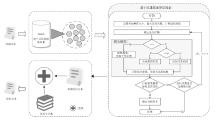
图1
对抗样本生成框架
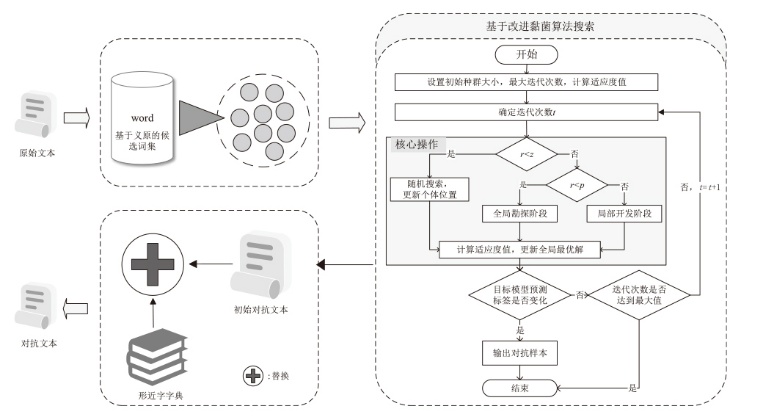
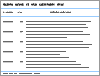
表1
离散空间中的逻辑操作
| 运算操作 | 符号 | 条件 | 结果生成规则 |
|---|---|---|---|
| 与(AND) | 输入词相同( | 保留原词 | |
| 输入词不同( | 在 | ||
| 或(OR) | 输入词相同( | 保留原词 | |
| 输入词不同( | 在 | ||
| 异或(XOR) | ⊕ | 输入词相同( | 在 |
| 输入词不同( | 在 |
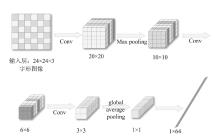
图2
生成字形特征向量示意图
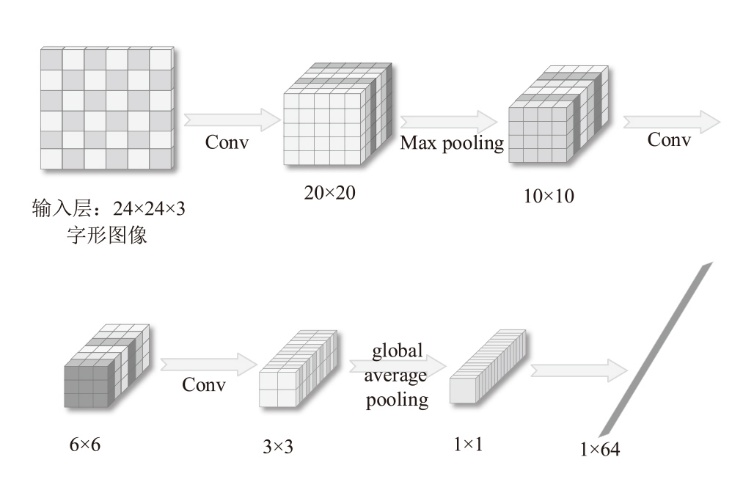
表2
在酒店评论数据集上的对比实验结果
| 网络模型 | 无修改 | 对比方法 | 本文方法 | ||||||
|---|---|---|---|---|---|---|---|---|---|
| CWordAttacker | WordHanding | TextFooler | ISMA | ||||||
| 准确率 | 准确率 | 降低幅度 | 准确率 | 降低幅度 | 准确率 | 降低幅度 | 准确率 | 降低幅度 | |
| TextCNN | 89.32% | 60.38% | 28.94% | 66.48% | 22.84% | 74.22% | 15.10% | 57.34% | 31.98% |
| LSTM | 91.46% | 55.74% | 35.72% | 57.17% | 34.29% | 67.28% | 24.18% | 51.28% | 40.18% |
| BERT | 92.64% | 57.25% | 35.39% | 60.95% | 31.69% | 67.82% | 24.82% | 54.12% | 38.52% |
| Transformer | 92.91% | 60.52% | 32.39% | 65.93% | 26.98% | 70.43% | 22.48% | 59.66% | 33.25% |
表3
在微博评论数据集上的对比实验结果
| 网络模型 | 无修改 | 对比方法 | 本文方法 | ||||||
|---|---|---|---|---|---|---|---|---|---|
| CWordAttacker | WordHanding | TextFooler | ISMA | ||||||
| 准确率 | 准确率 | 降低幅度 | 准确率 | 降低幅度 | 准确率 | 降低幅度 | 准确率 | 降低幅度 | |
| TextCNN | 87.32% | 59.43% | 27.89% | 63.34% | 23.98% | 72.84% | 14.48% | 55.49% | 31.83% |
| LSTM | 88.44% | 56.17% | 32.27% | 60.42% | 28.02% | 68.45% | 19.99% | 58.14% | 30.30% |
| BERT | 87.96% | 60.74% | 27.22% | 63.21% | 24.75% | 69.73% | 18.23% | 58.78% | 29.18% |
| Transformer | 89.88% | 57.55% | 32.33% | 62.16% | 27.72% | 70.65% | 19.23% | 59.57% | 30.31% |
表4
在电商购物评论数据集上的对比实验结果
| 网络模型 | 无修改 | 对比方法 | 本文方法 | ||||||
|---|---|---|---|---|---|---|---|---|---|
| CWordAttacker | WordHanding | TextFooler | ISMA | ||||||
| 准确率 | 准确率 | 降低幅度 | 准确率 | 降低幅度 | 准确率 | 降低幅度 | 准确率 | 降低幅度 | |
| TextCNN | 88.05% | 60.47% | 27.58% | 67.43% | 20.62% | 71.24% | 16.81% | 56.63% | 31.42% |
| LSTM | 88.74% | 58.35% | 30.39% | 61.24% | 27.50% | 67.52% | 21.22% | 57.92% | 30.82% |
| BERT | 90.86% | 62.64% | 28.22% | 66.85% | 24.01% | 71.44% | 19.42% | 54.16% | 36.70% |
| Transformer | 89.47% | 54.48% | 34.99% | 60.58% | 28.89% | 72.26% | 17.21% | 48.85% | 40.62% |
表5
不同实验方法生成对抗样本WMD分布情况
| WMD | 对比方法 | 本文方法 | ||
|---|---|---|---|---|
| CWordAttacker | WordHanding | TextFooler | ISMA | |
| 0~0.2 | 12.35% | 13.15% | 13.80% | 14.70% |
| 0.2~0.4 | 22.90% | 23.80% | 23.90% | 24.60% |
| 0.4~0.6 | 28.85% | 28.05% | 26.15% | 25.45% |
| 0.6~0.8 | 18.95% | 17.30% | 14.70% | 18.90% |
| 0.8及以上 | 16.95% | 17.70% | 21.45% | 16.35% |
表6
不同方法生成的对抗样本示例
| 方法 | 生成的对抗样本 | 识别结果 | 置信度 |
|---|---|---|---|
| 原始句子 | 酒店周围的污染问题非常严重,附近的河流都变黑了 | 负面评价 | 98.67% |
| CWordAttacker | 酒店周围的污染問題非常嚴重,附近的河流都變黑了 | 正面评价 | 85.39% |
| WordHanding | 酒店周围的污冉问题非常严仲,附近的河流都变嘿了 | 正面评价 | 78.47% |
| TextFooler | 酒店周围的废气情况非常糟糕,附近的水源都发臭了 | 负面评价 | 80.32% |
| ISMA(本文方法) | 酒店周围的汚染问题非常严峻,附近的河流都变黒了 | 正面评价 | 90.61% |
表7
志愿者评估结果
| 评估维度 | CWordAttacker | WordHanding | TextFooler | ISMA(本文方法) |
|---|---|---|---|---|
| 流畅性 | 4.0 | 2.7 | 3.8 | 4.2 |
| 语义保留度 | 4.1 | 2.3 | 2.5 | 4.3 |
| 迷惑性 | 3.7 | 3.0 | 3.4 | 4.0 |
表8
形近字优化模块的消融实验结果
| 网络模型 | 酒店评论数据集 | 微博评论数据集 | 电商购物评论数据集 | |||
|---|---|---|---|---|---|---|
| Baseline | +形近字替换 | Baseline | +形近字替换 | Baseline | +形近字替换 | |
| TextCNN | 72.74% | 57.34% | 73.59% | 55.49% | 70.65% | 56.63% |
| LSTM | 74.56% | 51.28% | 75.24% | 58.14% | 75.84% | 57.92% |
| BERT | 79.83% | 54.12% | 78.38% | 58.78% | 77.63% | 54.16% |
| Transformer | 76.44% | 59.66% | 79.24% | 59.57% | 79.54% | 48.85% |
| [1] | DHARIWAL P, NICHOL A. Diffusion Models Beat Gans on Image Synthesis[J]. Advances in Neural Information Processing Systems, 2021, 34: 8780-8794. |
| [2] | DEVLIN J, CHANG M W, LEE K, et al. BERT: Pre-Training of Deep Bidirectional Transformers for Language Understanding[C]//ACL. The 2019 Conference of the North American Chapter of the Association for Computational Linguistics:Human Language Technologies. Stroudsburg: ACL, 2019: 4171-4186. |
| [3] |
DING Hongwei, CHEN Leiyang, DONG Liang, et al. Imbalanced Data Classification: A KNN and Generative Adversarial Networks-Based Hybrid Approach for Intrusion Detection[J]. Future Generation Computer Systems, 2022, 131: 240-254.
doi: 10.1016/j.future.2022.01.026 URL |
| [4] | SZEGEDY C, ZAREMBA W, SUTSKEVER I, et al. Intriguing Properties of Neural Networks[EB/OL]. (2013-12-19)[2025-11-21]. https://arxiv.org/abs/1312.6199. |
| [5] | GOODFELLOW I J, SHLENS J, SZEGEDY C. Explaining and Harnessing Adversarial Examples[EB/OL]. (2014-12-20)[2025-11-21]. https://arxiv.org/abs/1412.6572. |
| [6] | YUAN Tianhao, JI Shunhui, ZHANG Pengcheng, et al. Adversarial Example Generation Method for Black Box Intelligent Speech Software[J]. Journal of Software, 2022, 33(5): 1569-1586. |
| 袁天昊, 吉顺慧, 张鹏程, 等. 针对黑盒智能语音软件的对抗样本生成方法[J]. 软件学报, 2022, 33(5): 1569-1586. | |
| [7] | MADRY A, MAKELOV A, SCHMIDT L, et al. Towards Deep Learning Models Resistant to Adversarial Attacks[EB/OL]. (2017-06-19)[2025-11-21]. https://arxiv.org/abs/1706.06083. |
| [8] | MAHESHWARY R, MAHESHWARY S, PUDI V. Generating Natural Language Attacks in a Hard Label Black Box Setting[C]//AAAI. The AAAI Conference on Artificial Intelligence. Palo Alto: AAAI, 2021: 13525-13533. |
| [9] | ALZANTOT M, SHARMA Y, ELGOHARY A, et al. Generating Natural Language Adversarial Examples[C]//ACL. The 2018 Conference on Empirical Methods in Natural Language Processing. Stroudsburg: ACL, 2018: 2890-2896. |
| [10] | ZANG Yuan, QI Fanchao, YANG Chenghao, et al. Word-Level Textual Adversarial Attacking as Combinatorial Optimization[C]//ACL. The 58th Annual Meeting of the Association for Computational Linguistics. Stroudsburg: ACL, 2020: 6066-6080. |
| [11] | TONG Xin, WANG Luona, WANG Runzheng, et al. A Generation Method of Word-Level Adversarial Samples for Chinese Text Classification[J]. Netinfo Security, 2020, 20(9): 12-16. |
| 仝鑫, 王罗娜, 王润正, 等. 面向中文文本分类的词级对抗样本生成方法[J]. 信息网络安全, 2020, 20(9): 12-16. | |
| [12] | WANG Wenqi, WANG Run, WANG Lina, et al. Adversarial Examples Generation Approach for Tendency Classification on Chinese Texts[J]. Journal of Software, 2019, 30(8): 2415-2427. |
| 王文琦, 汪润, 王丽娜, 等. 面向中文文本倾向性分类的对抗样本生成方法[J]. 软件学报, 2019, 30(8): 2415-2427. | |
| [13] | GAO Ji, LANCHANTIN J, SOFFA M L, et al. Black-Box Generation of Adversarial Text Sequences to Evade Deep Learning Classifiers[C]//IEEE.2018 IEEE Security and Privacy Workshops (SPW). New York: IEEE, 2018: 50-56. |
| [14] | JIN Di, JIN Zhijing, ZHOU J T, et al. Is Bert Really Robust? A Strong Baseline for Natural Language Attack on Text Classification and Entailment[C]//AAAI. The AAAI Conference on Artificial Intelligence. New York: AAAI, 2020: 8018-8025. |
| [15] | JIA R, LIANG P. Adversarial Examples for Evaluating Reading Comprehension Systems[C]//ACL. The 2017 Conference on Empirical Methods in Natural Language Processing. Stroudsburg: ACL, 2017: 2021-2031. |
| [16] | MINERVINI P, RIEDEL S. Adversarially Regularising Neural NLI Models to Integrate Logical Background Knowledge[C]//ACL.The 22nd Conference on Computational Natural Language Learning. Stroudsburg: ACL, 2018: 65-74. |
| [17] |
LI Shimin, CHEN Huiling, WANG Mingjing, et al. Slime Mould Algorithm: A New Method for Stochastic Optimization[J]. Future generation computer systems, 2020, 111: 300-323.
doi: 10.1016/j.future.2020.03.055 URL |
| [18] | DONG Zhendoong, DONG Qiang. HowNet and the Computation of Meaning (with CD-ROM)[M]. Singapore: World Scientific, 2006. |
| [19] | SATO M, SUZUKI J, SHINDO H, et al. Interpretable Adversarial Perturbation in Input Embedding Space for Text[C]//International Joint Conferences on Artificial Intelligence Organization. The 27th International Joint Conference on Artificial Intelligence. New York: International Joint Conferences on Artificial Intelligence Organization, 2018: 4323-4330. |
| [20] | ZHANG Huangzhao, ZHOU Hao, MIAO Ning, LI Lei. Generating Fluent Adversarial Examples for Natural Languages[C]//ACL. The 57th Annual Meeting of the Association for Computational Linguistics. Stroudsburg: ACL, 2019: 5564-5569. |
| [21] | SAMANTA S, MEHTA S. Towards Crafting Text Adversarial Samples[EB/OL]. (2017-07-10)[2025-11-21]. https://arxiv.org/abs/1707.02812. |
| [22] | MILLER G A. WordNet: A Lexical Database for English[J]. Communications of the ACM, 1995, 38(11): 39-41. |
| [23] | WANG Tianrui. Text Adversarial Sample Generation Method Based on Swarm Intelligence Optimization[D]. Chengdu: University of Electronic Science and Technology of China, 2023. |
| 王天瑞. 基于群智能优化的文本对抗样本生成方法[D]. 成都: 电子科技大学, 2023. | |
| [24] | LIU Wenjuan, WU Houyue, ZHANG Shunxiang. Adversarial Sample Generation Model Based on Improved Ant Colony Algorithm[J]. Journal of Chinese Information Processing, 2024, 38(8): 44-54. |
| 刘文娟, 吴厚月, 张顺香. 基于改进蚁群算法的对抗样本生成模型[J]. 中文信息学报, 2024, 38(8): 44-54. | |
| [25] | MENG Yuxian, WU Wei, WANG Fei, et al. Glyce:Glyph-Vectors for Chinese character representations[C]//Neural Information Processing Systems Foundation. Advances in Neural Information Processing Systems. New York: Curran Associates, Inc., 2019: 2742-2753. |
| [26] | KUSNER M J, SUN Yu, KOLKIN N I, et al. From Word Embeddings to Document Distances[C]//International Machine Learning Society. The 32nd International Conference on Machine Learning. Cambridge: JMLR, 2015: 957-966. |
| [1] | 张兴兰, 陶科锦. 基于高阶特征与重要通道的通用性扰动生成方法[J]. 信息网络安全, 2025, 25(5): 767-777. |
| [2] | 徐茹枝, 张凝, 李敏, 李梓轩. 针对恶意软件的高鲁棒性检测模型研究[J]. 信息网络安全, 2024, 24(8): 1184-1195. |
| [3] | 徐子荣, 郭焱平, 闫巧. 基于特征恶意度排序的恶意软件对抗防御模型[J]. 信息网络安全, 2024, 24(4): 640-649. |
| [4] | 张国敏, 屠智鑫, 邢长友, 王梓澎, 张俊峰. 基于对抗样本的流量时序特征混淆方法[J]. 信息网络安全, 2024, 24(12): 1882-1895. |
| [5] | 李奕轩, 贾鹏, 范希明, 陈尘. 基于控制流变换的恶意程序检测GNN模型对抗样本生成方法[J]. 信息网络安全, 2024, 24(12): 1896-1910. |
| [6] | 许可, 李嘉怡, 蒋兴浩, 孙锬锋. 一种基于轮廓稀疏对抗的视频步态隐私保护算法[J]. 信息网络安全, 2024, 24(1): 48-59. |
| [7] | 沈华, 田晨, 郭森森, 慕志颖. 基于对抗性机器学习的网络入侵检测方法研究[J]. 信息网络安全, 2023, 23(8): 66-75. |
| [8] | 李晨蔚, 张恒巍, 高伟, 杨博. 基于AdaN自适应梯度优化的图像对抗迁移攻击方法[J]. 信息网络安全, 2023, 23(7): 64-73. |
| [9] | 蒋曾辉, 曾维军, 陈璞, 武士涛. 面向调制识别的对抗样本研究综述[J]. 信息网络安全, 2023, 23(6): 74-90. |
| [10] | 仝鑫, 金波, 王斌君, 翟晗名. 融合对抗增强和多任务优化的恶意短信检测方法[J]. 信息网络安全, 2023, 23(10): 21-30. |
| [11] | 胡卫, 赵文龙, 陈璐, 付伟. 基于Logits向量的JSMA对抗样本攻击改进算法[J]. 信息网络安全, 2022, 22(3): 62-69. |
| [12] | 郑耀昊, 王利明, 杨婧. 基于网络结构自动搜索的对抗样本防御方法研究[J]. 信息网络安全, 2022, 22(3): 70-77. |
| [13] | 夏强, 何沛松, 罗杰, 刘嘉勇. 基于普遍对抗噪声的高效载体图像增强算法[J]. 信息网络安全, 2022, 22(2): 64-75. |
| [14] | 张郅, 李欣, 叶乃夫, 胡凯茜. 融合多重风格迁移和对抗样本技术的验证码安全性增强方法[J]. 信息网络安全, 2022, 22(10): 129-135. |
| [15] | 于克辰, 郭莉, 姚萌萌. 基于空间及能量维度的黑盒对抗样本生成方法[J]. 信息网络安全, 2021, 21(3): 72-78. |
| 阅读次数 | ||||||
|
全文 |
|
|||||
|
摘要 |
|
|||||