Netinfo Security ›› 2026, Vol. 26 ›› Issue (10): 1497-1525.doi: 10.3969/j.issn.1671-1122.2026.10.001
Previous Articles Next Articles
RF-based wireless sensing security: evolution, threats and defense
Li Guyue( ), Xu Xiaoyu, Chu Zhiming
School of Cyber Science and Engineering ,Southeast University Nanjing 211189, China
-
Received:2026-05-20Online:2026-10-10Published:2026-11-06 -
Contact:Li Guyue E-mail:guyuelee@seu.edu.cn

CLC Number:
Cite this article
Li Guyue, Xu Xiaoyu, Chu Zhiming. RF-based wireless sensing security: evolution, threats and defense[J]. Netinfo Security, 2026, 26(10): 1497-1525.
share this article
Add to citation manager EndNote|Ris|BibTeX
URL: http://netinfo-security.org/EN/10.3969/j.issn.1671-1122.2026.10.001
| 相关工作 | 文献 | 研究侧重点 | 分类依据 | 文章贡献 | 局限性 |
|---|---|---|---|---|---|
| 无线感知综述 | 文献 [ | 无线感知算法 | 无线感知 技术或场景 | 归纳无线 感知的关键技术进展 | 缺少安全性分析 |
| 攻防专题综述 | 文献 [ | 特定攻击范式或防御技术 | 攻击场景或攻击类型 | 总结典型的攻击或防御机制 | 侧重单一 维度,缺少跨平台对比 |
| 本文 | — | 射频无线感知安全 | 无线感知 平台、特征与方法 | 揭示无线感知技术演进与威胁的 内在关联 | 缺少太赫兹频段下的 安全性分析 |
| 平台 | 频段 | 感知范围 | 时延 | 功耗 | 适用感知任务 |
|---|---|---|---|---|---|
| 蜂窝 | 450 MHz~ 1 THz(预期) | 数百米 | 1~10 ms | 中等 | 支持亚厘米级定位、微动识别 |
| Wi-Fi | 2.4/5/6 GHz | 数十米 | 1~10 ms | 中高 | 支持高精度定位、 动作识别、健康监测 |
| RFID | 低频:125~134 kHz 高频:13 MHz | 约10米 | 小于1 s | 极低 | 支持近距离定位、 目标识别与运动追踪 |
| LoRa | 433/868/ 915 MHz | 城市约2 km,郊区约10 km | 较长 | 极低 | 支持粗定位、目标检测,传输速率偏低,不适合复杂的感知 需求 |
| 毫米波雷达 | 60/77 GHz | 数百米 | 小于1 ms | 中等 | 支持高精度定位、 速度与角度测量、 目标追踪及动作识别 |
| 名称 | 物理本质 | 获取机制 | 采集平台 | 脆弱性 |
|---|---|---|---|---|
| RSSI | 链路级 功率衰减 | 接收端对所有子载波的功率非相干求和 | Wi-Fi网卡、蜂窝基站、RFID标签、LoRa系统普遍支持 | 易受重放攻击、干扰 攻击 |
| CSI | 子载波级信道响应 | OFDM解调后计算每个子载波的复数 信道响应 | 修改固件后的商用Wi-Fi网卡,蜂窝 基站 | 易受对抗样本攻击、 信号伪造攻击 |
| BFI | 空间域 波束朝向 | 在MIMO系统中对CSI矩阵进行奇异值分解和吉文斯旋转 | IEEE 802.11 ac标准的Wi-Fi网卡或5G平台 | 数据压缩 导致特征丢失,易受信道操控 |
| 分类 | 感知方法 | 适配平台 | 依赖特征 | 典型算法 | 代表性性能 指标 |
|---|---|---|---|---|---|
| 模型驱动 | 几何模型法 | Wi-Fi、RFID、LoRa、蜂窝、毫米波雷达 | RSSI、CSI | 几何运动学 模型Widar[ | 定位误差为0.24 m |
| 菲涅尔区 理论[ | 呼吸误差小于0.5 bpm | ||||
| 信号处理 方法 | Wi-Fi、蜂窝、毫米波雷达 | CSI | DWT WiFinger[ | 手势识别误差为0.4% | |
| MUSIC SpotFi[ | 定位误差为0.4 m | ||||
| ISAC联合 优化 | 5G/6G蜂窝 | — | 文献[ | 速度估计 误差为0.1 m/s | |
| 数据驱动 | 通用深度 学习 | Wi-Fi、蜂窝 | CSI、 BFI | CNN+LSTM[ | 行为识别准确率为85% |
| LSTM[ | 人类活动 识别准确率为90% | ||||
| 多节点协同感知 | 多天线 Wi-Fi、分布式蜂窝基站 | CSI | AdaWiFi[ | 行为识别准确率为88.5% | |
| CREWS[ | 行为识别准确率为96% | ||||
| 跨域泛化与鲁棒算法 | Wi-Fi、蜂窝、毫米波雷达 | — | 自监督对比学习AutoFi[ | 泛化准确率为86.8% | |
| 少样本学习BeamSense[ | 泛化准确率为 90%~95% |
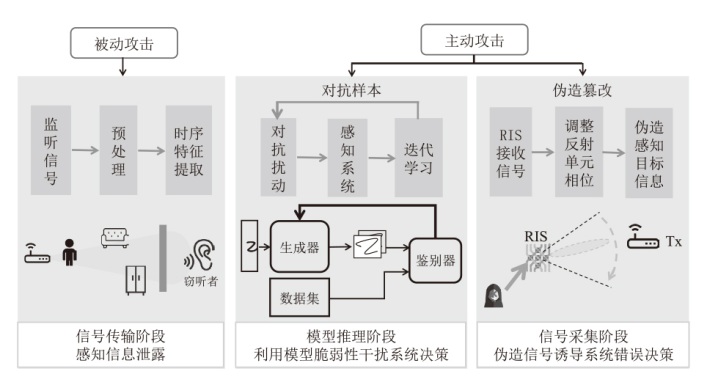
| 分类 | 涉及无线 感知平台 | 工作举例 | 核心原理 | 挑战 | |
|---|---|---|---|---|---|
| 被动攻击:无线感知系统的隐私 泄露 | 基于辐射泄露的敏感信息 窃取 | RFID、LoRa | SpiderMon[ | 监听设备运行过程中泄露的电磁辐射并恢复 信息 | 高采样率设备; 环境噪声剥离 |
| 基于通信协议特征的语义 推断 | Wi-Fi、 蜂窝 | WiFiLeaks[ | 监听通信协议信号,推断用户行为 | 语义标注成本高; 依赖连续采样流 | |
| 主动攻击:无线感知系统的干扰 对抗 | 基于模型对抗的对抗样本 构造 | Wi-Fi:伪造CSI或BFI; 蜂窝:伪造同步导频 | 白盒:Wi-Spoof[ 黑盒:MadRadar[ | 针对机器学习模型,向无线感知特征注入微小扰动,诱导模型误报 | 白盒攻击需要掌握模型参数; 黑盒攻击需获取查询接口; 平衡攻击性能与隐蔽性 |
| 基于信号注入的无线感知结果篡改 | RFID:干扰读写器使其无法获取标签回波; 毫米波雷达、Wi-Fi:改变信道 环境 | 信号欺骗:mmSpoof[ 信道操控:MmVanish[ | 针对感知源,主动伪造或重放信号;针对信道,主动改变信道环境加以干预 | 需要专用信号发射设备,如反射阵列; 需要考虑复杂的多径环境与信号同步 | |
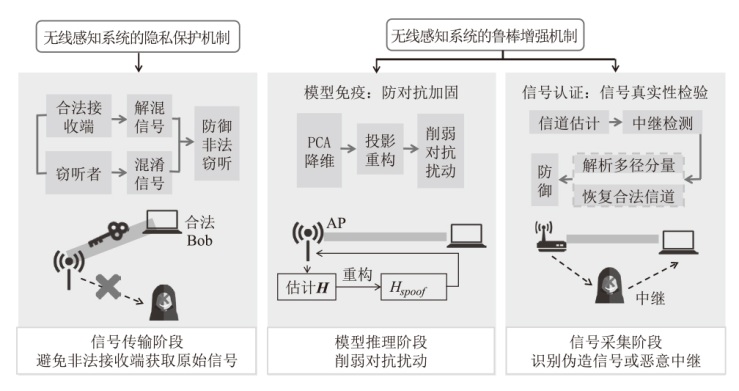
| 分类 | 涉及无线感知平台 | 工作举例 | 核心原理 | 挑战 | |
|---|---|---|---|---|---|
| 无线感知系统的隐私保护 机制 | 面向侧信道掩盖的信号混淆机制 | RFID、LoRa: 轻量级信号扰动 | IRShield[ | 利用波束成形等手段在信号源或信道层面对信号进行处理与重构,抑制敏感特征 | 平衡隐私保护与无线感知性能; 低功耗无源设备如何实现对抗计算 |
| 隐私保护的人工伪造帧注入机制 | Wi-Fi: 波束定向屏蔽、物理层加密; 蜂窝: 添加人工 响应 | PhyCloak[ | 在感知发射端引入人工噪声和随机化设计 | 如何在保障细粒度无线感知的条件下,防止特征被第三方恶意解耦 | |
| 无线感知系统的鲁棒增强 机制 | 基于无线感知模型免疫的防对抗 加固 | Wi-Fi、 蜂窝 | 对抗训练RMBN[ | 通过输入数据噪声平滑、模型梯度掩盖,增强深度学习无线感知模型的鲁棒性 | 对抗训练训练成本高; 泛化性有限 |
| 基于信号认证的信号真实性检验 | Wi-Fi:干扰检测与抑制; 毫米波雷达:上下文协同防御 | 干扰检测与抑制iSense[ | 通过异常信号阈值检测、多节点协同校验,甄别伪造、篡改、恶意注入的信号 | 高精度认证增加计算 开销; 自然多径变化与恶意操控难以区分 | |
| 防御策略类别 | 核心抗攻击类型 | 适用平台 | 典型防御 方法 | 典型防御效果 | 计算开销 |
|---|---|---|---|---|---|
| 信号混淆与掩蔽 | 设备 泄露、 被动监听 | Wi-Fi、蜂窝 | IRShield[ | 窃听率降至5% | 其中,N为RIS的反射单元总数,T为配置更新频率 |
| Protego[ | 窃听率降至25% | ||||
| 人工伪造帧注入与防护 | 隐私窃取、细粒度击键窃听 | Wi-Fi、蜂窝、毫米波雷达 | Secur-Fi[ | 窃听率降至28% | 其中,M为网卡天线通道数,N为子载波数 |
| PhyCloak[ | 攻击效果降至15% | N为信号采样点数 | |||
| 对抗训练与鲁棒 模型 | 对抗样本攻击 | Wi-Fi、 蜂窝 | RMBN[ | 面对攻击识别准确率恢复至85% | 其中,I为迭代次数,K为批量大小,D为网络参数维度 |
| 物理层认证与检验 | 信号注入、伪造欺骗、身份冒充 | Wi-Fi、RFID、LoRa、 蜂窝 | PHYAlert[ | 检测成功率98% | 其中, M为接收端天线数, N为子载波数 |
| RelayShield[ | 检测准确率95% | ||||
| 信道状态一致性 检测 | 伪造帧注入、中间人篡改 | RFID、LoRa、毫米波雷达 | iSense[ | 面对攻击识别准确率恢复至98.6% | N为单帧雷达信号的采样 点数 |
| [1] | Wei Bo, Song Hang, Katto J, et al. RSSI-CSI measurement and variation mitigation with commodity Wi-Fi device[J]. IEEE Internet of Things Journal, 2023, 10(7): 6249-6258. |
| [2] | ITU. Recommendation ITU-R M. 2160-0 (11/2023)-Framework and overall objectives of the future development of IMT for 2030 and beyond[EB/OL]. [2026-04-25]. https://www.itu.int/dms_pubrec/itu-r/rec/m/R-REC-M.2160-0-202311-I!!PDF-E.pdf. |
| [3] | Mosleh S, Coder J B, Scully C G, et al. Monitoring respiratory motion with Wi-Fi CSI: characterizing performance and the breathesmart algorithm[J]. IEEE Access, 2022, 10: 131932-131951. |
| [4] | Du Zhen, Liu Fan, Li Yunxin, et al. Toward ISAC-empowered vehicular networks: framework, advances, and opportunities[J]. IEEE Wireless Communications, 2025, 32(2): 222-229. |
| [5] | González-Prelcic N, Furkan K M, Kaltiokallio O, et al. The integrated sensing and communication revolution for 6G: vision, techniques, and applications[J]. Proceedings of the IEEE, 2024, 112(7): 676-723. |
| [6] | Zhang Yushu, Xiang Yong, Zhang L Y, et al. Secure wireless communications based on compressive sensing: a survey[J]. IEEE Communications Surveys & Tutorials, 2019, 21(2): 1093-1111. |
| [7] | Jornet J M, Knightly E W, Mittleman D M. Wireless communications sensing and security above 100 GHz[J]. Nature Communications, 2023, 14: 841. |
| [8] | Armenta-Garcia J A, Gonzalez-Navarro F F, Caro-Gutierrez J. Wireless sensing applications with Wi-Fi channel state information, preprocessing techniques, and detection algorithms: a survey[J]. Computer Communications, 2024, 224: 254-274. |
| [9] | Liu Jiao, Teng Guanlong, Hong Feng. Human activity sensing with wireless signals: a survey[J]. Sensors, 2020, 20(4): 1210. |
| [10] | Liu Jian, Liu Hongbo, Chen Yingying, et al. Wireless sensing for human activity: a survey[J]. IEEE Communications Surveys & Tutorials, 2020, 22(3): 1629-1645. |
| [11] | Duan Pengsong, Diao Xianguang, Cao Yangjie, et al. A comprehensive survey on Wi-Fi sensing for human identity recognition[J]. Electronics, 2023, 12(23): 4858. |
| [12] | Luong N C, Huynh-The T, Vu T H, et al. Advanced learning algorithms for integrated sensing and communication (ISAC) systems in 6G and beyond: a comprehensive survey[J]. IEEE Communications Surveys & Tutorials, 2026, 28: 2572-2611. |
| [13] | Wang Fei, Zhang Tingting, Xi Wei, et al. A survey on Wi-Fi sensing generalizability: taxonomy, techniques, datasets, and future research prospects[J]. IEEE Communications Surveys & Tutorials, 2026, 28: 5227-5266. |
| [14] | Uchiyama A, Saruwatari S, Maekawa T, et al. Context recognition by wireless sensing: a comprehensive survey[J]. Journal of Information Processing, 2021, 29: 46-57. |
| [15] | Ruotsalainen H, Shen Guanxiong, Zhang Junqing, et al. LoRaWAN physical layer-based attacks and countermeasures, a review[J]. Sensors, 2022, 22(9): 3127. |
| [16] | Noura H, Hatoum T, Salman O, et al. LoRaWAN security survey: issues, threats and possible mitigation techniques[J]. Internet of Things, 2020, 12: 100303. |
| [17] | Lee C C. Security and privacy in wireless sensor networks: advances and challenges[J]. Sensors, 2020, 20(3): 744. |
| [18] | Ram G M, Ilavarasan E. Security challenges in wireless sensor network: current status and future trends[J]. Wireless Personal Communications, 2024, 139(2): 1173-1202. |
| [19] | Yang Yanni, Hu Pengfei, Shen Jiaxing, et al. Privacy-preserving human activity sensing: a survey[J]. High-Confidence Computing, 2024, 4(1): 100204. |
| [20] | Yao Junmei, Liu Chaoyang, Luo Sheng, et al. Toward integrated sensing and communication: interference-resistance design for WiFi sensing[J]. IEEE Transactions on Mobile Computing, 2025, 24(10): 10807-10822. |
| [21] | Pirayesh H, Zeng Huacheng. Jamming attacks and anti-jamming strategies in wireless networks: a comprehensive survey[J]. IEEE Communications Surveys & Tutorials, 2022, 24(2): 767-809. |
| [22] | Xie Yucheng, Jiang Ruizhe, Guo Xiaonan, et al. Universal targeted adversarial attacks against mmWave-based human activity recognition[C]// IEEE INFOCOM 2023-IEEE Conference on Computer Communications. New York: IEEE, 2023: 1-10. |
| [23] | Geng Ruixu, Wang Jianyang, Yuan Yuqin, et al. A survey of wireless sensing security from a role-based view[J]. IEEE Communications Surveys & Tutorials, 2026, 28: 3412-3442. |
| [24] | Liu Xingyu, Meng Xin, Duan Hancong, et al. A survey on secure WiFi sensing technology: attacks and defenses[J]. Sensors, 2025, 25(6): 1913. |
| [25] | Zhang J A, Rahman M L, Wu Kai, et al. Enabling joint communication and radar sensing in mobile networks—a survey[J]. IEEE Communications Surveys & Tutorials, 2022, 24(1): 306-345. |
| [26] | Wei Zhiqing, Qu Hanyang, Wang Yuan, et al. Integrated sensing and communication signals toward 5G-a and 6G: a survey[J]. IEEE Internet of Things Journal, 2023, 10(13): 11068-11092. |
| [27] | Al-Habashna A, Rajus V S, Risopatron N A, et al. Indoor localization and building occupancy count estimation using LTE-a ultra-dense networks[C]// The 11th Annual Symposium on Simulation for Architecture and Urban Design. New York: ACM, 2020: 1-8. |
| [28] | Rai P K, Kumar A, Ali K M Z, et al. LTE-based passive radars and applications: a review[J]. International Journal of Remote Sensing, 2021, 42(19): 7489-7518. |
| [29] | Feng Yuda, Xie Yaxiong, Ganesan D, et al. LTE-based pervasive sensing across indoor and outdoor[C]// The 19th ACM Conference on Embedded Networked Sensor Systems. New York: ACM, 2021: 138-151. |
| [30] | Wu Zhefu, Lu Chengling, Wan Yuxuan, et al. LTE-ACN: a human activity recognition system using LTE signals and attention-guided ConvNeXt networks[J]. IEEE Transactions on Instrumentation and Measurement, 2025, 74: 5505912. |
| [31] | Ruan Yanlin, Chen Liang, Zhou Xin, et al. iPos-5G: indoor positioning via commercial 5G NR CSI[J]. IEEE Internet of Things Journal, 2023, 10(10): 8718-8733. |
| [32] | Ruan Yanlin, Chen Liang, Zhou Xin, et al. Hi-Loc: hybrid indoor localization via enhanced 5G NR CSI[J]. IEEE Transactions on Instrumentation and Measurement, 2022, 71: 5502415. |
| [33] | Li Xiaobo, Chen Liang, Zhou Xin, et al. Fusion of 5G carrier phase ranging and 5G CSI fingerprinting for indoor positioning[C]// 2022 14th International Conference on Wireless Communications and Signal Processing (WCSP). New York: IEEE, 2022: 1-5. |
| [34] | Hofstadler M, Larcher M, Feger R, et al. Optimized window function for improved estimation capabilities in 5G joint communication and sensing[C]// 2023 20th European Radar Conference (EuRAD). New York: IEEE, 2023: 335-338. |
| [35] | Pin T D K, He Jia, Li Yanchun, et al.Integrated sensing and communication in 6G:motivations, use cases, requirements, challenges and future directions[C]//2021 1st IEEE International Online Symposium on Joint Communications & Sensing (JC&S). New York: IEEE, 2021: 1-6. |
| [36] | Wang Shiguo, Fu Xuewen, Ruby R, et al. Pilot spoofing detection for massive MIMO mmWave communication systems with a cooperative relay[J]. Computer Communications, 2023, 202: 33-41. |
| [37] | Caballero E, Galdino I, Soto J C H, et al. Human activity recognition using Wi-Fi CSI[C]// International Conference on Pervasive Computing Technologies for Healthcare. Heidelberg: Springer, 2024: 309-321. |
| [38] | Adib F, Katabi D. See through walls with WiFi![C]// The ACM SIGCOMM 2013 conference on SIGCOMM. New York: ACM, 2013: 75-86. |
| [39] | Wang Zhengjie, Jiang Kangkang, Hou Yushan, et al. A survey on CSI-based human behavior recognition in through-the-wall scenario[J]. IEEE Access, 2019, 7: 78772-78793. |
| [40] | Wang Wei, Liu A X, Shahzad M, et al. Understanding and modeling of WiFi signal based human activity recognition[C]// The 21st Annual International Conference on Mobile Computing and Networking. New York: ACM, 2015: 65-76. |
| [41] | Zhang Ronghui, Jing Xiaojun, Wu Sheng, et al. Device-free wireless sensing for human detection: the deep learning perspective[J]. IEEE Internet of Things Journal, 2021, 8(4): 2517-2539. |
| [42] | Ma Yongsen, Zhou Gang, Wang Shuangquan, et al. SignFi: sign language recognition using WiFi[J]. Proceedings of the ACM on Interactive, Mobile, Wearable and Ubiquitous Technologies, 2018, 2(1): 1-21. |
| [43] | Sruthi P, Udgata S K. FingerFi:an alpha-numeric character-based gesture recognition using Wi-Fi sensing[C]//2023 28th Asia Pacific Conference on Communications (APCC). New York: IEEE, 2023: 213-218. |
| [44] | Li Junye, Yingchanakiate K, Mishra D, et al. Thermal source localization using WiFi sensing[C]// GLOBECOM 2024-2024 IEEE Global Communications Conference. New York: IEEE, 2024: 1875-1880. |
| [45] | Wang Haoming, Mishra D, Seneviratne A, et al. Analytical model for spatial resolution characterization of keystroke recognition using WiFi sensing[J]. IEEE Wireless Communications Letters, 2025, 14(8): 2606-2610. |
| [46] | Kodera K, Nishio T.Estimating deformation of tubular object from WiFi CSI toward tactile sensing[C]//2025 IEEE 22nd Consumer Communications & Networking Conference (CCNC). New York: IEEE, 2025: 1-6. |
| [47] | Wei Zhongcheng, Chen Wei, Ning Shuli, et al. A survey on WiFi-based human identification: scenarios, challenges, and current solutions[J]. ACM Transactions on Sensor Networks, 2025, 21(1): 1-32. |
| [48] | Picazo-Martinez P, Barroso-Fernández C, Calvillo-Fernandez A, et al. 802.11bf multiband passive sensing: reusing Wi-Fi signaling for sensing[J]. IEEE Internet of Things Journal, 2026, 13(6): 10547-10563. |
| [49] | Zhang Shengzhong, Yu Lei, Cheng Yinqian. An introduction to key technologies of Wi-Fi 7[J]. International Journal of Frontiers in Engineering Technology, 2024, 6(2): 060201. |
| [50] | Gu Yangyang, Chen Jing, He kun, et al. WiFiLeaks: exposing stationary human presence through a wall with commodity mobile devices[J]. IEEE Transactions on Mobile Computing, 2024, 23(6): 6997-7011. |
| [51] | Zhou Yuxuan, Chen Huangxun, Huang Chenyu, et al. WiAdv: practical and robust adversarial attack against WiFi-based gesture recognition system[J]. Proceedings of the ACM on Interactive, Mobile, Wearable and Ubiquitous Technologies, 2022, 6(2): 1-25. |
| [52] | Wang Jue, Katabi D. Dude, where’s my card: RFID positioning that works with multipath and non-line of sight[J]. ACM SIGCOMM Computer Communication Review, 2013, 43(4): 51-62. |
| [53] | Fan Xiaoyi, Gong Wei, Liu Jiangchuan. TagFree activity identification with RFIDs[J]. Proceedings of the ACM on Interactive, Mobile, Wearable and Ubiquitous Technologies, 2018, 2(1): 1-23. |
| [54] | Shuaieb W, Oguntala G, Alabdullah A, et al. RFID RSS fingerprinting system for wearable human activity recognition[J]. Future Internet, 2020, 12(2): 33. |
| [55] | Nadeem M, Habib A, Umair M Y. Chipless RFID based multi-sensor tag for printed electronics[J]. Heliyon, 2024, 10(4): e26494. |
| [56] | Bansal I, Bhat N, Gupta A, et al. SenSync: real-time and accurate passive sensing[C]// 2025 IEEE International Conference on RFID. New York: IEEE, 2025: 1-6. |
| [57] | Wang D, Zhang Jiale, Zhang Pei, et al. TagLabel: RFID based orientation and material sensing for automated package inspection[PP/OL]. V1. arXiv(2025-12-08)[2026-04-25]. https://arxiv.org/abs/2512.07097. |
| [58] | Juels A. RFID security and privacy: a research survey[J]. IEEE Journal on Selected Areas in Communications, 2006, 24(2): 381-394. |
| [59] | Akpakwu G A, Silva B J, Hancke G P, et al. A survey on 5G networks for the Internet of Things: communication technologies and challenges[J]. IEEE Access, 2018, 6: 3619-3647. |
| [60] | Augustin A, Yi Jiazi, Clausen T, et al. A study of LoRa: long range & low power networks for the internet of things[J]. Sensors, 2016, 16(9): 1466. |
| [61] | Peng Yao, Shangguan Longfei, Hu Yue, et al. PLoRa: a passive long-range data network from ambient LoRa transmissions[C]// The 2018 Conference of the ACM Special Interest Group on Data Communication. New York: ACM, 2018: 147-160. |
| [62] | Hossain T, Ahad M A R, Tazin T, et al. Activity recognition by using LoRaWAN sensor[C]// The 2018 ACM International Joint Conference and 2018 International Symposium on Pervasive and Ubiquitous Computing and Wearable Computers. New York: ACM, 2018: 58-61. |
| [63] | Zafari F, Gkelias A, Leung K K. A survey of indoor localization systems and technologies[J]. IEEE Communications Surveys & Tutorials, 2019, 21(3): 2568-2599. |
| [64] | Hu Kang, Gu Chaojie, Chen Jiming. LTrack: a LoRa-based indoor tracking system for mobile robots[J]. IEEE Transactions on Vehicular Technology, 2022, 71(4): 4264-4276. |
| [65] | Cui Hao, Wan Yaping, Zhong hua. LoRa-based human activity recognition using deep learning[C]// 2023 IEEE 3rd International Conference on Electronic Technology, Communication and Information (ICETCI). New York: IEEE, 2023: 170-175. |
| [66] | Nie Mingxing, Zou Liwei, Cui Hao, et al. Enhancing human activity recognition with LoRa wireless RF signal preprocessing and deep learning[J]. Electronics, 2024, 13(2): 264. |
| [67] | Bansal A, Gadre A, Singh V, et al. OwLL: accurate LoRa localization using the TV whitespaces[C]// The 20th International Conference on Information Processing in Sensor Networks. New York: ACM, 2021: 148-162. |
| [68] | Guo Xiuzhen, He Yuan, Nan Jing, et al. A low-power demodulator for LoRa backscatter systems with frequency-amplitude transformation[J]. IEEE/ACM Transactions on Networking, 2024, 32(4): 3515-3527. |
| [69] | Yang Qilin, Chang Xiangmao, Xu Zhuqing. LoRa-based micro-motion sensing for long-range static human detection[J]. IEEE Internet of Things Journal, 2026, 13(5): 9287-9297. |
| [70] | Pourghasem A, Kirner R, Tsokanos A, et al. Machine learning and deep learning-based multi-attribute physical-layer authentication for spoofing detection in LoRaWAN[J]. Future Internet, 2025, 17(2): 68. |
| [71] | Paidimarri A, Tzadok A, Garcia S S, et al. Eye-Beam: a mmWave 5G-compliant platform for integrated communications and sensing enabling AI-based object recognition[J]. IEEE Journal on Selected Areas in Communications, 2024, 42(9): 2354-2368. |
| [72] | An Sizhe, Li Yin, Ogras U. mRI:multi-modal 3D human pose estimation dataset using mmWave, RGB-D, and inertial sensors[C]// Advances in Neural Information Processing Systems 35. New York: Curran Associates, 2022: 27414-27426. |
| [73] | Kang Wenyuan, Ke Feng, Chang Y C.Non-contact realtime vital signs monitoring system based on millimeter wave FMCW radar[C]//2023 9th International Conference on Computer and Communications (ICCC). New York: IEEE, 2023: 1594-1599. |
| [74] | Wang Zetao, Li Gang, Yang Le. Dynamic hand gesture recognition based on micro-doppler radar signatures using hidden Gauss-Markov models[J]. IEEE Geoscience and Remote Sensing Letters, 2021, 18(2): 291-295. |
| [75] | Xu Xiangyu, Chen Yu, Ling Zhen, et al. mmEar: push the limit of COTS mmWave eavesdropping on headphones[C]// IEEE INFOCOM 2024-IEEE Conference on Computer Communications. New York: IEEE, 2024: 351-360. |
| [76] | Zhu Yi, Miao Chenglin, Xue Hongfei, et al. TileMask: a passive-reflection-based attack against mmWave radar object detection in autonomous driving[C]// The 2023 ACM SIGSAC Conference on Computer and Communications Security. New York: ACM, 2023: 1317-1331. |
| [77] | Puduru V K, Yakkati R R, Pardhasaradhi B, et al. Real-time detection of spot jamming attacks in mmWave radar systems using a lightweight CNN[J]. IEEE Sensors Letters, 2024, 8(12): 6014804. |
| [78] | Bahl P, Padmanabhan V N. RADAR: an in-building RF-based user location and tracking system[C]// Conference on Computer Communications. Nineteenth Annual Joint Conference of the IEEE Computer and Communications Societies. New York: IEEE, 2000: 775-784. |
| [79] | Xu Chenren, Firner B, Moore R S, et al. SCPL: indoor device-free multi-subject counting and localization using radio signal strength[C]// The 12th International Conference on Information Processing in Sensor Networks. New York: ACM, 2013: 79-90. |
| [80] | Yiu S, Dashti M, Claussen H, et al. Wireless RSSI fingerprinting localization[J]. Signal Processing, 2017, 131: 235-244. |
| [81] | Abdelnasser H, Harras K A, Youssef M. UbiBreathe: a ubiquitous non-invasive WiFi-based breathing estimator[C]// The 16th ACM International Symposium on Mobile Ad Hoc Networking and Computing. New York: ACM, 2015: 277-286. |
| [82] | Khan M Z, Usman M, Tahir A, et al. Transparent RFID tag wall enabled by artificial intelligence for assisted living[J]. Scientific Reports, 2024, 14: 18896. |
| [83] | Wang Zhongqin, Zhang J A, Wu Kai, et al. Rethinking RSSI for WiFi sensing[J]. npj Wireless Technology, 2026, 2: 45. |
| [84] | Kandel L N, Yu shucheng. Indoor localization using commodity Wi-Fi APs: techniques and challenges[C]// 2019 International Conference on Computing, Networking and Communications (ICNC). New York: IEEE, 2019: 526-530. |
| [85] | Li Ronghua, Hu Haibo, Ye Qingqing. RFTrack: stealthy location inference and tracking attack on Wi-Fi devices[J]. IEEE Transactions on Information Forensics and Security, 2024, 19: 5925-5939. |
| [86] | Halperin D, Hu Wenjun, Sheth A, et al. Tool release: gathering 802.11n traces with channel state information[J]. ACM SIGCOMM Computer Communication Review, 2011, 41(1): 53. |
| [87] | Li Hong, Yang Wei, Wang Jianxin, et al. WiFinger: talk to your smart devices with finger-grained gesture[C]// The 2016 ACM International Joint Conference on Pervasive and Ubiquitous Computing. New York: ACM, 2016: 250-261. |
| [88] | Yang Xiaolong, She Yuan, Xie Liangbo, et al. Channel state information-based multi-dimensional parameter estimation for massive rf data in smart environments[J]. EURASIP Journal on Advances in Signal Processing, 2021, 2021: 16. |
| [89] | Chung W Y, Shen L H, Feng K T, et al. WiRiS: transformer for RIS-assisted device-free sensing for joint people counting and localization using Wi-Fi CSI[C]// 2023 IEEE 34th Annual International Symposium on Personal, Indoor and Mobile Radio Communications (PIMRC). New York: IEEE, 2023: 1-6. |
| [90] | Niu Juan, He Xiuqing, Fang bei, et al. CSI-F: a human motion recognition method based on channel-state-information signal feature fusion[J]. Sensors, 2024, 24(3): 862. |
| [91] | Yin Cunyi, Miao Xiren, Chen Jing, et al. PowerSkel: a device-free framework using CSI signal for human skeleton estimation in power station[J]. IEEE Internet of Things Journal, 2024, 11(11): 20165-20177. |
| [92] | Youm S, Go S. Lightweight and efficient CSI-based human activity recognition via bayesian optimization-guided architecture search and structured pruning[J]. Applied Sciences, 2025, 15(2): 890. |
| [93] | Avola D, Emam E, Montagnini D, et al. WhoFi: deep person re-identification via Wi-Fi channel signal encoding[PP/OL]. V2. arXiv(2025-08-04)[2026-04-25]. https://arxiv.org/abs/2507.12869. |
| [94] | Liu Chuan, Hao Yanling, Liu Yue, et al. LWiHS: a lightweight Wi-Fi-enabled human sensing using feature fusion strategy[J]. IEEE Transactions on Instrumentation and Measurement, 2025, 74: 5031515. |
| [95] | Sharma A, Mishra D, Jha S, et al. Wi-Spoof: generating adversarial wireless signals to deceive Wi-Fi sensing systems[J]. Journal of Information Security and Applications, 2025, 91: 104052. |
| [96] | Zhou Yuxuan, Li Chenggao, Chen Huangxun, et al. RIStealth: practical and covert physical-layer attack against WiFi-based intrusion detection via reconfigurable intelligent surface[C]// The 21st ACM Conference on Embedded Networked Sensor Systems. New York: ACM, 2024: 195-208. |
| [97] | Kondo S, Itahara S, Yamashita K, et al. Bi-Directional beamforming feedback-based firmware-agnostic WiFi sensing: an empirical study[J]. IEEE Access, 2022, 10: 36924-36934. |
| [98] | Bejarano O, Knightly E W, Park M. IEEE 802.11ac: from channelization to multi-user MIMO[J]. IEEE Communications Magazine, 2013, 51(10): 84-90. |
| [99] | Haque K F, Meneghello F, Restuccia F. Wi-BFI: extracting the IEEE 802.11 beamforming feedback information from commercial Wi-Fi devices[C]// The 17th ACM Workshop on Wireless Network Testbeds, Experimental evaluation & Characterization. New York: ACM, 2023: 104-111. |
| [100] | Yi E, Wu Dan, Xiong Jie, et al. BFMSense: WiFi sensing using beamforming feedback matrix[C]// The 21st USENIX Symposium on Networked Systems Design and Implementation. Berkeley: USENIX, 2024: 1697-1712. |
| [101] | Li Xin, Hu Jingzhi, Luo Jun. Efficient beamforming feedback information-based Wi-Fi sensing by feature selection[J]. IEEE Wireless Communications Letters, 2024, 13(9): 2347-2351. |
| [102] | Tao Ran, Guo Jiajia, Cui Yiming, et al. FPNet: joint Wi-Fi beamforming matrix feedback and anomaly-aware indoor positioning[J]. IEEE Transactions on Communications, 2026, 74: 5199-5214. |
| [103] | Wang Junzhe, Li Wenwei, Zhou Jiarun, et al. FreeBFI: enabling fine-grained BFI sensing with an arbitrary number of antennas[J]. Proceedings of the ACM on Interactive, Mobile, Wearable and Ubiquitous Technologies, 2025, 9(4): 1-32. |
| [104] | Hu Jingyang, Wang Hongbo, Zheng Tianyue, et al. Password-stealing without hacking: Wi-Fi enabled practical keystroke eavesdropping[C]// The 2023 ACM SIGSAC Conference on Computer and Communications Security. New York: ACM, 2023: 239-252. |
| [105] | Xu Mingming, He Yinghui, Li Xin, et al. Beamforming made malicious: manipulating Wi-Fi traffic via beamforming feedback forgery[C]// The 30th Annual International Conference on Mobile Computing and Networking. New York: ACM, 2024: 908-922. |
| [106] | Wang Hao, Zhang Daqing, Ma Junyi, et al. Human respiration detection with commodity WiFi devices: do user location and body orientation matter?[C]// The 2016 ACM International Joint Conference on Pervasive and Ubiquitous Computing. New York: ACM, 2016: 25-36. |
| [107] | Kotaru M, Joshi K, Bharadia D, et al. SpotFi: decimeter level localization using WiFi[J]. ACM SIGCOMM Computer Communication Review, 2015, 45(4): 269-282. |
| [108] | Tapio V, Tervo N, Leinonen M E, et al.Bi-static sensing with 5G NR physical uplink shared channel transmission[C]//2024 IEEE 4th International Symposium on Joint Communications & Sensing (JC&S). New York: IEEE, 2024: 1-6. |
| [109] | Liu Fan, Cui Yuanhao, Masouros C, et al. Integrated sensing and communications: toward dual-functional wireless networks for 6G and beyond[J]. IEEE Journal on Selected Areas in Communications, 2022, 40(6): 1728-1767. |
| [110] | Özbay E, Bishoyi P K, Petrova M.Empowering 5G PRS-based ISAC with compressed sensing[C]//2024 IEEE 25th International Workshop on Signal Processing Advances in Wireless Communications (SPAWC). New York: IEEE, 2024: 341-345. |
| [111] | Wei Zhiqing, Wang Yuan, Ma Liang, et al. 5G PRS-based sensing: a sensing reference signal approach for joint sensing and communication system[J]. IEEE Transactions on Vehicular Technology, 2023, 72(3): 3250-3263. |
| [112] | Zhang Jin, Wu Fuxiang, Wei Bo, et al. Data augmentation and dense-LSTM for human activity recognition using WiFi signal[J]. IEEE Internet of Things Journal, 2021, 8(6): 4628-4641. |
| [113] | He Zhengran, Bouazizi M, Yin Yue, et al. Robust cross-scenario WiFi wireless sensing using incremental learning and elastic weight consolidation loss[J]. IEEE Internet of Things Journal, 2025, 12(13): 24288-24299. |
| [114] | Zheng Naiyu, Li Yuanchun, Jiang Shiqi, et al. AdaWiFi, collaborative WiFi sensing for cross-environment adaptation[J]. IEEE Transactions on Mobile Computing, 2025, 24(2): 845-858. |
| [115] | Chen Yinan, Zhou Yang, Huang Xiaoxia, et al. CREWS: collaborative robust edge WiFi sensing with asynchronous and incomplete observations[PP/OL]. V2. arXiv(2026-04-22)[2026-04-25]. https://arxiv.org/abs/2605.30356. |
| [116] | Yang Jianfei, Chen Xinyan, Zou Han, et al. AutoFi: toward automatic Wi-Fi human sensing via geometric self-supervised learning[J]. IEEE Internet of Things Journal, 2023, 10(8): 7416-7425. |
| [117] | Haque K F, Zhang Milin, Meneghello F, et al. BeamSense: rethinking wireless sensing with MU-MIMO Wi-Fi beamforming feedback[J]. Computer Networks, 2025, 258: 111020. |
| [118] | Qian Kun, Wu Chenshu, Yang Zheng, et al. Decimeter level passive tracking with WiFi[C]// The 3rd Workshop on Hot Topics in Wireless. New York: ACM, 2016: 44-48. |
| [119] | Ling Kang, Liu Yuntang, Sun Ke, et al. SpiderMon: towards using cell towers as illuminating sources for keystroke monitoring[C]// IEEE INFOCOM 2020-IEEE Conference on Computer Communications. New York: IEEE, 2020: 666-675. |
| [120] | Li Mengyuan, Meng Yan, Liu Junyi, et al. When CSI meets public WiFi: inferring your mobile phone password via WiFi signals[C]// The 2016 ACM SIGSAC Conference on Computer and Communications Security. New York: ACM, 2016: 1068-1079. |
| [121] | Lu Li, Ba Zhongjie, Lin Feng, et al. ActListener:imperceptible activity surveillance by pervasive wireless infrastructures[C]//2022 IEEE 42nd International Conference on Distributed Computing Systems (ICDCS). New York: IEEE, 2022: 776-786. |
| [122] | Xu Leiyang, Zheng Xiaolong, Li Xiangyuan, et al. WiCAM: imperceptible adversarial attack on deep learning based WiFi sensing[C]// 2022 19th Annual IEEE International Conference on Sensing, Communication, and Networking (SECON). New York: IEEE, 2022: 10-18. |
| [123] | Hunt D, Angell K, Qi Zhenzhou, et al. MadRadar: a black-box physical layer attack framework on mmWave automotive FMCW radars[PP/OL]. V2. arXiv(2023-11-27)[2026-04-25]. https://arxiv.org/abs/2311.16024. |
| [124] | Reddy V R, Jain I K, Bansal K, et al. mmSpoof:resilient spoofing of automotive millimeter-wave radars using reflect array[C]//2023 IEEE Symposium on Security and Privacy (SP). New York: IEEE, 2023: 1807-1821. |
| [125] | Abedi A, Vasisht D. Non-cooperative Wi-Fi localization & its privacy implications[C]// The 28th Annual International Conference on Mobile Computing and Networking. New York: ACM, 2022: 570-582. |
| [126] | Fang Xinmin, Xu Hailu, Tao Lingfeng, et al. MmVanish: extending the vanish attack for multi-radar exploitation of mmWave sensing with meta-material tags[C]// The 2nd International Workshop on Security and Privacy of Sensing Systems. New York: ACM, 2025: 12-16. |
| [127] | Spreitzer R, Moonsamy V, Korak T, et al. Systematic classification of side-channel attacks: a case study for mobile devices[J]. IEEE Communications Surveys & Tutorials, 2018, 20(1): 465-488. |
| [128] | Cui Minhao, Xie Binbin, Wang Qing, et al. EVLeSen: in-vehicle sensing with EV-leaked signal[C]// The 30th Annual International Conference on Mobile Computing and Networking. New York: ACM, 2024: 679-693. |
| [129] | Long Yan, Jiang Qinhong, Yan Chen, et al. EM eye: characterizing electromagnetic side-channel eavesdropping on embedded cameras[EB/OL]. [2026-04-25]. https://www.ndss-symposium.org/wp-content/uploads/2024-552-paper.pdf. |
| [130] | Dujić R L, Perković T, Škiljo M, et al. Privacy leakage of LoRaWAN smart parking occupancy sensors[J]. Future Generation Computer Systems, 2023, 138: 142-159. |
| [131] | Meng Yan, Zhu Haojin. Wireless traffic analysis based side-channel attacks and countermeasure in smart home[C]// The ACM Turing Award Celebration Conference-China 2023. New York: ACM, 2023: 150-151. |
| [132] | Hernandez S M, Bulut E. Adversarial occupancy monitoring using one-sided through-wall WiFi sensing[C]// ICC 2021-IEEE International Conference on Communications. New York: IEEE, 2021: 1-6. |
| [133] | Zhu Yanzi, Xiao Zhujun, Chen Yuxin, et al. Et tu alexa? When commodity WiFi devices turn into adversarial motion sensors[PP/OL]. V4. arXiv(2020-01-11)[2026-04-25]. https://arxiv.org/abs/1810.10109. |
| [134] | Lu Li, Chen Meng, Yu Jiadi, et al. An imperceptible eavesdropping attack on WiFi sensing systems[J]. IEEE/ACM Transactions on Networking, 2024, 32(5): 4009-4024. |
| [135] | Zhang Zijian, Avazov N, Liu Jiamou, et al. WiPOS: a POS terminal password inference system based on wireless signals[J]. IEEE Internet of Things Journal, 2020, 7(8): 7506-7516. |
| [136] | Yang E, He Qiuye, Fang Song. WINK: wireless inference of numerical keystrokes via zero-training spatiotemporal analysis[C]// The 2022 ACM SIGSAC Conference on Computer and Communications Security. New York: ACM, 2022: 3033-3047. |
| [137] | Chen Siyu, Jiang Hongbo, Hu Jingyang, et al. Silent thief: password eavesdropping leveraging Wi-Fi beamforming feedback from POS terminal[C]// IEEE INFOCOM 2024-IEEE Conference on Computer Communications. New York: IEEE, 2024: 321-330. |
| [138] | Wang Hongbo, Hu Jingyang, Zheng Tianyue, et al. MuKI-Fi: multi-person keystroke inference with BFI-enabled Wi-Fi sensing[J]. IEEE Transactions on Mobile Computing, 2024, 23(10): 9835-9850. |
| [139] | Chen Yunzhong, Yu Jiadi, Chen Yingying, et al. RFSpy: eavesdropping on online conversations with out-of-vocabulary words by sensing metal coil vibration of headsets leveraging RFID[C]// The 22nd Annual International Conference on Mobile Systems, Applications and Services. New York: ACM, 2024: 169-182. |
| [140] | Chen Yunzhong, Yu Jiadi, Kong Hao, et al. EMTap: eavesdropping on sound transmitted via audio cables by sensing electromagnetic variation using RFID[J]. Proceedings of the ACM on Interactive, Mobile, Wearable and Ubiquitous Technologies, 2025, 9(3): 1-25. |
| [141] | Zafar A, Khan A, Younis S.Classical adversarial attack on mm-wave FMCW radar[C]//2021 International Conference on Frontiers of Information Technology (FIT). New York: IEEE, 2021: 281-286. |
| [142] | Ambalkar H, Wang Xuyu, Mao Shiwen.Adversarial human activity recognition using Wi-Fi CSI[C]//2021 IEEE Canadian Conference on Electrical and Computer Engineering (CCECE). New York: IEEE, 2021: 1-5. |
| [143] | Xie Yucheng, Jiang Ruizhe, Guo Xiaonan, et al. Universal targeted attacks against mmWave-based human activity recognition system[C]// The 20th Annual International Conference on Mobile Systems, Applications and Services. New York: ACM, 2022: 541-542. |
| [144] | Li Changming, Xu Mingjing, Du Yicong, et al. Practical adversarial attack on WiFi sensing through unnoticeable communication packet perturbation[C]// The 30th Annual International Conference on Mobile Computing and Networking. New York: ACM, 2024: 373-387. |
| [145] | Yu Cong, Wu Zhi, Zhang Dongheng, et al. RFGAN: RF-based human synthesis[J]. IEEE Transactions on Multimedia, 2023, 25: 2926-2938. |
| [146] | Xu Leiyang, Zheng Xiaolong, Zhang Yucheng, et al. WiCAM2.0: imperceptible and targeted attack on deep learning based WiFi sensing[J]. ACM Transactions on Sensor Networks, 2024, 20(6): 1-22. |
| [147] | Wang Jiakai, Tao Ye, Zhang Yichi, et al. Adversarial examples against WiFi fingerprint-based localization in the physical world[J]. IEEE Transactions on Information Forensics and Security, 2024, 19: 8457-8471. |
| [148] | Shi Yi, Davaslioglu K, Sagduyu Y E. Generative adversarial network for wireless signal spoofing[C]// The ACM Workshop on Wireless Security and Machine Learning. New York: ACM, 2019: 55-60. |
| [149] | Ozbulak U, Vandersmissen B, Jalalvand A, et al. Investigating the significance of adversarial attacks and their relation to interpretability for radar-based human activity recognition systems[J]. Computer Vision and Image Understanding, 2021, 202: 103111. |
| [150] | Liu Jianwei, He Yinghui, Xiao Chaowei, et al. Physical-world attack towards WiFi-based behavior recognition[C]// IEEE INFOCOM 2022-IEEE Conference on Computer Communications. New York: IEEE, 2022: 400-409. |
| [151] | Kim B, Panchagatti A, Gerstoft P. Real-time adversarial attack to deep learning-based Wi-Fi human activity recognition[C]// 2025 IEEE International Conference on Acoustics, Speech and Signal Processing (ICASSP). New York: IEEE, 2025: 1-5. |
| [152] | Cao Hangcheng, Huang Wenbin, Xu Guowen, et al. Security analysis of WiFi-based sensing systems: threats from perturbation attacks[J]. IEEE Transactions on Dependable and Secure Computing, 2026, 23(2): 3994-4008. |
| [153] | He Qiuye, Fang Song. Phantom-CSI attacks against wireless liveness detection[C]// The 26th International Symposium on Research in Attacks, Intrusions and Defenses. New York: ACM, 2023: 440-454. |
| [154] | Huang Pei, Zhang Xiaonan, Yu Sihan, et al. IS-WARS: intelligent and stealthy adversarial attack to Wi-Fi-based human activity recognition systems[J]. IEEE Transactions on Dependable and Secure Computing, 2022, 19(6): 3899-3912. |
| [155] | Wang Xiangyu, Wang Xuyu, Mao Shiwen, et al. Adversarial deep learning for indoor localization with channel state information tensors[J]. IEEE Internet of Things Journal, 2022, 9(19): 18182-18194. |
| [156] | Huang Jinyang, Liu Bin, Miao Chenglin, et al. PhyFinAtt: an undetectable attack framework against PHY layer fingerprint-based WiFi authentication[J]. IEEE Transactions on Mobile Computing, 2024, 23(7): 7753-7770. |
| [157] | Can Y H, Furkan K M, Wymeersch H, et al. OFDM-based JCAS under attack: the dual threat of spoofing and jamming in WLAN sensing[J]. IEEE Internet of Things Journal, 2025, 12(10): 14511-14525. |
| [158] | Nallabolu P, Li Changzhi. A frequency-domain spoofing attack on FMCW radars and its mitigation technique based on a hybrid-chirp waveform[J]. IEEE Transactions on Microwave Theory and Techniques, 2021, 69(11): 5086-5098. |
| [159] | Komissarov R, Vaisman S, Wool A. Spoofing attacks against vehicular FMCW radar[J]. Journal of Cryptographic Engineering, 2023, 13(4): 473-484. |
| [160] | Han Xiao, Xiong Junjie, Shen Wenbo, et al. The perils of Wi-Fi spoofing attack via geolocation API and its defense[J]. IEEE Transactions on Dependable and Secure Computing, 2024, 21(5): 4343-4359. |
| [161] | Shan Haoqi, Zhang Boyi, Zhan Zihao, et al. Invisible finger:practical electromagnetic interference attack on touchscreen-based electronic devices[C]//2022 IEEE Symposium on Security and Privacy (SP). New York: IEEE, 2022: 1246-1262. |
| [162] | Wang Kai, Mitev R, Yan Chen, et al. Analyzing and defending GhostTouch attack against capacitive touchscreens[J]. IEEE Transactions on Dependable and Secure Computing, 2024, 21(5): 4360-4375. |
| [163] | Tu Yuju, Piramuthu S. On addressing RFID/NFC-based relay attacks: an overview[J]. Decision Support Systems, 2020, 129: 113194. |
| [164] | Chen Xingyu, Li Zhengxiong, Chen Baicheng, et al. MetaWave: attacking mmWave sensing with meta-material-enhanced tags[EB/OL]. [2026-04-25]. https://www.ndss-symposium.org/wp-content/uploads/2023/02/ndss2023_f348_paper.pdf. |
| [165] | Staat P, Elders-Boll H, Heinrichs M, et al. Mirror, mirror on the wall: wireless environment reconfiguration attacks based on fast software-controlled surfaces[C]// The 2022 ACM on Asia Conference on Computer and Communications Security. New York: ACM, 2022: 208-221. |
| [166] | Wei Menglin, Zhao Hanting, Galdi V, et al. Metasurface-enabled smart wireless attacks at the physical layer[J]. Nature Electronics, 2023, 6(8): 610-618. |
| [167] | Niu Hong, Xiao Yue, Lei Xia, et al. Reconfigurable intelligent surface-assisted passive beamforming attack[J]. IEEE Transactions on Information Forensics and Security, 2024, 19: 8236-8247. |
| [168] | Chen Jingyu, Cao Kunrui, Ding Haiyang, et al. Double-RIS enabled physical layer security for wireless-powered communication systems over rayleigh fading channels[J]. IEEE Transactions on Communications, 2025, 73(10): 9517-9535. |
| [169] | Staat P, Mulzer S, Roth S, et al. IRShield:a countermeasure against adversarial physical-layer wireless sensing[C]//2022 IEEE Symposium on Security and Privacy (SP). New York: IEEE, 2022: 1705-1721. |
| [170] | Li Xinyi, Feng Chao, Song Fengyi, et al. Protego: securing wireless communication via programmable metasurface[C]// The 28th Annual International Conference on Mobile Computing and Networking. New York: ACM, 2022: 55-68. |
| [171] | Qiao Yue, Zhang Ouyang, Zhou Wenjie, et al. PhyCloak:obfuscating sensing from communication signals[C]// The 13th USENIX Symposium on Networked Systems Design and Implementation (NSDI 16). Berkeley: USENIX, 2016: 685-699. |
| [172] | Zhang Jie, Li Meng, Tang Zhanyong, et al. Defeat your enemy hiding behind public WiFi: wiguard can protect your sensitive information from CSI-based attack[J]. Applied Sciences, 2018, 8(4): 515. |
| [173] | Shankar Y, Chakraborty A.Practical defense against adversarial WiFi sensing[C]//2024 IEEE International Conference on Advanced Networks and Telecommunications Systems (ANTS). New York: IEEE, 2024: 1-6. |
| [174] | Zühlke M M, Kudenko D. Adversarial robustness of neural networks from the perspective of lipschitz calculus: a survey[J]. ACM Computing Surveys, 2025, 57(6): 1-41. |
| [175] | Yang Shuai, Zhang Dongheng, Li Yadong, et al. iSense: enabling radar sensing under mutual device interference[J]. IEEE Transactions on Mobile Computing, 2024, 23(11): 10554-10569. |
| [176] | Gao Ning, Ni Qiang, Feng Daquan, et al. Physical layer authentication under intelligent spoofing in wireless sensor networks[J]. Signal Processing, 2020, 166: 107272. |
| [177] | Zhao Xingya, Chen Weihan, Srinivasan K. Malicious relay detection and legitimate channel recovery[C]// The 16th ACM Conference on Security and Privacy in Wireless and Mobile Networks. New York: ACM, 2023: 353-363. |
| [178] | Lu Zhaoyi, Xu Wenchao, Tu Ming, et al. Erasing radio frequency fingerprints via active adversarial perturbation[PP/OL]. V2. arXiv(2024-06-12)[2026-04-25]. https://arxiv.org/abs/2406.07349. |
| [179] | Asaad S, Wu Yifei, Bereyhi A, et al. Secure active and passive beamforming in IRS-aided MIMO systems[J]. IEEE Transactions on Information Forensics and Security, 2022, 17: 1300-1315. |
| [180] | Wang Yuwei, Sun Li, Du Qinghe. Multi-antenna signal masking and round-trip transmission for privacy-preserving wireless sensing[J]. IEEE Transactions on Information Forensics and Security, 2024, 19: 6305-6320. |
| [181] | Luo Jun, Cao Hangcheng, Jiang Hongbo, et al. MIMOCrypt:multi-user privacy-preserving Wi-Fi sensing via MIMO encryption[C]//2024 IEEE Symposium on Security and Privacy (SP). New York: IEEE, 2024: 2812-2830. |
| [182] | Jiao Xianjun, Mehari M, Liu Wei, et al. OpenWiFi CSI fuzzer for authorized sensing and covert channels[C]// The 14th ACM Conference on Security and Privacy in Wireless and Mobile Networks. New York: ACM, 2021: 377-379. |
| [183] | Ghiro L, Cominelli M, Gringoli F, et al. Wi-Fi localization obfuscation: an implementation in openWiFi[J]. Computer Communications, 2023, 205: 1-13. |
| [184] | Zhang Tianyang, Yu Bozhong, Xie Yaxiong, et al.Privacy protection in WiFi sensing via CSI fuzzing[C]//2024 IEEE/ACM Symposium on Edge Computing (SEC). New York: IEEE, 2024: 410-416. |
| [185] | Meng Xuanqi, Zhou Jiarun, Liu Xiulong, et al. Secur-Fi: a secure wireless sensing system based on commercial Wi-Fi devices[C]// IEEE INFOCOM 2023-IEEE Conference on Computer Communications. New York: IEEE, 2023: 1-10. |
| [186] | Cominelli M, Kosterhon F, Gringoli F, et al. IEEE 802.11 CSI randomization to preserve location privacy: an empirical evaluation in different scenarios[J]. Computer Networks, 2021, 191: 107970. |
| [187] | Jiang Jinyan, Wang Jiliang, Liu Yihao, et al. WiCloak:protect location privacy of WiFi devices[C]//2024 23rd ACM/IEEE International Conference on Information Processing in Sensor Networks (IPSN). New York: IEEE, 2024: 101-112. |
| [188] | Wang Yuwei, Sun Li, Du Qinghe, et al. PriSense: privacy-preserving wireless sensing for vital signs monitoring[J]. IEEE Wireless Communications Letters, 2024, 13(11): 3000-3004. |
| [189] | Gao Yixuan, Ahmed T, Chang Zekun, et al. VitalHide: enabling privacy-aware wireless sensing of vital signs[C]// The 26th International Workshop on Mobile Computing Systems and Applications. New York: ACM, 2025: 37-42. |
| [190] | Liu Hankai, Liu Xiulong, Xie Xin, et al. Application-oriented privacy filter for mmWave radar[J]. IEEE Communications Magazine, 2023, 61(12): 168-174. |
| [191] | Zhao Ping, Liu Wuwu, Zhang Guanglin, et al. Preserving privacy in WiFi localization with plausible dummy locations[J]. IEEE Transactions on Vehicular Technology, 2020, 69(10): 11909-11925. |
| [192] | Wang Zhiheng, Xu Yanyan, Yan Yuejing, et al. Privacy-preserving WiFi localization based on inner product encryption in a cloud environment[J]. IEEE Internet of Things Journal, 2024, 11(10): 17264-17282. |
| [193] | Liu Xiulong, Liu Hankai, Zhang Jiaqi, et al. Multi-user behavioral privacy filtering for mmWave radar sensing[J]. IEEE Transactions on Mobile Computing, 2025, 24(9): 8347-8361. |
| [194] | Chu Zhiming, Li Guyue, Meng Qingchun, et al. Defeating CSI obfuscation mechanisms: a study on unauthorized Wi-Fi sensing in wireless sensor network[J]. Computer Networks, 2025, 263: 111208. |
| [195] | Pervin N, Sanam T F, Imtiaz H. Privacy-preserving human activity recognition using principal component-based wavelet CNN[J]. Signal, Image and Video Processing, 2024, 18(12): 9141-9155. |
| [196] | Zhang Wei, Zhou Siwang, Peng Dan, et al. Understanding and modeling of WiFi signal-based indoor privacy protection[J]. IEEE Internet of Things Journal, 2021, 8(3): 2000-2010. |
| [197] | Chen Siguang, Miao Yifeng, Li Xue, et al. Compressed-sensing-based practical and efficient privacy-preserving federated learning[J]. IEEE Internet of Things Journal, 2024, 11(8): 14017-14030. |
| [198] | Chu Zhiming, Li Guyue, Meng Qingchun, et al. Privacy-preserving WiFi sensing in WSNS via CSI obfuscation[J]. Computers & Security, 2025, 157: 104594. |
| [199] | Zhu Ziqi, Zhu Bin, Zhang Huan, et al.Defense against query-based black-box attack with small gaussian-noise[C]//2022 7th IEEE International Conference on Data Science in Cyberspace (DSC). New York: IEEE, 2022: 249-256. |
| [200] | Cominelli M, Gringoli F, Cigno R L.Non intrusive Wi-Fi CSI obfuscation against active localization attacks[C]//2021 16th Annual Conference on Wireless On-demand Network Systems and Services Conference (WONS). New York: IEEE, 2021: 1-8. |
| [201] | Cominelli M, Gringoli F, Cigno R L. AntiSense: standard-compliant CSI obfuscation against unauthorized Wi-Fi sensing[J]. Computer Communications, 2022, 185: 92-103. |
| [202] | Tian Yinghua, Zheng Nae, Chen Xiang, et al. Wasserstein metric-based location spoofing attack detection in WiFi positioning systems[J]. Security and Communication Networks, 2021, 2021: 8817569. |
| [203] | Chen Yingjie, Wang Wei, Zhang Qian. Privacy-preserving location authentication in WiFi with fine-grained physical layer information[C]// 2014 IEEE Global Communications Conference. New York: IEEE, 2014: 4827-4832. |
| [204] | Ye Ayong, Li Qing, Zhang Qiang, et al. Detection of spoofing attacks in WLAN-based positioning systems using WiFi hotspot tags[J]. IEEE Access, 2020, 8: 39768-39780. |
| [205] | Alhoraibi L, Alghazzawi D, Alhebshi R, et al. Physical layer authentication in wireless networks-based machine learning approaches[J]. Sensors, 2023, 23(4): 1814. |
| [206] | Hoang T M, Vahid A, Tuan H D, et al. Physical layer authentication and security design in the machine learning era[J]. IEEE Communications Surveys & Tutorials, 2024, 26(3): 1830-1860. |
| [207] | Lai Zhifan, Chang Zikai, Sha Mingrui, et al. A comprehensive survey on physical layer authentication techniques: categorization and analysis of model-driven and data-driven approaches[J]. ACM Computing Surveys, 2025, 57(5): 1-35. |
| [208] | Katsumata S, Matsuda T, Nakamura W, et al. Revisiting fuzzy signatures: towards a more risk-free cryptographic authentication system based on biometrics[C]// The 2021 ACM SIGSAC Conference on Computer and Communications Security. New York: ACM, 2021: 2046-2065. |
| [209] | Chen Songlin, Wang Sijing, Xu Xingchen, et al. Physical layer security authentication based wireless industrial communication system for spoofing detection[C]// IEEE INFOCOM 2022-IEEE Conference on Computer Communications Workshops (INFOCOM WKSHPS). New York: IEEE, 2022: 1-2. |
| [210] | Jiang Zhiping, Zhao Kun, Li Rui, et al. PHYAlert: identity spoofing attack detection and prevention for a wireless edge network[J]. Journal of Cloud Computing, 2020, 9: 5. |
| [211] | Liu Yangyang, Zhang Pinchang, Liu Jun, et al. Exploiting fine-grained channel/hardware features for PHY-layer authentication in mmWave MIMO systems[J]. IEEE Transactions on Information Forensics and Security, 2023, 18: 4059-4074. |
| [212] | Meng Rui, Zhao Hangyu, Jin Liang, et al.TDGCN-based mobile multiuser physical-layer authentication for EI-enabled IIoT[C]//2026 IEEE Wireless Communications and Networking Conference (WCNC). New York: IEEE, 2026: 1-6. |
| [213] | Meneghello F, Rossi M, Restuccia F. DeepCSI:rethinking Wi-Fi radio fingerprinting through MU-MIMO CSI feedback deep learning[C]//2022 IEEE 42nd International Conference on Distributed Computing Systems (ICDCS). New York: IEEE, 2022: 1062-1072. |
| [214] | Ma Di, Saxena N. A context-aware approach to defend against unauthorized reading and relay attacks in RFID systems[J]. Security and Communication Networks, 2014, 7(12): 2684-2695. |
| [215] | Piramuthu S. Addressing relay attacks without distance-bounding in RFID tag inclusion/exclusion scenarios[C]// Advances in Signal Processing and Intelligent Recognition Systems. Heidelberg: Springer, 2019: 147-156. |
| [216] | Wang Ge, Cai Haofan, Qian Chen, et al. Hu-fu: replay-resilient RFID authentication[J]. IEEE/ACM Transactions on Networking, 2020, 28(2): 547-560. |
| [217] | Machaj J, Safon C, Matúška S, et al. Detection of access point spoofing in the Wi-Fi fingerprinting based positioning[J]. Sensors, 2024, 24(23): 7624. |
| [218] | Zahra F T, Bostanci Y S, Soyturk M. Real-time jamming detection in wireless IoT networks[J]. IEEE Access, 2023, 11: 70425-70442. |
| [219] | Liu Yulin, Wang Jie, Gao Qinghua, et al. Robust device-free mmWave sensing with specular reflection interference mitigation[J]. IEEE Transactions on Mobile Computing, 2025, 24(7): 5749-5764. |
| [220] | Lee S J, Lee Y R, Jeon S E, et al. Machine learning-based jamming attack classification and effective defense technique[J]. Computers & Security, 2023, 128: 103169. |
| [221] | Yang Jianfei, Chen Xinyan, Zou Han, et al. SenseFi: a library and benchmark on deep-learning-empowered WiFi human sensing[J]. Patterns, 2023, 4(3): 100703. |
| [222] | Yao Jiacheng, Xu Wei, Zhu Guangxu, et al. Energy-efficient edge inference in integrated sensing, communication, and computation networks[J]. IEEE Journal on Selected Areas in Communications, 2025, 43(10): 3580-3595. |
| [223] | Abadade Y, Temouden A, Bamoumen H, et al. A comprehensive survey on TinyML[J]. IEEE Access, 2023, 11: 96892-96922. |
| [224] | Zhai Shuangjiao, Tang Zhanyong, Nurmi P, et al. RISE: robust wireless sensing using probabilistic and statistical assessments[C]// The 27th Annual International Conference on Mobile Computing and Networking. New York: ACM, 2021: 309-322. |
| [225] | Xiong Yifeng, Liu Fan, Cui Yuanhao, et al. On the fundamental tradeoff of integrated sensing and communications under gaussian channels[J]. IEEE Transactions on Information Theory, 2023, 69(9): 5723-5751. |
| [226] | Li Peishi, Li Ming, Liu Rang, et al. Sensing-oriented adaptive resource allocation designs for OFDM-ISAC systems[J]. IEEE Transactions on Signal Processing, 2025, 73: 5121-5135. |
| [227] | Tian Yapeng, Xu Chenliang.Can audio-visual integration strengthen robustness under multimodal attacks?[C]//2021 IEEE/CVF Conference on Computer Vision and Pattern Recognition (CVPR). New York: IEEE, 2021: 5597-5607. |
| [228] | Chen Kai, Wei Zhipeng, Chen Jingjing, et al. GCMA: generative cross-modal transferable adversarial attacks from images to videos[C]// The 31st ACM International Conference on Multimedia. New York: ACM, 2023: 698-708. |
| [229] | Wang Yanting, Fu Hongye, Zou Wei, et al. MMCert:provable defense against adversarial attacks to multi-modal models[C]//2024 IEEE/CVF Conference on Computer Vision and Pattern Recognition (CVPR). New York: IEEE, 2024: 24655-24664. |
| [230] | Wei Xingxing, Huang Yao, Sun Yitong, et al. Unified adversarial patch for visible-infrared cross-modal attacks in the physical world[J]. IEEE Transactions on Pattern Analysis and Machine Intelligence, 2024, 46(4): 2348-2363. |
| [231] | Papangelo L, Pistilli M, Sciancalepore S, et al. Adversarial machine learning for image-based radio frequency fingerprinting: attacks and defenses[J]. IEEE Communications Magazine, 2024, 62(11): 108-113. |
| [232] | Li Meng, Luo Lei, Xiao Kun, et al. Adaptive semi-supervised algorithm for intrusion detection and unknown attack identification[J]. Applied Sciences, 2025, 15(4): 1709. |
| [233] | Li Jincheng, Zhang Shuhai, Cao Jiezhang, et al. Learning defense transformations for counterattacking adversarial examples[J]. Neural Networks, 2023, 164: 177-185. |
| [234] | Sinha S, Soysal A. Adversarial attacks and defenses for wireless signal classifiers using CDI-aware GANs[C]// ICC 2024-IEEE International Conference on Communications. New York: IEEE, 2024: 2095-2100. |
| [235] | Lo C R, Gringoli F, Bartoletti S, et al. Communication and sensing: wireless PHY-layer threats to security and privacy for IoT systems and possible countermeasures[J]. Information, 2025, 16(1): 31. |
| [236] | Amiriara H, Mirmohseni M, Elzanaty A, et al.A physical layer security framework for integrated sensing and semantic communication systems[C]//2025 IEEE Wireless Communications and Networking Conference (WCNC). New York: IEEE, 2025: 1-6. |
| [237] | Du Rui, Hua Haocheng, Xie Hailiang, et al. An overview on IEEE 802.11bf: WLAN sensing[J]. IEEE Communications Surveys & Tutorials, 2025, 27(1): 184-217. |
| [1] | Jianhua LIU, Xiaokun ZHENG, Dong ZHENG, Zhangheng AO. Secure Attribute Based Encryption Enabled Cloud Storage System with Ciphertext Search [J]. Netinfo Security, 2019, 19(7): 50-58. |
| [2] | Ronglei HU, Yanqiong HE, Ping ZENG, Xiaohong FAN. Design and Implementation of Medical Privacy Protection Scheme in Big Data Environment [J]. Netinfo Security, 2018, 18(9): 48-54. |
| [3] | Yanwei TIAN, Songru YANG, Jie LI. Research on Risks and Countermeasures of Wireless WiFi Key APP [J]. Netinfo Security, 2017, 17(7): 80-84. |
| [4] | . Dynamic Detection of Android Privacy Leakage based on Permission Analysis [J]. , 2014, 14(2): 27-. |
| Viewed | ||||||
|
Full text |
|
|||||
|
Abstract |
|
|||||