Netinfo Security ›› 2026, Vol. 26 ›› Issue (2): 291-303.doi: 10.3969/j.issn.1671-1122.2026.02.009
Previous Articles Next Articles
Network Defense Decision-Making Method Based on Moran Process and Stochastic Evolutionary Game Model
HU Hang( ), FENG Kai, TAN Jinglei, ZHANG Yuchen
School of Cryptographic Engineering ,Cyberspace Force Information Engineering University Zhengzhou 450001, China
-
Received:2025-05-24Online:2026-02-10Published:2026-02-23

CLC Number:
Cite this article
HU Hang, FENG Kai, TAN Jinglei, ZHANG Yuchen. Network Defense Decision-Making Method Based on Moran Process and Stochastic Evolutionary Game Model[J]. Netinfo Security, 2026, 26(2): 291-303.
share this article
Add to citation manager EndNote|Ris|BibTeX
URL: http://netinfo-security.org/EN/10.3969/j.issn.1671-1122.2026.02.009
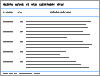
| 方法 | 博弈理论 基础 | 演化动态机制 | 博弈模型 类型 | 策略学习效率 | 攻防场景适应度 |
|---|---|---|---|---|---|
| 文献[ | 演化博弈 | 复制动态 | 确定性模型 | 慢 | 较差 |
| 文献[ | 演化博弈 | Wright-Fisher | 确定性模型 | 一般 | 一般 |
| 文献[ | 演化博弈、 强化学习 | 复制动态与RM算法 | 确定性模型 | 较快 | 较差 |
| 本文方法 | 演化博弈 | Moran | 随机博弈 模型 | 较快 | 较好 |
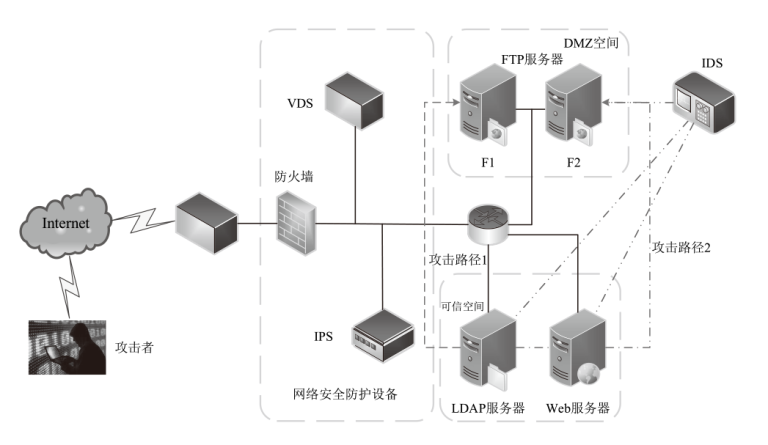
| 服务器 | 漏洞描述 | CVEID | 攻击复杂性 | CIA |
|---|---|---|---|---|
| LDAP | Local Privilege Escalation | CVE-2016-5195 | 中危 | 5.0 |
| Web | Cross-Site Scripting | CVE-2015-5330 | 低危 | 7.0 |
| FTP | Remote Code Execution | CVE-2014-0098 | 中危 | 10.0 |
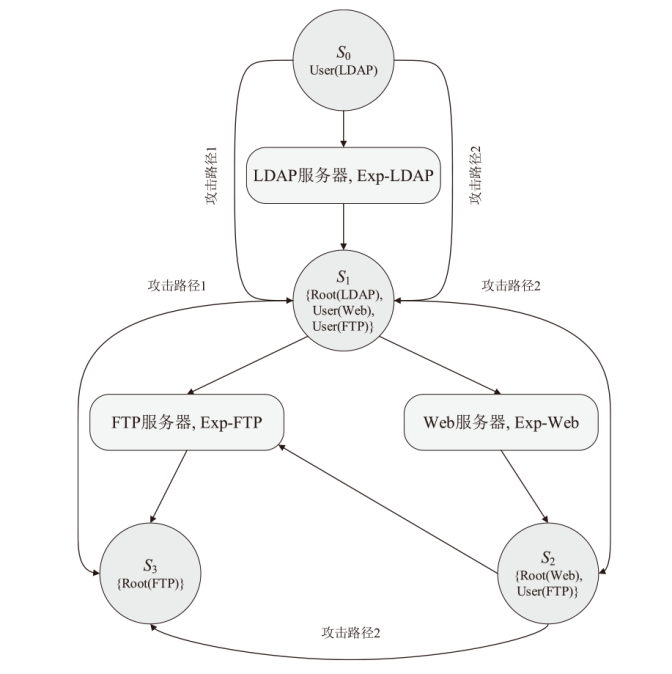
| 攻击者NA | 防御者ND | |
|---|---|---|
| Mon-LDAP | No-Mon | |
| Exp-LDAP | (-3, 3) | (5, -5) |
| No-Exp | (0,-2) | (0, 0) |
| 攻击者NA | 防御者ND | ||
|---|---|---|---|
| Mon-FTP | Mon-Web | No-Mon | |
| Exp-FTP | (-7, 7) | (12, -12) | (10, -10) |
| Exp-Web | (10, -10) | (-5, 5) | (7, -7) |
| No-Exp | (0, -3) | (0, -2) | (0, 0) |
| 攻击者NA | 防御者ND | |
|---|---|---|
| Mon-FTP | No-Mon | |
| Exp-FTP | (-7, 7) | (10, -10) |
| No-Exp | (0, -3) | (0, 0) |
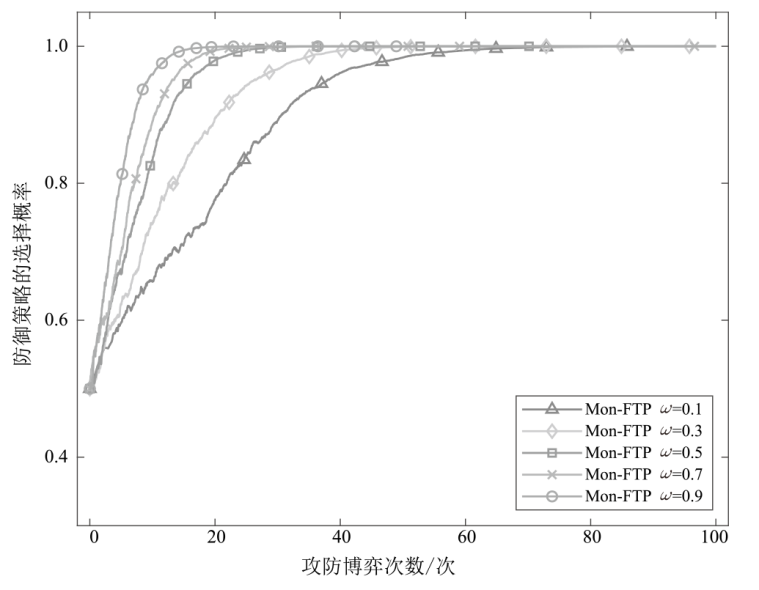
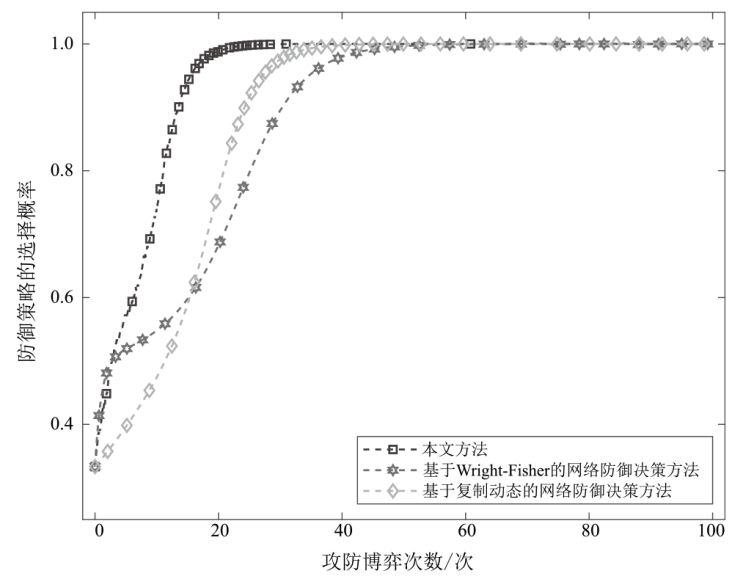
| [1] | MATHEU S N, HERNANDEZ-RAMOS J L, SKARMETA A F, et al. A Survey of Cybersecurity Certification for the Internet of Things[J]. ACM Computing Surveys, 2021, 53(6): 1-36. |
| [2] | OSBORNE M J. Introduction to GAME THEory[M]. Oxford: Oxford University Press, 2003. |
| [3] |
KAKKAD V, SHAH H, PATEL R, et al. A Comparative Study of Applications of Game Theory in Cyber Security and Cloud Computing[J]. Procedia Computer Science, 2019, 155: 680-685.
doi: 10.1016/j.procs.2019.08.097 URL |
| [4] | SHARMA D P, ENOCH S Y, CHO J H, et al. Dynamic Security Metrics for Software-Defined Network-Based Moving Target Defense[EB/OL]. (2020-11-15)[2025-02-17]. https://www.sciencedirect.com/science/article/abs/pii/S1084804520302770. |
| [5] | HO E, RAJAGOPALAN A, SKVORTSOV A, et al. Game Theory in Defence Applications: A Review[EB/OL]. (2021-11-02)[2025-02-17]. https://arxiv.org/abs/2111.01876. |
| [6] | HU Hao, LIU Yuling, ZHANG Hongqi, et al. Optimal Network Defense Strategy Selection Based on Incomplete Information Evolutionary Game[J]. IEEE Access, 2018(6): 29806-29821. |
| [7] |
SHAO Chengwu, LI Yanfu. Optimal Defense Resources Allocation for Power System Based on Bounded Rationality Game Theory Analysis[J]. IEEE Transactions on Power Systems, 2021, 36(5): 4223-4234.
doi: 10.1109/TPWRS.2021.3060009 |
| [8] | ZHANG Hengwei, TAN Jinglei, LIU Xiaohu, et al. Moving Target Defense Decision-Making Method: A Dynamic Markov Differential Game Model[C]// ACM. The 7th ACM Workshop on Moving Target Defense. New York: ACM, 2020: 21-29. |
| [9] |
HUANG Jianming, ZHANG Hengwei, WANG Jindong, et al. Defense Strategies Selection Based on Attack-Defense Evolutionary Game Model[J]. Journal on Communications, 2017, 38(1): 168-176.
doi: 10.11959/j.issn.1000-436x.2017019 |
|
黄健明, 张恒巍, 王晋东, 等. 基于攻防演化博弈模型的防御策略选取方法[J]. 通信学报, 2017, 38(1): 168-176.
doi: 10.11959/j.issn.1000-436x.2017019 |
|
| [10] | HUANG Jianming, ZHANG Hengwei. Selection of Optimal Defense Strategies Based on an Improved Replicator Dynamics Evolutionary Game Model[J]. Journal of Communications, 2018, 39(1): 170-182. |
|
黄健明, 张恒巍. 基于改进复制动态演化博弈模型的最优防御策略选取[J]. 通信学报, 2018, 39(1): 170-182.
doi: 10.11959/j.issn.1000-436x.2018010 |
|
| [11] | LIU Yanhua, CHEN Hui, ZHANG Hao, et al. Defense Strategy Selection Model Based on Multistage Evolutionary Game Theory[EB/OL]. (2021-12-11)[2025-02-17]. https://onlinelibrary.wiley.com/doi/10.1155/2021/4773894. |
| [12] | WU Zenan, TIAN Liqin, ZHANG Yi, et al. Network Attack and Defense Modeling and System Security Analysis: A Novel Approach Using Stochastic Evolutionary Game Petri Net[EB/OL]. (2021-11-13)[2025-02-17]. https://onlinelibrary.wiley.com/doi/10.1155/2021/4005877. |
| [13] |
ZHANG Hengwei, TAN Jinglei, LIU Xiaohu, et al. Cybersecurity Threat Assessment Integrating Qualitative Differential and Evolutionary Games[J]. IEEE Transactions on Network and Service Management, 2022, 19(3): 3425-3437.
doi: 10.1109/TNSM.2022.3166348 URL |
| [14] |
TAN Jinglei, JIN Hui, HU Hao, et al. WF-MTD: Evolutionary Decision Method for Moving Target Defense Based on Wright-Fisher Process[J]. IEEE Transactions on Dependable and Secure Computing, 2023, 20(6): 4719-4732.
doi: 10.1109/TDSC.2022.3232537 URL |
| [15] | MA Runnian, ZHANG Enning, WANG Gang, et al. A Network Defense Decision-Making Method Based on an Improved Evolutionary Game Model[J]. Journal of Electronics & Information Technology, 2023, 45(6): 1970-1980. |
| [16] |
JIN Hui, ZHANG Senlei, ZHANG Bin, et al. Evolutionary Game Decision-Making Method for Network Attack and Defense Based on Regret Minimization Algorithm[J]. Journal of King Saud University-Computer and Information Sciences, 2023, 35(3): 292-302.
doi: 10.1016/j.jksuci.2023.01.018 URL |
| [17] | HAN Tiaojuan, LU Jianfeng, ZHANG Hao, et al. Evolution Analysis of Low-Carbon Cooperation of Service Providers Based on Moran Process in Cloud Manufacturing[EB/OL]. (2024-03-21)[2025-02-17]. https://doi.org/10.1371/journal.pone.0299952. |
| [18] | WANG Xianjia, GU Cuiling, ZHAO Jinhua, et al. Stochastic Evolution Dynamic Model of Moran Process with Selection Difference and Its Application[J]. Systems Engineering-Theory & Practice, 2020, 40(5): 1193-1209. |
|
王先甲, 顾翠伶, 赵金华, 等. 选择差异下Moran过程的随机博弈模型及其应用[J]. 系统工程理论与实践, 2020, 40(5): 1193-1209.
doi: 10.12011/1000-6788-2019-1494-17 |
|
| [19] | XU Yanping, ZHU Lilong. Pharmaceutical Enterprises’ R&D Innovation Cooperation Moran Strategy When Considering Tax Incentives[EB/OL]. (2022-11-17)[2025-02-17]. https://www.mdpi.com/1660-4601/19/22/15197. |
| [20] | ZHU Lilong, XU Yanping. Pharmaceutical Enterprises’ Quality Management Decision Moran Analysis under Blockchain Technology-Based on the Perspective of Prospect Theory[EB/OL]. (2024-08-19)[2025-02-17]. https://www.cnki.com.cn/Article/CJFDTotal-ZGGK20240312002.htm. |
| 朱立龙, 徐艳萍. 区块链技术下医药企业质量管理决策Moran分析—基于前景理论的视角[EB/OL]. (2024-08-19)[2025-02-17]. https://www.cnki.com.cn/Article/CJFDTotal-ZGGK20240312002.htm. | |
| [21] | HE Shuhong, HUANG Zhenxiong. The Random Evolutionary Game Model of Disaster Reduction Cooperation Development in the Lancang-Mekong Sub-Region[J]. Journal of Catastrophology, 2024, 39(4): 76-80. |
| 何树红, 黄振雄. 澜湄次区域减灾合作发展的随机演化博弈模型[J]. 灾害学, 2024, 39(4): 76-80. | |
| [22] |
WHIGHAM P A, DICK G. Evolutionary Dynamics for the Spatial Moran Process[J]. Genetic Programming and Evolvable Machines, 2008, 9(2): 157-170.
doi: 10.1007/s10710-007-9046-6 URL |
| [23] |
NOWAK M A, SASAKI A, TAYLOR C, et al. Emergence of Cooperation and Evolutionary Stability in Finite Populations[J]. Nature, 2004, 428(6983): 646-650.
doi: 10.1038/nature02414 |
| [24] | TRAULSEN A, CLAUSSEN J C, HAUERT C. Coevolutionary Dynamics: From Finite to Infinite Populations[EB/OL]. (2005-12-02)[2025-02-17]. https://journals.aps.org/prl/abstract/10.1103/PhysRevLett.95.238701. |
| [25] | LEI Cheng, MA Duohe, ZHANG Hongqi. Optimal Strategy Selection for Moving Target Defense Based on Markov Game[J]. IEEE Access, 2017(5): 156-169. |
| [1] | WANG Huanzhen, XU Hongping, LI Kuangdai, LIU Yang, YAO Linyuan. A Study on Autonomous Decision-Making for Network Defense Based on Hierarchical Reinforcement Learning [J]. Netinfo Security, 2026, 26(1): 91-101. |
| [2] | JIN Zhigang, WANG Xinjian, LI Gen, YUE Shunmin. The Generation Method of Network Defense Strategy Combining with Attack Graph and Game Model [J]. Netinfo Security, 2021, 21(1): 1-9. |
| [3] | JIN Hui, ZHANG Hongqi, ZHANG Chuanfu, HU Hao. Research on Active Defense Decision-making Method Based on QRD in Complex Network [J]. Netinfo Security, 2020, 20(5): 72-82. |
| Viewed | ||||||
|
Full text |
|
|||||
|
Abstract |
|
|||||