信息网络安全 ›› 2026, Vol. 26 ›› Issue (10): 1552-1568.doi: 10.3969/j.issn.1671-1122.2026.10.004
基于HQC的可否认环签名方案
张艳硕1, 屠桢昊2( ), 王熙1, 刘冰1, 王志强2
- 1
北京电子科技学院密码科学与技术系 北京 100070
2北京电子科技学院网络空间安全系 北京 100070
-
收稿日期:2026-07-01出版日期:2026-10-10发布日期:2026-11-06 -
通讯作者:屠桢昊 E-mail:761429685@qq.com -
作者简介:张艳硕(1979—),男,陕西,副教授,博士,CCF高级会员,主要研究方向为密码理论及应用|屠桢昊(2002—),男,浙江,硕士研究生,主要研究方向为密码学|王熙(2002—),男,河北,硕士研究生,主要研究方向为密码学|刘冰(1976—),男,河北,副教授,博士,主要研究方向为密码学|王志强(1985—),男,安徽,副教授,博士,CCF高级会员,主要研究方向为网络与系统防御 -
基金资助:国家密码科学基金(2025NCSF02028);中央高校基本科研业务费专项资金(3282024001)
A deniable ring signature scheme based on HQC
Zhang Yanshuo1, Tu Zhenhao2(), Wang Xi1, Liu Bing1, Wang Zhiqiang2
- 1
Department of Cryptology Science and Technology ,Beijing Electronic Science & Technology Institute Beijing 100070, China
2Department of Cyberspace Security ,Beijing Electronic Science & Technology Institute Beijing 100070, China
-
Received:2026-07-01Online:2026-10-10Published:2026-11-06 -
Contact:Tu Zhenhao E-mail:761429685@qq.com

摘要:
随着量子计算技术的快速发展,基于大整数分解和离散对数问题的传统数字签名体制正面临潜在的安全风险。编码型密码体制由于其安全性建立在综合译码等计算困难问题上,被认为是实现抗量子密码的重要技术路线。然而,现有编码型签名方案在支持可否认语义方面的研究仍相对有限。针对上述问题,文章提出一种基于HQC编码结构的可否认环签名方案。该方案将Stern-Like Σ协议、OR组合与Fiat-Shamir变换系统适配到HQC公钥线性一致性关系上,将其作为零知识证明的基础声明语句,构造非交互式环签名。在此基础上,该方案进一步引入基于签名上下文的标签绑定机制,将签名者确认与非签名者否认算法作为独立层次嵌入环签名结构中,从而实现完整可否认语义。最后,在随机预言机模型下,对文章方案的不可伪造性、匿名性、可追踪性以及不可诽谤性等安全性质进行分析,并对计算、通信开销以及功能进行评估。实验结果表明,该方案能够在基于编码困难问题的安全假设下统一实现环匿名性与可否认语义,但其签名长度和计算开销受证明轮数与响应编码长度影响,更适用于环规模较小且重视抗量子安全与事后责任澄清的匿名认证场景。
中图分类号:
引用本文
张艳硕, 屠桢昊, 王熙, 刘冰, 王志强. 基于HQC的可否认环签名方案[J]. 信息网络安全, 2026, 26(10): 1552-1568.
Zhang Yanshuo, Tu Zhenhao, Wang Xi, Liu Bing, Wang Zhiqiang. A deniable ring signature scheme based on HQC[J]. Netinfo Security, 2026, 26(10): 1552-1568.
表1
符号说明
| 符号 | 说明 |
|---|---|
| 二元域 | |
| HQC参数,对应 | |
| 单个私钥分量的权重约束 | |
| 拼接私钥向量总权重约束 | |
| 私钥, | |
| 公钥分量, | |
| 循环卷积 | |
| 环公钥集合 | |
| 环大小 | |
| Σ协议并行轮数 | |
| 签名随机盐 | |
| Tag绑定向量 | |
| 签名标签 | |
| 准循环环 | |
| 汉明重量 | |
| 真实签名者索引 | |
| 随机置换 | |
| 确认、否认transcript |
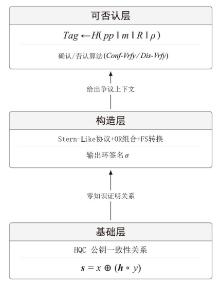
图1
方案框架
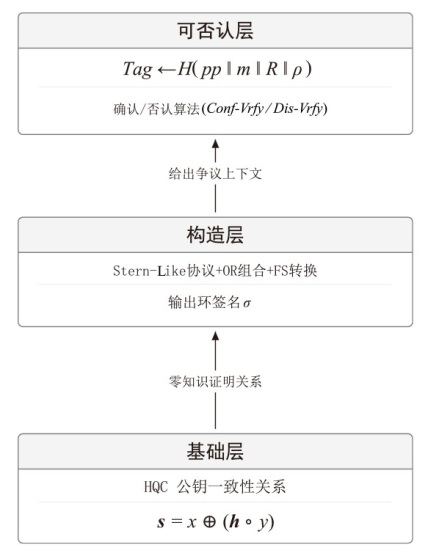
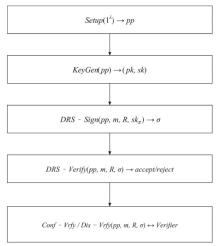
图2
方案算法流程
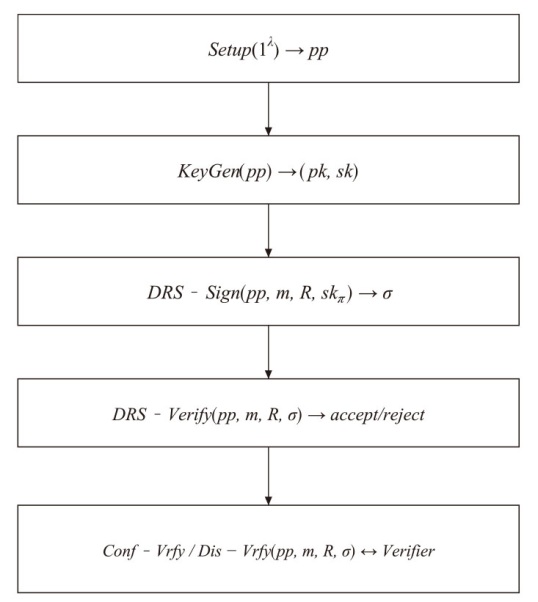
表2
通信开销相关符号及说明
| 符号 | 说明 |
|---|---|
| OR组合结构中的单个挑战份额 | |
| 单轮Stern-like证明中的承诺 | |
| 单轮Stern-like证明中的响应 | |
| 并行重复参数 | |
| 挑战相关维度参数 |
表3
不同方案的通信开销对比
| 方案 | 签名 | 确认 | 否认 |
|---|---|---|---|
| SM9可否认环签名 | |||
| SM2可否认环签名 | |||
| SDitH | — | — | |
| 本文方案 |
表4
计算开销分析相关符号及说明
| 符号 | 说明 |
|---|---|
| 双线性对运算 | |
| 双线性对群 | |
| 目标群 | |
| 哈希到点映射运算 | |
| 模 | |
| 二元向量加法/异或运算 | |
| 稀疏向量与准循环多项式卷积 | |
| 哈希函数运算 | |
| 稀疏向量权重验证运算 |
表5
计算开销对比分析
| 方案 | 签名 | 验证 | 确认 | 否认 |
|---|---|---|---|---|
| SM9可否认环签名 | (r+4)MG1+4BP+ MG2+2MGT | 2BP+MG2+ EGT+2MGT | 2MG1+4BP+ MG2+3MGT+ 2EGT | 2MG1+4BP+ MG2+3MGT+ 2EGT |
| SM2可否认环签名 | (4r-2)MG+ HTP+Iq | 4rMG+HTP | 8MG | v(10+z/2)MG |
| SDitH | τ·2D·(HP+ VM+VC) | τ·2D·(HP+ VM+VC) | — | — |
| 本文方案 | r·T·(VC+ 2Perm+ 3VM+3HP+ Wt)+2HP | r·T·(VC+ Perm+ 2VM+2HP+ Wt)+HP | T·(VC+Perm+ 2VM+2HP+ Wt) | T·(VC+Perm+ 2VM+2HP+ Wt) |
| [1] | Rivest R L, Shamir A, Tauman Y. How to leak a secret[C]// Advances in Cryptology- ASIACRYPT 2001. Heidelberg: Springer, 2001: 552-565. |
| [2] | Liu J K, Wong D S, Wei V K. Linkable ring signatures and their applications[C]// Information Security and Privacy: ACISP 2004. Heidelberg: Springer, 2004: 76-93. |
| [3] | Fujisaki E, Suzuki K. Traceable ring signature[C]// Public Key Cryptography—PKC 2007. Heidelberg: Springer, 2007: 181-200. |
| [4] | Bender A, Katz J, Morselli R. Ring signatures: stronger definitions, and constructions without random oracles[C]// Theory of Cryptography Conference (TCC 2006). Heidelberg: Springer, 2006: 60-79. |
| [5] | 张雪锋, 王柯航. 一种基于SM9的代理环签名方案[J]. 信息网络安全, 2025, 25(12): 1901-1913. |
| [6] | 张子松, 张博文, 童新海. 一种基于环签名的区块链电子投诉举报方案[J]. 计算机应用与软件, 2024, 41(7):329-335. |
| [7] | 叶青, 陈晴晴, 豆永鹏, 等. 格上身份基可追踪环签名方案[J]. 西安电子科技大学学报, 2023, 50(2):161-168. |
| [8] | Naor M. Deniable ring authentication[C]// Advances in Cryptology-CRYPTO 2002. Heidelberg: Springer, 2002: 481-498. |
| [9] | Komano Y, Ohta K. Efficient deniable ring authentication[C]// Information Security Conference (ISC 2006). Heidelberg: Springer, 2006: 232-247. |
| [10] | Shor P W. Algorithms for quantum computation: discrete logarithms and factoring[C]// The 35th Annual Symposium on Foundations of Computer Science. New York: IEEE, 1994: 124-134. |
| [11] | McEliece R J. A public-key cryptosystem based on algebraic coding theory: DSN Progress Report 42-44[R]. 1978: 114-116. |
| [12] | Aguilar-Melchor C, Aragon N, Bettaieb S, et al. HQC: A code-based key encapsulation mechanism[R/OL]. 2022. https://www.pqc-hqc.org/doc/archive_submissions.zip. |
| [13] | NIST. Status Report on the Fourth Round of the NIST Post-Quantum Cryptography Standardization Process: NIST IR 8545[R/OL]. 2025-03-11. https://nvlpubs.nist.gov/nistpubs/ir/2025/NIST.IR.8545.pdf. |
| [14] | Aggarwal D, Gentry C, et al. Ring signatures from lattice assumptions[C]// Advances in Cryptology-CRYPTO 2010. Heidelberg: Springer, 2010: 1-20. |
| [15] |
Langlois A, Stehle D. Worst-case to average-case reductions for module lattices[J]. Designs, Codes and Cryptography, 2015, 75(3): 565-599.
doi: 10.1007/s10623-014-9938-4 URL |
| [16] | Torres J, Boudarez F, Cayrel P L. Lattice-based ring signatures revisited[C]// ACNS 2018. Heidelberg:Springer, 2018: 205-224. |
| [17] | Aguilar-melchor C, Cayrel P L, Gaborit P. A new efficient threshold ring signature scheme based on coding theory[C]// Post-Quantum Cryptography (PQCrypto 2010). Heidelberg: Springer, 2010: 1-16. |
| [18] |
Cayrel P L, Veron P. Improved code-based identification schemes[J]. Information Processing Letters, 2010, 110(21): 966-971.
doi: 10.1016/j.ipl.2010.08.001 URL |
| [19] |
Stern J. A new paradigm for public key identification[J]. IEEE Transactions on Information Theory, 1996, 42(6): 1757-1768.
doi: 10.1109/18.556672 URL |
| [20] | Cramer R, Damgard I. On the amortized complexity of zero-knowledge protocols[C]// Advances in Cryptology—CRYPTO '94. Heidelberg: Springer, 2009: 177-191. |
| [21] | 张艳硕, 袁煜淇, 李丽秋, 等. 基于SM2的周期性可否认环签名方案[J]. 信息网络安全, 2024, 24(4):564-573. |
| [22] |
Sendrier N. Decoding one out of many[J]. IEEE Transactions on Information Theory, 2008, 54(8): 3565-3574.
doi: 10.1109/TIT.2008.926452 URL |
| [23] | Misoczki R., Tillich J-P, Sendrier N. MDPC-McEliece: new mceliece variants from moderate density parity-check codes[C]// IEEE International Symposium on Information Theory (ISIT). New York: IEEE, 2013: 2069-2073. |
| [24] | 丁勇, 罗世东, 杨昌松, 等. 基于SM9标识密码算法的可否认环签名方案[J]. 信息网络安全, 2024, 24(6):893-902. |
| [25] | Fiat A, Shamir A. How to prove yourself: practical solutions to identification and signature problems[C]// Advances in Cryptology-CRYPTO’86. Heidelberg: Springer, 1987: 186-194. |
| [26] |
Pointcheval D, Stern J. Security arguments for digital signatures and blind signatures[J]. Journal of Cryptology, 2000, 13(3): 361-396.
doi: 10.1007/s001450010003 URL |
| [27] | Stern J. A new identification scheme based on syndrome decoding[C]// Advances in Cryptology-CRYPTO’93. Heidelberg: Springer, 1994: 13-21. |
| [28] | Bender A, Katz J, Morselli R. Ring signatures: stronger definitions, and constructions without random oracles[J]. Journal of Cryptology, 2010, 23(4): 525-567. |
| [29] | Herranz J, Saez G. Forking lemmas for ring signature schemes[C]// International Conference on Cryptology. Heidelberg: Springer, 2003: 266-279. |
| [30] | 包子健, 何德彪, 彭聪, 等. 基于SM2数字签名算法的可否认环签名[J]. 密码学报, 2023, 10(2): 264-275. |
| [31] | Escher A, Krebs V. Syndrome decoding in the head[C]// Advances in Cryptology-EUROCRYPT 2019. Heidelberg: Springer, 2019: 403-432. |
| [1] | 张艳硕, 严梓洋, 李柏衡, 陈辉焱, 刘冰. 基于TUOV数字签名算法的可否认环签名方案[J]. 信息网络安全, 2026, 26(6): 886-898. |
| [2] | 丁勇, 罗世东, 杨昌松, 梁海. 基于SM9标识密码算法的可否认环签名方案[J]. 信息网络安全, 2024, 24(6): 893-902. |
| [3] | 肖昊, 赵延睿, 胡越, 刘笑帆. 抗量子密码中快速数论变换的硬件设计与实现[J]. 信息网络安全, 2023, 23(4): 72-79. |
| [4] | 陶云亭, 孔凡玉, 于佳, 徐秋亮. 抗量子格密码体制的快速数论变换算法研究综述[J]. 信息网络安全, 2021, 21(9): 46-51. |
| [5] | 李鱼, 韩益亮, 李喆, 朱率率. 基于LWE的抗量子认证密钥交换协议[J]. 信息网络安全, 2020, 20(10): 92-99. |
| [6] | 张焕国;王后珍. 抗量子计算密码体制研究(续前)[J]. , 2011, 11(6): 0-0. |
| [7] | 张焕国;王后珍. 抗量子计算密码体制研究(待续)[J]. , 2011, 11(5): 0-0. |
| 阅读次数 | ||||||
|
全文 |
|
|||||
|
摘要 |
|
|||||