信息网络安全 ›› 2025, Vol. 25 ›› Issue (4): 664-673.doi: 10.3969/j.issn.1671-1122.2025.04.014
结合提示词微调的智能合约漏洞检测方法
张雨轩1, 黄诚1, 柳蓉1, 冷涛2( )
)
- 1.四川大学网络空间安全学院,成都 610207
2.四川警察学院智能警务四川省重点实验室,泸州 646000
-
收稿日期:2025-01-15出版日期:2025-04-10发布日期:2025-04-25 -
通讯作者:冷涛lengtao@scpolicec.edu.cn -
作者简介:张雨轩(1999—),男,四川,硕士研究生,主要研究方向为漏洞检测、大语言模型安全|黄诚(1987—),男,四川,副教授,博士,CCF高级会员,主要研究方向为攻击检测、威胁溯源|柳蓉(2000—),女,四川,硕士研究生,主要研究方向为模糊测试、区块链安全|冷涛(1986—),男,四川,副教授,博士,主要研究方向为威胁狩猎、高级威胁检测、取证分析。 -
基金资助:国家自然科学基金(62472296);智能警务四川省重点实验室开放课题(ZNJW2024KFZD003);四川省科技厅聚源兴川项目(2024ZHCG0175)
Smart Contract Vulnerability Detection Method Combining Prompt Tuning
ZHANG Yuxuan1, HUANG Cheng1, LIU Rong1, LENG Tao2()
- 1. School of Cyber Science and Engineering, Sichuan University, Chengdu 610207, China
2. Intelligent Policing Key Laboratory of Sichuan Province, Sichuan Police College, Luzhou 646000, China
-
Received:2025-01-15Online:2025-04-10Published:2025-04-25

摘要:
随着区块链交易平台的飞速发展,智能合约的部署数量显著增加,而近年来不断爆出的智能合约漏洞致使区块链交易平台蒙受了巨大的经济损失。因此,智能合约安全领域的研究引起了研究者的广泛关注。然而,现有的漏洞检测方法要么严重依赖于专家规则或复杂的数据处理步骤,要么采用与该领域目标不符的模型或学习策略,导致检测效果不佳。基于此,文章提出一种利用进行提示词微调的智能合约漏洞检测方法PC-Detector,该方法通过引入特定于任务的提示词知识,确保目标任务与模型预训练阶段任务的一致性,从而增强模型适应,提高检测效果。具体来说,文章提出4种针对智能合约漏洞检测的提示词设计方法,并验证了代码嵌入提示词不同位置对检测性能的影响。此外,文章利用代码嵌入提示词对CodeT5系列模型进行提示词微调,从而检测出智能合约中的漏洞。实验结果表明,该方法可以显著提高检测性能。
中图分类号:
引用本文
张雨轩, 黄诚, 柳蓉, 冷涛. 结合提示词微调的智能合约漏洞检测方法[J]. 信息网络安全, 2025, 25(4): 664-673.
ZHANG Yuxuan, HUANG Cheng, LIU Rong, LENG Tao. Smart Contract Vulnerability Detection Method Combining Prompt Tuning[J]. Netinfo Security, 2025, 25(4): 664-673.
图1
漏洞检测任务中的提示词微调示例
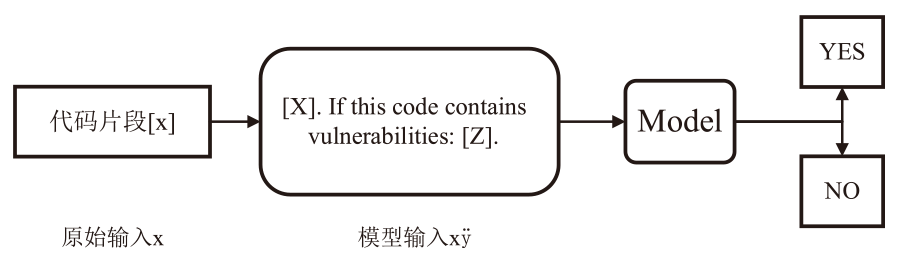
图2
PC-Detector 整体框架
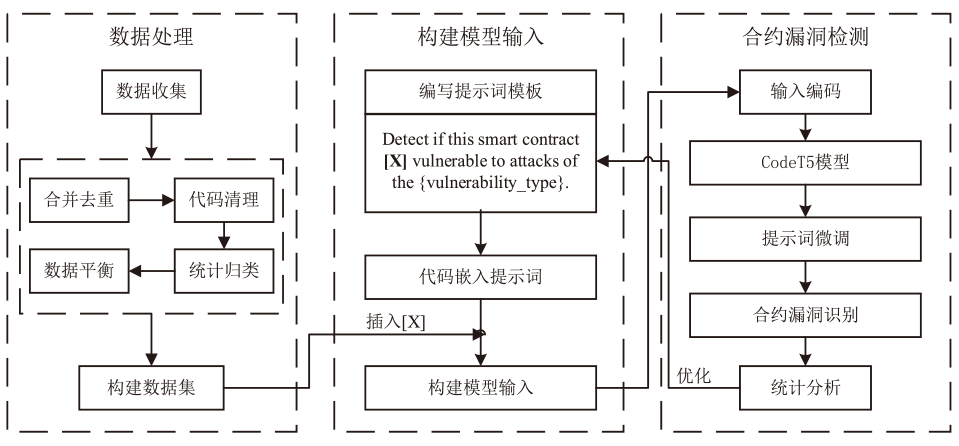
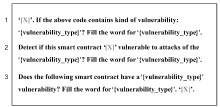
图3
代码嵌入提示词模板位置
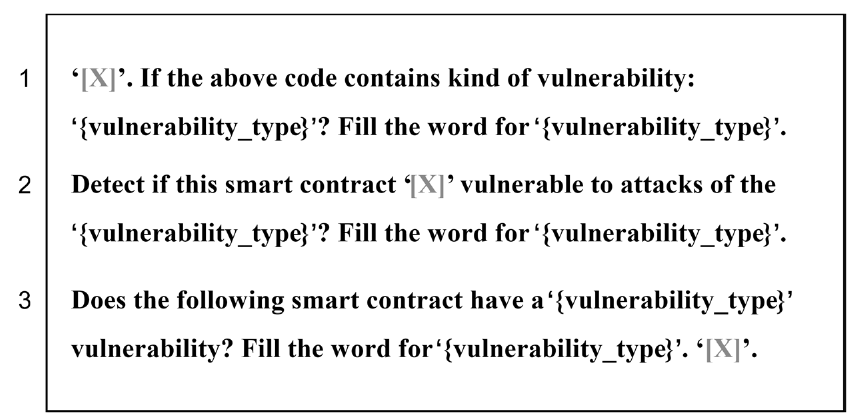
图4
可重入漏洞代码示例
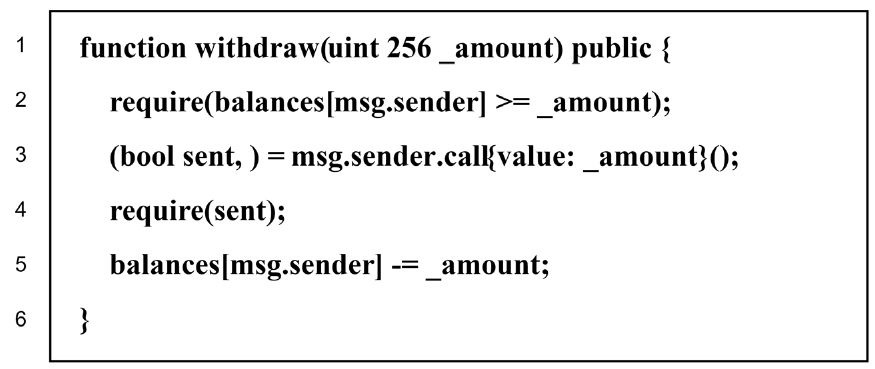
表1
提示词设计
| 类型 | 样例 |
|---|---|
| 直接提问 (1-a) | “[X]”. Does this smart contract have bugs of the ‘{vulnerability_type}’? Fill the word for ‘{vulnerability_type}’. |
| 直接提问 (1-b) | Detect if this smart contract “[X]” vulnerable to attacks of the ‘{vulnerability_type}’? Fill the word for ‘{vulnerability_type}’. |
| 直接提问 (1-c) | Does the following smart contract have a ‘{vulnerability_type}’ vulnerability? Fill the word for ‘{vulnerability_type}’.“[X]”. |
| 漏洞样例参考 (2-a) | This is an example of Solidity code with [VT] vulnerability:“[VE]”. Detect if this code “[X]” has [VT] vulnerability. |
| 漏洞原理描述 (3-a) | This is the cause of the [VT] vulnerability:“[VC]”. Based on the knowledge above detect if this code “[X]” has [VT] vulnerability. |
| 综合原理与样例 (4-a) | This is an example of Solidity code with [VT] vulnerability:“[VE]”. This is the cause of the [VT] vulnerability:“[VC]”. Based on the knowledge above detect if this code “[X]” has [VT] vulnerability. |
表2
数据集来源
| 数据集 | 描述 |
|---|---|
| 数据集Ⅰ[ | 1000余条合约,涉及4种类型的漏洞 |
| 数据集Ⅱ[ | 12000余条合约,涉及8种类型的漏洞 |
| 数据集Ⅲ[ | 100余条合约,涉及9种类型的漏洞 |
| 数据集Ⅳ[ | 9369条数据,涉及7种不同的漏洞类型 |
| 数据集Ⅴ[ | 可重入漏洞和正常合约共计473条的合约地址 |
| 数据集Ⅵ[ | 22634条正常合约在内的29种类型的合约地址 |
| 数据集Ⅶ[ | 1381条正常合约在内的21种类型的合约地址 |
| 数据集Ⅷ[ | 444条4种漏洞类型的合约地址 |
表3
微调方法与提示词微调方法的检测准确率对比
| 方法 | 准确率 | |
|---|---|---|
| CodeT5-small | 微调 | 87.82% |
| 提示词微调 | 90.45% | |
| CodeT5-base | 微调 | 88.34% |
| 提示词微调 | 91.74% | |
| CodeT5-large | 微调 | 88.96% |
| 提示词微调 | 91.89% | |
表4
不同类型提示词模板的检测性能对比
| 提示词 | 可重入漏洞 | 整数溢出漏洞 | ||||||
|---|---|---|---|---|---|---|---|---|
| 准确率 | 召回率 | 精确率 | F1值 | 准确率 | 召回率 | 精确率 | F1值 | |
| (1-a) | 91.53% | 93.34% | 90.03% | 91.67% | 92.33% | 91.07% | 92.75% | 91.90% |
| (1-b) | 91.63% | 92.42% | 90.50% | 91.44% | 92.42% | 91.62% | 91.68% | 91.65% |
| (1-c) | 90.40% | 86.62% | 93.64% | 89.96% | 91.27% | 92.06% | 89.97% | 91.00% |
| (2-a) | 93.33% | 92.79% | 92.87% | 92.83% | 92.55% | 94.39% | 93.22% | 93.80% |
| (3-a) | 92.83% | 90.11% | 91.75% | 90.91% | 92.70% | 93.60% | 92.98% | 93.29% |
| (4-a) | 94.29% | 96.09% | 93.20% | 94.62% | 93.67% | 95.37% | 93.10% | 94.22% |
| 提示词 | 时间操纵漏洞 | 委托调用漏洞 | ||||||
| 准确率 | 召回率 | 精确率 | F1值 | 准确率 | 召回率 | 精确率 | F1值 | |
| (1-a) | 90.88% | 87.39% | 90.11% | 88.73% | 89.71% | 82.06% | 90.21% | 85.94% |
| (1-b) | 91.12% | 88.09% | 91.69% | 88.58% | 89.73% | 83.22% | 89.98% | 86.47% |
| (1-c) | 90.62% | 87.15% | 88.34% | 87.74% | 88.92% | 82.00% | 86.62% | 84.25% |
| (2-a) | 93.87% | 91.42% | 94.21% | 92.79% | 90.44% | 85.44% | 91.33% | 88.29% |
| (3-a) | 94.65% | 92.71% | 92.98% | 92.84% | 90.02% | 85.49% | 90.42% | 87.89% |
| (4-a) | 94.55% | 92.92% | 94.43% | 93.67% | 91.98% | 86.62% | 91.88% | 89.17% |
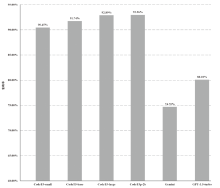
图5
6种大语言模型检测准确率对比
表5
本文方法与传统检测工具对比
| 方法 | 性能 | |||
|---|---|---|---|---|
| 准确率 | 召回率 | 精确率 | F1值 | |
| Slither | 68.50% | 63.31% | 70.26% | 66.60% |
| Mythril | 65.24% | 60.26% | 55.55% | 57.81% |
| Securify | 70.78% | 71.06% | 67.31% | 69.13% |
| Oyente | 64.96% | 56.51% | 51.61% | 53.95% |
| sFuzz | 48.94% | 28.18% | 29.33% | 28.74% |
| PC-Detector | 91.74% | 92.64% | 90.95% | 91.79% |
表6
本文方法与其他研究工作对比
| 方法 | 性能 | |||
|---|---|---|---|---|
| 准确率 | 召回率 | 精确率 | F1值 | |
| DLVA[ | 89.78% | 90.33% | 87.74% | 89.02% |
| Cross Modality Bug Detection[ | 85.13% | 80.52% | 82.82% | 81.65% |
| GraphDeeSmartContract[ | 68.82% | 68.80% | 69.29% | 69.04% |
| AMEVulDetector[ | 86.91% | 85.03% | 81.67% | 83.32% |
| SmartEmbed[ | 76.45% | 75.09% | 71.36% | 73.18% |
| ReChecker[ | 68.11% | 65.45% | 69.14% | 67.24% |
| PC-Detector | 91.74% | 92.64% | 90.95% | 91.79% |
| [1] | WOOD G. Ethereum: A Secure Decentralized Generalized Transaction Ledger[J]. Ethereum Project Yellow Paper, 2014, 151: 1-32. |
| [2] | BUTERIN V. A Next-Generation Smart Contract and Decentralized Application Platform[EB/OL]. (2022-05-19)[2025-01-02]. https://github.com/ethereum/wiki/wiki/White-Paper. |
| [3] | MENG Bo, LIU Jiabing, LIU Qin, et al. Survey of Smart Contract Security[J]. Chinese Journal of Network and Information Security, 2020, 6(3): 1-13. |
| 孟博, 刘加兵, 刘琴, 等. 智能合约安全综述[J]. 网络与信息安全学报, 2020, 6(3): 1-13. | |
| [4] | DHILLON V, METCALF D, HOOPER M. The DAO Hacked[J]. Blockchain Enabled Applications, 2021: 113-128. |
| [5] | KUSHWAHA S S, JOSHI S, SINGH D, et al. Ethereum Smart Contract Analysis Tools: A Systematic Review[J]. IEEE Access, 2022, 10: 57037-57062. |
| [6] | CONSENSYS. Mythril[EB/OL]. (2024-03-28)[2025-01-02]. https://github.com/ConsenSys/mythril. |
| [7] | TSANKOV P, DAN A, DRACHLERCOHEN D, et al. Securify: Practical Security Analysis of Smart Contracts[C]// ACM. 2018 ACM SIGSAC Conference on Computer and Communications Security. New York: ACM, 2018: 67-82. |
| [8] | BADRUDDOJA S, DANTU R, HE Yanyan, et al. Making Smart Contracts Smarter[C]// IEEE. Proceedings of the 2021 IEEE International Conference on Blockchain and Cryptocurrency. New York: IEEE, 2021: 1-3. |
| [9] | LIU Daifu. Research on Vulnerability Detection Methods for Ethereum Smart Contracts[D]. Nanjing: Southeast University, 2022. |
| 刘代富. 以太坊智能合约漏洞检测方法研究[D]. 南京: 东南大学, 2022. | |
| [10] | COLIN L S H, MOHAN P M, PAN J, et al. An Integrated Smart Contract Vulnerability Detection Tool Using Multi-Layer Perceptron on Real-Time Solidity Smart Contracts[J]. IEEE Access, 2024, 12: 23549-23567. |
| [11] | MIKOLOV T, CHEN Kai, CORRADO G, et al. Efficient Estimation of Word Representations in Vector Space[EB/OL]. (2013-09-07)[2025-01-02]. https://arxiv.org/abs/1301.3781. |
| [12] | ZHANG Xiaosong, NIU Weina, HUANG Shiping, et al. A Survey of Smart Contract Vulnerability Detection Methods Based on Deep Learning[J]. Journal of Sichuan University (Natural Science Edition), 2023, 60(2): 7-18. |
| 张小松, 牛伟纳, 黄世平, 等. 基于深度学习的智能合约漏洞检测方法综述[J]. 四川大学学报(自然科学版), 2023, 60(2): 7-18. | |
| [13] | JIE Wanqing, CHEN Qi, WANG Jiaqi, et al. A Novel Extended Multimodal AI Framework Towards Vulnerability Detection in Smart Contracts[EB/OL]. (2023-03-23)[2025-01-02]. https://doi.org/10.1016/j.ins.2023.03.132. |
| [14] | LE T T H, KIM J, LEE S, et al. Robust Vulnerability Detection in Solidity-Based Ethereum Smart Contracts Using Fine-Tuned Transformer Encoder Models[J]. IEEE Access, 2024, 12: 154700-154717. |
| [15] | HE Fei, LI Fei, LIANG Peili. Enhancing Smart Contract Security: Leveraging Pre-Trained Language Models for Advanced Vulnerability Detection[J]. IET Blockcahin, 2024, 4(1): 543-554. |
| [16] | DUY P T, KHOA N H, QUYEN N H, et al. Vulnsense: Efficient Vulnerability Detection in Ethereum Smart Contracts by Multimodal Learning with Graph Neural Network and Language Model[EB/OL]. (2023-09-05)[2025-01-02]. https://arxiv.org/abs/2309.08474v1. |
| [17] | JAIN V K, TRIPATHI M. An Integrated Deep Learning Model for Ethereum Smart Contract Vulnerability Detection[J]. International Journal of Information Security, 2024, 23(1): 557-575. |
| [18] | ADBELAZIZ T, HOBOR A. Smart Learning to Find Dumb Contracts[C]// USENIX. Proceedings of the 32nd USENIX Security Symposium (USENIX Security 23). Berkeley: USENIX, 2023: 1775-1792. |
| [19] | NGUYEN H H, NGUYEN N M, XIE Chunyao, et al. MANDO-HGT: Heterogeneous Graph Transformers for Smart Contract Vulnerability Detection[C]// IEEE. Proceedings of the 2023 IEEE/ACM 20th International Conference on Mining Software Repositories. New York: IEEE, 2023: 334-346. |
| [20] | CAI Jie, LI Bin, ZHANG Tao, et al. Fine-Grained Smart Contract Vulnerability Detection by Heterogeneous Code Feature Learning and Automated Dataset Construction[EB/OL]. (2023-12-14)[2025-01-02]. https://doi.org/10.1016/j.jss.2023.111919. |
| [21] | LUO Feng, LUO Ruijie, CHEN Ting, et al. SCVHunter: Smart Contract Vulnerability Detection Based on Heterogeneous Graph Attention Network[C]// IEEE. Proceedings of the IEEE/ACM 46th International Conference on Software Engineering. New York: IEEE, 2024: 2098-2110. |
| [22] | QIAN Peng, LIU Zhenguang, YIN Yifang, et al. Cross-Modality Mutual Learning for Enhancing Smart Contract Vulnerability Detection on Bytecode[C]// ACM. Proceedings of the ACM Web Conference. New York: ACM, 2023: 2220-2229. |
| [23] | ZHANG Ningyu, LI Luoqiu, CHEN Xiang, et al. Differentiable Prompt Makes Pre-Trained Language Models Better Few-Shot Learners[EB/OL]. (2022-05-04)[2025-01-02]. https://arxiv.org/abs/2108.13161v7. |
| [24] | LESTER B, ALRFOU R, CONSTANT N. The Power of Scale for Parameter-Efficient Prompt Tuning[C]// ACL. 2021 Conference on Empirical Methods in Natural Language Processing. Stroudsburg: ACL, 2021: 3045-3059. |
| [25] | LI L, LIANG P. Prefix-Tuning: Optimizing Continuous Prompts for Generation[C]// ACL. Proceedings of the 59th Annual Meeting of the Association for Computational Linguistics and the 11th International Joint Conference on Natural Language Processing. Stroudsburg: ACL, 2021: 4582-4597. |
| [26] | WANG Chaozheng, YANG Yuanhang, GAO Cuiyun, et al. Prompt Tuning in Code Intelligence: An Experimental Evaluation[J]. IEEE Transactions on Software Engineering, 2023, 49(11): 4869-4885. |
| [27] | CHEN Yizheng, DING Zhoujie, ALOWAIN L, et al. DiverseVul: A New Vulnerable Source Code Dataset for Deep Learning Based Vulnerability Detection[C]// ACM. 26th International Symposium on Research in Attacks, Intrusions and Defenses. New York: ACM, 2023: 654-668. |
| [28] | THAPA C, JANG S I, AHMED M E, et al. Transformer-Based Language Models for Software Vulnerability Detection[C]// ACM. Proceedings of the 38th Annual Computer Security Applications Conference. New York: ACM, 2022: 481-496. |
| [29] | BROWN T B, MANN B, RYDER N, et al. Language Models are Few-shot Learners[C]// NIPS. 34th International Conference on Neural Information Processing Systems. New York: CAI, 2020: 1877-1901. |
| [30] | PyTorch. PyTorch[EB/OL]. (2024-11-18)[2025-01-02]. https://pytorch.org. |
| [31] | HUGGING F. Hugging Face[EB/OL]. (2024-11-18)[2025-01-02]. https://huggingface.co. |
| [32] | LIU Zhenguang, QIAN Peng, YANG Jiaxu, et al. Rethinking Smart Contract Fuzzing: Fuzzing With Invocation Ordering and Important Branch Revisiting[J]. IEEE Transactions on Information Forensics and Security, 2023, 18: 1237-1251. |
| [33] | SMARTBUGS. SB Curated: A Curated Dataset of Vulnerable Solidity Smart Contracts[EB/OL]. (2024-06-17)[2025-01-02]. https://github.com/smartbugs/smartbugs-curated. |
| [34] | GHALEB A, PATTABIRAMAN K. How Effective are Smart Contract Analysis Tools? Evaluating Smart Contract Static Analysis Tools Using Bug Injection[C]// ACM. Proceedings of the 29th ACM SIGSOFT International Symposium on Software Testing and Analysis. New York: ACM, 2020: 415-427. |
| [35] | ADBELAZIZ T, HOBOR A. Reentrancy Benchmark[EB/OL]. (2023-02-01)[2025-01-02]. https://bit.ly/Reentrancy_benchmark. |
| [36] | ADBELAZIZ T, HOBOR A. EthereumSClarge[EB/OL]. (2023-02-01)[2025-01-02]. https://bit.ly/EthereumSC_Dataset_Large. |
| [37] | ADBELAZIZ T, HOBOR A. EthereumSCsmall[EB/OL]. (2023-02-01)[2025-01-02]. https://bit.ly/EthereumSC_Dataset_Small. |
| [38] | ADBELAZIZ T, HOBOR A. SolidiFI Benchmark[EB/OL]. (2023-02-01)[2025-01-02]. https://bit.ly/SolidiFI_benchmark. |
| [39] | GEMINI T, ROHAN A, SEBASTIAN B, et al. Gemini: A Family of Highly Capable Multimodal Models[EB/OL]. (2024-06-17)[2025-01-02]. https://arxiv.org/abs/2312.11805v4. |
| [40] | NGUYEN T D, PHAM L H, SUN Jun, et al. sFuzz: An Efficient Adaptive Fuzzer for Solidity Smart Contracts[C]// ACM. Proceedings of the ACM/IEEE 42nd International Conference on Software Engineering. New York: ACM, 2020: 778-788. |
| [41] | ZHUANG Yuan, LIU Zhenguang, QIAN Peng, et al. Smart Contract Vulnerability Detection Using Graph Neural Networks[C]// IJCAI. Proceedings of the Twenty-Ninth International Conference on International Joint Conferences on Artificial Intelligence. San Francisco: Morgan Kaufmann, 2021: 3283-3290. |
| [42] | LIU Zhenguang, QIAN Peng, WANG Xiang, et al. Smart Contract Vulnerability Detection: From Pure Neural Network to Interpretable Graph Feature and Expert Pattern Fusion[EB/OL]. (2021-06-17)[2025-01-02]. https://arxiv.org/abs/2106.09282. |
| [43] | GAO Zhipeng, JIANG Lingxiao, XIA Xin, et al. Checking Smart Contracts with Structural Code Embedding[J]. IEEE Transactions on Software Engineering, 2021, 47(12): 2874-2891. |
| [44] | QIAN Peng, LIU Zhenguang, HE Qingming, et al. Towards Automated Reentrancy Detection for Smart Contracts Based on Sequential Models[J]. IEEE Access, 2020, 8: 19685-19695. |
| [1] | 张学旺, 卢荟, 谢昊飞. 基于节点中心性和大模型的漏洞检测数据增强方法[J]. 信息网络安全, 2025, 25(4): 550-563. |
| [2] | 杨亚涛, 丁渝诚, 刘培鹤, 桑鹏. 基于区块链的隐私保护和数字认证研究[J]. 信息网络安全, 2025, 25(4): 640-653. |
| [3] | 王勇, 武一帆, 万前程. 基于中国剩余定理的可编辑区块链方案研究[J]. 信息网络安全, 2025, 25(1): 36-47. |
| [4] | 余礼苏, 李彪, 姚元志, 温家进, 黎子鹏, 王振. 区块链辅助无人机移动边缘计算系统的性能优化[J]. 信息网络安全, 2024, 24(9): 1432-1443. |
| [5] | 吕秋云, 周凌飞, 任一支, 周士飞, 盛春杰. 一种全生命周期可控的公共数据共享方案[J]. 信息网络安全, 2024, 24(8): 1291-1305. |
| [6] | 张继威, 王文俊, 牛少彰, 郭向阔. 区块链扩展解决方案:ZK-Rollup综述[J]. 信息网络安全, 2024, 24(7): 1027-1037. |
| [7] | 张立强, 路梦君, 严飞. 一种基于函数依赖的跨合约模糊测试方案[J]. 信息网络安全, 2024, 24(7): 1038-1049. |
| [8] | 郭瑞, 杨鑫, 王俊茗. 基于区块链的可验证可撤销属性加密方案[J]. 信息网络安全, 2024, 24(6): 863-878. |
| [9] | 凌治, 杨明, 余江银. 基于IPFS和区块链技术的电力安全交易平台研究[J]. 信息网络安全, 2024, 24(6): 968-976. |
| [10] | 田钊, 牛亚杰, 佘维, 刘炜. 面向车联网的车辆节点信誉评估方法[J]. 信息网络安全, 2024, 24(5): 719-731. |
| [11] | 石润华, 杨婧怡, 王鹏博, 刘华伟. V2G中基于区块链的在线/离线跨域身份认证方案[J]. 信息网络安全, 2024, 24(4): 587-601. |
| [12] | 胡海洋, 刘畅, 王栋, 魏旭. 基于区块链的清洁能源数据溯源机制[J]. 信息网络安全, 2024, 24(4): 626-639. |
| [13] | 刘峰, 江佳齐, 黄灏. 面向加密货币交易介质及过程的安全综述[J]. 信息网络安全, 2024, 24(3): 330-351. |
| [14] | 薛茗竹, 胡亮, 王明, 王峰. 基于联邦学习和区块链技术的TAP规则处理系统[J]. 信息网络安全, 2024, 24(3): 473-485. |
| [15] | 翟鹏, 何泾沙, 张昱. 物联网环境下基于SM9算法和区块链技术的身份认证方法[J]. 信息网络安全, 2024, 24(2): 179-187. |
| 阅读次数 | ||||||
|
全文 |
|
|||||
|
摘要 |
|
|||||