信息网络安全 ›› 2026, Vol. 26 ›› Issue (9): 1455-1467.doi: 10.3969/j.issn.1671-1122.2026.09.011
无线传感器网络的捕食型蠕虫病毒传播行为研究
马润年1( ), 陈姗姗1, 王刚2, 李建全3
- 1
西安欧亚学院通识教育学院 西安 710065
2空军工程大学信息与导航学院 西安 710077
3陕西科技大学数学与数据科学学院 西安 710021
-
收稿日期:2026-01-25出版日期:2026-09-10发布日期:2026-09-30 -
通讯作者:马润年 E-mail:mrn314@163.com -
作者简介:马润年(1963—),男,陕西,教授,博士,主要研究方向为复杂网络建模及应用|陈姗姗(1986—),女,陕西,讲师,硕士,主要研究方向为复杂网络建模及应用|王刚(1976—),男,湖北,教授,博士,主要研究方向为网络空间安全、复杂网络|李建全(1965—),男,山西,教授,博士,主要研究方向为微分方程定性理论、传染病动力学 -
基金资助:国家自然科学基金(11971281)
The study of predatory worm spreading behavior in wireless sensor networks
Ma Runnian1(), Chen Shanshan1, Wang Gang2, Li Jianquan3
- 1
School of General Education ,Xi’an Eurasia University Xi’an 710065, China
2Information and Navigation Institute ,Air Force Engineering University Xi’an 710077, China
3School of Mathematics and Data Science ,Shaanxi University of Science and Technology Xi’an 710021, China
-
Received:2026-01-25Online:2026-09-10Published:2026-09-30 -
Contact:Ma Runnian E-mail:mrn314@163.com

摘要:
无线传感器网络(WSN)具有广泛的应用前景,同时也易受恶意攻击。重点保护部分节点可使其免受网络病毒侵害,从而提高网络整体的抗毁性和容错率。文章借助于Holling-Ⅱ类捕食模型,量化研究了一类带有重点防护对象的WSN蠕虫病毒传播模型的动力学行为,并设计针对性病毒抑制策略。首先,给出模型的局部和全局渐近稳定条件;然后,研究模型产生Hopf分岔的充分条件,并讨论分岔方向以及周期解的稳定性;最后,求出模型平衡点转化的参数阈值,并据此设计病毒防治方案。理论分析和数值实验表明,该模型能够为网络蠕虫的防治提供参考。
中图分类号:
引用本文
马润年, 陈姗姗, 王刚, 李建全. 无线传感器网络的捕食型蠕虫病毒传播行为研究[J]. 信息网络安全, 2026, 26(9): 1455-1467.
Ma Runnian, Chen Shanshan, Wang Gang, Li Jianquan. The study of predatory worm spreading behavior in wireless sensor networks[J]. Netinfo Security, 2026, 26(9): 1455-1467.
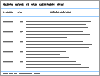
表1
参数含义
| 参数 | 含义 |
|---|---|
| 易感节点的Logistic增长率 | |
| 易感节点的最大网络承载容量 | |
| 单位时间内易感节点被感染的最大数量 | |
| 局部重点保护节点在全部节点中所占比例 | |
| 易感节点的半饱和系数 | |
| 易感节点的修复率系数 | |
| 感染节点的修复率系数 | |
| 易感节点向感染节点的转化率 |
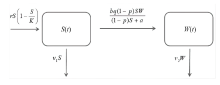
图1
模型状态转移示意图
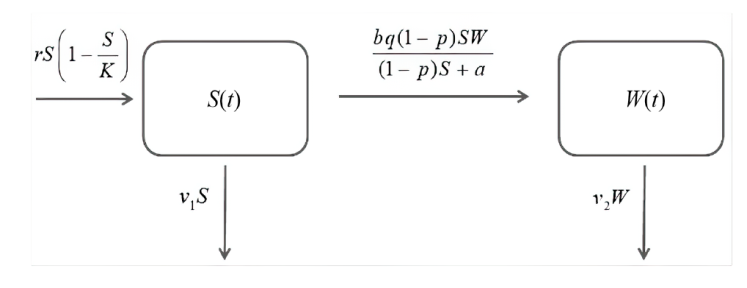

图2
分岔阈值附近参数p对模型的影响

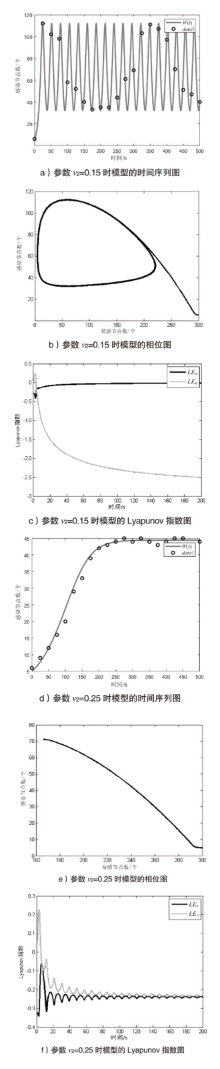
图3
分岔阈值附近参数v2对模型的影响
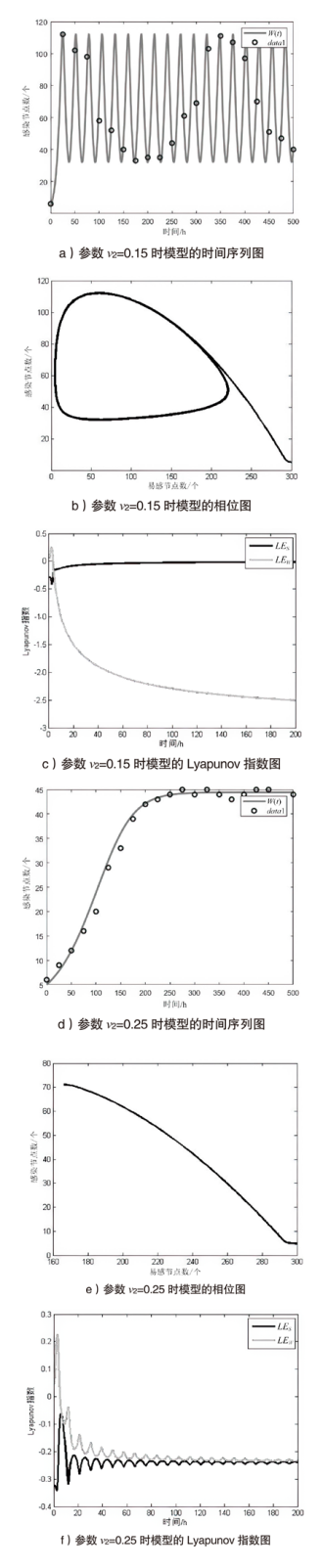
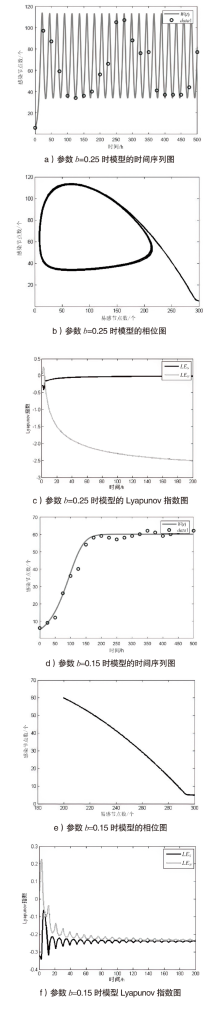
图4
分岔阈值附近参数b对模型的影响
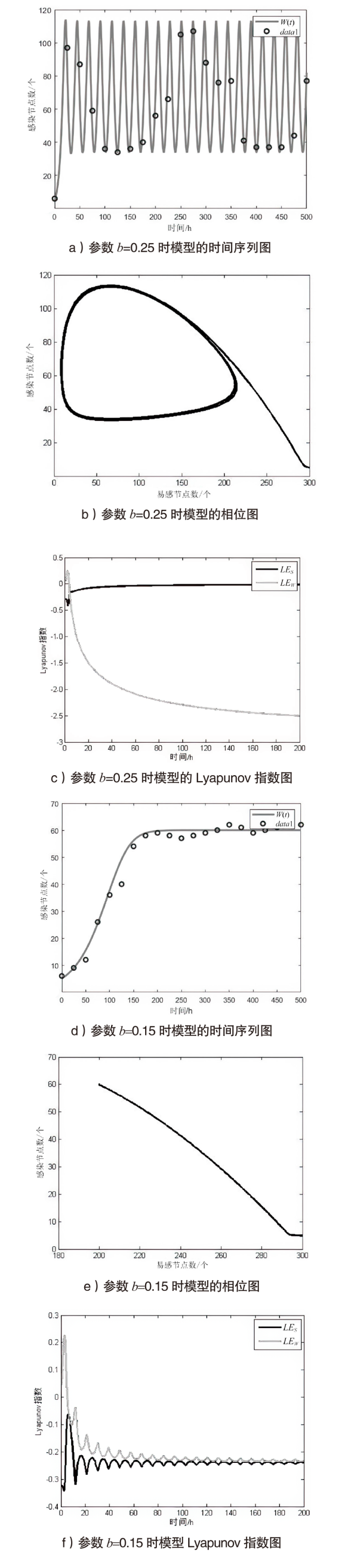
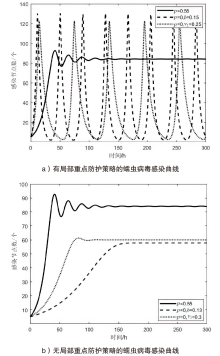
图5
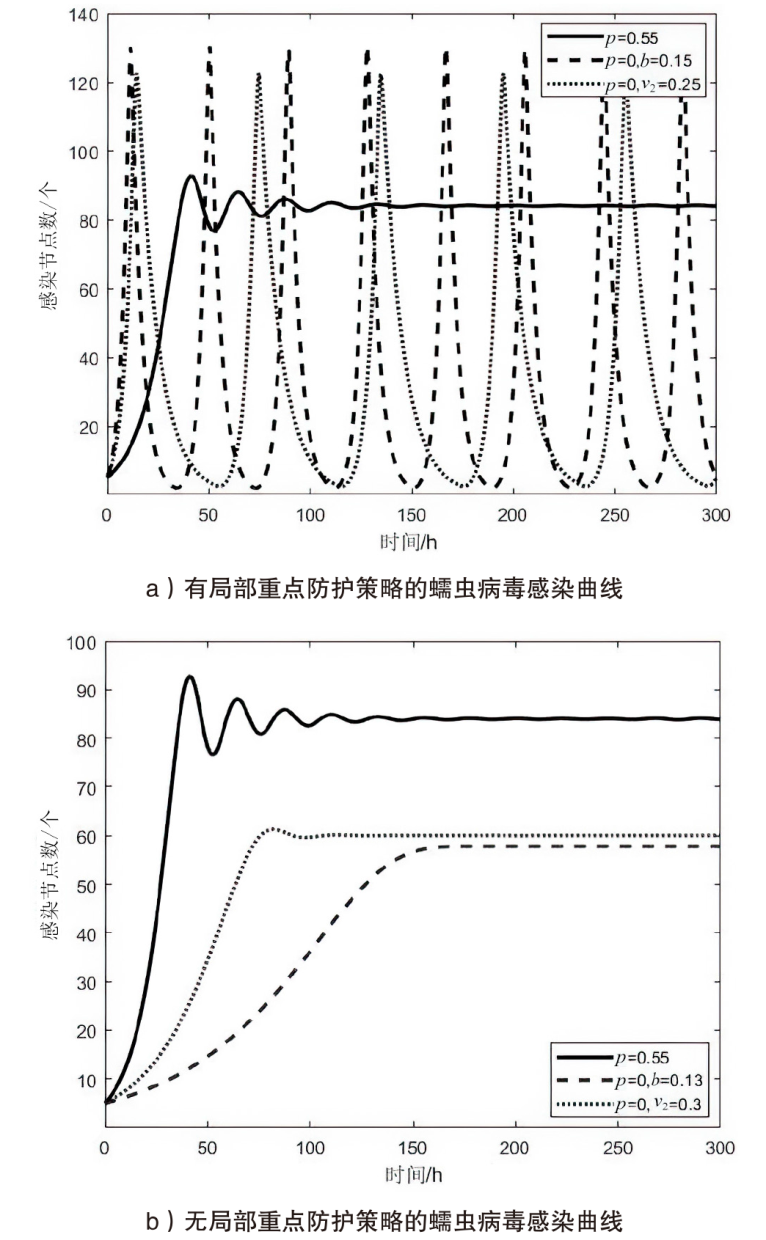
有/无局部重点防护策略的蠕虫病毒传播行为比较
| [1] | Malhi A K, Batra S, Pannu H S. Security of vehicular ad-hoc networks: a comprehensive survey[EB/OL]. (2019-11-14)[2025-01-20]. https://www.sciencedirect.com/science/article/abs/pii/S0167404818312872. |
| [2] | Abdollahi A, Rejeb K, Rejeb A, et al. Wireless sensor networks in agriculture: insights from bibliometric analysis[EB/OL]. (2021-10-30)[2025-01-20]. https://www.mdpi.com/2071-1050/13/21/12011. |
| [3] |
Jamshed M, Ali K, Abbasi Q, et al. Challenges, applications, and future of wireless sensors in internet of things: a review[J]. IEEE Sensors Journal, 2022, 22(6): 5482-5494.
doi: 10.1109/JSEN.2022.3148128 URL |
| [4] |
Asgarian F, Najafi K. Bluesync: time synchronization in bluetooth low energy with energy-efficient calculations[J]. IEEE Internet of Things Journal, 2021, 9(11): 8633-8645.
doi: 10.1109/JIOT.2021.3116921 URL |
| [5] | Pragadeswaran S, Madhumitha S, Gopinath S. Certain investigation on military applications of wireless sensor network[J]. International Journal of Advanced Research in Science, Communication and Technology, 2021, 3(1): 14-19. |
| [6] |
Fu Zijie, Shareeda M, Saare M, et al. Wireless sensor networks in the internet of things: review, techniques, challenges, and future directions[J]. Indonesian Journal of Electrical Engineering and Computer Science, 2023, 31(2): 1190-1200.
doi: 10.11591/ijeecs.v31.i2 URL |
| [7] |
Singh S, Manju A, Malik A, et al. A threshold-based energy efficient military surveillance system using heterogeneous wireless sensor networks[J]. Soft Computing, 2023, 27(2): 1163-1176.
doi: 10.1007/s00500-021-06033-4 |
| [8] | Khan A, Khan F. A cost-efficient radiation monitoring system for nuclear sites: designing and implementation[EB/OL]. (2021-09-26)[2025-01-20]. https://pdfs.semanticscholar.org/bca9/9496eb3c3f6fd62f432ca746d556c145a1cd.pdf. |
| [9] | Haque M, Hossain T, Sarker M, et al. A hybrid approach to enhance the lifespan of wsns in nuclear power plant monitoring system[EB/OL]. (2022-03-14)[2025-01-20]. https://www.nature.com/articles/s41598-022-08075-6. |
| [10] |
Zhang Huanan, Xing Suping, Wang Jiannan. Security and application of wireless sensor network[J]. Procedia Computer Science, 2021, 183(1): 486-492.
doi: 10.1016/j.procs.2021.02.088 URL |
| [11] | Muhajjar R, Flayh N, Al-Zubaidie M. A perfect security key management method for hierarchical wireless sensor networks in medical environments[EB/OL]. (2023-02-15)[2025-01-20]. https://doi.org/10.3390/electronics12041011. |
| [12] | Benyezza H, Bouhedda M, Kara R. Smart platform based on IoT and wsn for monitoring and control of a greenhouse in the context of precision agriculture[EB/OL]. (2023-10-16)[2025-01-20]. https://www.sciencedirect.com/science/article/abs/pii/S2542660523001531. |
| [13] | Qasim H, Hamza A, Audah L, et al. Design and implementation home security system and monitoring by using wireless sensor networks WSN/Internet of things IoT[J]. International Journal of Electrical and Computer Engineering, 2020, 10(3): 2617-2624. |
| [14] | Daanoune I, Baghdad A, Ullah W. Adaptive coding clustered routing protocol for energy efficient and reliable WSN[EB/OL]. (2022-06-24)[2025-01-20]. https://www.sciencedirect.com/science/article/abs/pii/S1874490722000593. |
| [15] | 江金芳, 韩光洁. 无线传感器网络中信任管理机制研究综述[J]. 信息网络安全, 2020, 20(4): 12-20. |
| [16] | Akram V, Dagdeviren Z, Dagdeviren O, et al. Pinc: pickup non-critical node based k-connectivity restoration in wireless sensor networks[EB/OL]. (2021-09-26)[2025-01-20]. https://www.mdpi.com/1424-8220/21/19/6418. |
| [17] |
马润年, 王班, 王刚, 等. 基于互信息的通信网络节点重要性度量方法[J]. 电子学报, 2017, 45(3): 747-752.
doi: 10.3969/j.issn.0372-2112.2017.03.035 |
| [18] |
Singh A, Singh R, Iyengar S. Node-weighted centrality: a new way of centrality hybridization[J]. Computational Social Networks, 2020, 7(6): 1-33.
doi: 10.1186/s40649-019-0075-0 |
| [19] | 冯光升, 张盈希, 任奕菲, 等. 无线传感器网络中虚假数据途中过滤技术研究[J]. 信息网络安全, 2023, 23(5): 22-31. |
| [20] | Liu Gaoyuan, Zhao Huiqi, Fan Fang, et al. An enhanced intrusion detection model based on improved knn in wsns[EB/OL]. (2022-02-11)[2025-01-20]. https://www.mdpi.com/1424-8220/22/4/1407. |
| [21] |
Deo S, Gothwal D. Improving performance of cross-domain firewalls in multi-firewall system[J]. International Journal on Recent and Innovation Trends in Computing and Communication, 2015, 3(4): 2127-2131.
doi: 10.17762/ijritcc2321-8169.150478 URL |
| [22] |
González O E, González Y B, Becerra K R. Multiple stable states in a model based on predator-induced defenses[J]. Ecological Complexity, 2017, 32(12): 111-120.
doi: 10.1016/j.ecocom.2017.10.004 URL |
| [23] |
Tang Guangyao, Tang Sanyi, Cheke R. Global analysis of holling type ii predator-Prey model with constant prey refuge[J]. Nonlinear Dynamics, 2013, 76: 635-647.
doi: 10.1007/s11071-013-1157-4 URL |
| [24] | Liu Guiyun, Chen Jieyong, Liang Zhongwei, et al. Dynamical analysis and optimal control for seir model based on virus mutation in wsns[EB/OL]. (2022-04-22)[2025-01-20]. https://www.mdpi.com/2227-7390/9/9/929. |
| [25] | Khujamatov K, Ahmad K, Reynazarov E, et al. Markov chain based modeling bandwidth states of the wireless sensor networks of monitoring system[J]. International Journal of Advanced Science and Technology, 2020, 29(4): 4889-4903. |
| [26] |
Keshri K, Mishra K, Mallick K. A predator-prey model on the attacking behavior of malicious objects in wireless nanosensor networks[J]. Nano Communication Networks, 2018, 15: 1-16.
doi: 10.1016/j.nancom.2018.01.002 URL |
| [27] | Li Wenjie, Ji Jinchen, Huang Lihong, et al. Global dynamics and control of malicious signal transmission in wireless sensor networks[EB/OL]. (2023-05-18)[2025-01-20]. https://www.sciencedirect.com/science/article/abs/pii/S1751570X22001194. |
| [28] | Li Wenjie, Guan Yajuan, Cao Jinde, et al. A note on global stability of a degenerate diffusion avian influenza model with seasonality and spatial heterogeneity[EB/OL]. (2024-02-04)[2025-01-20]. https://www.sciencedirect.com/science/article/abs/pii/S0893965923003166. |
| [29] | 钟敦昊, 张冬梅, 张玉. 一种基于相似度计算的无线传感器网络入侵检测方法[J]. 信息网络安全, 2016, 16(2): 22-27. |
| [30] |
Zhou Bo, Saad W. Age of information in ultra-dense iot systems: performance and mean-field game analysis[J]. IEEE Transactions on Mobile Computing, 2023, 23(5): 4533-4547.
doi: 10.1109/TMC.2023.3292515 URL |
| [31] |
Liu Zhiqiang, Ghulam M, Zheng Jiangbin, et al. Intrusion detection in wireless sensor network using enhanced empirical based component analysis[J]. Future Generation Computer Systems, 2022: 135(1): 181-193.
doi: 10.1016/j.future.2022.04.024 URL |
| [32] | Ouni R, Saleem K. Framework for sustainable wireless sensor network based environmental monitoring[EB/OL]. (2022-07-07)[2025-01-20]. https://www.mdpi.com/2071-1050/14/14/8356. |
| [33] | Hale J. Ordinary differential equations[M]. New York: Johan Wiley and Sons, 1969. |
| [34] | Kuznetsov Y. Elements of applied bifurcation theory[M]. Heidelberg: Springer, 2004. |
| [35] | Robinson R. An introduction to dynamical system: continuous and discrete[M]. New York: Machine Industry Press, 2005. |
| [1] | 冯光升, 张盈希, 任奕菲, 高素林. 无线传感器网络中虚假数据途中过滤技术研究[J]. 信息网络安全, 2023, 23(5): 22-31. |
| [2] | 张永棠. 一种基于安全区域的WSN流量分析聚合方法[J]. 信息网络安全, 2021, 21(9): 80-89. |
| [3] | 肖帅, 张翰林, 咸鹤群, 陈飞. 一种面向物联网设备的口令认证密钥协商协议[J]. 信息网络安全, 2021, 21(10): 83-89. |
| [4] | 江金芳, 韩光洁. 无线传感器网络中信任管理机制研究综述[J]. 信息网络安全, 2020, 20(4): 12-20. |
| [5] | 亢保元, 王佳强, 邵栋阳, 李春青. 一种适用于异构Ad Hoc无线传感器网络的身份认证与密钥共识协议[J]. 信息网络安全, 2018, 18(1): 23-30. |
| [6] | 章红艳, 许力, 林丽美. 无线传感器网络中基于超立方体的对密钥建立方案研究[J]. 信息网络安全, 2017, 17(12): 1-5. |
| [7] | 钟敦昊, 张冬梅, 张玉. 一种基于相似度计算的无线传感器网络入侵检测方法[J]. 信息网络安全, 2016, 16(2): 22-27. |
| [8] | 刘伟, 叶清, 王成. 基于动态密钥管理的改进LEACH路由算法[J]. 信息网络安全, 2015, 15(8): 41-46. |
| [9] | 苏彬庭, 方禾, 许力. 基于Q-Learning的无线传感器网络生命周期平衡路由[J]. 信息网络安全, 2015, 15(4): 74-77. |
| [10] | 龚婉婉, 刘士兴, 冯婷婷. 基于无线传感器网络的智能家居监控平台设计[J]. 信息网络安全, 2015, 15(3): 79-83. |
| [11] | 仇各各, 汪学明, 张言胜. 基于HECC的WSN身份认证协议研究[J]. 信息网络安全, 2015, 15(12): 54-58. |
| [12] | 杨骏玮, 方杰, 张仕斌, 陈建钧. WSNs中基于重复博弈的信任评价方法研究[J]. 信息网络安全, 2014, 14(8): 82-87. |
| [13] | 佟鑫;张利;戴明. 物联网感知层安全威胁建模研究[J]. , 2013, 13(Z): 0-0. |
| [14] | 郎为民;陈林;王昊. 无线传感器网络云连接认证研究[J]. , 2013, 13(3): 0-0. |
| [15] | 高立兵. 基于无线传感器网络的井下定位系统研究[J]. , 2013, 13(2): 0-0. |
| 阅读次数 | ||||||
|
全文 |
|
|||||
|
摘要 |
|
|||||