Netinfo Security ›› 2025, Vol. 25 ›› Issue (8): 1208-1222.doi: 10.3969/j.issn.1671-1122.2025.08.003
Previous Articles Next Articles
Deep Attention Network Architecture for Malicious Code Detection
LI Sicong, WANG Fei( ), WEI Ziling, CHEN Shuhui
- College of Computer Science, National University of Defense Technology, Changsha 410073, China
-
Received:2025-06-09Online:2025-08-10Published:2025-09-09

CLC Number:
Cite this article
LI Sicong, WANG Fei, WEI Ziling, CHEN Shuhui. Deep Attention Network Architecture for Malicious Code Detection[J]. Netinfo Security, 2025, 25(8): 1208-1222.
share this article
Add to citation manager EndNote|Ris|BibTeX
URL: http://netinfo-security.org/EN/10.3969/j.issn.1671-1122.2025.08.003
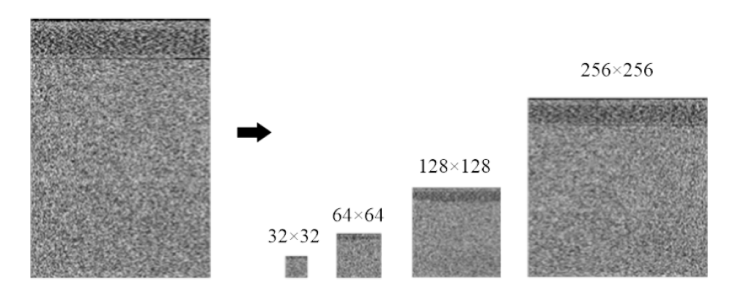
| 文件大小/KB | 宽度/像素 |
|---|---|
| <10 | 32 |
| 10 ~30 | 64 |
| 30 ~60 | 128 |
| 60 ~100 | 256 |
| 100 ~200 | 384 |
| 200 ~500 | 512 |
| 500 ~1000 | 768 |
| >1000 | 1024 |
| 家族名称 | 标签编号 | 样本数/个 | 类型 |
|---|---|---|---|
| Allaple.A Allaple.L VB.AT Yuner.A | 3 | 2824 | Worm |
| 4 | 1491 | ||
| 23 | 383 | ||
| 25 | 775 | ||
| Autorun.K | 6 | 81 | Worm: AutoIT |
| Alueron.gen!J C2LOP.gen!g C2LOP.P Malex.gen!J Skintrim.N | 5 | 173 | Trojan |
| 7 | 175 | ||
| 8 | 121 | ||
| 17 | 111 | ||
| 20 | 55 | ||
| Adialer.C Dialplatform.B Instantaccess | 1 | 97 | Dialer |
| 9 | 152 | ||
| 12 | 356 | ||
| Lolyda.AA1 Lolyda.AA2 Lolyda.AA3 Lolyda.AT | 13 | 153 | PWS |
| 14 | 159 | ||
| 15 | 98 | ||
| 16 | 134 | ||
| Dontovo.A Obfuscator.AD Swizzor.gen!E Swizzor.gen!I Wintrim.BX | 10 | 137 | Trojan Downloader |
| 18 | 117 | ||
| 21 | 103 | ||
| 22 | 107 | ||
| 24 | 72 | ||
| Fakerean | 11 | 306 | Rogue |
| Agent.FYI | 2 | 91 | Backdoor |
| Rbot!gen | 19 | 133 |
| 家族名称 | 标签编号 | 样本数/个 | 类型 |
|---|---|---|---|
| Ramnit | 1 | 1541 | Worm |
| Lollipop | 2 | 2478 | Adware |
| Kelihos_ver3 | 3 | 2942 | Backdoor |
| Vundo | 4 | 474 | Trojan |
| Simda | 5 | 42 | Backdoor |
| Tracur | 6 | 751 | TrojanDownloader |
| Kelihos_ver1 | 7 | 398 | Backdoor |
| Obfuscator.ACY | 8 | 1228 | 各种混淆代码 |
| Gatak | 9 | 1013 | Backdoor |
| 参数量 | 准确率 | 精确率 | 召回率 | F1值 | Parameters |
|---|---|---|---|---|---|
| 32×32 | 84.28% | 83.44% | 84.27% | 82.82% | 0.31×10⁶ |
| 64×64 | 94.22% | 93.08% | 94.22% | 93.26% | 0.35×10⁶ |
| 128×128 | 98.61% | 98.61% | 98.60% | 98.60% | 0.50×10⁶ |
| 256×256 | 99.47% | 99.49% | 99.47% | 99.46% | 1.11×10⁶ |
| 512×512 | 99.04% | 99.18% | 99.04% | 99.06% | 3.58×10⁶ |
| 优化器 | 准确率 | 精确率 | 召回率 | F1值 |
|---|---|---|---|---|
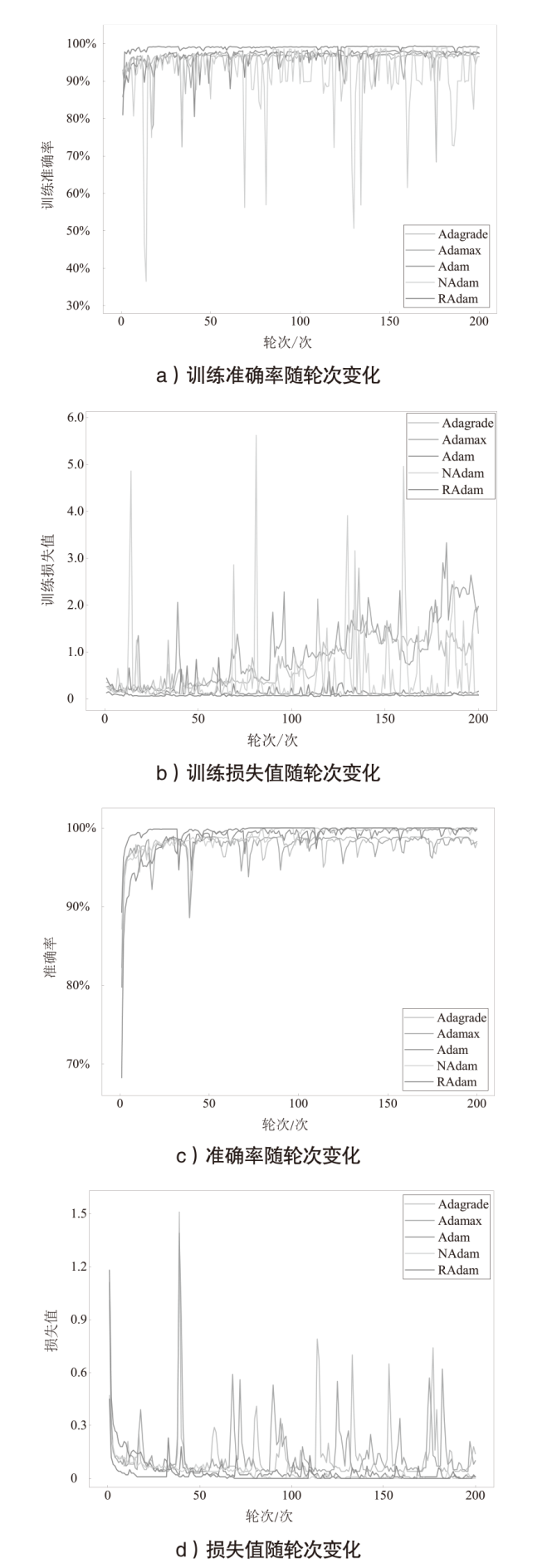
| Adagrade | 97.20% | 96.26% | 97.20% | 96.68% |
| Adamax | 97.67% | 96.71% | 97.67% | 97.13% |
| Adam | 98.32% | 98.38% | 98.32% | 98.30% |
| NAdam | 99.00% | 99.08% | 99.00% | 99.01% |
| RAdam | 99.47% | 99.49% | 99.47% | 99.46% |
| 归一化方法 | 准确率 | 精确率 | 召回率 | F1值 |
|---|---|---|---|---|
| 中心裁剪 | 95.32% | 95.42% | 95.43% | 95.42% |
| 零填充 | 99.14% | 99.17% | 99.14% | 99.15% |
| 平均池化 | 99.36% | 99.37% | 99.36% | 99.36% |
| 双线性插值 | 99.47% | 99.49% | 99.47% | 99.46% |
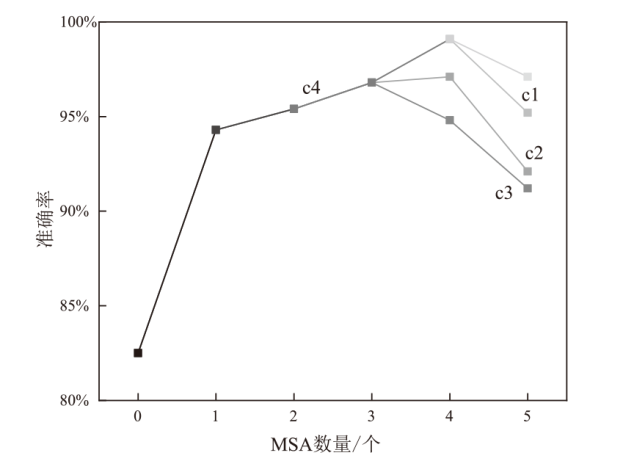
| 模型 | 准确率 | 精确率 | 召回率 | F1值 |
|---|---|---|---|---|
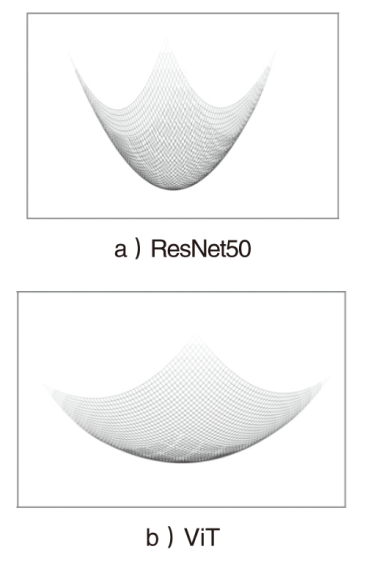
| ResNet50 | 97.54% | 97.57% | 97.54% | 97.53% |
| ViT | 97.63% | 96.72% | 97.63% | 97.10% |
| MSA-ResNet | 99.47% | 99.49% | 99.47% | 99.46% |
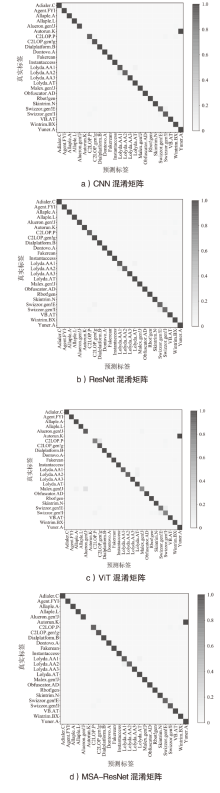
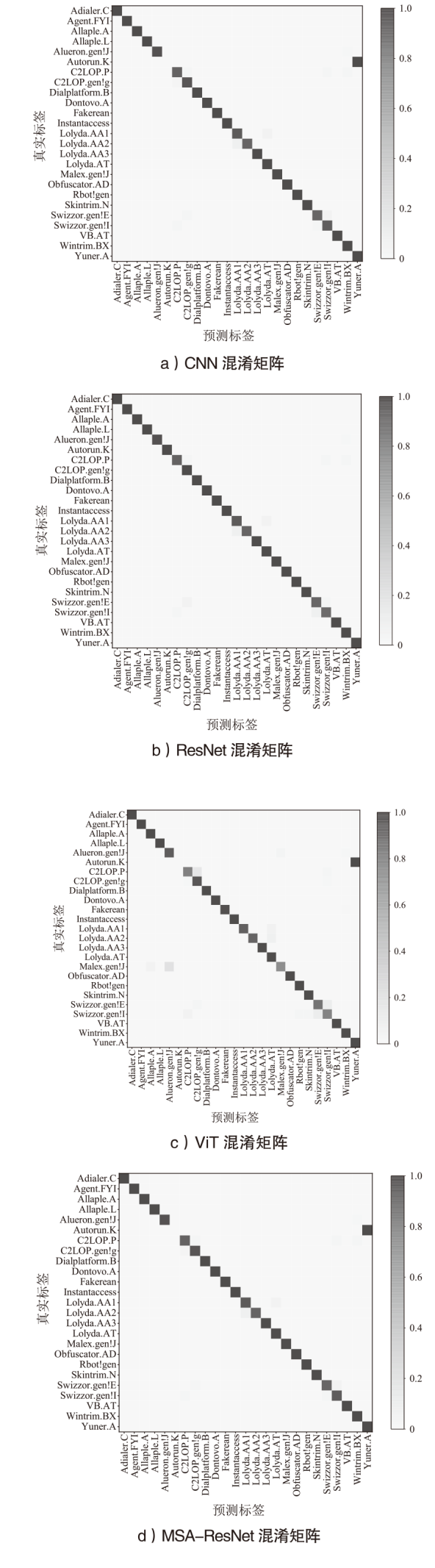
| 模型 | 准确率 | 精确率 | 召回率 | F1值 |
|---|---|---|---|---|
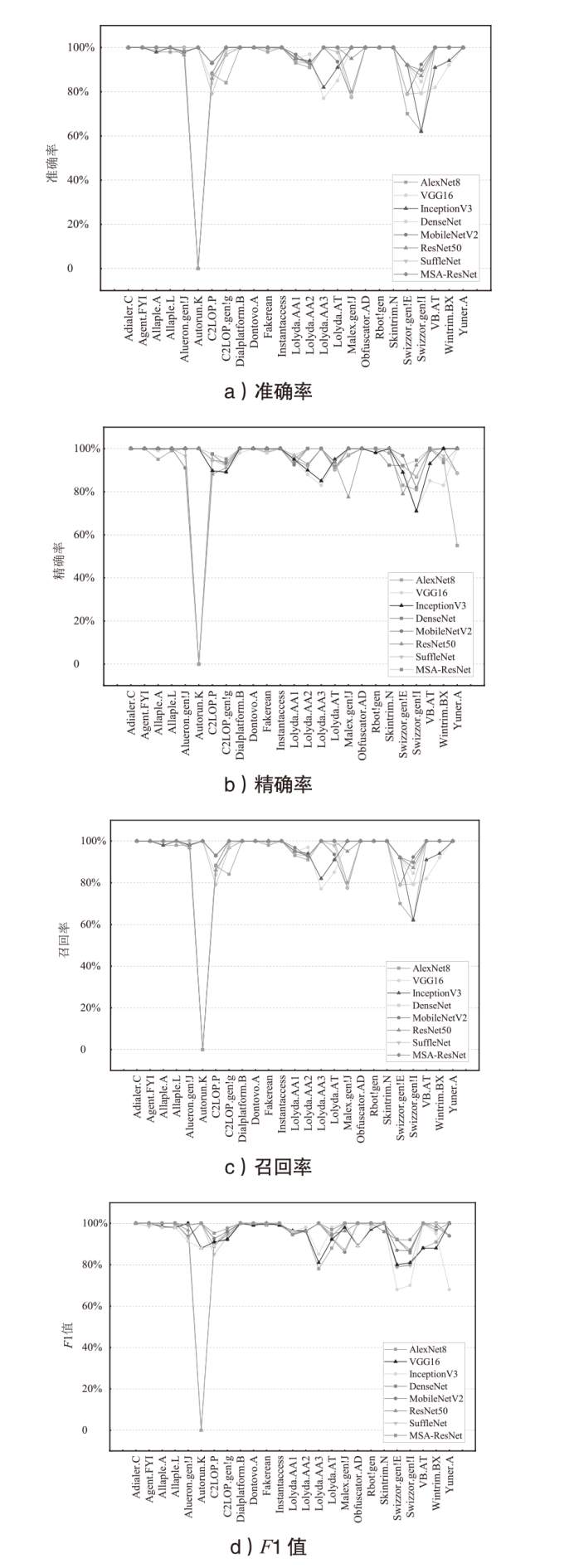
| AlexNet8 | 94.12% | 92.77% | 94.12% | 93.19% |
| VGG16 | 97.11% | 97.00% | 97.11% | 97.03% |
| DenseNet | 99.07% | 99.08% | 99.07% | 99.06% |
| MobileNetV2 | 97.63% | 96.72% | 97.63% | 97.10% |
| ResNet50 | 97.92% | 97.54% | 97.92% | 97.40% |
| ShuffleNet | 98.35% | 98.41% | 98.35% | 98.33% |
| InceptionV3 | 98.71% | 98.72% | 98.71% | 98.71% |
| MSA-ResNet | 99.47% | 99.49% | 99.47% | 99.46% |
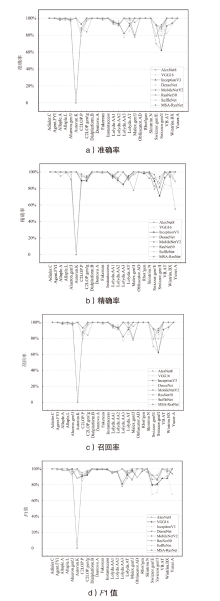
| 方法 | 数据集 | 模型概述 | 准确率 | 精确率 | 召回率 | F1值 |
|---|---|---|---|---|---|---|
| 文献[ | Malimg | GIST+KNN | 97.18% | — | — | — |
| 文献[ | Malimg | SPAM | 97.40% | — | — | — |
| 文献[ | Malimg | DRBA+CNN | 94.50% | 96.60% | 88.40% | — |
| 文献[ | Malimg | LGMP+KNN | 98.40% | — | 98.20% | 97.1% |
| 文献[ | Malimg | NSGAII+CNN | 97.60% | 97.60% | 88.40% | — |
| 文献[ | Malimg | CNN+LSTM | 96.30% | 96.30% | 96.20% | 96.20% |
| 文献[ | Malimg | CNN+BiGRU | 96.30% | 91.80% | 91.50% | 91.60% |
| 文献[ | Malimg | CSGM+KNN | 98.40% | — | 98.20% | 97.10% |
| 文献[ | Malimg | MxN+GLCM | 98.58% | 98.04% | 98.06% | 98.05% |
| 文献[ | Malimg | SWS+RF | 98.65% | 98.86% | 98.63% | 98.74% |
| 文献[ | Malimg | DCNN | 98.79% | 98.79% | 98.47% | 98.46% |
| 文献[ | Malimg | IMCFN | 98.82% | 98.85% | 98.81% | 98.75% |
| 文献[ | Malimg | DenseNet201 | 98.97% | — | — | 98.88% |
| 文献[ | Malimg | DEAM+Densenet | 98.50% | 96.90% | 96.60% | 96.70% |
| 文献[ | Malimg | Two-level ANN | 99.13% | — | — | — |
| 文献[ | Malimg | MCFT-CNN | 99.19% | 97.72% | 97.76% | 97.68% |
| 文献[ | Malimg | DTMIC | 98.93% | 99.00% | 99.00% | 99.00% |
| 本文方法 | Malimg | MSA-ResNet | 99.47% | 99.49% | 99.47% | 99.46% |
| 文献[ | BIG2015 | CNN+Gray | 97.49% | — | — | 94.38% |
| 文献[ | BIG2015 | CNN+LSTM+Gray | 98.20% | — | — | 95.77% |
| 文献[ | BIG2015 | LeNet5+RGB+ Word2Vec | 98.76% | — | — | — |
| 文献[ | BIG2015 | RNN+Word2Vec+ skip-gram | 97.80% | — | — | — |
| 文献[ | BIG2015 | CFG+LSTM | 87.80% | — | — | 84.20% |
| 文献[ | BIG2015 | CFG+Graph+ transformer | 92.70% | — | — | 90.10% |
| 文献[ | BIG2015 | One-class SVM | 92.00% | — | — | — |
| 文献[ | BIG2015 | PCA+KNN | 96.60% | — | — | — |
| 文献[ | BIG2015 | Mcs-ResNet | 97.21% | — | — | — |
| 本文方法 | BIG2015 | MSA-ResNet | 99.36% | 99.29% | 99.35% | 99.32% |
| [1] | China Internet Network Information Centre. The 55th Statistical Report on the Development of the Internet in China[EB/OL]. (2025-01-17)[2025-04-15]. https://www.cnnic.net.cn/. |
| 中国互联网络信息中心. 第55次《中国互联网络发展状况统计报告》[EB/OL]. (2025-01-17)[2025-04-15]. https://www.cnnic.net.cn/. | |
| [2] | National Computer Network Emergency Response Technical Team/Coordination Center of China (CNCERT/CC). 2021 First Half Year China Internet Network Security Monitoring Data Analysis Report[EB/OL]. (2021-06-30)[2025-04-15]. https://www.cert.org.cn/. |
| 国家计算机网络应急技术处理协调中心(CNCERT/CC). 2021年上半年我国互联网网络安全监测数据分析报告[EB/OL]. (2021-06-30)[2025-04-15]. https://www.cert.org.cn/. | |
| [3] | DAMODARAN A, TROIA F D, VISAGGIO C A, et al. A Comparison of Static, Dynamic, and Hybrid Analysis for Malware Detection[J]. Journal of Computer Virology and Hacking Techniques, 2017, 13: 1-12. |
| [4] | ALAZAB M. Profiling and Classifying the Behavior of Malicious Codes[J]. Journal of Systems and Software, 2015, 100: 91-102. |
| [5] |
WANG Shuo, WANG Jian, WANG Ya'nan, et al. A Fast Malicious Code Detection Method Based on Feature Fusion[J]. Acta Electronica Sinica, 2023, 51(1): 57-66.
doi: 10.12263/DZXB.20211701 |
|
王硕, 王坚, 王亚男, 等. 一种基于特征融合的恶意代码快速检测方法[J]. 电子学报, 2023, 51(1):57-66.
doi: 10.12263/DZXB.20211701 |
|
| [6] | CONTI G, BRATUS S, SHUBINA A, et al. Automated Mapping of Large Binary Objects Using Primitive Fragment Type Classification[J]. Digital Investigation, 2010, 7: 3-12. |
| [7] | NATARAJ L, KARTHIKEYAN S, JACOB G, et al. Malware Images: Visualization and Automatic Classification[C]// ACM. The 8th International Symposium on Visualization for Cyber Security. New York: ACM, 2011: 1-7. |
| [8] |
HAN Xiaoguang, QU Wu, YAO Xuanxia, et al. Research on Malicious Code Variants Detection Based on Texture Fingerprint[J]. Journal on Communications, 2014, 35(8): 125-136.
doi: 10.3969/j.issn.1000-436x.2014.08.016 |
|
韩晓光, 曲武, 姚宣霞, 等. 基于纹理指纹的恶意代码变种检测方法研究[J]. 通信学报, 2014, 35(8):125-136.
doi: 10.3969/j.issn.1000-436x.2014.08.016 |
|
| [9] | NATARAJ L, YEGNESWARAN V, PORRAS P, et al. A Comparative Assessment of Malware Classification Using Binary Texture Analysis and Dynamic Analysis[C]// ACM. The 4th ACM Workshop on Security and Artificial Intelligence. New York: ACM, 2011: 21-30. |
| [10] | WANG Jialai, ZHANG Chao, QI Xuyan, et al. A Survey of Intelligent Malware Detection on Windows Platform[J]. Journal of Computer Research and Development, 2021, 58(5): 977-994. |
| 汪嘉来, 张超, 戚旭衍, 等. Window平台恶意软件智能检测综述[J]. 计算机研究与发展, 2021, 58(5):977-994. | |
| [11] |
REN Zhuojun, CHEN Guang, LU Wenke. Malware Visualization Methods Based on N-Gram Features[J]. Acta Electronica Sinica, 2019, 47(10): 2108-2115.
doi: 10.3969/j.issn.0372-2112.2019.10.012 |
|
任卓君, 陈光, 卢文科. 基于N-gram特征的恶意代码可视化方法[J]. 电子学报, 2019, 47(10):2108-2115.
doi: 10.3969/j.issn.0372-2112.2019.10.012 |
|
| [12] |
NATARAJ L, MANJUNATH B S. SPAM: Signal Processing to Analyze Malware[J]. IEEE Signal Processing Magazine, 2016, 33(2): 105-117.
doi: 10.1109/MSP.2015.2507185 |
| [13] | KANCHERLA K, MUKKAMALA S. Image Visualization Based Malware Detection[C]// IEEE. 2013 IEEE Symposium on Computational Intelligence in Cyber Security. New York: IEEE, 2013: 40-44. |
| [14] |
LIU Yashu, WANG Zhihai, YAN Hanbing, et al. Method of Anti-Confusion Texture Feature Descriptor for Malware Images[J]. Journal on Communications, 2018, 39(11): 44-53.
doi: 10.11959/j.issn.1000-436x.2018227 |
|
刘亚姝, 王志海, 严寒冰, 等. 抗混淆的恶意代码图像纹理特征描述方法[J]. 通信学报, 2018, 39(11):44-53.
doi: 10.11959/j.issn.1000-436x.2018227 |
|
| [15] | NAEEM H, GUO Bing, NAEEM M R, et al. Identification of Malicious Code Variants Based on Image Visualization[J]. Computers & Electrical Engineering, 2019, 76: 225-237. |
| [16] | LU Xidong, DUAN Zhemin, QIAN Yekui, et al. Malicious Code Classification Method Based on Deep Forest[J]. Journal of Software, 2020, 31(5): 1454-1464. |
| 卢喜东, 段哲民, 钱叶魁, 等. 一种基于深度森林的恶意代码分类方法[J]. 软件学报, 2020, 31(5):1454-1464. | |
| [17] | GIBERT D, MATEU C, PLANES J, et al. Using Convolutional Neural Networks for Classification of Malware Represented as Images[J]. Journal of Computer Virology and Hacking Techniques, 2019, 15(1): 15-28. |
| [18] | VASAN D, ALAZAB M, WASSAN S, et al. IMCFN: Image-Based Malware Classification Using Fine-Tuned Convolutional Neural Network Architecture[EB/OL]. (2025-01-17)[2025-04-15].https://www.cnnic.net.cn/. |
| [19] | KABANGA E K, KIM C H. Malware Images Classification Using Convolutional Neural Network[J]. Journal of Computer and Communications, 2018, 6(1): 153-158. |
| [20] | CUI Zhihua, XUE Fei, CAI Xingjuan, et al. Detection of Malicious Code Variants Based on Deep Learning[J]. IEEE Transactions on Industrial Informatics, 2018, 14(7): 3187-3196. |
| [21] |
CUI Zhihua, DU Lei, WANG Penghong, et al. Malicious Code Detection Based on CNNs and Multi-Objective Algorithm[J]. Journal of Parallel and Distributed Computing, 2019, 129: 50-58.
doi: 10.1016/j.jpdc.2019.03.010 |
| [22] | HE Kaiming, ZHANG Xiangyu, REN Shaoqing, et al. Deep Residual Learning for Image Recognition[C]// IEEE. 2016 IEEE Conference on Computer Vision and Pattern Recognition. New York: IEEE, 2016: 770-778. |
| [23] | ZHANG Chenjia, ZHU Lei, CHEN Pu, et al. Individual Recognition Method of Communication Emitter Based on Attention Mechanism[J]. Communications Technology, 2021, 54(7): 1594-1600. |
| 张宸嘉, 朱磊, 陈璞, 等. 基于注意力机制的通信辐射源个体识别方法[J]. 通信技术, 2021, 54(7):1594-1600. | |
| [24] | ZHOU Chenchao, CHEN Qun, LI Zhanhuai, et al. Evaluation Object Category Determination Based on Attention and Two-Way LSTM[J]. Journal of Northwestern Polytechnical University, 2019, 37 (3): 558-564. |
| 周陈超, 陈群, 李战怀, 等. 基于注意力和双向LSTM的评价对象类别判定[J]. 西北工业大学学报, 2019, 37(3):558-564. | |
| [25] | VASWANI A, SHAZEER N, PARMAR N, et al. Attention All You Need[C]// Neural Information Processing Systems. The 31st International Conference on Neural Information Processing Systems. New York: Curran Associates, 2017: 6000-6010. |
| [26] | RONEN R, RADU M, FEUERSTEIN C, et al. Microsoft Malware Classification Challenge[EB/OL]. (2018-02-22)[2025-04-15]. https://arxiv.org/abs/1802.10135. |
| [27] |
LI Qi, MI Jiaxin, LI Weishi, et al. CNN-Based Malware Variants Detection Method for Internet of Things[J]. IEEE Internet of Things Journal, 2021, 8(23): 16946-16962.
doi: 10.1109/JIOT.2021.3075694 |
| [28] | SUDHAKAR S K. MCFT-CNN: Malware Classification with Fine-Tuning Convolution Neural Networks Using Traditional and Transfer Learning in the Internet of Things[J]. Future Generation Computer Systems, 2021, 125: 334-351. |
| [29] |
VINAYAKUMAR R, ALAZAB M, SOMAN K P, et al. Robust Intelligent Malware Detection Using Deep Learning[J]. IEEE Access, 2019, 7: 46717-46738.
doi: 10.1109/ACCESS.2019.2906934 |
| [30] | VENKATRAMAN S, ALAZAB M, VINAYAKUMAR R. A Hybrid Deep Learning Image-Based Analysis for Effective Malware Detection[J]. Journal of Information Security and Applications, 2019, 47: 377-389. |
| [31] | NAEEM H, GUO Bing, ULLAH F, et al. A Cross-Platform Malware Variant Classification Based on Image Representation[J]. KSII Transactions on Internet and Information Systems, 2019, 13(7): 3756-3777. |
| [32] | VERMA V, MUTTOO S K, SINGH V B. Multiclass Malware Classification via First- and Second-Order Texture Statistics[EB/OL]. (2020-10-01)[2025-04-15]. https://doi.org/10.1016/j.cose.2020.101895. |
| [33] | ROSELINE S A, GEETHA S, KADRY S, et al. Intelligent Vision-Based Malware Detection and Classification Using Deep Random Forest Paradigm[J]. IEEE Access, 2020, 8: 206303-206324. |
| [34] | NAEEM H, ULLAH F, NAEEM M R, et al. Malware Detection in Industrial Internet of Things Based on Hybrid Image Visualization and Deep Learning Model[EB/OL]. (2020-08-01)[2025-04-15]. https://doi.org/10.1016/j.adhoc.2020.102154. |
| [35] | ANANDH V, VINOD P, MENON V G. Malware Visualization and Detection Using DenseNets[J]. Personal and Ubiquitous Computing, 2021, 28: 153-169. |
| [36] | WANG Changguang, ZHAO Ziqiu, WANG Fangwei, et al. A Novel Malware Detection and Family Classification Scheme for IoT Based on DEAM and DenseNet[EB/OL]. (2021-01-05)[2025-04-15]. https://doi.org/10.1155/2021/6658842. |
| [37] | MOUSSAS V, ANDREATOS A. Malware Detection Based on Code Visualization and Two-Level Classification[EB/OL]. (2021-03-11)[2025-04-15]. https://doi.org/10.3390/info12030118. |
| [38] | SUDHAKAR, KUMAR S. MCFT-CNN: Malware Classification with Fine-Tuned Convolution Neural Networks Using Traditional and Transfer Learning in the Internet of Things[J]. Future Generation Computer Systems, 2021, 125: 334-351. |
| [39] | KUMAR S, JANET B. DTMIC: Deep Transfer Learning for Malware Image Classification[EB/OL]. (2022-02-01)[2025-04-15]. https://doi.org/10.1016/j.jisa.2021.103063. |
| [40] | VU D L, NGUYEN T K, NGUYEN T V, et al. A Convolutional Transformation Network for Malware Classification[C]// IEEE. 2019 6th NAFOSTED Conference on Information and Computer Science. New York: IEEE, 2019: 234-239. |
| [41] | LE Quan, BOYDELL O, MAC N B, et al. Deep Learning at the Shallow End: Malware Classification for Non-Domain Experts[J]. Digital Investigation, 2018, 26: 118-126. |
| [42] | QIAO Yanchen, JIANG Qingshan, JIANG Zhenchao, et al. A Multi-Channel Visualization Method for Malware Classification Based on Deep Learning[C]// IEEE. 2019 18th IEEE International Conference on Trust, Security and Privacy in Computing and Communications/13th IEEE International Conference on Big Data Science and Engineering. New York: IEEE, 2019: 757-762. |
| [43] | CHEN Jun, GUO Shize, MA Xin, et al. SLAM: A Malware Detection Method Based on Sliding Local Attention Mechanism[EB/OL]. (2020-09-25)[2025-04-15]. https://doi.org/10.1155/2020/6724513. |
| [44] | HUO Xuan, LI Ming, ZHOU Zhihua. Control Flow Graph Embedding Based on Multi-Instance Decomposition for Bug Localization[C]// AAAI. The AAAI Conference on Artificial Intelligence. Menlo Park: AAAI, 2020: 4223-4230. |
| [45] | MOON H J, BU S J, CHO S B. Directional Graph Transformer-Based Control Flow Embedding for Malware Classification[C]// Springer. Intelligent Data Engineering and Automated Learning-IDEAL 2021: 22nd International Conference. Heidelberg: Springer, 2021: 426-436. |
| [46] | BURNAEV E, SMOLYAKOV D. One-Class SVM with Privileged Information and Its Application to Malware Detection[C]// IEEE. 2016 IEEE 16th International Conference on Data Mining Workshops. New York: IEEE, 2016: 273-280. |
| [47] | NARAYANAN B N, DJANEYE-BOUNDJOU O, KEBEDE T M. Performance Analysis of Machine Learning and Pattern Recognition Algorithms for Malware Classification[C]// IEEE. 2016 IEEE National Aerospace and Electronics Conference (NAECON) and Ohio Innovation Summit (OIS). New York: IEEE, 2016: 338-342. |
| [48] | SHAO Yanli, LU Yang, WEI Dan, et al. Malicious Code Classification Method Based on Deep Residual Network and Hybrid Attention Mechanism for Edge Security[EB/OL]. (2022-01-01)[2025-04-15]. https://doi.org/10.1155/2022/3301718. |
| [1] | ZHANG Xinglan, TAO Kejin. Universal Perturbations Generation Method Based on High-Level Features and Important Channels [J]. Netinfo Security, 2025, 25(5): 767-777. |
| [2] | QIN Guangxue, LI Lisha. ARX Block Cipher Distinguisher Based on Quantum Convolutional Neural Network [J]. Netinfo Security, 2025, 25(3): 467-477. |
| [3] | ZHANG Shuangquan, YIN Zhonghao, ZHANG Huan, GAO Peng. Research on Cyber Attack Detection Technology Based on Residual Convolutional Neural Network [J]. Netinfo Security, 2025, 25(2): 240-248. |
| [4] | LIU Lianhai, LI Huiye, MAO Donghui. CBAM-CNN Network-Based Intrusion Detection Method Using Image Convex Hull Features [J]. Netinfo Security, 2024, 24(9): 1422-1431. |
| [5] | XU Kaiwen, ZHOU Yichao, GU Wenquan, CHEN Chen, HU Xiyuan. A Multi-Scale Feature Fusion Deepfake Detection Algorithm Based on Reconstruction Learning [J]. Netinfo Security, 2024, 24(8): 1173-1183. |
| [6] | XUE Yu, ZHANG Yixuan. Survey on Deep Neural Architecture Search [J]. Netinfo Security, 2023, 23(9): 58-74. |
| [7] | YUAN Wenxin, CHEN Xingshu, ZHU Yi, ZENG Xuemei. HTTP Payload Covert Channel Detection Method Based on Deep Learning [J]. Netinfo Security, 2023, 23(7): 53-63. |
| [8] | JIANG Yingzhao, CHEN Lei, YAN Qiao. Distributed Denial of Service Attack Detection Algorithm Based on Two-Channel Feature Fusion [J]. Netinfo Security, 2023, 23(7): 86-97. |
| [9] | ZHAO Xiaolin, WANG Qiyao, ZHAO Bin, XUE Jingfeng. Research on Anonymous Traffic Classification Method Based on Machine Learning [J]. Netinfo Security, 2023, 23(5): 1-10. |
| [10] | ZHAO Caidan, CHEN Jingqian, WU Zhiqiang. Automatic Modulation Recognition Algorithm Based on Multi-Channel Joint Learning [J]. Netinfo Security, 2023, 23(4): 20-29. |
| [11] | YAO Yuan, FAN Zhaoshan, WANG Qing, TAO Yuan. Malicious Domain Detection Method Based on Multivariate Time-Series Features [J]. Netinfo Security, 2023, 23(11): 1-8. |
| [12] | LI Sicong, WANG Jian, SONG Yafei, HUANG Wei. Malicious Code Classification Method Based on BiTCN-DLP [J]. Netinfo Security, 2023, 23(11): 104-117. |
| [13] | QIN Yifang, ZHANG Jian, LIANG Chen. Research on Feature Extraction Technology of Electronic Medical Record Data Based on Neural Networks [J]. Netinfo Security, 2023, 23(10): 70-76. |
| [14] | LIU Guangjie, DUAN Kun, ZHAI Jiangtao, QIN Jiayu. Mobile Traffic Application Recognition Based on Multi-Feature Fusion [J]. Netinfo Security, 2022, 22(7): 18-26. |
| [15] | WANG Haoyang, LI Wei, PENG Siwei, QIN Yuanqing. An Intrusion Detection Method of Train Control System Based on Ensemble Learning [J]. Netinfo Security, 2022, 22(5): 46-53. |
| Viewed | ||||||
|
Full text |
|
|||||
|
Abstract |
|
|||||