信息网络安全 ›› 2026, Vol. 26 ›› Issue (5): 684-698.doi: 10.3969/j.issn.1671-1122.2026.05.002
基于频域分布对齐的无训练黑盒深伪攻击方法
虞楚尔1, 王菡悦1, 吴坚2,3,4, 丁伟杰3, 陈先钳2,4, 王总辉1( )
)
- 1
浙江大学计算机科学与技术学院 杭州 310027
2浙江省公安厅网络安全保卫总队 杭州 310009
3浙江警察学院信息网络安全学院 杭州 310053
4浙江大学网络空间安全学院 杭州 310027
-
收稿日期:2026-01-20出版日期:2026-05-10发布日期:2026-06-03 -
通讯作者:王总辉 zhwang@zju.edu.cn -
作者简介:虞楚尔(1995—),女,浙江,博士研究生,主要研究方向为多媒体内容安全|王菡悦(2003—),女,河南,硕士研究生,主要研究方向为人工智能内容安全|吴坚(1980—),男,浙江,正高级工程师,硕士,主要研究方向为人工智能、网络安全和数字取证技术|丁伟杰(1980—),男,河南,教授,博士,主要研究方向为人工智能内容安全、数据智能分析及网络空间治理技术|陈先钳(1984—),男,浙江,正高级工程师,硕士,主要研究方向为电子数据取证技术|王总辉(1979—),男,浙江,高级工程师,博士,主要研究方向为内容安全、人工智能安全和计算机体系结构 -
基金资助:国家重点研发计划(2024YFF0618800)
A Training-Free Black-Box Attack against DeepFake Detectors via Frequency Distribution Alignment
YU Chuer1, WANG Hanyue1, WU Jian2,3,4, DING Weijie3, CHEN Xianqian2,4, WANG Zonghui1()
- 1
College of Computer Science and Technology ,Zhejiang University Hangzhou 310027, China
2Cybersecurity Corps ,Zhejiang Provincial Public Security Department Hangzhou 310009, China
3College of Information and Cyber Security ,Zhejiang Police College Hangzhou 310053, China
4School of Cyber Science and Technology ,Zhejiang University Hangzhou 310027, China
-
Received:2026-01-20Online:2026-05-10Published:2026-06-03

摘要:
随着深度伪造(简称“深伪”)技术生成质量不断逼近真实影像,深伪检测在多媒体内容安全中的作用愈发重要。然而,现有方法多依赖真实与伪造样本的统计偏差进行判别,使其在黑盒条件下面临对抗脆弱性。文章研究在无训练、零查询黑盒场景下检测系统的安全性,提出一种新的攻击视角,将对抗攻击建模为对伪造图像统计指纹的定向修复,而非外源噪声扰动。基于此,文章提出频域分布对齐的无训练黑盒攻击方法(SpectralFusion)。该方法利用深伪生成中天然存在的真实-伪造成对先验,在无需访问检测器参数、梯度及额外训练与查询的前提下,通过频域分析定位伪造图像与真实参考的统计差异,并仅对异常频段进行受控修正。具体地,设计差异感知掩码以精确定位异常频段,并引入自适应融合强度机制动态调节修正能量;结合局部重叠块的频谱处理策略,实现对伪造频域特征的精细对齐与重建。实验结果表明,SpectralFusion在保持较高视觉保真度的同时,能够稳定削弱多种检测模型的判别置信度,并在不同模型架构与伪造类型下展现出良好泛化能力。研究结果揭示了深伪检测模型在频域统计层面的潜在安全隐患,为评估黑盒检测系统的鲁棒性提供了新视角。
中图分类号:
引用本文
虞楚尔, 王菡悦, 吴坚, 丁伟杰, 陈先钳, 王总辉. 基于频域分布对齐的无训练黑盒深伪攻击方法[J]. 信息网络安全, 2026, 26(5): 684-698.
YU Chuer, WANG Hanyue, WU Jian, DING Weijie, CHEN Xianqian, WANG Zonghui. A Training-Free Black-Box Attack against DeepFake Detectors via Frequency Distribution Alignment[J]. Netinfo Security, 2026, 26(5): 684-698.

图1
频域交换与随机扰动样本的视觉对比
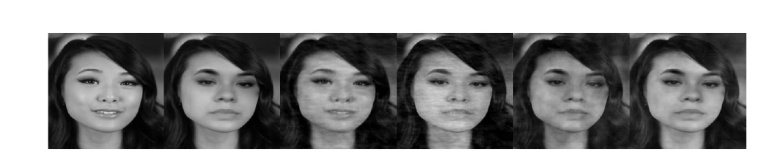
表1
幅值与相位谱敏感性分析实验结果
| 输入变体 | 幅值来源(A) | 相位来源(P) | 平均伪造 置信度↓ | 判伪率 (大于0.5)↓ |
|---|---|---|---|---|
| 目标真实图像Ir | 真实(Ar) | 真实(Pr) | 0.02 | 1.0% |
| 原始伪造图像If | 伪造(Af) | 伪造(Pf) | 0.95 | 96.6% |
| 相位替换图像 Iphase-swap | 伪造(Af) | 真实(Pr) | 0.41 | 37.7% |
| 幅值替换图像 Imag-swap | 真实(Ar) | 伪造(Pf) | 0.63 | 67.9% |
| 随机相位图像 Irand-phase | 伪造(Af) | 伪造+噪声 | 0.88 | 96.8% |
| 随机幅值图像 Irand-mag | 伪造+噪声 | 伪造(Pf) | 0.87 | 92.1% |
图2
SpectralFusion处理流程
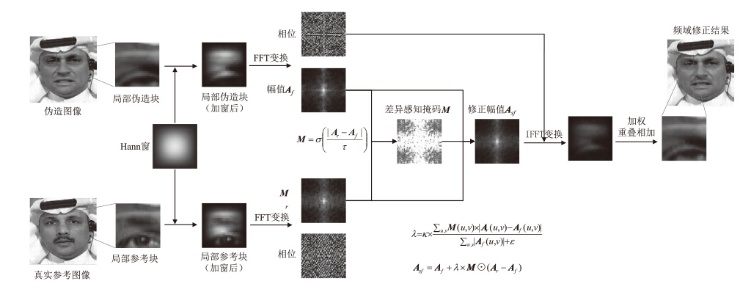
表2
FF++ Deepfakes的主攻击性能与跨模型迁移性对比
| 攻击方法 | Xception | F3Net | UIA-ViT | RECCE | 视觉质量 | ||||||
|---|---|---|---|---|---|---|---|---|---|---|---|
| ASR | ASR | ASR | ASR | PSNR/dB | SSIM | LPIPS | |||||
| 高斯模糊 | 0.3% | 0.026 | 7.7% | 0.163 | 0 | -0.010 | 0 | -0.058 | 32.7 | 0.927 | 0.179 |
| 中值滤波 | 2.9% | 0.045 | 9.2% | 0.149 | 0 | -0.102 | 0 | -0.064 | 32.1 | 0.909 | 0.203 |
| PGD | 100% | 0.993 | 90.6% | 0.892 | 79.8% | 0.777 | 90.7% | 0.853 | 30.8 | 0.706 | 0.424 |
| DI-FGSM | 100% | 0.994 | 94.9% | 0.930 | 87.1% | 0.855 | 89.9% | 0.840 | 31.2 | 0.728 | 0.434 |
| C&W | 97.0% | 0.944 | 76.5% | 0.730 | 33.9% | 0.326 | 56.5% | 0.513 | 41.5 | 0.962 | 0.149 |
| SpectralFusion | 58.4% | 0.557 | 56.2% | 0.515 | 35.3% | 0.349 | 39.6% | 0.370 | 32.0 | 0.971 | 0.049 |
表3
FF++不同伪造子集上的跨方法泛化性能评估
| 伪造 数据集 | 参数 | Xception | F3Net | UIA-ViT | RECCE | 视觉质量 | ||||||
|---|---|---|---|---|---|---|---|---|---|---|---|---|
| ASR | ASR | ASR | ASR | PSNR/dB | SSIM | LPIPS | ||||||
| Deepfakes (源域) | 2.0 | 58.4% | 0.557 | 56.2% | 0.515 | 35.3% | 0.349 | 39.6% | 0.370 | 32.0 | 0.971 | 0.049 |
| FaceSwap | 3.0 | 28.1% | 0.281 | 29.0% | 0.287 | 39.7% | 0.379 | 36.8% | 0.352 | 32.4 | 0.970 | 0.051 |
| Face2Face | 6.0 | 33.6% | 0.330 | 48.1% | 0.452 | 61.3% | 0.579 | 57.9% | 0.477 | 34.7 | 0.965 | 0.069 |
| NeuralTextures | 6.0 | 56.3% | 0.521 | 65.5% | 0.600 | 62.9% | 0.577 | 61.6% | 0.467 | 36.1 | 0.972 | 0.055 |
| Deeperforensics-1.0 | 2.0 | 61.7% | 0.399 | 69.6% | 0.410 | 60.7% | 0.486 | 36.8% | 0.207 | 33.7 | 0.981 | 0.029 |
表4
在已逃逸检测的伪造样本上的RFR
| 伪造数据集 | Xception | F3Net | UIA-ViT | 平均值 |
|---|---|---|---|---|
| Deepfakes | 5.1% | 3.5% | 2.0% | 3.5% |
| FaceSwap | 10.2% | 6.7% | 7.6% | 8.2% |
| Face2Face | 9.8% | 5.0% | 2.5% | 5.8% |
| NeuralTextures | 7.7% | 5.3% | 3.9% | 5.6% |
| DeeperForensics-1.0 | 2.6% | 1.4% | 3.0% | 2.3% |
| 平均值 | 7.1% | 4.4% | 3.8% | 5.1% |
表5
消融实验结果
| 变体 | 自适应频域掩码M | 自适应融合强度λ | 局部重叠融合 | ASR | PSNR/dB | SSIM | LPIPS | |
|---|---|---|---|---|---|---|---|---|
| A1(Global Linear) | — | — | — | 19.5% | 0.213 | 30.9 | 0.919 | 0.196 |
| A2(Mask Only) | √ | — | √ | 70.9% | 0.666 | 31.3 | 0.965 | 0.071 |
| A3(Intensity Only) | — | √ | √ | 60.0% | 0.573 | 31.1 | 0.965 | 0.059 |
| A4(Global Adaptive) | √ | √ | — | 13.1% | 0.148 | 32.7 | 0.937 | 0.159 |
| B1(Block Linear) | — | — | √ | 67.7% | 0.638 | 29.0 | 0.967 | 0.069 |
| B2(Block Swap-LF) | — | — | √ | 39.5% | 0.380 | 37.1 | 0.956 | 0.103 |
| B3(Block Swap-HF) | — | — | √ | 54.4% | 0.513 | 31.2 | 0.960 | 0.084 |
| A5(SpectralFusion) | √ | √ | √ | 58.4% | 0.560 | 31.3 | 0.967 | 0.057 |
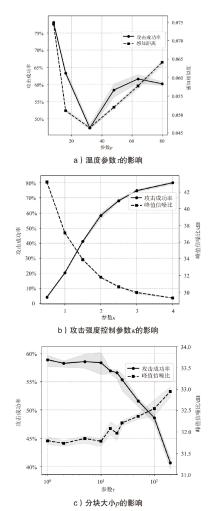
图3
超参数敏感性分析
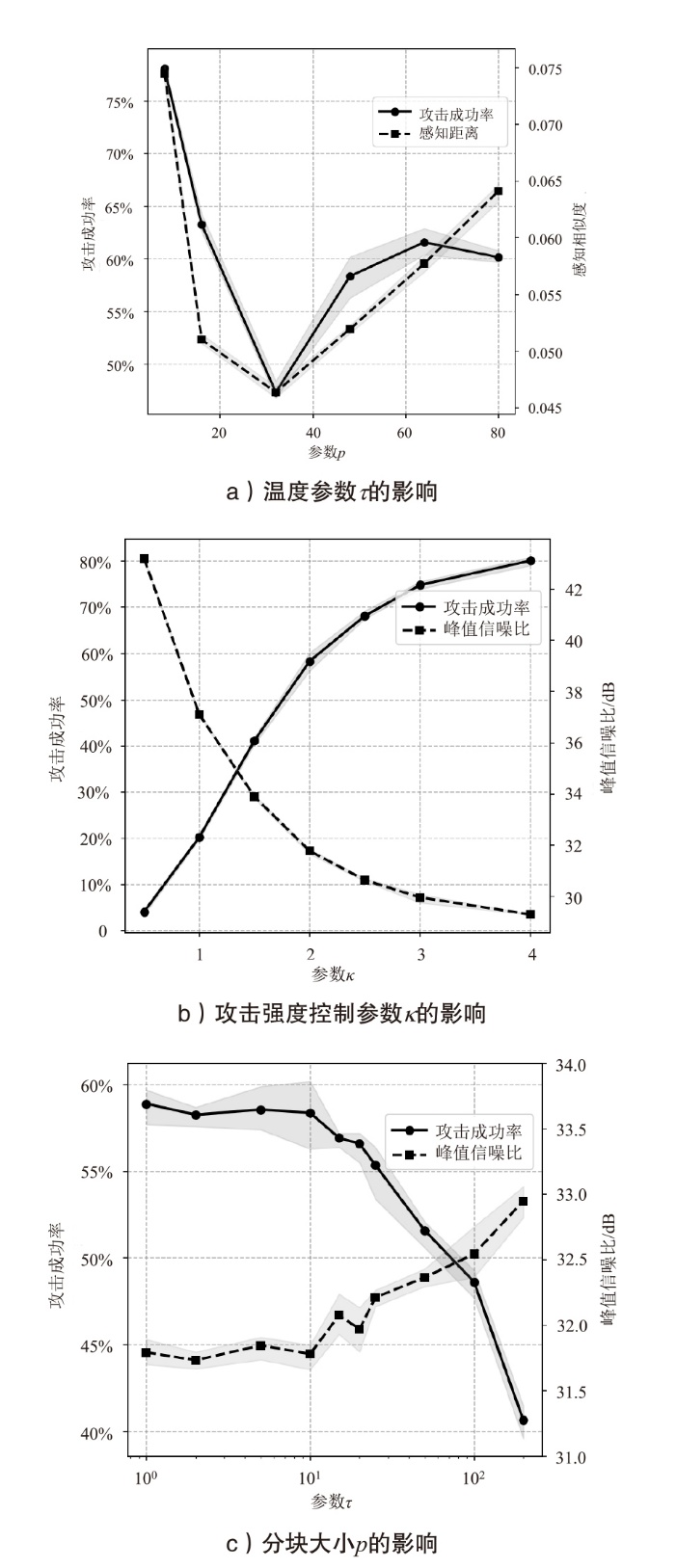
表6
参数敏感性分析详细数据
| 参数类型 | 参数值 | 攻击性能 | 视觉质量 | |||
|---|---|---|---|---|---|---|
| ASR | PSNR/dB | SSIM | LPIPS | |||
| 温度参数 τ | 1.0 | 58.9% | 0.565 | 31.79 | 0.970 | 0.053 |
| 2.0 | 58.3% | 0.564 | 31.73 | 0.970 | 0.054 | |
| 5.0 | 58.6% | 0.553 | 31.85 | 0.970 | 0.053 | |
| 10.0 | 58.4% | 0.557 | 31.78 | 0.971 | 0.052 | |
| 15.0 | 56.9% | 0.544 | 32.08 | 0.972 | 0.050 | |
| 20.0 | 56.6% | 0.540 | 31.97 | 0.972 | 0.050 | |
| 25.0 | 55.4% | 0.530 | 32.21 | 0.972 | 0.049 | |
| 50.0 | 51.6% | 0.501 | 32.37 | 0.973 | 0.047 | |
| 100.0 | 48.6% | 0.465 | 32.54 | 0.974 | 0.045 | |
| 200.0 | 40.7% | 0.398 | 32.95 | 0.976 | 0.041 | |
| 攻击强度 控制参数 κ | 0.5 | 4.1% | 0.046 | 43.20 | 0.996 | 0.008 |
| 1.0 | 20.3% | 0.206 | 37.11 | 0.988 | 0.024 | |
| 1.5 | 41.2% | 0.409 | 33.90 | 0.979 | 0.038 | |
| 2.0 | 58.4% | 0.557 | 31.78 | 0.971 | 0.052 | |
| 2.5 | 68.2% | 0.650 | 30.65 | 0.964 | 0.063 | |
| 3.0 | 74.9% | 0.705 | 29.97 | 0.959 | 0.071 | |
| 4.0 | 80.1% | 0.746 | 29.30 | 0.954 | 0.082 | |
| 分块大小 p | 8 | 78.1% | 0.742 | 27.63 | 0.939 | 0.075 |
| 16 | 63.3% | 0.598 | 29.96 | 0.960 | 0.051 | |
| 32 | 47.3% | 0.459 | 31.54 | 0.970 | 0.046 | |
| 48 | 58.4% | 0.557 | 31.78 | 0.971 | 0.052 | |
| 64 | 61.6% | 0.584 | 32.06 | 0.970 | 0.058 | |
| 80 | 60.2% | 0.566 | 31.95 | 0.968 | 0.064 | |
表7
不同参考图对齐场景下的攻击鲁棒性测试汇总
| 场景分类 | 实验配置说明 | ASR | PSNR/dB | |
|---|---|---|---|---|
| Pose Mismatch | 随机抽取视频帧 (存在姿态差异) | 52.8% | 0.508 | 24.6 |
| Jitter(Shift) | 像素随机位移 | 48.9% | 0.474 | 27.1 |
| Jitter(Scale) | 随机缩放 | 41.0% | 0.397 | 27.5 |
| Hybrid | 位移 + 缩放复合扰动 | 42.3% | 0.404 | 26.2 |
| Baseline | 完全像素级对齐 | 58.4% | 0.557 | 31.5 |
| [1] | ROSSLER A, COZZOLINO D, VERDOLIVA L, et al. FaceForensics++: Learning to Detect Manipulated Facial Images[C]//IEEE. 2019 IEEE/CVF International Conference on Computer Vision (ICCV). New York: IEEE, 2019: 1-11. |
| [2] | LI Lingzhi, BAO Jianmin, ZHANG Ting, et al. Face X-Ray for More General Face Forgery Detection[C]//IEEE. 2020 IEEE/CVF Conference on Computer Vision and Pattern Recognition (CVPR). New York: IEEE, 2020: 5000-5009. |
| [3] | QIAN Yuyang, YIN Guojun, SHENG Lu, et al. Thinking in Frequency: Face Forgery Detection by Mining Frequency-Aware Clues[C]//Springer. European Conference on Computer Vision. Heidelberg: Springer, 2020: 86-103. |
| [4] | LI Jiaming, XIE Hongtao, LI Jiahong, et al. Frequency-Aware Discriminative Feature Learning Supervised by Single-Center Loss for Face Forgery Detection[C]//IEEE. 2021 IEEE/CVF Conference on Computer Vision and Pattern Recognition (CVPR). New York: IEEE, 2021: 6454-6463. |
| [5] | CARLINI N, FARID H. Evading Deepfake-Image Detectors with White- and Black-Box Attacks[C]//IEEE. The IEEE/CVF Conference on Computer Vision and Pattern Recognition Workshops. New York: IEEE, 2020: 658-659. |
| [6] | APRUZZESE G, ANDERSON H S, DAMBRA S, et al. “Real Attackers Don’t Compute Gradients”: Bridging the Gap between Adversarial ML Research and Practice[C]//IEEE. 2023 IEEE Conference on Secure and Trustworthy Machine Learning (SaTML). New York: IEEE, 2023: 339-364. |
| [7] | PANEBIANCO F, D’ONGHIA M, ZANERO S, et al. How Stealthy Is Stealthy? Studying the Efficacy of Black-Box Adversarial Attacks in the Real World[C]//IFIP. IFIP International Conference on ICT Systems Security and Privacy Protection. Heidelberg: Springer, 2025: 140-154. |
| [8] |
LIU Chi, CHEN Huajie, ZHU Tianqing, et al. Making DeepFakes More Spurious: Evading Deep Face Forgery Detection via Trace Removal Attack[J]. IEEE Transactions on Dependable and Secure Computing, 2023, 20(6): 5182-5196.
doi: 10.1109/TDSC.2023.3241604 URL |
| [9] | CHEN Renwang, CHEN Xuanhong, NI Bingbing, et al. SimSwap: An Efficient Framework for High Fidelity Face Swapping[C]//ACM. The 28th ACM International Conference on Multimedia. New York: ACM, 2020: 2003-2011. |
| [10] | HALIASSOS A, VOUGIOUKAS K, PETRIDIS S, et al. Lips Don’t Lie: A Generalisable and Robust Approach to Face Forgery Detection[C]//IEEE. 2021 IEEE/CVF Conference on Computer Vision and Pattern Recognition (CVPR). New York: IEEE, 2021: 5037-5047. |
| [11] | ASTRID M, GHORBEL E, AOUADA D. Audio-Visual Deepfake Detection with Local Temporal Inconsistencies[C]//IEEE. 2025 IEEE International Conference on Acoustics, Speech and Signal Processing (ICASSP). New York: IEEE, 2025: 1-5. |
| [12] |
XU Z J, ZHANG Yaoyu, LUO Tao. Overview Frequency Principle/Spectral Bias in Deep Learning[J]. Communications on Applied Mathematics and Computation, 2025, 7(3): 827-864.
doi: 10.1007/s42967-024-00398-7 |
| [13] | WANG Shengyu, WANG O, ZHANG R, et al. CNN-Generated Images Are Surprisingly Easy to Spot… for Now[C]//IEEE. 2020 IEEE/CVF Conference on Computer Vision and Pattern Recognition (CVPR). New York: IEEE, 2020: 8692-8701. |
| [14] | GEIRHOS R, RUBISCH P, MICHAELIS C, et al. ImageNet-Trained CNNs are Biased towards Texture; Increasing Shape Bias Improves Accuracy and Robustness[EB/OL]. (2018-11-29)[2026-01-02]. https://arxiv.org/abs/1811.12231. |
| [15] | CHEN Guangyao, PENG Peixi, MA Li, et al. Amplitude-Phase Recombination: Rethinking Robustness of Convolutional Neural Networks in Frequency Domain[C]//IEEE. 2021 IEEE/CVF International Conference on Computer Vision (ICCV). New York: IEEE, 2021: 448-457. |
| [16] |
DONG Junhao, WANG Yuan, LAI Jianhuang, et al. Restricted Black-Box Adversarial Attack against DeepFake Face Swapping[J]. IEEE Transactions on Information Forensics and Security, 2023, 18: 2596-2608.
doi: 10.1109/TIFS.2023.3266702 URL |
| [17] | BATTIATO S, CASU M, GUARNERA F, et al. Adversarial Attacks on Deepfake Detectors: A Challenge in the Era of AI-Generated Media[C]// ACM. The 33rd ACM International Conference on Multimedia. New York: ACM, 2025: 13714-13719. |
| [18] | JIANG Liming, LI Ren, WU W, et al. DeeperForensics-1.0: A Large-Scale Dataset for Real-World Face Forgery Detection[C]// IEEE. 2020 IEEE/CVF Conference on Computer Vision and Pattern Recognition (CVPR). New York: IEEE, 2020: 2886-2895. |
| [19] | ZHUANG Wanyi, CHU Qi, TAN Zhentao, et al. UIA-ViT: Unsupervised Inconsistency-aware Method Based on Vision Transformer for Face Forgery Detection[C]// Springer. European Conference on Computer Vision. Heidelberg: Springer, 2022: 391-407. |
| [20] | CAO Junyi, MA Chao, YAO Taiping, et al. End-to-End Reconstruction-Classification Learning for Face Forgery Detection[C]// IEEE. 2022 IEEE/CVF Conference on Computer Vision and Pattern Recognition (CVPR). New York: IEEE, 2022: 4103-4112. |
| [21] | MADRY A, MAKELOV A, SCHMIDT L, et al. Towards Deep Learning Models Resistant to Adversarial Attacks[EB/OL]. (2017-06-19)[2026-01-02]. https://arxiv.org/abs/1706.06083. |
| [22] | XIE Cihang, ZHANG Zhishuai, ZHOU Yuyin, et al. Improving Transferability of Adversarial Examples with Input Diversity[C]// IEEE. 2019 IEEE/CVF Conference on Computer Vision and Pattern Recognition (CVPR). New York: IEEE, 2019: 2725-2734. |
| [23] | CARLINI N, WAGNER D. Towards Evaluating the Robustness of Neural Networks[C]// IEEE. 2017 IEEE Symposium on Security and Privacy (SP). New York: IEEE, 2017: 39-57. |
| [1] | 陈宇琪, 钱汉伟, 夏玲玲, 王群. FEViT:一种基于频域增强ViT的深度伪造检测模型[J]. 信息网络安全, 2026, 26(3): 432-441. |
| [2] | 陈咏豪, 蔡满春, 张溢文, 彭舒凡, 姚利峰, 朱懿. 多尺度多层次特征融合的深度伪造人脸检测方法[J]. 信息网络安全, 2025, 25(9): 1456-1464. |
| [3] | 赵伟, 任潇宁, 薛吟兴. 基于集成学习的成员推理攻击方法[J]. 信息网络安全, 2024, 24(8): 1252-1264. |
| [4] | 李晨蔚, 张恒巍, 高伟, 杨博. 基于AdaN自适应梯度优化的图像对抗迁移攻击方法[J]. 信息网络安全, 2023, 23(7): 64-73. |
| [5] | 彭舒凡, 蔡满春, 刘晓文, 马瑞. 基于图像细粒度特征的深度伪造检测算法[J]. 信息网络安全, 2022, 22(11): 77-84. |
| [6] | 仝鑫, 王罗娜, 王润正, 王靖亚. 面向中文文本分类的词级对抗样本生成方法[J]. 信息网络安全, 2020, 20(9): 12-16. |
| 阅读次数 | ||||||
|
全文 |
|
|||||
|
摘要 |
|
|||||