信息网络安全 ›› 2025, Vol. 25 ›› Issue (9): 1465-1472.doi: 10.3969/j.issn.1671-1122.2025.09.014
贝叶斯优化的DAE-MLP恶意流量识别模型
王新猛1( ), 陈俊雹1, 杨一涛1, 李文瑾2, 顾杜娟2
- 1.南京警察学院信息技术学院,南京 210023
2.绿盟科技集团股份有限公司,北京 100080
-
收稿日期:2025-06-05出版日期:2025-09-10发布日期:2025-09-18 -
通讯作者:王新猛wxmjr@sina.com -
作者简介:王新猛(1973—),男,江苏,教授,硕士,主要研究方向为网络空间安全|陈俊雹(1990—),男,江苏,副教授,博士,主要研究方向为公安人工智能|杨一涛(1980—),男,江苏,教授,硕士,主要研究方向为公安信息技术|李文瑾(1983—),女,湖北,硕士,CCF高级会员,主要研究方向为网络攻防技术|顾杜娟(1979—),女,江苏,博士,CCF会员,主要研究方向为人工智能与网络安全 -
基金资助:CCF-绿盟科技“鲲鹏”科研基金(CCF-NSFOCUS 202217)
Bayesian Optimized DAE-MLP Malicious Traffic Identification Model
WANG Xinmeng1(), CHEN Junbao1, YANG Yitao1, LI Wenjin2, GU Dujuan2
- 1. Department of Information Technology, Nanjing Police University, Nanjing 210023, China
2. NSFOCUS Technologies Group Co., Ltd., Beijing 100080, China
-
Received:2025-06-05Online:2025-09-10Published:2025-09-18

摘要:
随着互联网技术的迅猛发展,网络安全问题愈发凸显,其中恶意流量已成为网络安全领域亟需解决的关键问题之一。文章首先对NSL-KDD、CSIC 2010和CICIDS2017等网络入侵检测数据集进行预处理和融合,构建成新的研究数据集;然后,基于深度自编码器(DAE)的恶意流量特征提取算法,提取出具有较强鲁棒性的流量特征,并通过贝叶斯优化调整基于DAE-MLP的恶意流量识别算法的超参数;最后,对多种典型的机器学习和深度学习模型进行比较实验与分析。实验结果表明,相较于传统的机器学习和深度学习模型,文章提出的恶意流量识别模型具有更强的数据表示和自动特征学习能力,计算复杂度较低,可以更好地捕捉数据中的复杂模式,并具备一定的可解释性。
中图分类号:
引用本文
王新猛, 陈俊雹, 杨一涛, 李文瑾, 顾杜娟. 贝叶斯优化的DAE-MLP恶意流量识别模型[J]. 信息网络安全, 2025, 25(9): 1465-1472.
WANG Xinmeng, CHEN Junbao, YANG Yitao, LI Wenjin, GU Dujuan. Bayesian Optimized DAE-MLP Malicious Traffic Identification Model[J]. Netinfo Security, 2025, 25(9): 1465-1472.
表1
文本特征编码
| protocol_type_icmp | protocol_type_tcp | protocol_type_udp | service_IRC | service_X11 | service_Z39_50 | service_auth | flag_SF | flag_SH | … |
|---|---|---|---|---|---|---|---|---|---|
| 0 | 1 | 0 | 0 | 0 | 0 | 0 | 0 | 0 | … |
| 0 | 1 | 0 | 0 | 0 | 0 | 0 | 1 | 0 | … |
| 1 | 0 | 0 | 0 | 0 | 0 | 0 | 1 | 0 | … |
| 0 | 1 | 0 | 0 | 0 | 0 | 0 | 0 | 0 | … |
| 0 | 1 | 0 | 0 | 0 | 0 | 0 | 1 | 0 | … |
| 0 | 1 | 0 | 0 | 0 | 0 | 0 | 1 | 0 | … |
表2
添加特征类型
| flag_SF | flag_SH | duration | src_bytes | dst_bytes |
|---|---|---|---|---|
| 0 | 0 | 0 | 0 | 0 |
| 1 | 0 | 2 | 12983 | 0 |
| 1 | 0 | 0 | 20 | 0 |
| 0 | 0 | 1 | 0 | 15 |
| 1 | 0 | 0 | 267 | 14515 |
| 1 | 0 | 0 | 1022 | 387 |
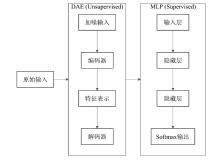
图1
本文恶意流量识别模型结构
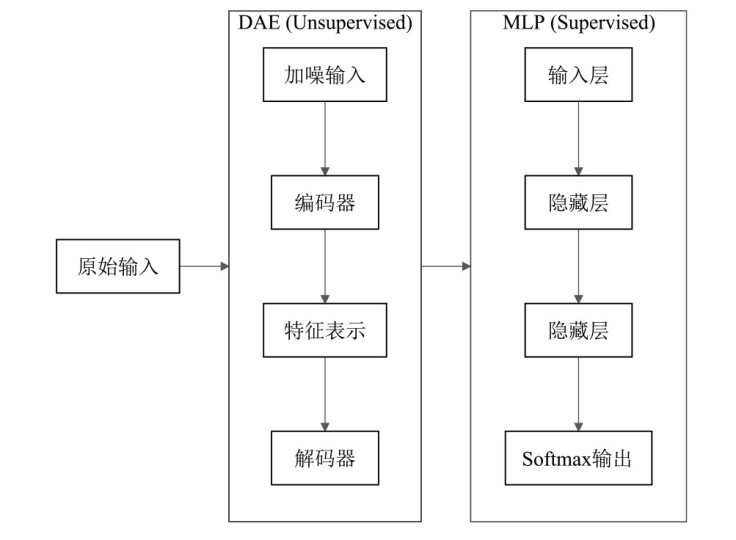
表3
模型结构
| 模块 | 层类型 | 参数说明 | 输入/输出 |
|---|---|---|---|
| DAE | 加噪层 | σ=0.3高斯噪声 | 原始输入(n=121) |
| 编码器 | FC层:[121→64→30]、ReLU | 低维特征(d=30) | |
| 解码器 | FC层:[30→64→121]、ReLU | 重建输出(n=121) | |
| MLP | 输入层 | 接收DAE特征(d=30) | 输入层 |
| 隐藏层1 | 256神经元、ReLU、Dropout=0.5 | — | |
| 隐藏层2 | 128神经元、ReLU | — | |
| 输出层 | 5神经元、Softmax | 攻击类型分类 |
表4
DAE关键参数配置
| 参数 | 取值 | 选择依据 |
|---|---|---|
| 噪声分布 | N(0,σ2) | 对称分布不引入偏差,零均值保持原始数据中心性 |
| 噪声标准差σ | 0.3 | 基于特征尺度分析,约占特征动态范围的30% |
| 噪声范围 | 全局添加 | 对所有输入特征施加相同强度噪声,避免选择性扰动导致的局部过适应 |
| 特征裁剪 | [0,1] | 匹配输入特征的归一化范围,防止噪声破坏 数据结构 |
表5
计算复杂度对比
| 优化方法 | 计算复杂度 | 是否适配本文 |
|---|---|---|
| 网格搜索 | 否(维度灾难) | |
| 随机搜索 | 部分适配(收敛慢) | |
| BO | 是 |
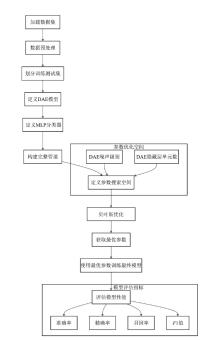
图2
本文模型训练及超参数优化思路
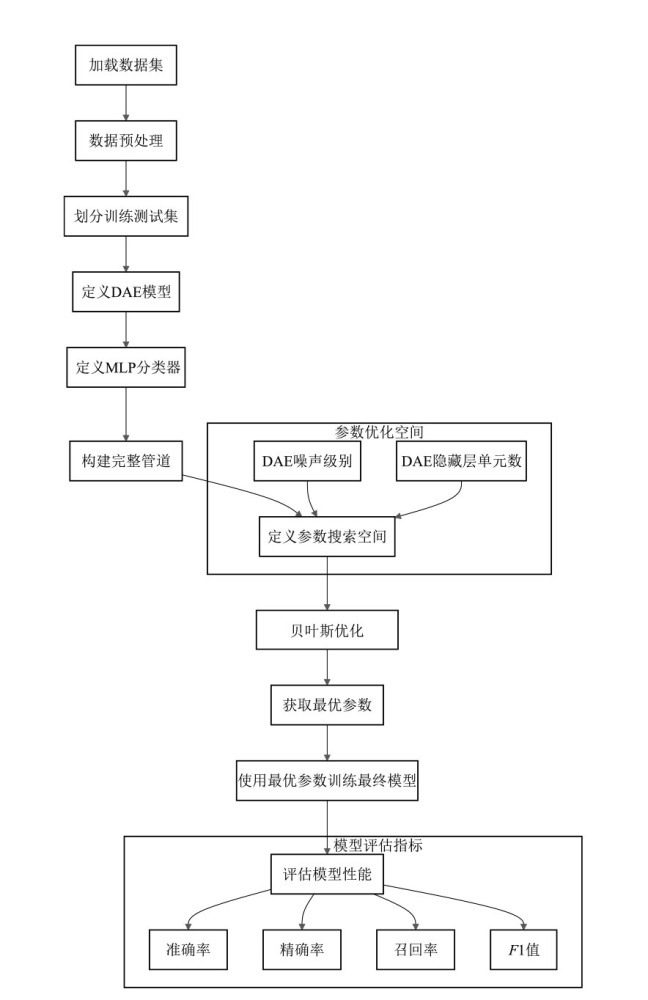
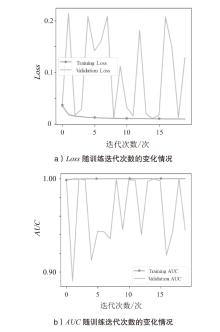
图3
Loss和AUC随训练迭代次数的变化情况
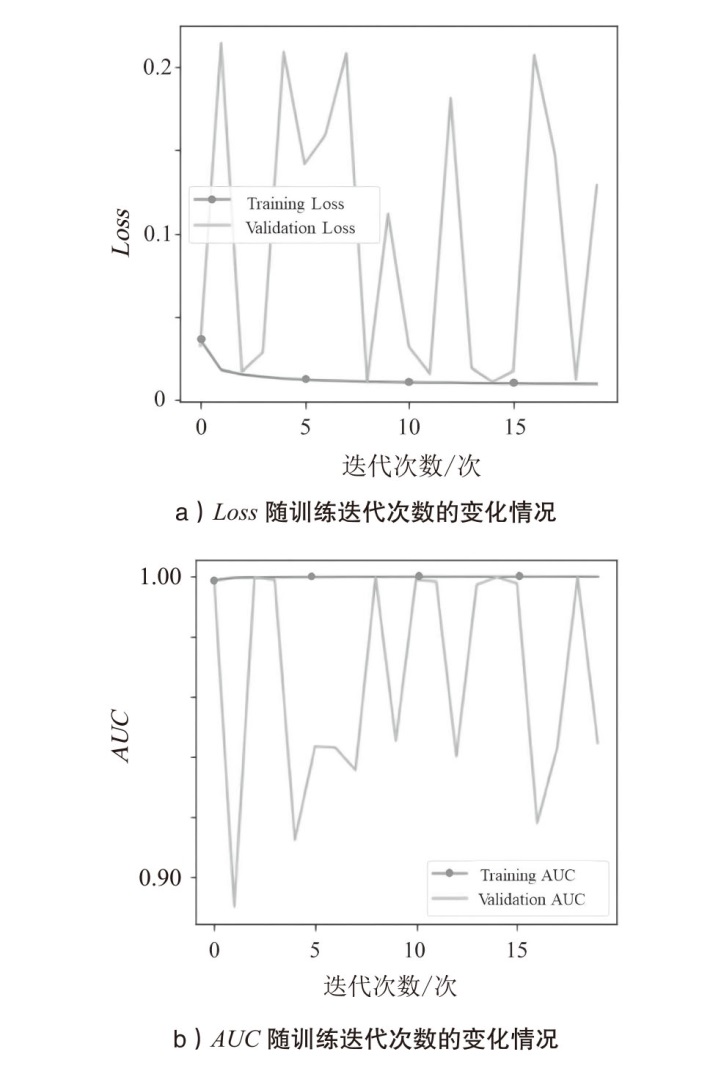
表6
模型迭代历史数值
| 迭代次数/次 | Loss | action_AUC | val_loss | val_action_AUC |
|---|---|---|---|---|
| 0 | 0.036335 | 0.998471 | 0.032487 | 0.998998 |
| 1 | 0.018133 | 0.999324 | 0.214438 | 0.890129 |
| 2 | 0.015530 | 0.999441 | 0.017086 | 0.999524 |
| 3 | 0.014110 | 0.999501 | 0.028566 | 0.998675 |
| 4 | 0.013048 | 0.999553 | 0.209165 | 0.912300 |
| 5 | 0.012381 | 0.999555 | 0.141838 | 0.943375 |
| 6 | 0.011859 | 0.999591 | 0.159256 | 0.942962 |
| 7 | 0.011508 | 0.999633 | 0.208285 | 0.935487 |
| 8 | 0.011195 | 0.999619 | 0.010951 | 0.999571 |
| 9 | 0.011012 | 0.999638 | 0.111816 | 0.945271 |
| 10 | 0.010776 | 0.999645 | 0.031982 | 0.998757 |
| 11 | 0.010602 | 0.999651 | 0.015887 | 0.998084 |
| 12 | 0.010613 | 0.999663 | 0.181298 | 0.940058 |
| 13 | 0.010297 | 0.999673 | 0.019244 | 0.997025 |
| 14 | 0.010227 | 0.999669 | 0.011030 | 0.999523 |
| 15 | 0.010153 | 0.999669 | 0.017522 | 0.997513 |
| 16 | 0.010014 | 0.999681 | 0.207399 | 0.917826 |
| 17 | 0.009968 | 0.999688 | 0.147266 | 0.943102 |
| 18 | 0.009935 | 0.999694 | 0.012492 | 0.999692 |
| 19 | 0.009838 | 0.999678 | 0.128855 | 0.944568 |
表7
实验结果分析
| 算法 | Accuracy | Precision | Recall | F1-Score |
|---|---|---|---|---|
| 决策树算法 | 99.2591% | 98.9711% | 99.4434% | 0.992067 |
| KNN算法 | 99.0487% | 98.8223% | 99.1395% | 0.989806 |
| 随机森林算法 | 99.2643% | 99.0184% | 99.4064% | 0.992120 |
| 逻辑回归算法 | 39.7359% | 42.0935% | 78.1631% | 0.547190 |
表8
CNN模型结构
| 层(类型) | 输出形状 | 参数数量/个 |
|---|---|---|
| input_1 (InputLayer) | (None, 1000) | 0 |
| embedding (Embedding) | (None, 1000, 64) | 4800 |
| conv1d (Conv1D) | (None, 995, 64) | 24640 |
| max_pooling1d(MaxPooling1D) | (None, 248, 64) | 0 |
| conv1d_1 (Conv1D) | (None, 243, 128) | 49280 |
| max_pooling1d_1(MaxPooling1D) | (None, 60, 128) | 0 |
| flatten (Flatten) | (None, 384) | 0 |
| dense (Dense) | (None, 32) | 12320 |
| dropout (Dropout) | (None, 32) | 0 |
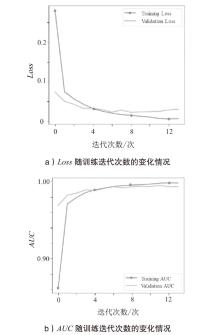
图4
Loss和AUC随训练迭代次数的变化情况
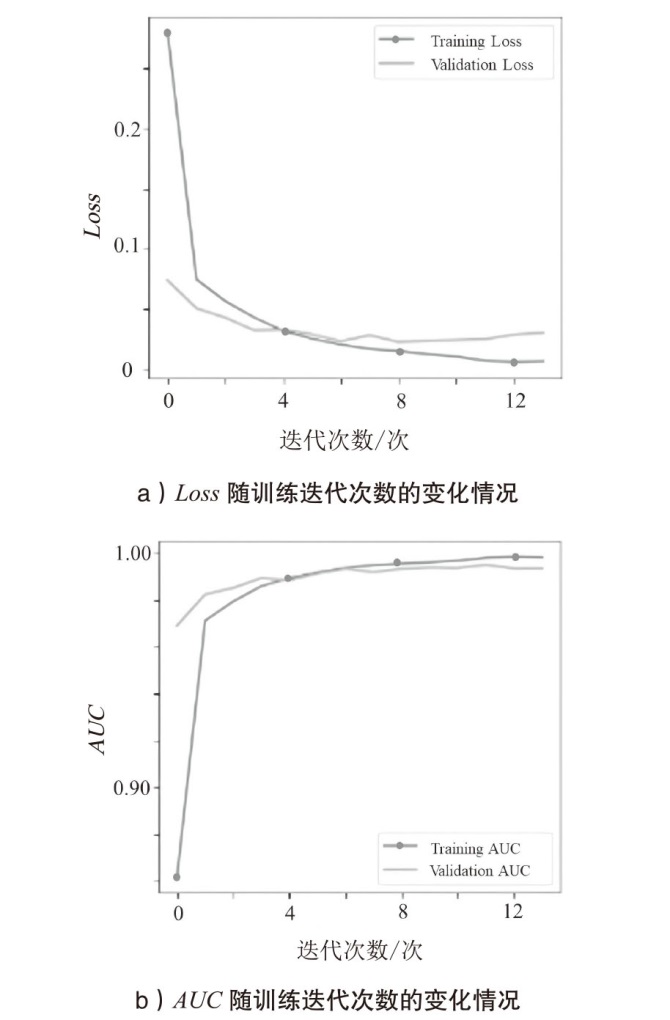
表9
实验结果
| 评价指标 | Precision | Recall | F1-Score | Accuracy |
|---|---|---|---|---|
| 数值 | 99.4456% | 99.4433% | 0.994429 | 99.4433% |
表10
不同算法的时间复杂度对比分析
| 模型 | 时间复杂度 | 参数说明 |
|---|---|---|
| CNN | O(N×K2×C×H×W×L)+ O(K×H'×W'×L) | 输入数据的尺寸为H×W×C,卷积层数量为L,每个卷积层的卷积核数量为K,H'和W'是输出特征图的高度和宽度 |
| Transformer | O(N×(L2×d+L×d2)) | N表示序列数(样本数),L表示序列长度(特征数),d表示特征/ 嵌入维度 |
| RF | O(T×N×d)+O(T×d) | T表示树的数量,N表示数据集中样本数量,d表示树的平均深度 |
| 决策树 | O(N×M×log2N)+O(log2N) | N表示样本数,M表示特征数,log2N表示树的深度 |
| KNN | O(N×M)+O(Nlog2K) | N表示样本数,M表示特征数, K表示最近邻的数量 |
| DAE-MLP | O(N×D×H)+O(N× | N表示样本数,D表示特征数,H表示隐藏层神经元的数量,L表示MLP 的总层数, 第l、l+1 层的神经元数量 |
| [1] | MASEER Z K, YUSOF R, BAHAMAN N, et al. Benchmarking of Machine Learning for Anomaly Based Intrusion Detection Systems in the CICIDS2017 Dataset[J]. IEEE Access, 2021, 9: 22351-22370. |
| [2] | SANCHEZ O R, REPETTO M, CARREGA A, et al. Evaluating ML-Based DDoS Detection with Grid Search Hyperparameter Optimization[C]// IEEE. 2021 IEEE 7th International Conference on Network Softwarization. New York: IEEE, 2021: 402-408. |
| [3] | ELSAYED M S, LE-KHAC N A, DEV S, et al. DDoSNet: A Deep-Learning Model for Detecting Network Attacks[C]// IEEE. IEEE 21st International Symposium on a World of Wireless, Mobile and Multimedia Networks. New York: IEEE, 2020: 391-396. |
| [4] | SADAF K, SULTANA J. Intrusion Detection Based on Autoencoder and Isolation Forest in Fog Computing[J]. IEEE Access, 2020, 8: 167059-167068. |
| [5] | AMIRI F, YOUSEFI M R, LUCAS C, et al. Mutual Information-Based Feature Selection for Intrusion Detection Systems[J]. Journal of Network and Computer Applications, 2011, 34(4): 1184-1199. |
| [6] | MUKHERJEE S, SHARMA N. Intrusion Detection Using Naive Bayes Classifier with Feature Reduction[J]. Procedia Technology, 2012, 4: 119-128. |
| [7] | RAO B B, SWATHI K. Fast KNN Classifiers for Network Intrusion Detection System[J]. Indian Journal of Science and Technology, 2017, 10(14): 1-10. |
| [8] | THASEEN I S, KUMAR C A. Intrusion Detection Model Using Fusion of PCA and Optimized SVM[C]// IEEE. 2014 International Conference on Contemporary Computing and Informatics. New York: IEEE, 2014: 879-884. |
| [9] | CAO Yangchen, ZHU Guosheng, QI Xiaoyun, et al. Research on Intrusion Detection Classification Based on Random Forest[J]. Computer Science, 2021, 48(S1): 459-463. |
| 曹扬晨, 朱国胜, 祁小云, 等. 基于随机森林的入侵检测分类研究[J]. 计算机科学, 2021, 48(S1): 459-463. | |
| [10] | FAN Yuchen. Research on Intrusion Detection Based on Deep Learning and Association Rules[D]. Beijing: China Academy of Railway Sciences Corporation Limited, 2022. |
| 范禹辰. 基于深度学习和关联规则的入侵检测研究[D]. 北京: 中国铁道科学研究院, 2022. | |
| [11] | HOU Yuluo. Research on Malicious HTTP Request Detection Based on Machine Learning[D]. Chengdu: University of Electronic Science and Technology of China, 2022. |
| 侯禹洛. 基于机器学习的恶意HTTP请求检测研究[D]. 成都: 电子科技大学, 2022. | |
| [12] | GONG Xinyu. Research on Deeplearning Based Web Attack Detection[D]. Shanghai: Shanghai Jiao Tong University, 2020. |
| 龚昕宇. 基于深度学习的Web攻击检测研究[D]. 上海: 上海交通大学, 2020. | |
| [13] | VARTOUNI A M, KASHI S S, TESHNEHLAB M. An Anomaly Detection Method to Detect Web Attacks Using Stacked Auto-Encoder[C]// IEEE. 2018 6th Iranian Joint Congress on Fuzzy and Intelligent Systems. New York: IEEE, 2018: 131-134. |
| [14] | CHAKIR O, REHAIMI A, SADQI Y, et al. An Empirical Assessment of Ensemble Methods and Traditional Machine Learning Techniques for Web-Based Attack Detection in Industry 5.0[J]. Journal of King Saud University-Computer and Information Sciences, 2023, 35(3): 103-119. |
| [15] | KAMAL H, MASHALY M. Advanced Hybrid Transformer-CNN Deep Learning Model for Effective Intrusion Detection Systems with Class Imbalance Mitigation Using Resampling Techniques[EB/OL]. (2024-12-23)[2025-06-01]. https://doi.org/10.3390/fi16120481. |
| [1] | 徐茹枝, 武晓欣, 吕畅冉. 基于Transformer的超分辨率网络对抗样本防御方法研究[J]. 信息网络安全, 2025, 25(9): 1367-1376. |
| [2] | 赵文宇, 党晨曦, 杜振华, 张健. 基于硬件性能计数器的勒索软件检测技术研究与实现[J]. 信息网络安全, 2025, 25(9): 1397-1406. |
| [3] | 陈咏豪, 蔡满春, 张溢文, 彭舒凡, 姚利峰, 朱懿. 多尺度多层次特征融合的深度伪造人脸检测方法[J]. 信息网络安全, 2025, 25(9): 1456-1464. |
| [4] | 曹越, 方泊璎, 魏高达, 李金宇, 杨洋, 彭涛. 车载以太网环境下CAN总线入侵检测系统兼容性评估与优化[J]. 信息网络安全, 2025, 25(8): 1175-1195. |
| [5] | 金志刚, 李紫梦, 陈旭阳, 刘泽培. 面向数据不平衡的网络入侵检测系统研究综述[J]. 信息网络安全, 2025, 25(8): 1240-1253. |
| [6] | 孙南, 秦中元, 胡爱群, 李涛. 基于仿生免疫的可编程数据平面入侵检测方法[J]. 信息网络安全, 2025, 25(8): 1263-1275. |
| [7] | 王钢, 高雲鹏, 杨松儒, 孙立涛, 刘乃维. 基于深度学习的加密恶意流量检测方法研究综述[J]. 信息网络安全, 2025, 25(8): 1276-1301. |
| [8] | 荀毅杰, 崔嘉容, 毛伯敏, 秦俊蔓. 基于联邦学习的智能汽车CAN总线入侵检测系统[J]. 信息网络安全, 2025, 25(6): 872-888. |
| [9] | 张兴兰, 陶科锦. 基于高阶特征与重要通道的通用性扰动生成方法[J]. 信息网络安全, 2025, 25(5): 767-777. |
| [10] | 金增旺, 江令洋, 丁俊怡, 张慧翔, 赵波, 方鹏飞. 工业控制系统安全研究综述[J]. 信息网络安全, 2025, 25(3): 341-363. |
| [11] | 陈红松, 刘新蕊, 陶子美, 王志恒. 基于深度学习的时序数据异常检测研究综述[J]. 信息网络安全, 2025, 25(3): 364-391. |
| [12] | 刘晨飞, 万良. 基于时空图神经网络的CAN总线入侵检测方法[J]. 信息网络安全, 2025, 25(3): 478-493. |
| [13] | 李海龙, 崔治安, 沈燮阳. 网络流量特征的异常分析与检测方法综述[J]. 信息网络安全, 2025, 25(2): 194-214. |
| [14] | 武浩莹, 陈杰, 刘君. 改进Simon32/64和Simeck32/64神经网络差分区分器[J]. 信息网络安全, 2025, 25(2): 249-259. |
| [15] | 金地, 任昊, 唐瑞, 陈兴蜀, 王海舟. 基于情感辅助多任务学习的社交网络攻击性言论检测技术研究[J]. 信息网络安全, 2025, 25(2): 281-294. |
| 阅读次数 | ||||||
|
全文 |
|
|||||
|
摘要 |
|
|||||