信息网络安全 ›› 2025, Vol. 25 ›› Issue (7): 1138-1152.doi: 10.3969/j.issn.1671-1122.2025.07.012
多智能体系统安全防护技术研究综述
汪正阳1, 刘晓露1( ), 沈卓炜2, 韦梦立1
- 1.东南大学数学学院,南京 211189
2.东南大学网络空间安全学院,南京 211189
-
收稿日期:2025-05-19出版日期:2025-07-10发布日期:2025-08-07 -
通讯作者:刘晓露 E-mail:101300566@seu.edu.cn -
作者简介:汪正阳(2004—),男,安徽,本科,主要研究方向为多智能体系统、数据安全|刘晓露(1992—),女,四川,副教授,博士,主要研究方向为多智能体协调控制|沈卓炜(1974—),男,江苏,副教授,博士,CCF会员,主要研究方向为高可信分布式软件架构、工业互联网、车联网及其安全|韦梦立(1993—),男,江苏,博士研究生,主要研究方向为分布式学习与隐私保护 -
基金资助:国家自然科学基金(622303210)
Review of Security Protection Technologies for Multi-Agent Systems
WANG Zhengyang1, LIU Xiaolu1(), SHEN Zhuowei2, WEI Mengli1
- 1. School of Mathematics, Southeast University, Nanjing 211189, China
2. School of Cyber Science and Engineering, Southeast University, Nanjing 211189, China
-
Received:2025-05-19Online:2025-07-10Published:2025-08-07 -
Contact:LIU Xiaolu E-mail:101300566@seu.edu.cn

摘要:
文章聚焦于多智能体系统的安全防护技术,从系统面临的威胁视角展开全面且深入的探讨。首先,基于多智能体系统具备开放性、异构性、自治性、协同性、动态适应性和涌现性6个主要特性,探讨其内生安全风险。从攻击目标、攻击方式和攻击者属性3个维度,对系统的安全风险进行分类,给出相关攻击方式。其次,概述安全威胁识别方法,指出威胁建模方法的局限性。在安全防御技术方面,梳理加密与认证、入侵检测与响应、信誉管理、容错设计、安全策略与审计等领域面临的挑战和研究进展。再次,探讨大模型直接调用智能体可能引发的跨域攻击威胁,分析视觉、音频攻击手段被大模型利用后可能导致的损害,并从打断攻击链的角度分析可能的防御措施。从次,阐述安全架构的演进方向,介绍弹性安全架构和内部工作逻辑。最后,对国内外研究现状进行总结,并从理论、技术和学科融合创新方面给出后续研究建议。
中图分类号:
引用本文
汪正阳, 刘晓露, 沈卓炜, 韦梦立. 多智能体系统安全防护技术研究综述[J]. 信息网络安全, 2025, 25(7): 1138-1152.
WANG Zhengyang, LIU Xiaolu, SHEN Zhuowei, WEI Mengli. Review of Security Protection Technologies for Multi-Agent Systems[J]. Netinfo Security, 2025, 25(7): 1138-1152.
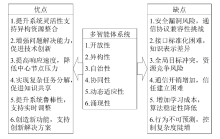
图1
多智能体系统特性、优点和缺点
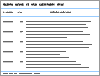
表1
多智能体系统安全威胁分类
| 分类维度 | 威胁类型 | 典型示例 |
|---|---|---|
| 攻击目标 | 针对智能体本体的攻击[ | 节点劫持、恶意指令注入[ |
| 针对通信链路的攻击[ | 窃听、中间人攻击(MITM)、拒绝服务(DoS)攻击、破坏攻击、事件触发攻击、复合攻击、用户攻击 | |
| 针对系统协调机制的攻击[ | 共识攻击(拜占庭攻击、女巫攻击)、信誉系统操纵、共谋攻击[ | |
| 攻击方式 | 主动攻击 | 伪造信息、拒绝服务、消息注入、知识注入等 |
| 被动攻击 | 流量分析、信息收集 | |
| 攻击者的 属性 | 内部攻击 | 恶意智能体、叛变节点、滥用权限 |
| 外部攻击 | 网络入侵、物理破坏 |
表2
MAS威胁映射
| 威胁类型 | MAS典型表现 | 应对措施 |
|---|---|---|
| 欺骗(Spoofing) | 身份伪造(如篡改ACL sender字段) | 强身份认证(去中心化身份认证(DID)+零知识证明) |
| 篡改(Tampering) | 消息内容/路由篡改 | 端到端加密+区块链存证 |
| 否定(Repudiation) | 否认已发送消息 | 不可抵赖签名(如XMSS) |
| 信息披露 (Info Disclosure) | 敏感数据泄露 | 同态加密+ABE(属性基 加密)访问控制 |
| 拒绝服务(DoS)攻击 | 针对资源的泛洪攻击 | 速率限制+信誉机制 |
| 权限提升(Elevation) | 权限提升(如滥用ontology参数) | 最小权限原则+动态ABAC |
表3
密码技术特性对比分析
| 文献 | 密码 类型 | 加密 类型 | 密钥机制 | 数学基础 /核心技术 | 优势 | 局限性 | 适用 场景 |
|---|---|---|---|---|---|---|---|
| 文献[ | DES-56 | 对称 加密 | 共享密钥(静态单一密钥) | Feistel结构,56位密钥 | 运算复杂度低,速度快 | 密钥短易被暴力破解,安全性弱 | 传统低安全 需求 场景 |
| 文献[ | AES-256 | 对称 加密 | 共享密钥(静态单一密钥) | SPN结构,256位密钥 | 抗暴力破解能力强,标准化程度高 | 密钥管理压力大 | 物联网、边缘计算 |
| 文献[ | RSA | 非对称加密 | 公钥/私钥分离 | 大整数分解难题 | 安全性高,支持数字签名 | 计算开销大,密钥长度长 | 传统互联网、数字 证书 |
| 文献[ | ECC | 非对称加密 | 公钥/私钥分离 | 椭圆曲线离散对数问题 | 同等安全下密钥更短,效 率高 | 实现复杂,量子攻击威胁 | 物联网、移动设备 |
| 文献[ | NTRU/Ring -LWE | 非对称加密 | 公钥/私钥分离 | 格理论难题 | 抗量子攻击,轻 量化 | 性能损耗需优化 | 量子威胁场景、机器人 系统 |
| 文献[ | Paillier | 同态 加密 | 公钥/私钥分离 | 复合剩余类问题 | 支持加法同态运算 | 计算密集,适用场景受限 | 隐私计算、多方协作 |
| 文献[ | 动态盐法+OTP | 混合 加密 | 动态盐值生成 | LCG算法+一次性密 码本 | 抗彩虹表攻击,随机性高 | 盐值同步要求严格 | 高动态安全需求场景 |
| 文献[ | 门限密码学 | 分布式加密 | 分片密钥管理 | 秘密共享 协议 | 防单点泄露,容错性高 | 分片重组复杂度高 | 多智能体系统、去中心化网络 |
| 文献[ | 抗量子协同 加密 | 后量子加密 | 分层封装机制 | 格理论+门限分片 | 抗量子攻击,支持分布式 协作 | 实现复杂度高 | 量子计算环境、多智能体集群 |
表4
相关文献研究方向和创新点
| 文献 | 研究方向 | 创新点 |
|---|---|---|
| 文献[ | 抗操纵信誉系统 | BFT共识结合令牌经济模型 |
| 文献[ | 动态信任评估 | 迁移学习与边缘计算优化 |
| 文献[ | 零信任实时监测 | KD-tree快速定位与区块链审计 |
| 文献[ | 轻量级分布式架构 | 多智能体分层管理与ZKP认证 |
| 文献[ | 复杂场景信任管理 | AGV信任建模与自组织团队形成 |
表5
相关文献在容错研究上的区别
| 文献 | 稳定性理论 | 优化方法 | 决策过程 |
|---|---|---|---|
| 文献[ | 一致最终有界性(Uniformly Ultimate Bounded,UUB) | Lagrange乘子法、Lyapunov安全成本网络 | 约束马尔可夫决策过程 |
| 文献[ | 拜占庭容错共识 +可信执行环境(硬件隔离 | 加密优化模型,交替方向乘子法 | 分层迭代框架 + 计算结果链上验证 + 经济激励与认证机制 |
| 文献[ | Lyapunov稳定性理论,Barbalat引理,凸包收敛性理论 | LMI优化,鲁棒自适应优化 | 分层决策架构,信息受限下的决策策略,性能-鲁棒性权衡 |
| 文献[ | 均方有界共识 | 多轮询协议(Multiple Rapid Ring Protocol,MRRP) | 集成概率攻击模型和边界约束,通过分布式观测器-控制器实现鲁棒 决策 |
| 文献[ | 二次型Lyapunov函数,触发函数包含时间补偿项,避免Zeno行为 | 事件触发机制减少通信负担,冲动控制最小化能量消耗 | 感知邻居状态 → 计算触发函数 → 若触发,则施加冲动控制 → 动态补偿故障和攻击 |
| 文献[ | 均方有界稳定性的Lyapunov框架 | 基于LMI的鲁棒控制设计 | 决策过程分为攻击响应层和脉冲控制层 |
| 文献[ | 概率有界的椭球集稳定性理论 | 基于LMI的椭球区域极小化与扰动抑制优化 | 混合攻击建模(FDIAs + 重放攻击)与输出反馈容错控制 |
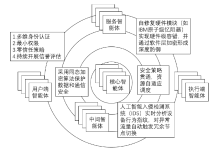
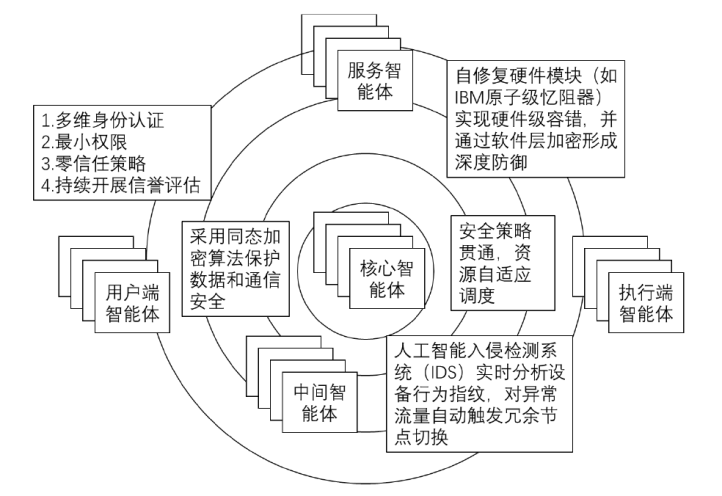
图2
自适应弹性多智能体安全架构组成示意图
| [1] | BALAJI P G, SRINIVASAN D. Innovations in Multi-Agent Systems and Applications-1[M]. Heidelberg: Springer, 2010. |
| [2] | DORRI A, KANHERE S S, JURDAK R. Multi-Agent Systems: A Survey[J]. IEEE Access, 2018, 6: 28573-28593. |
| [3] | BO Jianxiong, ZHAO Xu. Vehicle Edge Computing Task Offloading Strategy Based on Multi-Agent Deep Reinforcement Learning[EB/OL]. (2025-03-05) [2025-05-10]. https://link.springer.com/article/10.1007/s10723-025-09800-x#citeas. |
| [4] | CHEN Jie, ZHANG Zequn, WANG Liping, et al. Self-Adaptive Production Scheduling for Discrete Manufacturing Workshop Using Multi-Agent Cyber Physical System[EB/OL]. (2025-03-26) [2025-05-10]. https://www.sciencedirect.com/science/article/abs/pii/S0952197625006384. |
| [5] | CHENG Yuheng, ZHAO Huan, ZHOU Xiyuan, et al. A Large Language Model for Advanced Power Dispatch[EB/OL]. (2025-03-15) [2025-05-10]. https://doi.org/10.1038/s41598-025-91940-x. |
| [6] | SHITHARTH S, ALSHAREEF A M, KHADIDOS A O, et al. A Conjugate Self-Organizing Migration (CSOM) and Reconciliate Multi-Agent Markov Learning (RMML) Based Cyborg Intelligence Mechanism for Smart City Security[EB/OL]. [2025-05-10]. https://pubmed.ncbi.nlm.nih.gov/37735185/. |
| [7] | DING Lifu, YAN Gangfeng. A Survey of the Security Issues and Defense Mechanisms of Multi-Agent Systems[J]. CAM Transactions on Intelligent Systems, 2020, 15(3):425-434. |
| 丁俐夫, 颜钢锋. 多智能体系统安全性问题及防御机制综述[J]. 智能系统学报, 2020, 15(3):425-434. | |
| [8] | Foundation for Intelligent Physical Agents. FIPA ACL Message Structure Specification[EB/OL]. (2002-12-03) [2025-05-10]. http://www.fipa.org/specs/fipa00061/SC00061G.html. |
| [9] | Foundation for Intelligent Physical Agents. FIPA Abstract Architecture Specification[EB/OL]. (2002-12-03) [2025-05-10]. http://www.fipa.org/specs/fipaoo001/SC00001L.html. |
| [10] | Foundation for Intelligent Physical Agents. FIPA Agent Management Specification[EB/OL]. (2004-03-18) [2025-05-10]. http://www.fipa.org/specs/fipa0023/SC00023K.html. |
| [11] | WU Jiangxing. Cyber Resilience System Engineering Empowered by Endogenous Security and Safety[M]. Heidelberg: Springer, 2024. |
| [12] | HEDIN Y, MORADIAN E. Security in Multi-Agent Systems[J]. Procedia Computer Science, 2015, 60: 1604-1612 |
| [13] | ZHANG Dan, FENG Gang, SHI Yang, et al. Physical Safety and Cyber Security Analysis of Multi-Agent Systems: A Survey of Recent Advances[J]. IEEE/CAA Journal of Automatica Sinica, 2021, 8(2): 319-333. |
| [14] | JIN Zengwang, JIANG Lingyang, DING Junyi, et al. A Review of Research on Industrial Control System Security[J]. Netinfo Security, 2025, 25(3): 341-363. |
| 金增旺, 江令洋, 丁俊怡, 等. 工业控制系统安全研究综述[J]. 信息网络安全, 2025, 25(3):341-363. | |
| [15] | JAIN G, SOLOMON J N R. Taxonomy of Multi-Agent Systems Attacks and their Defense Tactics in Certifying Security of Cyber Physical Systems[C]// IEEE. 2023 International Conference on Advances in Computation, Communication and Information Technology (ICAICCIT). New York: IEEE, 2023: 648-652. |
| [16] | LI S C, HUANG Y, TAI B C, et al. Using Data Mining Methods to Detect Simulated Intrusions on a Modbus Network[C]// IEEE. 2017 IEEE 7th International Symposium on Cloud and Service Computing (SC2). New York: IEEE, 2017: 143-148. |
| [17] | ZHANG Tianyu, YANG Guanghong, YE Dan. Asymmetrical Vulnerability of Heterogeneous Multi-Agent Systems under False-Data Injection Attacks[EB/OL]. (2024-10-22) [2025-05-10]. https://www.sciencedirect.com/science/article/pii/S0005109824004412. |
| [18] | ROCHER L, TOURNIER A J, YA D M. Adversarial Competition and Collusion in Algorithmic Markets[J]. Nat Mach Intell, 2023, 5: 497-504. |
| [19] | MATT T, BHARANIDHARAN S, SAMI A, et al. A Review of Threat Modelling Approaches for APT-Style Attacks[EB/OL]. (2021-01-16) [2025-05-10]. https://www.sciencedirect.com/science/article/pii/S2405844021000748. |
| [20] | SHAYMAA M K, HAYRETDIN B, TARMO K. Threat Modeling of Industrial Control Systems: A Systematic Literature Review[EB/OL]. (2023-10-27) [2025-05-10]. https://www.sciencedirect.com/science/article/pii/S0167404823004534. |
| [21] | KANYAMEE K, SATHITWIRIYAWONG C. High-Availability Decentralized Multi-Agent Key Recovery System[C]// IEEE. 2009 Eighth IEEE/ACIS International Conference on Computer and Information Science. New York: IEEE, 2009: 290-294. |
| [22] | MANI A K, ADEDAYO O M. Dynamic Calculation of Password Salts for Improved Resilience Towards Password Cracking Algorithms[C]// IEEE. 12th International Symposium on Digital Forensics and Security (ISDFS). New York: IEEE, 2024: 1-6. |
| [23] | BACHTIAR M M, DITANAYA T H, WASISTA S, et al. Security Enhancement of AES Based Encryption Using Dynamic Salt Algorithm[C]// ICAE. 2018 International Conference on Applied Engineering (ICAE). Amsterdam: Elsevier, 2018: 1-6. |
| [24] | YE Qing, HE Junfei, YANG Zhichao. Research Progress in Lattice-Based Public-Key Encryption with Keyword Search[J]. Netinfo Security, 2024, 24(6): 903-916. |
| 叶清, 何俊霏, 杨智超. 基于格的可搜索公钥加密研究进展[J]. 信息网络安全, 2024, 24(6):903-916. | |
| [25] | HASAN H, SALAH T, SHEHADA D, et al. Secure Lightweight ECC-Based Protocol for Multi-Agent IoT Systems[C]// IEEE. The 13th International Conference on Wireless and Mobile Computing, Networking and Communications (WiMob). New York: IEEE, 2017: 1-8. |
| [26] | YAN Yamin, CHEN Zhiyong, VARADHARAJAN V. Consensus of Networked Control Multi-Agent Systems Using a Double-Layer Encryption Scheme[J]. Journal of Automation and Intelligence, 2023(2): 218-226. |
| [27] | VARMA R, MELVILLE C, PINELLO C, et al. Post Quantum Secure Command and Control of Mobile Agents Inserting Quantum-Resistant Encryption Schemes in the Secure Robot Operating System[C]// IEEE. 2020 Fourth IEEE International Conference on Robotic Computing (IRC). New York: IEEE, 2020: 33-40. |
| [28] | ZHANG Jian, LI Lei, LIU Weidong, et al. Multi-Subject Information Interaction and One-Way Hash Chain Authentication Method for V2G Application in Internet of Vehicles[C]// IFIP. 2022 4th International Conference on Intelligent Information Processing (IIP). Heidelberg: Springer, 2022: 134-137. |
| [29] | LAU C H, YAN Fan, CHAN S. Effectiveness of Authentication Schemes in the Internet of Things Networks with Different Structural Topologies[C]// ACM. 2023 International Wireless Communications and Mobile Computing (IWCMC). New York: ACM, 2023: 1118-1123. |
| [30] | NABIL T C, OMAR A O, HASSAN E G, et al. Secured Storage of Smart Grid Events: Blockchain Based on Multi Agents Markov Decision Processes[C]// IEEE. 2024 11th International Conference on Wireless Networks and Mobile Communications (WINCOM). New York: IEEE, 2024: 1-7. |
| [31] | KAMALAKANTA S Y. VENU M, RAHUL K, et al. Attention Based Multi-Agent Intrusion Detection Systems Using Reinforcement Learning[EB/OL]. (2021-07-01) [2025-05-10]. https://www.sciencedirect.com/science/article/abs/pii/S2214212621001411. |
| [32] | SREEKANTH V, KAMALAKANTA S, DINESH M, et al. Federated Reinforcement Learning Based Intrusion Detection System Using Dynamic Attention Mechanism[EB/OL]. (2023-09-19) [2025-05-10]. https://www.sciencedirect.com/science/article/abs/pii/S2214212623001928. |
| [33] | ZHANG Chen, LIAN Zhuotao, HUANG Huakun, et al. PCIDS: Permission and Credibility-Based Intrusion Detection System in IoT Gateways[J]. IEEE Internet of Things Journal, 2024, 11(1): 904-913. |
| [34] | USAMA A, MOHAMMAD N, AMNA S, et al. Signature-Based Intrusion Detection Using Machine Learning and Deep Learning Approaches Empowered with Fuzzy Clustering[EB/OL]. (2025-01-11) [2025-05-10]. https://www.nature.com/articles/s41598-025-85866-7. |
| [35] | WANG Jing. Multi Agent System Based Smart Grid Anomaly Detection Using Blockchain Machine Learning model in Mobile Edge Computing Network[EB/OL]. (2024-11-23) [2025-05-10]. https://www.sciencedirect.com/science/article/pii/S0045790624007523. |
| [36] | CHENG Fabin, LIANG Hongjing, NIU Ben, et al. Adaptive Neural Self-Triggered Bipartite Secure Control for Nonlinear MASs Subject to DoS Attacks[J]. Information Sciences, 2023(631): 256-270. |
| [37] | LI Hui, WU Wei, TONG Shaocheng. Adaptive Fuzzy Output-Feedback Secure Consensus Fault-Tolerant Control of Nonlinear Multi-Agent Systems Under DoS Attacks[EB/OL]. (2024-11-20) [2025-05-10]. https://link.springer.com/article/10.1007/s40815-024-01898-7. |
| [38] | HU Xiaoyan, LI Yuanxin, TONG Shaocheng. Event-Triggered Secure Control of Nonlinear Multi-Agent Systems Under Sensor Attacks[J]. Journal of the Franklin Institute, 2023(360): 9468-9489. |
| [39] | FAN Na, GAO Yuxin, LI Jialong, et al. Multi-Attack Identification and Mitigation Mechanism Based on Multi-Agent Collaboration in Vehicular Named Data Networking[EB/OL]. (2025-03-25) [2025-05-10]. https://www.sciencedirect.com/science/article/abs/pii/S138912862500194X. |
| [40] | HUO Shicheng, WU Hao, WU Tiejun, et al. Secure Output Containment of Heterogeneous Multi-Agent Systems against Hybrid Attacks[J]. ISA Transactions, 2024(148): 191-200. |
| [41] | CAVALCANTE R C, BITTENCOURT I I, SILVA A P D, et al. A Survey of Security in Multi-Agent Systems[J]. Expert Systems with Applications, 2012, 39: 4835-4846. |
| [42] | ZHENG Min, WANG Hong, LIU Hong, et al. Survey on Consensus Algorithms of Blockchain[J]. Netinfo Security, 2019, 19(7): 8-24. |
| 郑敏, 王虹, 刘洪, 等. 区块链共识算法研究综述[J]. 信息网络安全, 2019, 19(7):8-24. | |
| [43] | BENNACEUR J, ZOUAGHI W, MABROUK A. Multi-Dimensional Trust Model: Towards Multi-Layered Secure Architecture for Enhanced Threat Information Sharing[EB/OL]. (2024-10-17) [2025-05-10]. https://doi.org/10.1007/s11518-024-5631-y. |
| [44] | ANAMIKA S, RAJESH K D, ANUPAM K S. Personalized Device Authentication Scheme Using Q-Learning-Based Decision-Making with the Aid of Transfer Fuzzy Learning for IIoT Devices in Zero Trust Network (PDA-QLTFL)[EB/OL]. (2024-07-17) [2025-05-10]. https://www.sciencedirect.com/science/article/abs/pii/S004579062400363X. |
| [45] | WEI Feng, CHEN Zhao, WANG Yin, et al. Security Risk Assessment System for Power Monitoring Systems Based on Zero Trust Architecture[C]// IEEE. 2024 4th International Conference on Computer Science, Electronic Information Engineering and Intelligent Control Technology (CEI). New York: IEEE, 2024: 215-218. |
| [46] | MRABET K, BOUANANI F E, BEN-AZZA H. Generalized Secure and Dynamic Decentralized Reputation System with a Dishonest Majority[J]. IEEE Access, 2023, 11: 9368-9388. |
| [47] | AL-SHAMAILEH M, ANTHONY P, CHARTERS S. Trust and Reputation Management in IoT Using Multi-Agent System Approach[C]// Springer. PRICAI 2023:Trends in Artificial Intelligence. Heidelberg: Springer, 2023: 480-485. |
| [48] | KHANDAIT A U, PATTANSHETTI T R. Lightweight Authentication System Based on Zero Knowledge Proof for IoT Devices[C]// IEEE. 2024 Global Conference on Communications and Information Technologies (GCCIT). New York: IEEE, 2024: 1-5. |
| [49] | AKRAM J, ANAISSI A. DDRM: Distributed Drone Reputation Management for Trust and Reliability in Crowdsourced Drone Services[C]// IEEE. 2024 IEEE International Conference on Web Services (ICWS). New York: IEEE, 2024: 921-931. |
| [50] | KE Changbo, XIAO Fu, CAO Yan, et al. A Group-Vehicles Oriented Reputation Assessment Scheme for Edge VANETs[J]. IEEE Transactions on Cloud Computing, 2024(12): 859-875. |
| [51] | FORTINO G, MESSINA F, ROSACI D, et al. A Trust-Based Team Formation Framework for Mobile Intelligence in Smart Factories[J]. IEEE Transactions on Industrial Informatics, 2020(16): 6133-6142. |
| [52] | MUSHTAQ S U, SHEIKH S, IDREES S M, et al. In-Depth Analysis of Fault Tolerant Approaches Integrated with Load Balancing and Task Scheduling[J]. Peer-to-Peer Networking and Applications, 2024, 17: 4303-4337. |
| [53] | SUN Huihui, JIANG Hui, ZHANG Long, et al. Multi-Robot Hierarchical Safe Reinforcement Learning Autonomous Decision-Making Strategy Based on Uniformly Ultimate Boundedness Constraints[EB/OL]. (2025-02-18) [2025-05-10]. https://www.nature.com/articles/s41598-025-89285-6. |
| [54] | SUN Qinghan, MA Huan, ZHAO Tian, et al. Break down the Decentralization-Security-Privacy Trilemma in Management of Distributed Energy Systems[EB/OL]. (2024-05-27) [2025-05-10]. https://www.nature.com/articles/s41467-024-48860-7#citeas. |
| [55] |
YUAN Chengzhi, ZENG Wei, DAI Shilu. Distributed Model Reference Adaptive Containment Control of Heterogeneous Uncertain Multi-Agent Systems[J]. ISA Transactions, 2019, 86: 73-86.
doi: S0019-0578(18)30429-4 pmid: 30502121 |
| [56] | LIU Jinliang, ZHENG Hao, ZHA Lijuan, et al. Secure Consensus for Multiagent Systems with Hybrid Cyber Attacks: A Multi-Round-Robin Protocol-Based Approach[EB/OL]. (2024-06-10) [2025-05-10]. https://www.sciencedirect.com/science/article/abs/pii/S0020025524007928. |
| [57] | LI Wenyu, SADER M, ZHU Zhibin, et al. Event-Triggered Fault-Tolerant Secure Containment Control of Multi-Agent Systems through Impulsive Scheme[J]. Information Sciences, 2023(622): 1128-1140. |
| [58] | YANG Zonglin, LING Guang, GE Mingfeng. Secure Impulsive Tracking of Multi-Agent Systems with Directed Hypergraphtopologies against Hybrid Deception Attacks[EB/OL]. (2024-09-09) [2025-05-10]. https://www.sciencedirect.com/science/article/abs/pii/S0893608024006154. |
| [59] | PANG Kai, MA Lifeng, BAI Hongyang, et al. Probability-Guaranteed Secure Consensus Control for Time-Varying Stochastic Multi-Agent Systems under Mixed Attacks[J]. Journal of the Franklin Institute, 2022(359): 2541-2564. |
| [60] | MURCIA J M B, CÁNOVAS E, GARCÍA-RODRÍGUEZ J, et al. Decentralised Identity Management Solution for Zero-Trust Multi-Domain Computing Continuum Frameworks[EB/OL]. (2024-08-09) [2025-05-10]. https://www.sciencedirect.com/science/article/pii/S0167739X2400429. |
| [61] | LIU Cong. Application of Security Algorithm in Audit Data Asset Valuation Based on Distributed Machine Learning[EB/OL]. (2023-05-18) [2025-05-10]. https://link.springer.com/article/10.1007/s11277-023-10497-y#citeas. |
| [62] | HOSSAIN M Z, IMTEAJ A. Securing Vision-Language Models with a Robust Encoder Against Jailbreak and Adversarial Attacks[C]// IEEE. 2024 IEEE International Conference on Big Data (BigData). New York: IEEE, 2024: 6250-6259. |
| [63] | ZHANG Yingying, JIANG Zhengdan, CHENG Xingkai, et al. A Method of SQL Injection Attack Detection Based on Large Language Models[C]// IEEE. 2024 2nd International Conference on Computer Network Technology and Electronic and Information Engineering (CNTEIE). New York: IEEE, 2024: 154-158. |
| [64] | LIANG Jingguo, YI Ru, CHEN Jicheng, et al. Securing Autonomous Vehicles Visual Perception: Adversarial Patch Attack and Defense Schemes with Experimental Validations[EB/OL]. (2024-05-21) [2025-05-10]. https://ieeexplore.ieee.org/document/10535728. |
| [65] | LU Yantao, REN Haining, CHAI Weiheng, et al. Time-Aware and Task-Transferable Adversarial Attack for Perception of Autonomous Vehicles[J]. Pattern Recognition Letters, 2024(178): 145-152. |
| [66] | LIU Tiantian, LIN Feng, WANG Zhangsen, et al. MagBackdoor: Beware of Your Loudspeaker as a Backdoor For Magnetic Injection Attacks[C]// IEEE. 2023 IEEE Symposium on Security and Privacy (SP). New York: IEEE, 2023: 3416-3431. |
| [67] | CHENG Peng, WANG Yuwei, HUANG Peng, et al. ALIF: Low-Cost Adversarial Audio Attacks on Black-Box Speech Platforms Using Linguistic Features[C]// IEEE. 2024 IEEE Symposium on Security and Privacy (SP). New York: IEEE, 2024: 1628-1645. |
| [68] | WOOLDRIDGE M, JENNINGS N R. Intelligent Agents: Theory and Practice[J]. The Knowledge Engineering Review, 1995, 10(2): 115-152. |
| [69] | SCHMIDT S, STEELE R, DILLON T S, et al. Fuzzy Trust Evaluation and Credibility Development in Multi-Agent Systems[J]. Applied Soft Computing, 2007(7): 492-505. |
| [70] | CHRISTIDIS K, DEVETSIKIOTIS M. Blockchains and Smart Contracts for the Internet of Things[J]. IEEE Access, 2016(4): 2292-2303. |
| [71] | PAPADOPOULOS G T, ANTONA M, STEPHANIDIS C. Towards Open and Expandable Cognitive AI Architectures for Large-Scale Multi-Agent Human-Robot Collaborative Learning[J]. IEEE Access, 2021(9): 73890-73909. |
| [1] | 欧阳梦迪, 孙钦硕, 李发根. SM9加密算法的颠覆攻击与改进[J]. 信息网络安全, 2024, 24(6): 831-842. |
| [2] | 李万青, 朱丽, 刘兴安, 郑伟, 古乙舜. 水力发电站关键信息基础设施网络安全防护技术[J]. 信息网络安全, 2024, 24(12): 1955-1962. |
| [3] | 于成丽, 张阳, 贾世杰. 云环境中数据安全威胁与防护关键技术研究[J]. 信息网络安全, 2022, 22(7): 55-63. |
| [4] | 唐春明, 林旭慧. 隐私保护集合交集计算协议[J]. 信息网络安全, 2020, 20(1): 9-15. |
| [5] | 裘玥, 李思其. 人工智能发展应用过程的安全威胁分析及解决策略研究[J]. 信息网络安全, 2018, 18(9): 35-41. |
| [6] | 陈震杭, 王张宜, 彭国军, 夏志坚. 针对未知PHP反序列化漏洞利用的检测拦截系统研究[J]. 信息网络安全, 2018, 18(4): 47-55. |
| [7] | 邹红霞, 齐斌, 王宇, 李冀兴. 基于联盟链和DNA编码的局域网加密技术[J]. 信息网络安全, 2018, 18(12): 31-37. |
| [8] | 陈向荣, 程丁, 秦鹏宇, 程成. 一种基于STDM的用户隐私数据保护方案研究[J]. 信息网络安全, 2017, 17(5): 44-50. |
| [9] | 王昱镔, 陈思, 程楠. 工业控制系统信息安全防护研究[J]. 信息网络安全, 2016, 16(9): 35-39. |
| [10] | 马书磊, 田洪娟, 刘丰. 一种基于龙芯平台的安全防护网关设计与实现[J]. 信息网络安全, 2016, 16(9): 196-201. |
| [11] | 王群. 基于安全域的信息安全防护体系研究[J]. 信息网络安全, 2015, 15(9): 206-210. |
| [12] | 王志强, 王红凯, 张旭东, 沈潇军. 工业控制系统安全隐患及应对措施研究[J]. 信息网络安全, 2014, 14(9): 203-206. |
| [13] | 张庆阳, 杨阳, 程久军, 廖竞学. 基于手机动态密码的计算机使用权限管理机制[J]. 信息网络安全, 2014, 14(11): 46-51. |
| [14] | 张海霞;连一峰. 基于测试床模拟的通用安全评估框架[J]. , 2013, 13(Z): 0-0. |
| [15] | 祁振一;郑旭;刘建林. 一种基于欧拉回路序列的加密算法[J]. , 2013, 13(3): 0-0. |
| 阅读次数 | ||||||
|
全文 |
|
|||||
|
摘要 |
|
|||||